Past exam of the condensed matter physics major option course of the University of Oxford 2015 8 b Solution by  Codex 0 2026-10-25
Cool a thick superconducting ring through its transition in a controlled external flux, remove or change the applied field while keeping the ring superconducting, and measure the persistent trapped flux using a calibrated pickup coil and sensitive magnetometer. Repeating while varying the cooling flux selects successive winding sectors. The measured flux is close to steps separated by when the kinetic-inductance correction is negligible. A SQUID-based flux readout can resolve that spacing; scanning local magnetic imaging offers another way to observe the trapped flux without identifying the ring current with an ordinary dissipative transport current.
The experiment tests the phase-winding/fluxoid relation in a. Self-inductance, London penetration depth and the size of the ring determine how nearly the measured geometric flux follows integer steps. A periodic response alone should not be used to infer an absolute trapped flux without calibration and the relevant inductive corrections.
TODO — source figure gap: the surviving ordinary-ring and two-junction-ring outlines and labels are readable, but page 9's figure form calls 52 absent raster objects, /R514 through /R565. The original archived parent has identical damage. An intact figure is needed to recover any missing image-specific details; those raster components have not been inferred or recreated. The observation method above answers the physical request without requiring the unavailable artwork; the TODO concerns verification of the input illustration rather than a missing part of the solution. The original circuit schematic used in c is an independent diagram of the stated model, not a claimed reconstruction of the unavailable artwork.
Past exam of the condensed matter physics major option course of the University of Oxford 2015 8 a Solution by Codex 0 2026-10-25
Codex 0 2026-10-25Start from a gauge-invariant Ginzburg-Landau theory of superconductivity gradient energy , with the coherent pair order parameter and its charge. Varying the free energy with respect to gives the current density displayed in the source. Write to obtainSingle-valuedness around a loop in superconducting material requires . Integrating the current relation therefore gives the exact fluxoid conditionFor a thick ring choose the contour sufficiently deep in the material that the current term is negligible. Then flux itself is approximately quantized, with positive quantumThe sign of the pair charge is absorbed into the orientation of . In a thin ring with appreciable kinetic inductance, it is the fluxoid, not exactly the geometrical flux alone, that remains quantized. A state with nonzero phase-gradient current is a concrete counterexample to dropping the current integral without justification. The flux-only identity thus uses the ordinary thick-ring or negligible-kinetic-inductance limit in addition to phase single-valuedness.
Past exam of the condensed matter physics major option course of the University of Oxford 2015 7 c Solution by Codex 0 2026-10-25
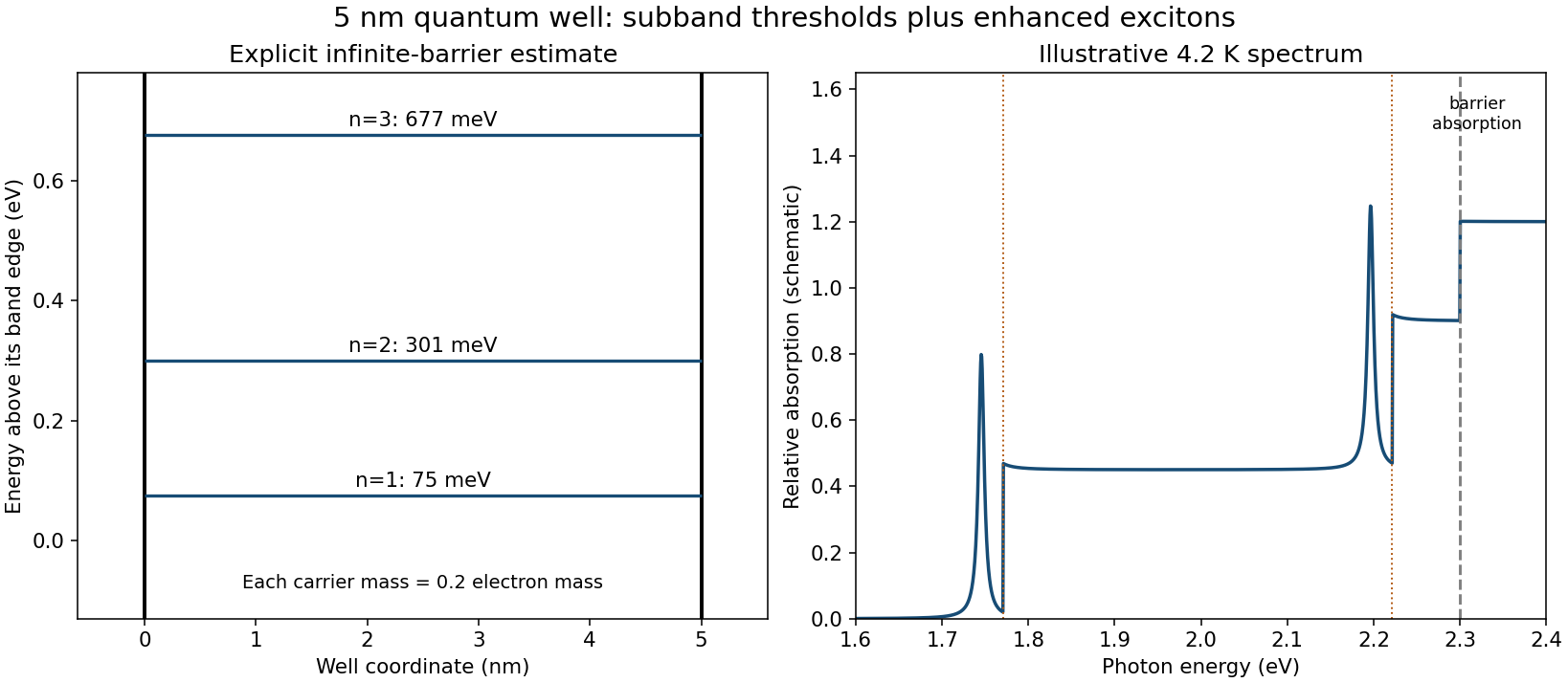
Codex 0 2026-10-25Assume type-I confinement of both carriers, and first use an infinite square well as an explicit estimate. For thickness nm and each carrier mass , confinement measured from the corresponding well band edge isThus the first three infinite-well levels are approximately , and meV for each carrier. Interband envelope overlap favors matching quantum numbers when the electron and hole well profiles are the same. Ignoring exciton binding energy initially, their absorption thresholds areThe first two lie in the requested optical window. Two-dimensional subband joint densities of states produce step-like onsets, with excitonic peaks just below them, rather than only a bulk three-dimensional onset. Confinement strengthens electron–hole binding: the ideal strict-two-dimensional hydrogen ground binding is meV, while a finite-width well interpolates toward the bulk value near meV. The nm width is comparable to the bulk exciton radius, so neither limiting binding value is exact. A schematic based on the infinite-well estimate therefore has first exciton peaks around – eV and – eV, followed by their subband continua; the eV barrier absorption is another feature near the top of the requested window.
The barrier gap alone does not specify the finite confinement energies. Under type-I alignment it supplies only eV. It does not give their division or the barrier effective masses, and a larger gap by itself does not prove type-I alignment. Infinite-well levels are consequently estimates, not uniquely determined measured levels.
For a concrete conditional comparison, assigning equal eV electron and hole barriers and taking the same mass on both sides gives finite square well levels , and meV per carrier. These follow from for even levels and for odd levels, with , . The corresponding unbound-pair optical thresholds would be , and eV before exciton shifts. This example is deliberately conditional and demonstrates why band offsets must not be invented to make a unique finite square well spectrum. The requested schematic below states which approximation it uses.
Past exam of the condensed matter physics major option course of the University of Oxford 2015 7 b Solution by Codex 0 2026-10-25
Codex 0 2026-10-25The sharp solid curve is the K spectrum; the broadened dashed curve is the K spectrum. At low temperature, a strong discrete exciton transition appears just below the continuum edge, with weaker higher members converging toward the band gap. Heating broadens those resonances through scattering, reduces their spectral resolution, and shifts the band edge to lower photon energy. The lower-energy broad dashed maximum is therefore not evidence for a second unrelated low-temperature band gap.
Read approximate energies from the native figure: the main low-temperature peak is near eV and a weaker feature is near – eV, with the continuum edge around eV. A three-dimensional hydrogenic series then givesFor example, predicts about meV, consistent with those feature spacings. These are graphical estimates at roughly meV precision, not extra digits extracted from the line widths. The strong direct interband onset and subgap series support a direct-gap Wannier-Mott interpretation. The continuum absorption scale is of order m, corresponding to an optical absorption length of order a micrometre. At K, meV is already comparable with the inferred binding scale, explaining why a sharp Rydberg series is poorly resolved; at K, meV.
With , the reduced mass is . In the screened hydrogen model,It follows thatA radius of several nanometres is consistent with an extended exciton in an ordinary semiconductor lattice. The relative permittivity inferred here is the effective dielectric screening parameter of that model; identifying the material chemically or determining a full dielectric spectrum is not possible from these data alone.
Past exam of the condensed matter physics major option course of the University of Oxford 2015 7 a Solution by Codex 0 2026-10-25
Codex 0 2026-10-25A Frenkel exciton is a tightly bound electron–hole excitation localized on approximately one molecular or ionic unit. Its radius is comparable to the lattice spacing, its exciton binding energy can be large, and transport is described through transfer of the local excitation between units. Molecular solids such as crystalline anthracene provide a natural example: the optical excitation is largely associated with an individual molecule, so a broad parabolic-band hydrogen model is not the most useful starting point.
A Wannier-Mott exciton extends over many unit cells. It is described approximately by a conduction electron and a valence hole with effective masses and a dielectric-screened Coulomb attraction. Its binding is usually smaller, and its levels resemble a hydrogenic series. gallium arsenide is a suitable example because its direct-gap band-edge carriers have light effective masses and substantial dielectric dielectric screening, supporting spatially extended excitons. Localization length and dielectric screening, rather than whether a material happens to be called a semiconductor, distinguish the two limiting pictures. Real materials can lie between the limits, so neither family is a universal sharp classification.
Past exam of the condensed matter physics major option course of the University of Oxford 2015 6 c Solution by Codex 0 2026-10-25
Codex 0 2026-10-25A magnetic field quantizes closed semiclassical orbits into Landau levels. Their passage through the Fermi energy modulates the density of states and scattering, producing Shubnikov-de Haas oscillations of resistivity. The fundamental frequency for a regular extremal orbit perpendicular to the field isThus two distinct fundamentals ordinarily identify two inequivalent extremal areas, rather than two arbitrary points or two spin directions automatically giving two different geometric areas.
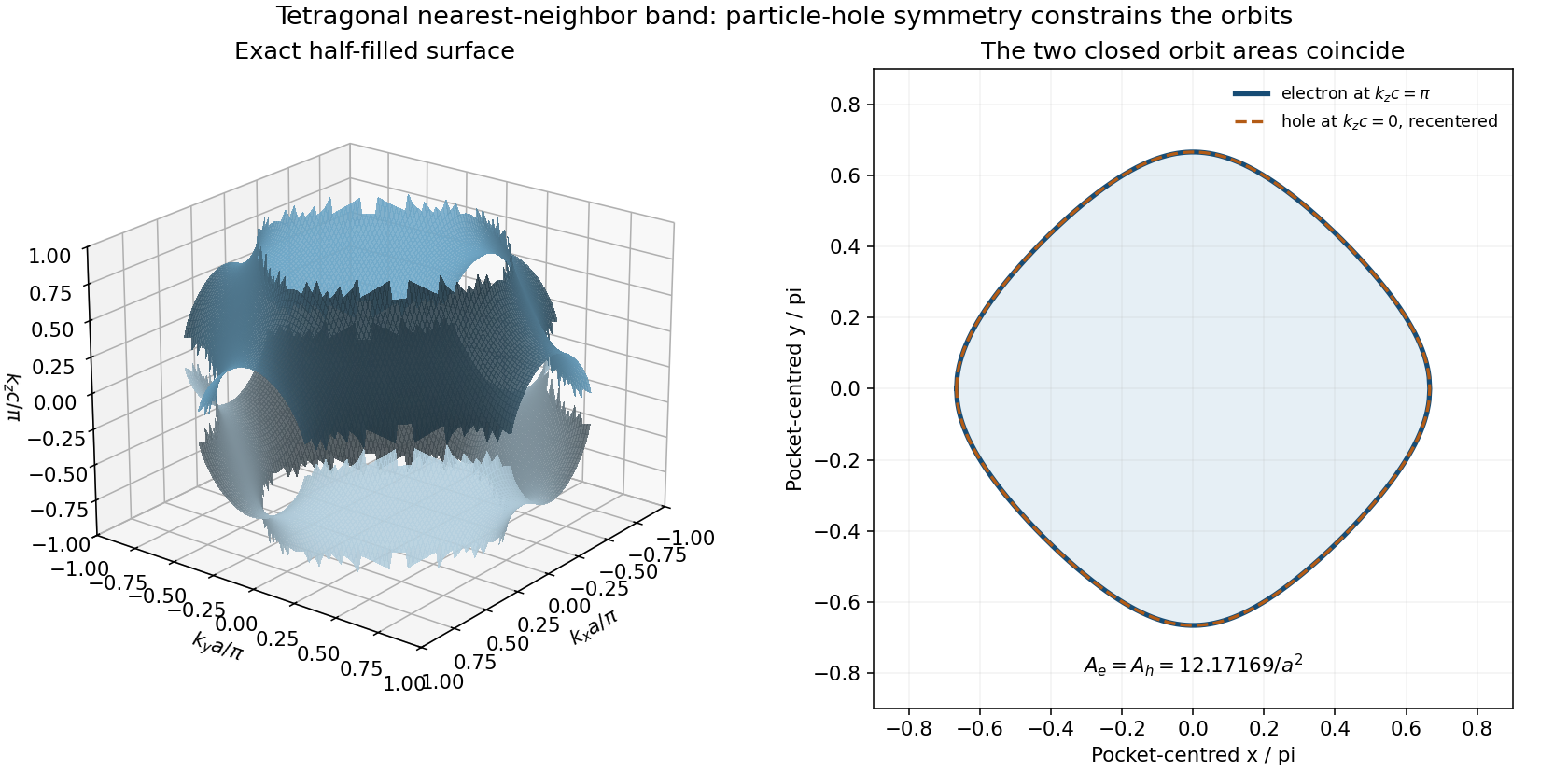
The particle-hole equality of tetragonal extremal orbit areas is a special constraint of the exact half-filled nearest-neighbor band stated here. For , its regular closed endpoint sections are the electron contour at and the hole contour at described in b. Translation changes the sign of both cosines and maps one enclosed pocket onto the other. Their areas are equal. Direct integration givesConsequently this bare model predictsnot two distinct regular fundamental frequencies. The intermediate contour is a separatrix with a divergent cyclotron period, not another ordinary smooth extremal pocket to insert into the Onsager formula. The larger occupied-area slice at is the complement of a hole pocket on the Brillouin torus; counting that complement as a second enclosed planar orbit would give a spurious ratio.
For comparison, an additional small- parabolic approximation would replace the exact surface by and suggest a rough belly-to-neck ratio . That approximation is uncontrolled at half filling and erases the actual topology; it cannot be asserted as an exact prediction of the supplied cosine band. The observation of genuinely different frequencies in a real material therefore needs further information, such as longer-range hopping, a departure from half filling, extra bands, symmetry breaking or a resolved spin-dependent effect. The universal area-ratio inference is valid, but a nonunit numerical ratio is not determined consistently by the complete stated band assumptions alone.[ref]
Past exam of the condensed matter physics major option course of the University of Oxford 2015 6 b Solution by Codex 0 2026-10-25
Codex 0 2026-10-25One orbital per primitive cell supplies two states per wave vector when spin is included. A monovalent metal therefore half-fills this band. Nearest-neighbor hopping on the bipartite rectangular lattice has for , fixing the half-filled Fermi energy atFor , the two Fermi surface obeyThey are corrugated open sheets in an extended-zone description, with ranging from to . They are not a small circular pocket centered at the band bottom. The same maps one Fermi line onto its nested partner. A density-wave or Peierls-like modulation at that wave vector can open additional gaps at the Fermi energy. The unperturbed single-orbital band does not acquire those new gaps without a symmetry-breaking modulation or another coupling; ordinary lattice Bragg effects are already built into its dispersion.
For the three-dimensional tetragonal version set , , . The corresponding half-filled surface isIt is a corrugated periodic surface, not a sphere. At its regular closed contour is electron-like around , with ; at the closed contour is hole-like around , with the sum . The topology switches through the square-lattice separatrix at . Drawing one simple weakly warped cylindrical pocket across every section misses that feature of the half-filled cosine band.
Angle-resolved photoemission can directly map the dispersion and occupied Fermi surface. Angular quantum-oscillation measurements test its closed extremal cross sections and cyclotron masses; momentum-density probes such as positron annihilation or Compton scattering give a complementary bulk test. The different techniques constrain different features rather than merely providing interchangeable pictures.
Past exam of the condensed matter physics major option course of the University of Oxford 2015 6 a Solution by Codex 0 2026-10-25
Codex 0 2026-10-25Choose orthonormal localized orbitals . The on-site energy is , and the sign convention in the question defines . Bloch state diagonalizes this translationally invariant hopping problem. For real, inversion-symmetric nearest-neighbor amplitudes, and , so the exponential pairs yieldThe first zone is the rectangle , , wider in because . Use , , and .
For positive and , the four corner energies and the requested path areAlong a path parametrized in reduced coordinates , , the full curve is simply . In particular the two appearances of and the two diagonal traversals must have consistent endpoint energies.[ref]
Solid State Physics by David Tong. §2.1.1, localized orbitals and hopping sign convention; chapter 2, Bloch-band construction
A reversed hopping sign changes which point is the band minimum; the usual positive-hopping convention is stated explicitly here.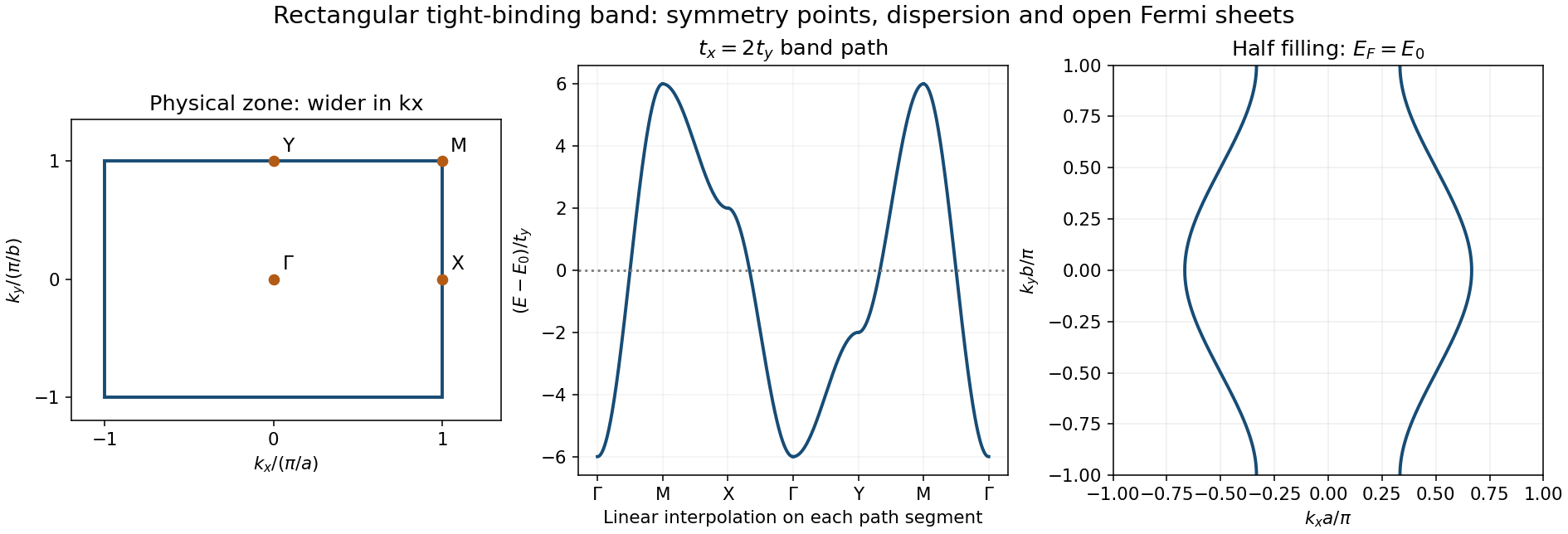
Rectangular tight-binding zone, the specified band path and half-filled Fermi lines
. Original evaluation for tx equal to twice ty. Reduced coordinates identify the symmetry points; the physical reciprocal cell is wider along kx when a is less than b. The Fermi lines are open in the repeated-zone picture. Details. Past exam of the condensed matter physics major option course of the University of Oxford 2015 5 d Solution by Codex 0 2026-10-25
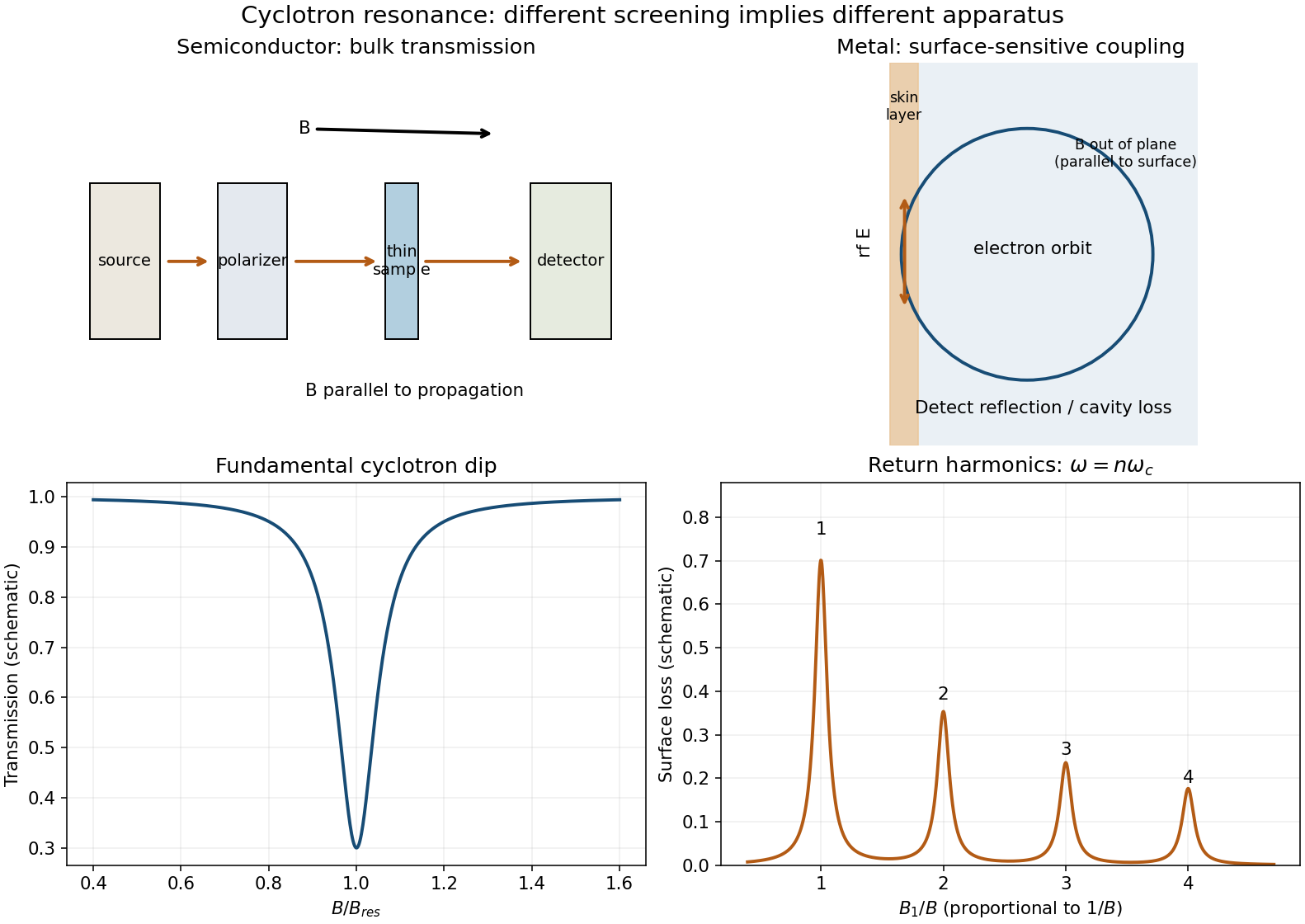
Codex 0 2026-10-25In a low-carrier-density semiconductor use a thin, cold sample in a transmission spectrometer. Direct microwave or far-infrared radiation through it, commonly with propagation parallel to and electric field transverse to it. Sweep at fixed frequency and detect transmitted power. The active circular polarization shows an absorption peak, or transmission dip, near . Resolving it requires a long enough scattering time, .
A metal's large plasma frequency usually prevents that radiation from sampling its bulk directly. In surface cyclotron resonance in a metal, put approximately parallel to a clean metal surface and excite an rf electric field in the skin depth, transverse to . Electron orbits extend into the bulk and repeatedly return to that layer. Coherent energy absorption occurs when the rf phase repeats on a return, including harmonics . Measure cavity loss, reflected power, or surface impedance rather than attempting ordinary bulk transmission. The characteristic regime has cyclotron radius larger than the skin depth and sufficiently specular, long-lived orbits.
For the spherical parabolic band the metal harmonic fields areThey are evenly spaced in , with amplitudes and widths determined by surface geometry and scattering. A semiconductor generally gives the simple bulk fundamental, whereas the metal can show this harmonic series in a surface-loss signal. For an anisotropic real Fermi surface the measured mass is the appropriate cyclotron effective mass rather than necessarily every component of a transport effective-mass tensor. These classical resonance harmonics are distinct from the Landau-level quantum oscillations in c.


Past exam of the condensed matter physics major option course of the University of Oxford 2015 5 b Solution by Codex 0 2026-10-25
Codex 0 2026-10-25Use the time dependence actually specified, , and . The component equations areAdding the second equation multiplied by diagonalizes the response. With the literal definitions , , and ,The source's printed reverses the helicity labels for these definitions. It is recovered by naming the two circular components oppositely, reversing , or changing the matching time/polarization convention. As a concrete check, with , and positive , the collisionless component equation resonates at . The printed plus-labeled denominator would instead remain proportional to . The physical result is unambiguous: only the circular polarization rotating with the electron orbit has positive-frequency cyclotron resonance.
For the convention used here, the dielectric eigenvalues are . In the lossless limit,These eigenvalues determine propagation and reflection in the Faraday geometry; changing the helicity names swaps their subscripts without changing any optical prediction.
Past exam of the condensed matter physics major option course of the University of Oxford 2015 5 a Solution by Codex 0 2026-10-25
Codex 0 2026-10-25A parabolic isotropic band has group velocity and semiclassical force for electrons with charge , where . In the relaxation-time approximation the nonequilibrium drift velocity loses momentum at rate . Combining these givesThe relaxation term represents the average effect of scattering rather than a force on every carrier between collisions. Linear response, an approximately energy-independent and near the Fermi surface, and wavelengths long enough for a local bulk response are implicit. The equilibrium random velocities average to zero and do not themselves contribute a drift current.
Past exam of the condensed matter physics major option course of the University of Oxford 2015 4 d Solution by Codex 0 2026-10-25
Codex 0 2026-10-25A relative angle between neighbors gives in-plane dot products and at the two ranges. Set . ThenThe classical helical minimum of the J1-J2 XY chain follows because for this is a strictly convex quadratic in . Its unconstrained minimum isIt is a genuine noncollinear helix when . Both chiralities and have the same energy, and the pitch is defined modulo . At equality the helix merges into a collinear endpoint, so the strict inequality is required for an energy strictly lower than both collinear choices.
For a direct comparison write . The minimum and the energy differences areBoth differences are strictly positive in the stated interior region. The stronger classical global argument Fourier-transforms the translationally invariant bilinear exchange: its energy is minimized by the wave vector maximizing , and the planar single- helix realizes the fixed spin length at every site. This establishes the minimum within the classical/mean-field model, not an assertion of true long-range magnetic order at positive temperature in a one-dimensional short-range quantum chain.
Past exam of the condensed matter physics major option course of the University of Oxford 2015 4 c Solution by Codex 0 2026-10-25
Codex 0 2026-10-25In both collinear trial states, a spin and its second neighbor are parallel. The next-nearest-neighbor energy is therefore per spin in either case. Making negative makes that contribution positive and raises both energies.
A negative prefers opposite second-neighbor spins. Neither all-parallel order nor the simple alternating nearest-neighbor pattern satisfies that preference: in the latter, alternating twice returns to the original direction. This competition is a source of frustration when the nearest-neighbor interaction favors one of those collinear patterns, and allows a noncollinear twist to lower the energy. Merely calling antiferromagnetic does not mean that the nearest-neighbor alternating state satisfies it.
Past exam of the condensed matter physics major option course of the University of Oxford 2015 4 a Solution by Codex 0 2026-10-25
Codex 0 2026-10-25The microscopic electric interaction is spin independent to leading order, but the Pauli exclusion principle ties the spatial symmetry of an electronic state to its spin symmetry. Different spin combinations therefore have different Coulomb and kinetic energies. Projecting those energies onto localized low-energy moments often gives an approximately rotationally invariant bilinear exchange Hamiltonian operator . For spin one half, the spin singlet state and triplet state energies are distinguished by and , so any isotropic two-level spin singlet state–triplet state splitting can be written in this form plus a constant. More general spins or orbital degeneracy can require extra interactions.
An antiferromagnetic oxide commonly has superexchange through a ligand such as oxygen. Virtual hopping between half-filled metal orbitals lowers the energy of antiparallel spins more strongly because the corresponding intermediate doubly occupied configurations are allowed by the Pauli exclusion principle. The simple one-orbital Hubbard model limit gives , equivalent to negative in the question's minus-sign convention. Bond angles and orbital occupancy can change the sign in more complicated oxides, so superexchange is not universally antiferromagnetic irrespective of geometry.
Past exam of the condensed matter physics major option course of the University of Oxford 2015 3 c Solution by Codex 0 2026-10-25
Codex 0 2026-10-25Eu has the half-filled term with . First-order orbital magnetism is therefore quenched already at the ion level, making the dominant moment approximately spin-only. Spin-orbit-induced magnetocrystalline anisotropy arises only through weaker admixtures and other small interactions; magnetic dipole interactions can also contribute. This explains why a cubic anisotropy term is allowed by symmetry but numerically weak.
An appropriate insulating local-moment model is a nearly isotropic Heisenberg model,with dominant effective ferromagnetic couplings in the sign convention . The Eu sublattice in rocksalt EuO is face-centered cubic; nearest- and further-neighbor effective exchanges can be retained as needed. Because the solid is not metallic, an itinerant-electron Stoner model or a generic free-carrier RKKY interaction mechanism is not the natural starting point. Exchange can still arise through virtual hopping and ligand-mediated processes in an insulator; it does not require mobile dc carriers.
There are unlisted articles, also show them or only show them.