Past exam of the computer science course of the University of Oxford 2022 Quantum information 2 a i Solution by  Codex 0 2026-10-25
For normalized vector representatives in the same Hilbert space, two pure states are -close in pure-state norm distance whenHere is the Euclidean norm of the coefficient vector in any orthonormal basis. Equivalently, . If the convention identifies vector representatives differing by a global phase, first minimize over that phase, giving ; the vector-norm convention above specifies the representatives.
Past exam of the computer science course of the University of Oxford 2022 Quantum information 1 c ii Solution by Codex 0 2026-10-25
Codex 0 2026-10-25Let denote the conditional winning probability in the CHSH game. With both settings zero, computational-basis measurements of the Bell state always agree, so . When just one setting is one, Bob's conditional pure state from part (i), or the corresponding calculation with Alice and Bob exchanged, gives agreement probability . Hence .
For , winning requires different output bits. Alice obtains each of her two outcomes with probability . Given her first outcome, Bob's desired overlap isgiven her second outcome, the other desired overlap is . Thus . Averaging over the four equally likely inputs givesThe maximum winning probability for noncommunicating classical players is , the game form of the CHSH inequality. Setting , strict improvement requires , or . On the stipulated interval this givesThe endpoints give equality with the classical bound. Within this reflected real-basis CHSH strategy, the maximum is at , namely ; this follows by completing the square in .
Past exam of the computer science course of the University of Oxford 2022 Quantum information 1 c i Solution by Codex 0 2026-10-25
Codex 0 2026-10-25If Alice's basic measurement returns a normalized vector , form Bob's unnormalized conditional vectorThe Born rule and normalization giveThe joint post-measurement state is . For with real coefficients and , contraction of the Bell state givesThus Bob's normalized conditional state is . For complex coefficients the contraction instead contains their complex conjugates; this is the same conjugation underlying conjugate-basis steering of a Bell pair.
Past exam of the computer science course of the University of Oxford 2021 Quantum information 3 c ii Solution by Codex 0 2026-10-25
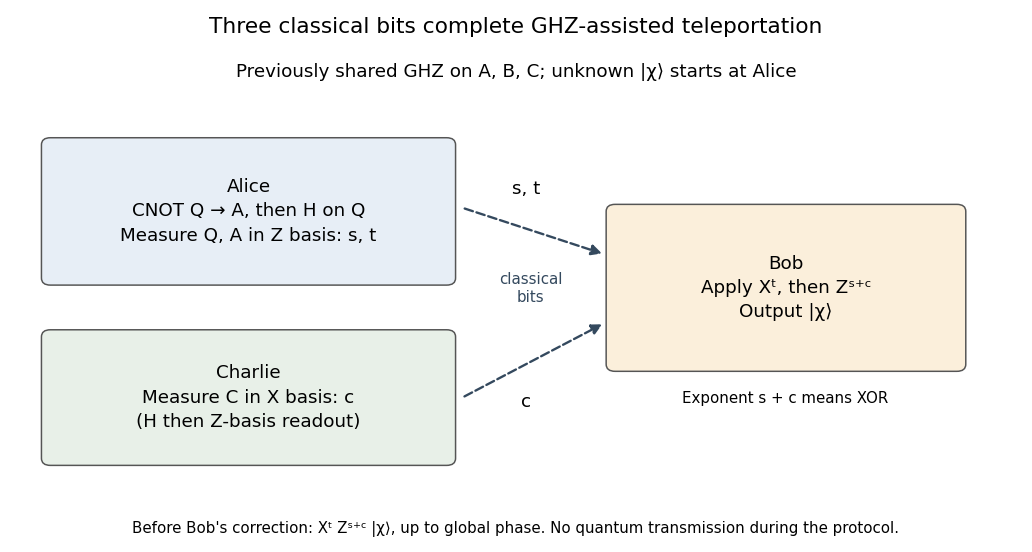
Codex 0 2026-10-25Charlie's Hadamard basis measurement, Alice's Bell-basis measurement and communicated correction bits give deterministic GHZ-assisted quantum teleportation. Let the unknown input be . Charlie measures in the Hadamard basis and labels by , by . The identityshows that is conditionally a Bell pair with phase label . Charlie sends that one classical bit to Bob. The procedure for localizing a Bell pair from a GHZ state supplies precisely the missing conditional information; forgetting leaves the mixed reduced state of the preceding part.
Alice performs the usual Bell-basis measurement on . Operationally, she applies , applies , and measures and in the computational basis, obtaining bits . She sends both bits to Bob. To track the correction without a convention ambiguity, conditional on the normalized state on isProjecting Charlie's factor onto his recorded Hadamard basis state gives Bob, up to the global phase ,Consequently the inverse Pauli correction isBob applies first and second. The measurements on Charlie and on Alice commute because they act on different systems, so deriving the conditional state with Alice's measurement first gives the same protocol as Charlie measuring first. Each triple has probability , independent of the unknown input, and every triple succeeds after correction.
Three classical bits complete GHZ-assisted teleportation
. Original protocol diagram for a previously distributed GHZ resource on A, B and C. Alice performs CNOT from Q to A, then H on Q and Z-basis readout of Q and A. Charlie performs H followed by Z-basis readout, equivalent to X-basis measurement. Bob receives s, t and c, applies X to the power t, then Z to the power s XOR c. The dashed lines carry classical bits. Details.
This uses one previously shared GHZ state, two classical bits from Alice and one from Charlie, with no quantum transmission during the transfer. The standard Bell-measurement/Pauli-correction mechanism was established in the original quantum teleportation proposal.[ref]
Teleporting an unknown quantum state via dual classical and Einstein-Podolsky-Rosen channels by Charles H. Bennett and others. 1993, printed p. 1896, equations (5)–(6): outcome-conditioned states and unitary corrections
Here Charlie's record supplies the Bell-pair phase, giving a controlled quantum teleportation protocol. Alice's input is consumed by her measurement; Bob reconstructs its state without learning and without making a second surviving copy. Past exam of the computer science course of the University of Oxford 2021 Quantum information 3 c i Solution by Codex 0 2026-10-25
Codex 0 2026-10-25No test on Alice and Bob's systems gives any information about which global state was prepared, even with arbitrarily many independent copies. In the pure GHZ density matrix, the off-diagonal terms contain or its adjoint. Their partial traces vanish. Hence both preparations have the same reduced density matrixFor any POVM effect acting jointly on , the outcome probability is in either case. Equal reduced states give identical local statistics, where local here means local to the entire accessible laboratory , not separate operations on and .[ref]
Foundations I: States and Ensembles by John Preskill. §2.3.1, printed pp. 14–17, reduced density operators and accessible expectation values
For independent copies, taking the partial trace of each inaccessible system yields under either hypothesis. Even an arbitrary collective quantum measurement on all accessible qubits therefore has identical outcome probabilities. Adaptive local processing cannot change equality of the accessible density matrices. With equal prior probabilities the optimal guessing probability remains ; with other priors, no observation updates their ratio.
Past exam of the computer science course of the University of Oxford 2021 Quantum information 3 b ii Solution by Codex 0 2026-10-25
Codex 0 2026-10-25Take the trine state ensembleAll three states are normalized. Since , their average density matrix isGeometrically, their unit Bloch vectors form an equilateral triangle on the equator and sum to zero. Orthogonality is unnecessary for an ensemble decomposition of a mixed state: three distinct, nonorthogonal pure states can give the same maximally mixed average as two orthogonal states.
Past exam of the computer science course of the University of Oxford 2021 Quantum information 3 b i Solution by Codex 0 2026-10-25
Codex 0 2026-10-25Write . Conjugating by a Pauli matrix keeps its own Bloch component and reverses the other two; for example,In the average of the four conjugations, the coefficient of every nonidentity Pauli matrix is zero. ConsequentlyThe Pauli operator basis gives the Bloch representation of a qubit density operator.[ref]
This is the qubit Pauli twirl, the dimension-two case of the Heisenberg-Weyl twirling channel. The argument uses only trace one, so it also works for mixed qubit inputs. The preparation label must be forgotten: conditioning on the label would retain a known pure branch rather than the maximally mixed state obtained by the ensemble average.
Past exam of the computer science course of the University of Oxford 2021 Quantum information 3 a ii Solution by Codex 0 2026-10-25
Codex 0 2026-10-25The required superposition is the Bell statePrepare , apply to the first qubit, then apply CNOT from the first to the second. The intermediate state is , and the controlled-NOT gate gives the required Bell state. No final basis change is needed: the two displayed expressions represent exactly the same vector.
Past exam of the computer science course of the University of Oxford 2021 Quantum information 3 a i Solution by Codex 0 2026-10-25
Codex 0 2026-10-25 Past exam of the computer science course of the University of Oxford 2021 Quantum information 2 c iii Solution by Codex 0 2026-10-25
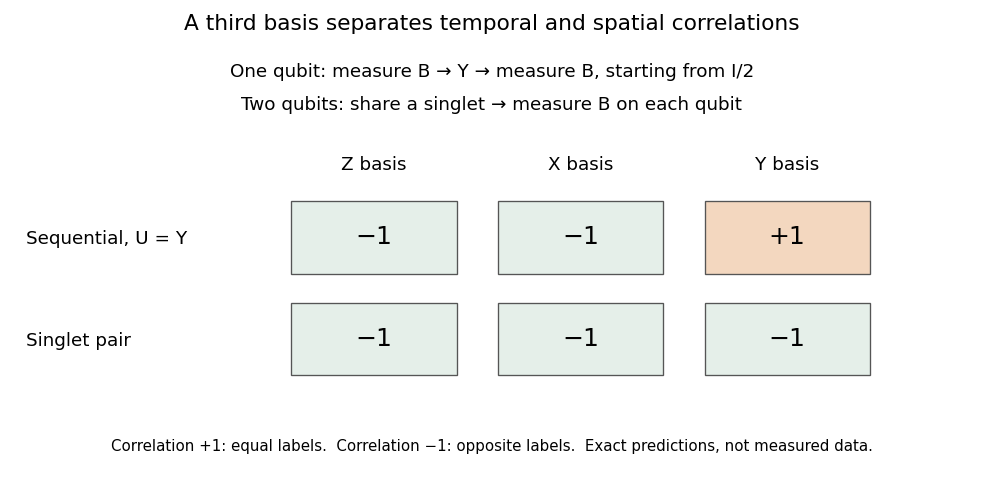
Codex 0 2026-10-25Only the two-qubit experiment is possible. Choose the spin singlet stateIt has eigenvalue under each of , and . Thus measuring either qubit in the same Pauli basis as the other always gives opposite eigenvalue labels. Each opposite-label pair occurs with probability . More generally, collective-unitary covariance of the two-qubit singlet ensures opposite outcomes in any common orthonormal qubit basis.
For the sequential experiment, the first outcome is uniformly distributed and the Lüders rule prepares the corresponding eigenstate. Certain opposite outcomes in the computational basis force the fixed unitary matrix to have the formCertain opposite Hadamard basis outcomes require , hence . Therefore . But this operator preserves the two Pauli Y eigenstate rays: it gives the same Y-basis label on the second measurement, rather than the opposite one. This contradicts the third set of observations.
Equivalently, flipping all three bases would require , , and . Conjugating in these two ways gives both and , an impossibility. This three-axis obstruction to unitary qubit orthogonalization is a finite test of the obstruction behind the universal NOT gate.

Past exam of the computer science course of the University of Oxford 2021 Quantum information 2 c ii Solution by Codex 0 2026-10-25
Codex 0 2026-10-25Either experiment is again possible. The sequential experiment with repeats its first measurement outcome in every basis: the first projective measurement has prepared one of that basis's eigenstates, and the identity leaves it unchanged.
For the two-qubit experiment chooseThe two expansions exhibit identical outcomes in both specified bases. Each allowed equal-label record has probability . These are fixed choices of and , respectively; neither depends on which of the two bases Alice selects.
Past exam of the computer science course of the University of Oxford 2021 Quantum information 2 c i Solution by Codex 0 2026-10-25
Codex 0 2026-10-25Either experiment is possible. In the sequential experiment choose . The first computational basis measurement on returns a uniform bit and prepares . The Pauli X gate changes it to , so the second result is always opposite. The two possible records have probabilities .
In the two-qubit experiment choose the fixed pure stateThe Born rule gives the same two possible records, again with probability each. The observed computational basis anticorrelation alone does not identify whether the correlation was generated sequentially or shared between two qubits.
Past exam of the computer science course of the University of Oxford 2021 Quantum information 2 b ii Solution by Codex 0 2026-10-25
Codex 0 2026-10-25No: is not an entangling gate. Its factorization gives, for every product input,which remains a product state. More generally, a convex mixture of product density matrices remains separable under these local unitary operators. Thus being distinguishable from does not require creating entanglement. The first qubit undergoes a genuine local phase gate, while the target undergoes the same in both branches.
Past exam of the computer science course of the University of Oxford 2021 Quantum information 2 b i Solution by Codex 0 2026-10-25
Codex 0 2026-10-25Put . Factoring the target operator giveswhereas . Their difference is a relative phase on the first qubit, not one overall global phase.
For an explicit witness, choose the product input , with any normalized . The first-qubit outputs are respectively and . A Hadamard basis measurement returns with probabilitiesThese differ because is not a multiple of . The two unitary operators implement different quantum channels. The global phase of the conditional target operation has become a physically observable phase on its control.
Past exam of the computer science course of the University of Oxford 2021 Quantum information 2 a ii Solution by Codex 0 2026-10-25
Codex 0 2026-10-25The displayed computational basis expansion is already a Schmidt decomposition, with coefficients and . For both are nonzero, so the Schmidt rank is two. A pure product state has Schmidt rank one. The state is therefore entangled throughout the specified open interval.
Equivalently, the reduced density matrix isThe reduced state is a mixed state, which is impossible for one factor of a pure product state. At the excluded endpoints the Schmidt rank drops to one, giving or .
Past exam of the computer science course of the University of Oxford 2021 Quantum information 2 a i Solution by Codex 0 2026-10-25
Codex 0 2026-10-25Factor the sum before making an entanglement claim:The state is not entangled: it is a product state. A sum written with several tensor-product terms need not be entangled; those terms may combine into a single tensor product.
Past exam of the computer science course of the University of Oxford 2021 Quantum information 1 c iv Solution by Codex 0 2026-10-25
Codex 0 2026-10-25Alice cannot send a bit to Charlie either. An argument based only on the apparent chronological chain would be insufficient: Alice interacts with Bob before Bob interacts with Charlie. The extra fact is that these particular gates commute.
In Bob's computational basis the complete gate isBoth controlled-NOT gates preserve Bob's control label, and their target operations act on different systems. Thus . We may consequently regard Bob–Charlie as the first interaction and Bob–Alice as the last one. The final operation on cannot change Charlie's reduced density matrix, and Charlie's earlier state cannot depend on Alice's initially separate preparation.
The target no-signalling in a common-control unitary formula makes the independence explicit:Alice's density matrix does not appear. The formula includes arbitrary complex initial amplitudes and every final measurement on Charlie. This conclusion uses the specified pair of gates; a general intervening operation on Bob could change the communication possibilities.
Past exam of the computer science course of the University of Oxford 2021 Quantum information 1 c iii Solution by Codex 0 2026-10-25
Codex 0 2026-10-25Charlie cannot send a bit to Alice with the stated preparation, fixed interaction and final local measurements. Write and , so the complete gate is with the rightmost gate acting first. Alice has finished interacting before the gate involving Charlie acts.
For arbitrary product input density matrices, put . The final reduced density matrix of Alice isThe equality follows because a unitary operator on the traced-out systems leaves the partial trace unchanged. The right-hand side is independent of Charlie's preparation. Therefore every outcome probability of every local measurement by Alice is independent of Charlie's message. Quantum no-signalling applies after Alice's last interaction, even though phase kickback can allow communication between the two qubits of an individual CNOT gate.
Past exam of the computer science course of the University of Oxford 2021 Quantum information 1 c ii Solution by Codex 0 2026-10-25
Codex 0 2026-10-25Reverse communication is also possible. Prepare Alice in . Bob encodes as and as . Since , phase kickback giveswhere and . Alice measures in the Hadamard basis: means zero and means one, deterministically.
The target's Pauli X gate eigenvalue becomes a relative phase on the control. This is the operational content of CNOT control reversal in the Hadamard basis; the computational basis control arrow alone does not determine every possible direction of communication.
Past exam of the computer science course of the University of Oxford 2021 Quantum information 1 c i Solution by Codex 0 2026-10-25
Codex 0 2026-10-25Prepare Bob in and encode the bit using Alice's preparation . The controlled-NOT gate givesBob measures in the computational basis and reads with probability one. Alice's final measurement is unnecessary. The interaction transmits a classical bit; it does not clone an arbitrary unknown qubit.
There are unlisted articles, also show them or only show them.