Past exam of the condensed matter physics course of the University of Oxford 2014 1 a Solution by  Codex 0 2026-10-25
A Bravais lattice is an infinite periodic set of equivalent points , with integer and independent primitive translations . It describes translation symmetry, without assigning a chemical species to a point. An atomic basis of a crystal is the motif of atoms, with their species and relative positions, repeated identically at every lattice point. The resulting crystal structure consists of the lattice decorated by that basis; the basis can contain several atoms even when the lattice is primitive.
A primitive unit cell tiles space under lattice translations and contains exactly one lattice point, counting shared boundary points fractionally. Its volume is . A conventional unit cell is chosen to display useful crystal symmetry and may contain several lattice points. Thus a centered conventional cell is not primitive, but the crystal still has a primitive cell. Neither cell size nor the number of dots drawn on its boundary should be confused with the number of atoms in the crystal basis.
Past exam of the condensed matter physics course of the University of Oxford 2013 4 e Solution by Codex 0 2026-10-25
Codex 0 2026-10-25Room-temperature iron is ferromagnetic: interactions among its electronic moments produce spontaneous local order. The independent-ion Curie law therefore needs an interaction and an ordered-state description. In a Weiss mean-field approximation, replace the applied field by . Above the ordering temperature, linearizing the single-ion response yieldsThis is the Curie–Weiss approximation on the paramagnetic side. Merely substituting room temperature below into that high-temperature formula would produce a negative response and is not a valid model of stable iron.
Below , use the full nonlinear moment response to the effective field; it has nonzero zero-field solutions. On a chosen ordered branch the local small-field response has the form , rather than through the origin. Macroscopic magnetic domains and hysteresis further determine the measured net moment. Exchange interactions, arising from electronic quantum statistics and Coulomb correlations, supply the alignment energy; bare dipolar fields alone do not explain ordinary iron's strong ferromagnetism. A localized-ion Weiss model describes the qualitative ordering, while iron's itinerant electronic structure limits a literal independent-fixed-ion interpretation.
Past exam of the condensed matter physics course of the University of Oxford 2013 4 d Solution by Codex 0 2026-10-25
Codex 0 2026-10-25Linear Curie behavior fails gradually when the Zeeman energy of a substantial moment is comparable to thermal energy. Its appropriate scale isAt , . Thus : about for , or for a spin-one-half moment with . Larger moments saturate at smaller fields. The source does not specify numerical , so it determines this parametric scale rather than one universal room-temperature threshold. At sufficiently large field the moment tends toward and cannot keep increasing linearly with .
Past exam of the condensed matter physics course of the University of Oxford 2013 4 c Solution by Codex 0 2026-10-25
Codex 0 2026-10-25Let . The single-ion partition function and mean projected magnetic moment areFor , the geometric sum also givesIn the high-temperature, weak-polarization regime , expand the Boltzmann factors. The numerator's zero-order term vanishes because , and the first-order term uses . The denominator is . ThereforeThis fixed-field per-ion Curie coefficient describes mean moment per ion at fixed field, so it includes . It is not the field-independent volume-susceptibility Curie constant. For number density and , the latter is , giving . At , the specified moment is zero and both expressions vanish.
Past exam of the condensed matter physics course of the University of Oxford 2013 4 b Solution by Codex 0 2026-10-25
Codex 0 2026-10-25Interpret the source's as the dimensionless angular-momentum operator, with . If angular momentum is written with physical units, the magnetic-moment formula instead contains ; this is a convention, not an extra factor in the requested energy.
The field fixes the quantization axis, soThere are Zeeman levels equally spaced in energy by . For positive , the state with largest positive moment has lowest energy. The given sign defines through the specified moment relation; inserting an additional electron-charge minus sign into it would change the source convention.
Past exam of the condensed matter physics course of the University of Oxford 2013 4 a Solution by Codex 0 2026-10-25
Codex 0 2026-10-25In the SI linear-response convention , a diamagnetic contribution has negative susceptibility: the induced moment opposes the applied field. Orbital motion supplies a familiar microscopic mechanism, and closed-shell atoms can be diamagnetic even without permanent moments. Paramagnetism has positive susceptibility, with induced magnetization along the field; thermal alignment of permanent localized moments is one mechanism, while conduction-electron spin response is another.
Neither sign alone is a definition of ferromagnetic ordering. An ordinary paramagnetic phase has no spontaneous zero-field magnetization. A diamagnetic background can coexist with a larger paramagnetic contribution in the same specimen. Curie's inverse-temperature law describes an appropriate localized-moment model, not every possible paramagnet.
Past exam of the condensed matter physics course of the University of Oxford 2013 3 d Solution by Codex 0 2026-10-25
Codex 0 2026-10-25For passive friction , the time dependence of each spatial normal coordinate follows its damping regime:
For any fixed positive damping, sufficiently small nonzero is overdamped because . The slow branch then has , a diffusive long-wavelength relaxation. At exactly , uniform translation has no restoring force, so and the constant displacement need not decay. Thus saying every amplitude simply decays as is valid only for the underdamped envelope, not for all wave numbers.
Past exam of the condensed matter physics course of the University of Oxford 2013 3 c Solution by Codex 0 2026-10-25
Codex 0 2026-10-25For a viscously damped monatomic-chain phonon, the extra force gives on the left of the preceding equation. Keep a real wave number and permit complex frequency in the convention . The dispersion equation isWriting , its two roots areThe negative imaginary part corresponds to decay with the chosen time convention. Here has units of mass per time, while is a decay rate. A driven experiment at specified real frequency would instead solve for a generally complex wave number; it is a different way of specifying the response, not a contradictory sign choice.
Past exam of the condensed matter physics course of the University of Oxford 2013 3 b Solution by Codex 0 2026-10-25
Codex 0 2026-10-25Substitute the traveling normal mode . Combining the opposite-neighbour phases givesso the positive-frequency branch isFor positive spring constants this is a stable acoustic branch. At long wavelengths,The next-nearest-neighbour bond spans twice the distance, hence contributes the factor four. Relative to , positive increases the sound speed by . The chain still has one acoustic branch and no optical branch.
The group speed near and the maximum frequency need not change in the same way. The zone-edge value is always , because the next-nearest-neighbour sites then move together. For the frequency maximum moves inside the zone, with ; the small- sound speed nevertheless keeps increasing.
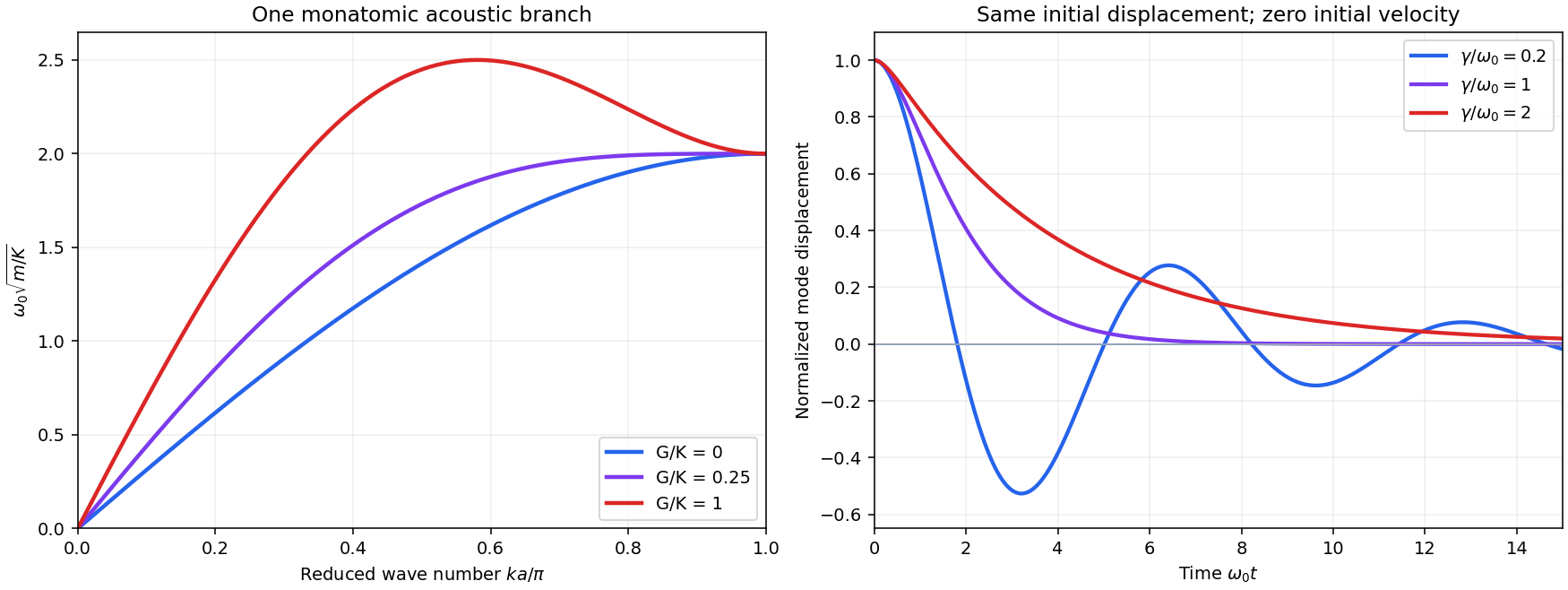
One acoustic branch with further-neighbour springs, and three viscous-decay regimes
. Original calculated dispersions for stated values of , all normalized using the same . The right panel shows a single normal coordinate with initial displacement one and initial velocity zero, for damping ratios . It illustrates that a nonoscillatory overdamped response does not have the same envelope as an underdamped phonon. Details.
Past exam of the condensed matter physics course of the University of Oxford 2013 3 a Solution by Codex 0 2026-10-25
Codex 0 2026-10-25Let be the equilibrium spacing of this monatomic chain and the displacement from . The right nearest-neighbour bond exerts and the left bond . The two next-nearest-neighbour bonds similarly connect to . ThusEvery uniform displacement gives zero force, as translation symmetry requires. There is one displacement coordinate per primitive cell. Adding further-neighbour springs does not introduce a second atom or turn this into a diatomic-chain problem.
Past exam of the condensed matter physics course of the University of Oxford 2013 2 d Solution by Codex 0 2026-10-25
Codex 0 2026-10-25Use the supplied effective electrostatic term and enforce charge neutrality while varying the chain length: , with and fixed. The total energy per positive ion becomesThe positive quadratic term supplies degeneracy pressure against compression. Differentiating gives the neutral one-dimensional metal equilibrium density,where is the Bohr radius. The second derivative verifies a minimum. Within this specified toy energy, the minimizing electron density is independent of ; instead the equilibrium ion spacing is .
At the minimum the electrostatic contribution is minus twice the kinetic contribution, so . These follow from the given electrostatic approximation, not from a full self-consistent calculation of a real one-dimensional metal. In particular, additional Coulomb terms cannot be appended without the corresponding neutral-background subtraction that defines the supplied finite energy.
Past exam of the condensed matter physics course of the University of Oxford 2013 2 c Solution by Codex 0 2026-10-25
Codex 0 2026-10-25For a one-dimensional free-electron gas of length , allowed wave vectors have spacing . Including two spin states and occupied wave vectors from to ,The ground-state kinetic energy is found by integrating rather than assigning every electron the Fermi energy:Charge neutrality gives because each positive ion has charge . Thus . Since the ion separation is , and . These are one-dimensional number densities and state counts; using a three-dimensional relation here would change the model. The results concern the ground-state Fermi-gas contribution, neglecting electron interactions beyond the supplied electrostatic energy.
Past exam of the condensed matter physics course of the University of Oxford 2013 2 b Solution by Codex 0 2026-10-25
Codex 0 2026-10-25For a repulsive short-range potential and a stable finite minimum, assume and integer . Setting givesAt this point , soHere denotes the second derivative of the energy , not a displacement variable. The negative equilibrium energy is the cohesive energy per pair relative to infinite separation.
The qualifiers on matter: an arbitrary real coefficient and integer exponent do not automatically describe stabilizing repulsion. For instance gives collapse as , whereas gives and has no isolated finite equilibrium. The displayed minimum therefore applies to the physically repulsive, faster-than-Coulomb branch of the stated model.
Past exam of the condensed matter physics course of the University of Oxford 2013 2 a Solution by Codex 0 2026-10-25
Codex 0 2026-10-25Put with . Relative to a chosen positive ion, successive neighbours have alternating charge. The sum of its interactions with all other ions is . Summing this over all ions would count every pair twice, so the total electrostatic energy is , or per ion pair.
There are nearest-neighbour bonds in a periodic chain of pairs; boundary corrections are negligible for large . If is the energy of each such bond, the repulsive contribution per ion pair is . Therefore the alternating-charge chain cohesive energy isThe factor two in the short-range term counts two bonds per ion pair. If a repulsion parameter were instead defined as the whole pair's repulsive coefficient, it would equal in this convention; changing that definition must not silently change the equilibrium formula. The absolute zero of energy is separated ions for a genuinely decaying repulsion.
Past exam of the condensed matter physics course of the University of Oxford 2013 1 d Solution by Codex 0 2026-10-25
Codex 0 2026-10-25Diffraction thermal-expansion thermometry needs a stable monochromatic X-ray beam, controlled collimation, an accurately calibrated angular scale, and an X-ray-sensitive detector with enough counts to fit reproducible line centroids. Crystal monochromators or appropriate energy selection are relevant here; an apparatus for visible-light interference does not directly measure these X-ray peaks. Sample displacement and angular-zero drift should be checked with a suitable reference standard.
The first-order angular sensitivities are about and degrees per kelvin, respectively. A one-kelvin inference therefore requires comparable centroid stability, with high count statistics and control of systematic errors; a centroid can be fitted more precisely than the line width. Fractional wavelength drift also mimics lattice expansion, so the desired temperature precision constrains relative to .
The powder must be at a known uniform temperature and allowed to equilibrate. Mechanical stress, clamping, composition changes, oxidation and phase changes can also shift or broaden peaks. Accurate work requires a calibrated , including the actual temperature dependence of the thermal expansion coefficient, rather than assuming the supplied constant describes every temperature exactly. Using both lines provides a consistency check on a common cubic expansion.
Past exam of the condensed matter physics course of the University of Oxford 2013 1 c Solution by Codex 0 2026-10-25
Codex 0 2026-10-25At fixed radiation wavelength, differentiating Bragg's law gives . With constant linear thermal expansion coefficient ,Both scattering angles decrease as the lattice expands. Substitution givesThese are shifts of , not of the Bragg angle alone. As a finite-step check, using gives . It produces shifts and , consistent with the first-order estimate. A strictly constant differential coefficient would instead give ; its difference from the linear length approximation is second order in this small expansion.
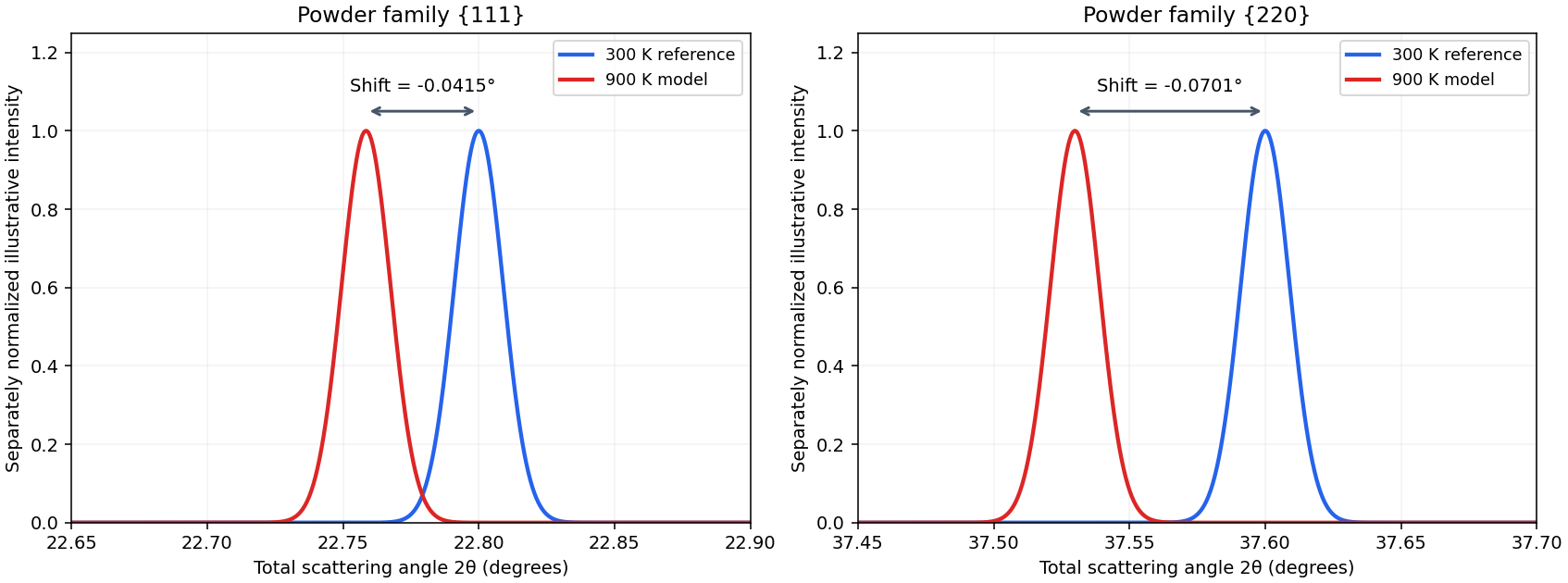
Calculated thermal shifts of the two lowest-angle diamond-cubic powder lines
. Original illustrative line profiles centred on the stated scattering angles and their calculated shifted positions. Each line is normalized separately; the chosen common Gaussian width is not a measured instrumental width, and the panels do not predict an intensity ratio. The finite-step curves use . Details.
Past exam of the condensed matter physics course of the University of Oxford 2013 1 b Solution by Codex 0 2026-10-25
Codex 0 2026-10-25Interpret the reported angles as total scattering angles . The photon energy givesCombining with the two index assignments yieldsThe slight difference is consistent with the rounded angular data, givingThe intensity estimate needs a stated convention. The geometric structure factors obey and , so equal atomic factors give a single-directed-reflection ratio . For a powder line, the powder diffraction multiplicities are eight for and twelve for . Hence a multiplicity-and-structure-factor estimate isif other angle-dependent factors are neglected.
A measured integrated powder intensity also contains the Lorentz-polarization factor, atomic form factor, thermal-motion factor and instrument/sample corrections. For example, in the common unpolarized symmetric powder geometry,Including this factor but still taking equal atomic factors gives , rather than . More generally,within that geometry, before other corrections. The actual form factors and measurement geometry are not supplied, so no unique precision experimental peak-height ratio follows. The values , and refer to distinct explicitly stated levels of approximation; a powder family must not be silently treated as one directed reflection.
Past exam of the condensed matter physics course of the University of Oxford 2013 1 a Solution by Codex 0 2026-10-25
Codex 0 2026-10-25The sites form a face-centered cubic lattice decorated by an identical two-atom atomic basis of a crystal, at fractional displacements and . This is the diamond cubic structure; the eight atoms in its conventional cube are not eight independent Bravais-lattice points.
For identical silicon atomic scattering factors , the conventional-cell structure factor separates into the FCC factor and the two-site motif factor:The first factor vanishes unless are all even or all odd. For all-even indices, the motif also vanishes if ; it survives if the sum is divisible by four. All-odd indices survive, with motif modulus . Thus and are absent by centering, is absent by the diamond basis, and and are allowed.
For a cubic cell, . At fixed X-ray wavelength, Bragg's law makes the smallest scattering angles correspond to the smallest allowed positive values of . These start with and , soThe braces denote whole powder families, including their symmetry-equivalent plane normals. The next family is , with squared-index sum ; using the FCC rule alone would incorrectly insert a line before .
Past exam of the condensed matter physics course of the University of Oxford 2012 4 e Solution by Codex 0 2026-10-25
Codex 0 2026-10-25With spin degeneracy, each energy band contains two electrons per primitive unit cell. Divalency therefore permits a filled first band, but only if its maximum lies below the second band's minimum. With negligible ionic periodic potential, the circular Fermi surface and the rectangular zone have equal enclosed area, not equal shape. Electrons occupy some states outside the first zone while some higher-energy first-zone states remain empty. Folded bands overlap, and the material is a metal.
A periodic potential mixes plane waves differing by a reciprocal lattice vector. At a two-wave Bragg point, the nearly-free electron model gives a direct gap . Increasing appropriate Fourier coefficients can remove the band overlap. With the first band filled, the system is then a band insulator, provided the temperature is small compared with the insulating band gap in energy units.
The rectangular free-electron band-overlap scale follows from two different points in reciprocal space. Put . Before gap opening, the highest first-zone energy is at the corner, while the lowest second-zone energy is at the midpoint of the nearer face:Thus the downward shift of the first-band maximum plus the upward shift of the second-band minimum must overcomeIn a rigid-splitting estimate, an opening lowers the first band by and raises the second by , giving the familiar threshold . Equality is only band touching, not a positive insulating gap. This expression is the overlap that must be removed, under that explicit band-shift approximation.
Positive direct gaps can coexist with band overlap: a local direct splitting and the global indirect band gap are not interchangeable. The shape and Fourier coefficients of the ionic potential are unspecified, so there is no universal exact critical direct-gap width determined by alone. For a concrete demonstration, a separable potential has axial direct gaps and . To first order, the corner's lowest level is , and the two candidate second-band minima are and . Therefore, within this model and neglecting higher-order band shifts, nonoverlap requiresEqual axial gaps would give the first-order estimate , rather than the rigid-splitting estimate. Such a large opening can exceed the quantitative range of weak-potential perturbation theory, but the example identifies the missing model assumption: corner levels feel both couplings. The exact general answer is the positive indirect-gap criterion above; a geometry-only direct-gap threshold would claim more than the supplied potential information supports.
Past exam of the condensed matter physics course of the University of Oxford 2012 4 d Solution by Codex 0 2026-10-25
Codex 0 2026-10-25For one electron per primitive unit cell, the areal number density is . The Fermi circle has radius . The nearer first-zone boundary is , because . The circle protrudes precisely whenAt equality the Fermi surface only touches the boundary. Crossing an extended-zone boundary alone does not make a gap: the free electron gas remains metallic when the ionic periodic potential is neglected.
There are unlisted articles, also show them or only show them.