Past exam of the computer science course of the University of Oxford 2020 Quantum information 1 b iii Solution by  Codex 0 2026-10-25
ChooseOrthonormality makes this a unit vector. Its probability amplitudes in the given measurement basis are , so the required probabilities are .
Past exam of the computer science course of the University of Oxford 2020 Quantum information 1 b ii Solution by Codex 0 2026-10-25
Codex 0 2026-10-25Choose . Its inner products with the three measurement vectors are , so the Born rule gives certainty for the outcome labelled 2 and zero probability for the other two outcomes. This uses the measurement basis, rather than assuming that its label 2 means the initial state must be the computational vector .
Past exam of the computer science course of the University of Oxford 2020 Quantum information 1 b i Solution by Codex 0 2026-10-25
Codex 0 2026-10-25Choose . Since , the probability amplitudes in the measurement basis are . Their squared moduli give by the Born rule.
Past exam of the computer science course of the University of Oxford 2019 Quantum information 3 b ii Solution by Codex 0 2026-10-25
Codex 0 2026-10-25Squaring the diagonal gate givesThus the T gate is available up to a global phase. Reading the supplied W columns in order , it sends to , to , and fixes the other two vectors: it is CNOT with the second wire controlling the first. Conjugating both wires by the Hadamard gate reverses that orientation:For instance, write . Conjugation uses and , , yielding . Expanding the first-wire Z eigenspaces gives , as required.
We have H directly and finite constructions of CNOT and T up to physically irrelevant global phase. By universality transfer by exact gate synthesis, the assumed universality of proves that is universal under the phase-insensitive convention. There is no assertion of arbitrary strict operator-norm phases: on a fixed register these generators have only a finite set of possible determinants, which would obstruct density in the entire unitary group if global phase were treated as an observable target.
Past exam of the computer science course of the University of Oxford 2019 Quantum information 3 b i Solution by Codex 0 2026-10-25
Codex 0 2026-10-25Both the controlled-NOT gate and Pauli X gate permute computational basis vectors. Any finite composition remains a permutation matrix, and so sends to another computational basis vector. It cannot prepare a superposition such as .
This also rules out approximation: the squared overlap of that target with any computational basis vector is at most , so even after optimizing global phase the pure-state norm distance is at least . Hence is not universal. Basis permutations can create entanglement on some superposed inputs, but this gate set cannot create the required superposition from the specified basis input.
Past exam of the computer science course of the University of Oxford 2019 Quantum information 3 a iii Solution by Codex 0 2026-10-25
Codex 0 2026-10-25A finite universal quantum gate set can approximate every unitary on any fixed finite number of qubits to any prescribed positive accuracy, using a finite circuit of its gates on allowed wires. Explicitly, for every target and there is such a circuit withThe global-phase convention is the one just specified. Universality means arbitrary approximation, not exact representation of an uncountable family by finitely described circuits. Products of approximate gates can be controlled using the quantum circuit gate-error telescoping bound.
Past exam of the computer science course of the University of Oxford 2019 Quantum information 3 a ii Solution by Codex 0 2026-10-25
Codex 0 2026-10-25Under fixed phase representatives, two unitary operators on the same space are -close when , where the operator norm isThus every input vector is approximated uniformly, not merely one selected input. Under the phase-insensitive convention, replace this bound by . The minimization uses one phase for the whole operator, not a separately chosen phase inside the supremum for each input. This is operator-norm distance between unitary gates with the stated global-phase identification.
Past exam of the computer science course of the University of Oxford 2019 Quantum information 3 a i Solution by Codex 0 2026-10-25
Codex 0 2026-10-25For normalized vector representatives in the same Hilbert space, the vector-norm convention is . Since physical pure states identify global phases, a phase-insensitive version isThe equality follows by choosing the phase to make the overlap real and nonnegative. This states an explicit pure-state norm distance convention; fidelity-based or trace-distance conventions use different numerical error parameters. We use the phase-insensitive convention for the universality claim below.
Past exam of the computer science course of the University of Oxford 2019 Quantum information 2 d ii Solution by Codex 0 2026-10-25
Codex 0 2026-10-25Suppose . Measure C in the orthonormal basis . Its two AB conditional vectors would be proportional torespectively. Both are product states, because measuring the original GHZ state's C factor in the computational basis selects or . This contradicts part (i), which applies to every basic measurement basis of the W state's C factor. Therefore no local unitary transformation maps GHZ to W.
An additional invariant makes the distinction visible without measurement records. Across the partition AB versus C, the GHZ reduced density matrix on C has eigenvalues , whereas the W state's are . By local-unitary invariance of reduced-state spectra, these spectra cannot be changed by local unitaries. This supplies the same impossibility and emphasizes that the proposed transformation is a product of unitaries, not arbitrary postselected local processing.
Past exam of the computer science course of the University of Oxford 2019 Quantum information 2 d i Solution by Codex 0 2026-10-25
Codex 0 2026-10-25Consider one normalized measurement vector on C. The unnormalized partial inner product on AB isIts tensor-product coefficient matrix and determinant areThe two-qubit product-state determinant criterion therefore says that this branch is entangled whenever . Its probability is , so such a branch is physically possible and can be normalized without changing whether its determinant vanishes.
For an orthonormal basis , completeness gives . At least one vector has . Hence at least one nonzero-probability outcome leaves AB entangled, proving conditional entanglement of the three-qubit W state. Some bases give two entangled branches; the computational basis gives one entangled and one product branch. The claim is not that every outcome must entangle AB.
Past exam of the computer science course of the University of Oxford 2019 Quantum information 2 b ii Solution by Codex 0 2026-10-25
Codex 0 2026-10-25Here . Keeping that complex conjugation, the joint amplitude isHence . The cancellation is destructive quantum interference between the two source components, not the absence of either local outcome. Each local outcome individually has probability , since each reduced density matrix is . Omitting the conjugation in the second bra would turn the cancellation into reinforcement and give the wrong answer.
Past exam of the computer science course of the University of Oxford 2019 Quantum information 2 b i Solution by Codex 0 2026-10-25
Codex 0 2026-10-25The joint Born rule uses the tensor product of the two outcome bras. Its amplitude isThe other source component vanishes on contraction with on A. ThereforeThis is a joint probability: , while . Dropping the first factor would give only the conditional probability.
Past exam of the computer science course of the University of Oxford 2019 Quantum information 2 a ii Solution by Codex 0 2026-10-25
Codex 0 2026-10-25A bipartite unitary operator is an entangling gate if it maps at least one product state to an entangled state. It need not entangle every product input. For example, the controlled-NOT gate entangles but leaves as a product. A gate that preserves every product input is not entangling, even if it exchanges the two subsystems.
Past exam of the computer science course of the University of Oxford 2019 Quantum information 2 a i Solution by Codex 0 2026-10-25
Codex 0 2026-10-25A normalized bipartite pure state is entangled when it cannot be written as a product state . Equivalently, its Schmidt rank exceeds one. This definition concerns the specified partition into systems A and B; the mixed-state definition of separability requires a different convex-mixture condition.
Past exam of the computer science course of the University of Oxford 2019 Quantum information 1 e ii Solution by Codex 0 2026-10-25
Codex 0 2026-10-25At the last step, and . Ignoring the recorded outcome, the final density matrix isFor large , the Taylor expansion givesThus , and the final state tends to , or as a pure-state representative. In fact , and its trace distance from is exactly . With records retained, the final conditional state is with probability tending to one. These are compatible descriptions, not a coherent sum of the two outcome branches. This quantum Zeno effect guides a known preparation through slowly rotating measurement bases; it is not a unitary Pauli X gate acting coherently on an arbitrary unknown input.
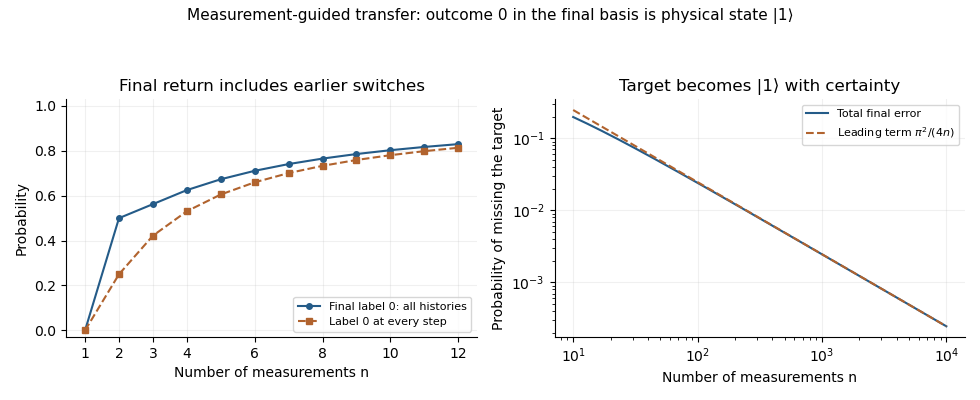
Total probability of the final target outcome versus the uninterrupted measurement record, and the asymptotic target-error probability in measurement-guided Zeno transfer
. Details. 
Past exam of the computer science course of the University of Oxford 2019 Quantum information 1 e i Solution by Codex 0 2026-10-25
Codex 0 2026-10-25Put . Between successive measurement bases, the squared overlap is for retaining the same label and for changing label. The first step obeys the same rule if we regard the initial state as label 0 at angle zero. Thus the recorded labels form a Markov chain with transition matrix .
Let be the probability of label 0 after step . Then andSince , iteration yieldsThis is the total final-outcome probability, including histories that change label an even number of times. The smaller quantity counts only the history with label 0 at every step and is not the requested total. For example, at the total is , whereas the uninterrupted history has probability . At , the final basis is up to signs, so the total probability of label 0 is zero, as the formula also gives. This distinguishes nonselective measurement-guided Zeno transfer from postselection on one record.
Past exam of the computer science course of the University of Oxford 2019 Quantum information 1 d iii Solution by Codex 0 2026-10-25
Codex 0 2026-10-25Prepare the uniform pure stateEvery permutation matrix fixes this vector, so
RandomPermute returns with certainty. Choose an orthonormal basis with first vector , for example the quantum Fourier transform basis. Under RandomReset, the returned state is , which gives each of the measurement labels probability .Guess
RandomPermute on label 0 and RandomReset on every other label. ThenThis is invariant-pure-state discrimination against a maximally mixed reset. It also agrees with the Holevo–Helstrom theorem: the eigenvalues of are once and with multiplicity , giving optimal equal-prior success . This confirms optimal discrimination of these returned states, in addition to constructing the requested strategy.[ref]The Theory of Quantum Information by John Watrous. §3.1.1, Theorem 3.4 and equation (3.20), optimal binary-state discrimination
For , the actions coincide and the formula correctly gives random-guessing success . Past exam of the computer science course of the University of Oxford 2019 Quantum information 1 d ii Solution by Codex 0 2026-10-25
Codex 0 2026-10-25Use the preparation and measurement from part (i).
RandomReset returns the density matrix , a maximally mixed state. In the basis its two outcomes each have probability . In contrast, RandomFlip always gives outcome 0.Guess
RandomFlip after 0 and RandomReset after 1. With the supplied equal priors,An outcome 1 identifies the reset action, but outcome 0 does not identify the flip action with certainty. For example, Bayes' theorem gives posterior probability for the flip action after 0. The total success rate already accounts for the reset runs that also produce 0. Past exam of the computer science course of the University of Oxford 2019 Quantum information 1 d i Solution by Codex 0 2026-10-25
Codex 0 2026-10-25Choose and its orthogonal companion . Since , either branch of
RandomFlip returns the same pure state. Alice therefore obtains label 0 with certainty, andThe alternative choice also works: its sign change under is only a global phase. The useful property is being a Pauli eigenstate of the Pauli X gate. Past exam of the computer science course of the University of Oxford 2019 Quantum information 1 b iii Solution by Codex 0 2026-10-25
Codex 0 2026-10-25Set and . They are self-adjoint operators and satisfy , because the original factors are both self-adjoint and unitary. They also commute: each acts on a different tensor factor. HenceThe same calculation in the opposite order gives . Thus is a unitary matrix for every allowed pair of factors. Commutation cancels the cross terms, while their relative imaginary coefficient supplies the opposite signs. This is the commuting-involution unitary combination.
There are unlisted articles, also show them or only show them.