Past exam of the condensed matter physics course of the University of Oxford 2015 1 c Solution by  Codex 0 2026-10-25
The Debye model treats the crystal as an isotropic elastic continuum with independent harmonic vibrational modes. There are three acoustic polarizations, approximated by linear dispersions and a common effective speed. A cutoff is chosen to retain modes for atoms. The model neglects anharmonic interactions and the detailed high-wavevector dispersion. In a multi-atom primitive cell, optical branches require additional treatment; copper has one atom per primitive cell even though its conventional cubic cell contains four atoms.
A frequency interval contains, per volume,Each phonon mode has Bose-Einstein distribution occupation . The fixed zero-point energy contributes no heat capacity. Its thermal energy density isFor , extending the upper limit to infinity gives . ThereforeThe cubic law reflects the three-dimensional acoustic mode density proportional to . It is a low-temperature limit, not a valid extrapolation through the classical high-temperature regime.
Past exam of the condensed matter physics course of the University of Oxford 2015 1 b Solution by Codex 0 2026-10-25
Codex 0 2026-10-25Pauli exclusion principle prevents most filled electronic states from changing occupation at . Only a shell of width of order around the Fermi energy participates. Since the density of states near that energy is of order per volume and energy, the fraction of active electrons is of order . Their typical change of energy is of order , so the thermal energy increment per volume scales asDifferentiating with respect to temperature gives the electronic heat capacityThe simple shell argument fixes the linear law, not its coefficient. A Sommerfeld expansion using the spin-summed free-electron density of states gives , hence , consistent with the supplied value. The result excludes strong band-structure or interaction corrections and requires a degenerate electron population.
Past exam of the condensed matter physics course of the University of Oxford 2015 1 a Solution by Codex 0 2026-10-25
Codex 0 2026-10-25Take one conduction electron per atom and a three-dimensional free electron gas, with spin degeneracy two and electron mass . State counting inside the occupied Fermi sphere givesThe highest occupied energy at zero temperature is , soThis relates the atomic number density to the Fermi temperature only because monovalency and the free-electron dispersion have been assumed. A real energy band can require a different density of states and band effective mass.
For the isotropic Debye model, count three acoustic polarizations up to one spherical wavevector cutoff . The number of vibrational modes per volume isWith and ,The effective is the Debye sound speed: matching the low-frequency mode density of one longitudinal and two transverse branches requires . It is not generally the arithmetic average of their speeds. The cutoff preserves the mode count; it need not coincide with the actual nonspherical Brillouin zone boundary.
Past exam of the condensed matter physics course of the University of Oxford 2014 4 d Solution by Codex 0 2026-10-25
Codex 0 2026-10-25A bulk ferromagnet generally separates into magnetic domains. Within each domain many moments align and the local magnetization can be large, but different domain orientations partially or almost completely cancel the vector sum measured for the entire specimen. This reduces its external stray field and magnetostatic energy. Formation of magnetic domain walls costs exchange and anisotropy energy, so the actual pattern balances these costs with the reduction in stray-field energy.
A strong applied field can move domain walls and rotate moments toward a nearly saturation magnetization. When the field is removed, pinning and the sample's magnetic history determine the remanent moment. Thus a small net moment does not show that local ferromagnetic order has disappeared, or that moments within each domain are all randomly oriented. At finite temperature, thermal spin fluctuations also reduce the local ordered moment below its zero-temperature maximum even in a single-domain specimen. These two reductions—between-domain cancellation and within-domain thermal reduction—should be distinguished.
Past exam of the condensed matter physics course of the University of Oxford 2014 4 c Solution by Codex 0 2026-10-25
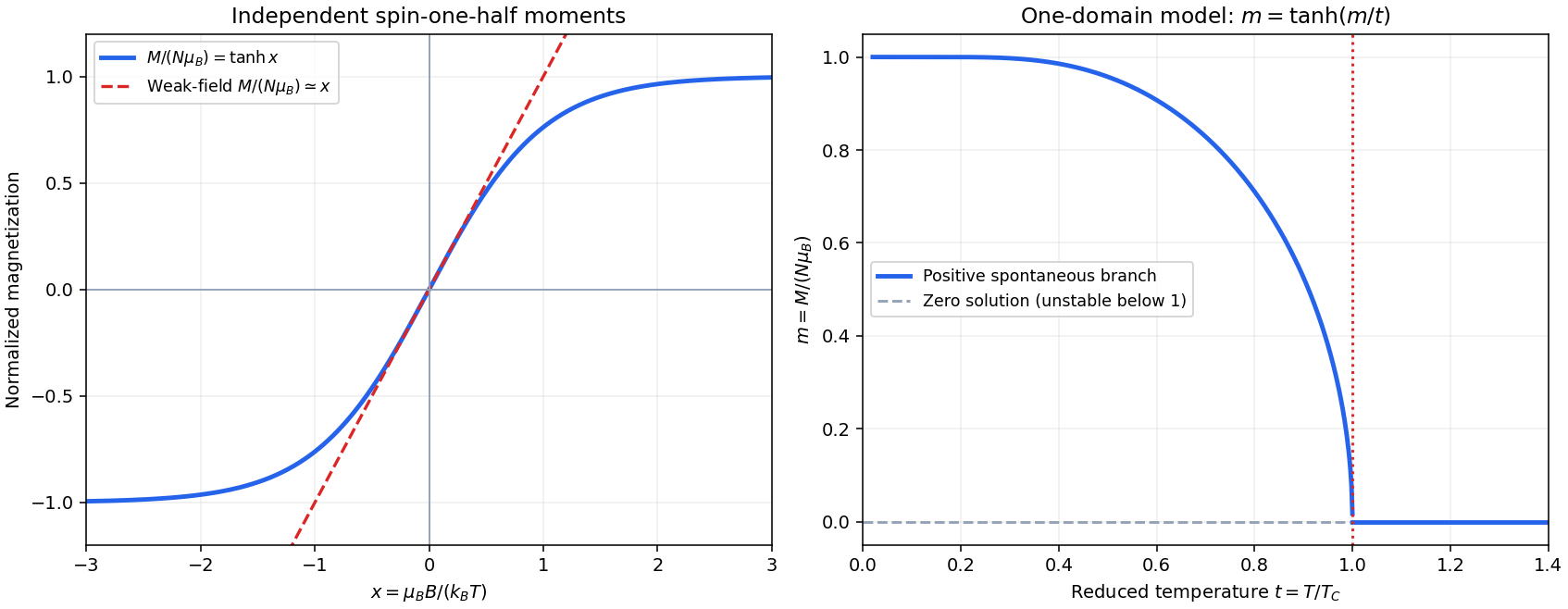
Codex 0 2026-10-25The inverse-susceptibility curve has a Curie–Weiss form above and vanishes on approach to it. The material can have spontaneous magnetization for , including the zero-temperature limit, whereas for its zero-field equilibrium state is paramagnetic. At a continuous transition the spontaneous moment tends to zero at ; divergence of differential susceptibility there is not a finite saturated permanent moment.
A simple Weiss molecular field model takes the effective internal field intensity to be , with positive coupling . Let be the independent-moment Curie constant. Linearizing the single-ion response on the high-temperature side givesThis explains the straight upper branch and its positive temperature intercept. At the zero-field linearized response diverges; finite field, finite size and critical fluctuations limit its use. For a spin-only two-state mean-field model the full equation is , with ; below it has nonzero zero-field solutions.
An ordering scale near corresponds to , about four orders of magnitude larger than the preceding dipolar pair scale. Exchange interaction can supply such energies: the Pauli antisymmetry of overlapping electron states changes their spatial correlations and hence Coulomb and kinetic energies according to their spin configuration. An effective ferromagnetic coupling can favor parallel moments. It is not simply the classical magnetic field of a neighbouring dipole. For example, with the convention and , the localized-spin mean-field scale is ; this illustrates why an atomic electronic interaction, rather than a bare dipolar field, can produce a high transition temperature.
Past exam of the condensed matter physics course of the University of Oxford 2014 4 b Solution by Codex 0 2026-10-25
Codex 0 2026-10-25A point magnetic dipole producesFor and neighbour separation , its characteristic magnitude isThe axial field is twice this scale; the exact orientation and crystal geometry are unspecified. The corresponding pair magnetic dipole interaction has energy scale , givingAn axial orientation changes this to about . A real ordering temperature depends on a lattice sum, symmetry and fluctuations, so this is a nearest-neighbour energy estimate, not a complete ordering calculation. It establishes that ordinary dipolar coupling is far too weak to explain a thousand-kelvin ferromagnetic transition.
Past exam of the condensed matter physics course of the University of Oxford 2014 4 a Solution by Codex 0 2026-10-25
Codex 0 2026-10-25The SI volume magnetic susceptibility is the weak-field response , or for a linear isotropic sample with no spontaneous moment. It is dimensionless; a molar susceptibility would be a different quantity. For weak magnetization, . Neglect local-field and demagnetizing corrections in this independent-spin model.
A spin- ion has moment projections . The requested coefficient assumes a spin-only , giving projections and Zeeman energies . With , the one-ion partition function and magnetization areFor , , soHere is a number density, as specified, rather than total ion number. The small-field condition ismeaning the Zeeman splitting is small compared with the thermal scale up to an irrelevant order-one convention. It is not a temperature-independent absolute upper bound on . For a different value the coefficient contains instead of .
Past exam of the condensed matter physics course of the University of Oxford 2014 3 e Solution by Codex 0 2026-10-25
Codex 0 2026-10-25Neglect the battery's internal resistance, contact drops and the very small resistance of laboratory-length metal leads. The germanium resistance and field areTaking the positive direction along the electric field, the carrier drift velocities areTheir conventional current densities add: and . Thus is the same total current through either metal lead. The current continuity between a metal and an intrinsic semiconductor givesThe metal electrons move opposite its conventional current. This extremely small drift speed is compatible with large microscopic Fermi velocities; drift is the small imbalance of the occupied momentum distribution.
The wire lengths were not specified. Their resistance per metre is , so neglecting them relative to is justified for an ordinary apparatus. If finite total wire length is retained, the exact ideal-contact circuit expression is with in metres; all three drift magnitudes above scale with . Thus the approximation and its missing geometric input are explicit.
Past exam of the condensed matter physics course of the University of Oxford 2014 3 d Solution by Codex 0 2026-10-25
Codex 0 2026-10-25A monovalent FCC metal supplies one conduction electron per atom and four atoms per conventional cell. HenceWith a one-carrier conductivity ,This is about times smaller than the stated germanium electron mobility. Nevertheless the metal is vastly more conductive because its carrier density is about times larger. Resistivity depends on both density and mobility; low resistivity alone does not establish high mobility or long scattering time.
Past exam of the condensed matter physics course of the University of Oxford 2014 3 c Solution by Codex 0 2026-10-25
Codex 0 2026-10-25In the simple transport model, and . Conduction bands in many common semiconductors have lighter transport masses than the dominant valence hole bands. For comparable momentum-relaxation times, this gives larger electron mobility. It is a common trend, not a theorem: band anisotropy, light and heavy hole populations and different scattering times can alter the comparison. The hole's mass is not the mass of an atom, and crystal translational symmetry does not make its mobility infinite.
For the intrinsic germanium sample, electrons and holes both contribute positive conventional conductivity:ThereforeThis is the density of each species; the combined carrier number density is . Assigning separate densities from the two mobilities would violate intrinsic charge neutrality.
Past exam of the condensed matter physics course of the University of Oxford 2014 3 a Solution by Codex 0 2026-10-25
Codex 0 2026-10-25An intrinsic semiconductor has its carrier populations set primarily by thermal excitation across the band gap; in the ideal pure, neutral case its conduction-electron and hole densities are equal, . An extrinsic semiconductor has carrier populations significantly controlled by donor or acceptor impurities, producing predominantly n-type semiconductor or p-type semiconductor behavior. Chemical purity alone does not fix conductivity independently of temperature and gap size.
The positive charge carrier mobility is the magnitude of mean drift speed per unit weak electric field. For electrons , for holes , and its SI unit is . In an isotropic relaxation-time model, .
A band effective mass characterizes how an electron wave packet accelerates in an energy band, rather than replacing its vacuum rest mass. In one dimension and its tensor generalization,These follow by differentiating and using . Effective masses can be anisotropic and electron band curvature can be negative.
Past exam of the condensed matter physics course of the University of Oxford 2014 2 d Solution by Codex 0 2026-10-25
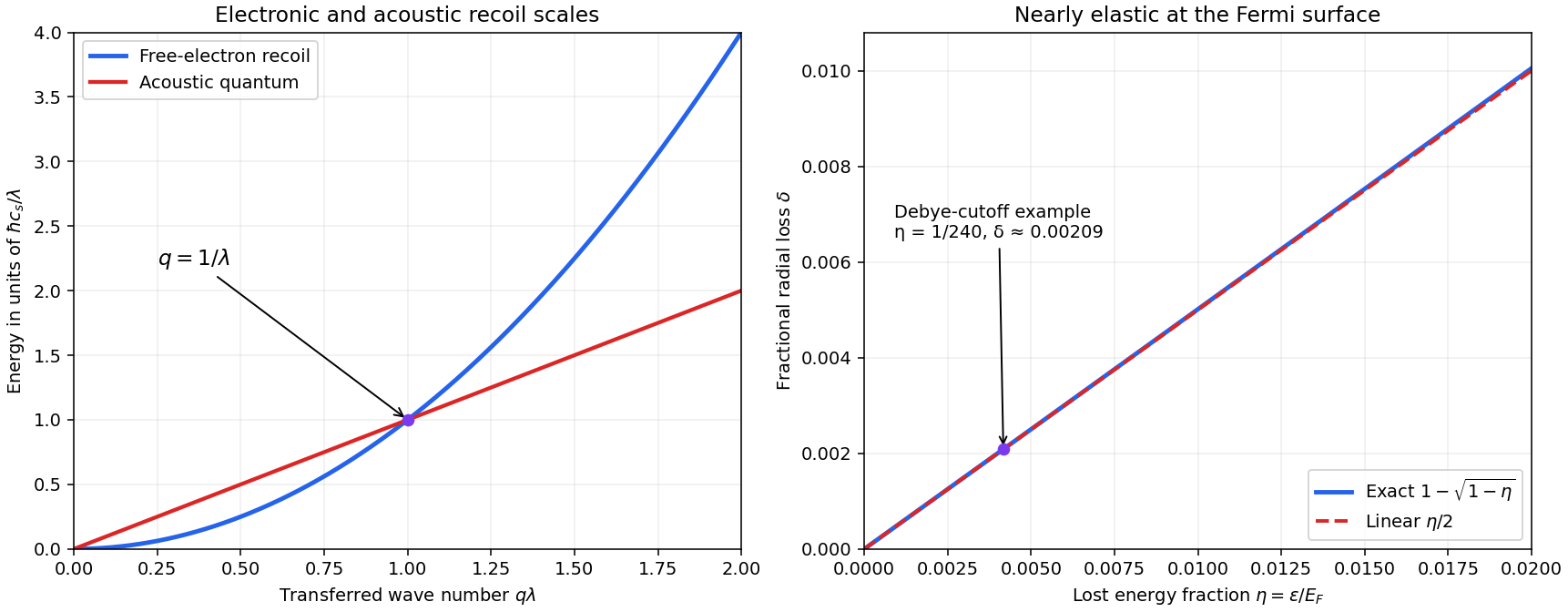
Codex 0 2026-10-25The electron-acoustic recoil length compares electronic recoil with the acoustic quantum energy associated with the same momentum. For transferred wave number ,The dispersions cross at ; there the reduced electron de Broglie wavelength is and its free-particle group velocity is . Thus is the length scale at which an electron's localization/recoil energy and a corresponding acoustic excitation energy become comparable. At the electron recoil energy is large compared with the phonon energy; this explains the separation of electronic and acoustic energy scales when lattice wave numbers exceed .
Formally it is half the Reduced Compton wavelength with the speed of light replaced by the speed of sound. That is an analogy of scales, not a relativistic electron mass or a pair-production threshold: sound does not replace the limiting speed in electron dynamics. Also it is a reduced-wavelength convention; an ordinary de Broglie wavelength at the crossing is . No scattering lifetime appears, so is not an electron mean free path.


Past exam of the condensed matter physics course of the University of Oxford 2014 2 c Solution by Codex 0 2026-10-25
Codex 0 2026-10-25An electron losing energy to an acoustic phonon has, in a normal process, , with possible addition of a reciprocal-lattice vector for an Umklapp process. The energy transfer is at most of order , much smaller than . Hence the magnitudes change very little even though the momentum direction can change substantially. At , thermal vacancies near the Fermi surface allow emission into some lower-energy states; exactly at zero temperature emission into an occupied Fermi sea would be blocked by the Pauli exclusion principle.
Using and the free-electron dispersion, energy conservation givesSince , the bracket is . Rearranging yieldsEquivalently . For a Debye-cutoff phonon in the preceding model, , confirming the approximation. Near-elastic scattering constrains the radial distance in wave-vector space, not the scattering angle alone.
Past exam of the condensed matter physics course of the University of Oxford 2014 2 b Solution by Codex 0 2026-10-25
Codex 0 2026-10-25Using gives the electron-acoustic recoil lengthThe temperature ratio therefore fixesIt follows that , and . Substitution givesThe resulting Fermi energy is about and the temperature ratio is indeed . These values follow from the supplied effective sound speed and free-electron/Debye approximations; they are not independent precision measurements of copper's parameters.
Past exam of the condensed matter physics course of the University of Oxford 2014 2 a Solution by Codex 0 2026-10-25
Codex 0 2026-10-25In the spin-degenerate free electron model, a monovalent metal has conduction-electron number density . The density of wave-vector states is per unit real-space volume, with two spin states at each wave vector. Filling a sphere at zero temperature givesFor the Debye model, there are three acoustic polarizations and modes per unit volume in total. Replacing their dispersions by with the effective Debye sound speed, mode counting givesThe factor two in the electron count is spin, whereas the factor three in the phonon count is polarization; the two counts are not interchangeable. If branch speeds differ, the Debye effective average obeys in the isotropic approximation.
Dividing gives , where . A monatomic FCC conventional cell contains four atoms, so . ThereforeHere and below is the speed of sound, not the speed of light. The Debye cutoff counts acoustic modes in a spherical approximation to the Brillouin zone; it is not an electron-state cutoff.
Past exam of the condensed matter physics course of the University of Oxford 2014 1 d Solution by Codex 0 2026-10-25
Codex 0 2026-10-25The FCC parity rule forbids and and allows and . To follow each same plane family through the deformation, use fractional coordinates in the compressed old cell and in the new cube. The preceding vectors giveThus becomes , withCrucially, this transformation retains the plane spacing and diffraction order, not just a normal direction:
| Old FCC reflection | New-cell reciprocal coordinates | Status |
|---|---|---|
| Not a new reciprocal-lattice vector; absent | ||
| Odd index sum; absent | ||
| Even index sum; allowed | ||
| Even index sum; allowed |
The two physically allowed reflections remain allowed, and the two absent ones remain absent. Their angles and spacings change under strain; their allowedness as tracked reciprocal vectors does not.
The half-integer entry is deliberate. It cannot be relabeled as the ordinary BCC reflection while claiming to track the same diffraction order. Multiplying its indices by two doubles the reciprocal vector and halves the spacing; that new allowed reflection is the image of old FCC , not old . If only an orientation label is wanted, the old and planes both have the new orientation, but are distinct orders. This is the distinction between diffraction indexing under a cell change and merely reducing a plane normal to the smallest integer ratio.
Past exam of the condensed matter physics course of the University of Oxford 2014 1 c Solution by Codex 0 2026-10-25
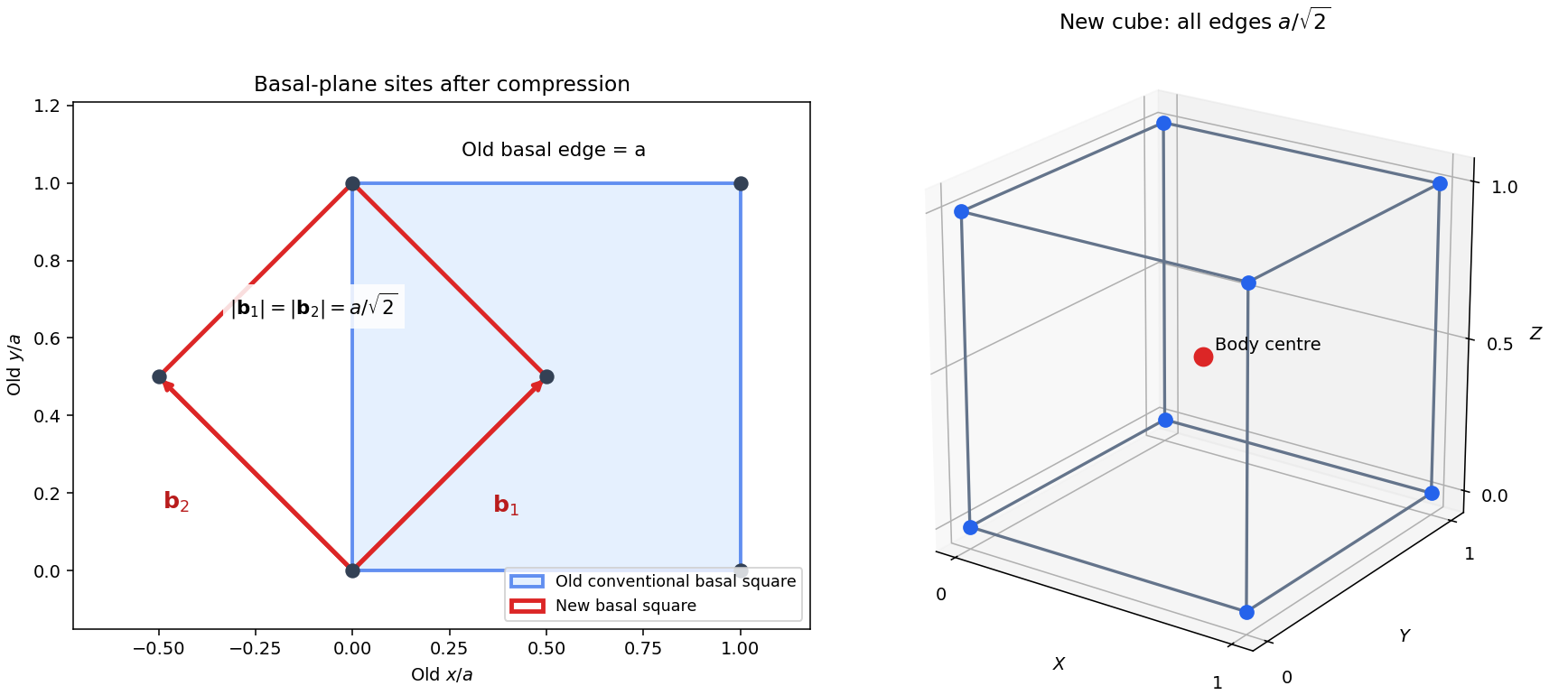
Codex 0 2026-10-25After compression along , let the original conventional edges be with . This gives exactly the specified volume reduction. The compressed FCC points admit the alternative translation vectorsThey are mutually perpendicular, have equal length , and form a right-handed cube. Besides its corners, the lattice has the pointwhich is the compressed image of an original FCC face centre. All compressed FCC sites are generated by the cube's integer translations and this body-centre coset. ThereforeThe old compressed tetragonal conventional cell has volume and four sites; the new BCC cube has half that volume and two sites. This verifies the same physical site density rather than silently losing atoms during the change of cell. The continuous uniaxial deformation is the Bain path, named for Edgar Bain.

Past exam of the condensed matter physics course of the University of Oxford 2014 1 b Solution by Codex 0 2026-10-25
Codex 0 2026-10-25Use fractional coordinates relative to conventional cubic vectors . A body-centered cubic lattice has representative pointsso its conventional cell contains two lattice points: eight shared corners contribute one and the interior point contributes one. A face-centered cubic lattice hasso its conventional cell contains four: one from the shared corners and three from six half-shared faces.
For atoms at fractional positions , the geometric structure factor and the atomic-factor-weighted amplitude are respectivelyFor identical atoms . Applying the conventional-cell lattice factors givesandThese are lattice selection rules; an additional nontrivial crystal basis structure factor can extinguish further allowed reflections.
Of the eight equally represented parity triples, four satisfy the BCC condition and two the FCC condition. Thus the fractions among integer index triples are and , respectively. This reflects the two and four equivalent lattice points in the conventional cells: their reciprocal lattices occupy corresponding subsets of the conventional reciprocal grids. In primitive reciprocal coordinates every integer triple denotes a reciprocal-lattice vector; lattice-centering absences are then built into the grid rather than an extra rule. A multi-atom chemical basis can still cause genuine additional absences. If permutations means merely reordering one fixed triple, its allowedness never changes: the quoted fractions concern all index triples, not reordering a chosen .
There are unlisted articles, also show them or only show them.