Past exam of the physics of atmospheres and oceans course of the University of Oxford 2016 4 Solution by  Codex 0 2026-10-25
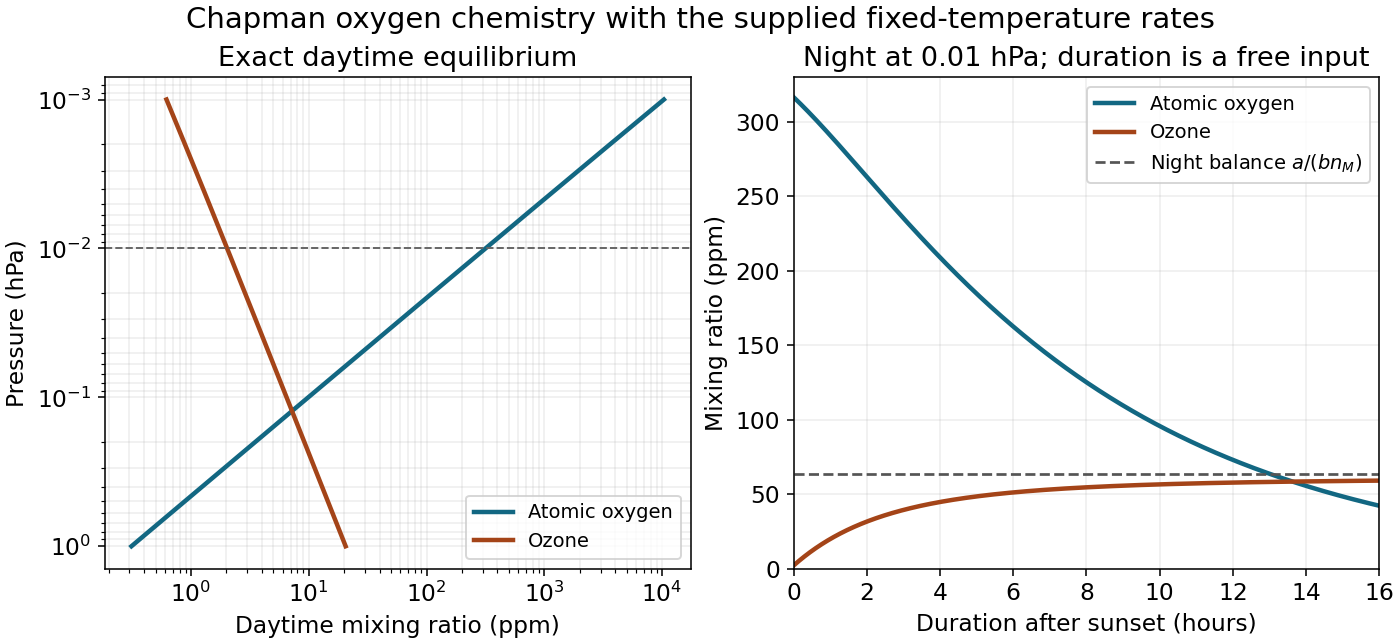
Third body and steady partition. The third molecule removes excess association energy and momentum, stabilizing newly formed ozone rather than being consumed in the net reaction. Its decreasing abundance with altitude suppresses three-body ozone formation strongly. Write , , , and , with held as reservoirs. The kinetic equations areThe fast association/photolysis subsystem conserves odd oxygen, , and has eigenvalues . Its partition-adjustment time is thereforeThis neglects the slower production and mutual-destruction terms while finding that fast mode. On its equilibrium partition, , and total odd-oxygen equilibrium gives . HenceWith fixed oxygen mole fraction and temperature, the atomic-oxygen mixing ratio scales as in this approximation, and thus increases upward as pressure decreases.
Lifetime versus relaxation. The distinction is formalized by Chapman family lifetime versus relaxation time. In the ozone-dominated regime , the family abundance is approximately , and its gross chemical lifetime isThis recovers the printed as a family turnover time under its additional partition assumption. It is not generally an e-folding relaxation time. With rapid partitioning, the family equation is . Linearizing about equilibrium gives relaxation rate but turnover rate , a factor of two difference. More generally the approximate family lifetime is , and its relaxation time is half that quantity. Neither can be replaced by when atomic oxygen dominates.
For a direct check using the complete two-species equations, the equilibrium Jacobian matrix isThe numerical high-altitude example below gives eigenmode times about and , whereas the printed is only . Thus interpreting both printed expressions as universal eigenmode time constants would be false, even though the fast partition and the ozone-dominated turnover approximations are useful.
Setting in the fast-partition approximation gives , henceRetaining mutual destruction gives and changes this estimate by less than one percent. The formal high-altitude limit of is : ozone photolysis, unlike three-body association, does not slow merely because collider density decreases. This is a partition timescale, not the lifetime of all odd oxygen. Extrapolating the fixed-reservoir approximation indefinitely upward would eventually cease to be self-consistent.
Day and night. At and , and . The exact equilibrium is conveniently obtained fromThe physical root givesTheir ratio is , consistent with the requested approximate factor ; the simpler fast-partition estimate gives approximately . The printed fast time is at this pressure.
For nighttime Chapman ozone, after sunset set both photolysis rates to zero. Ozone initially grows by converting atomic oxygen, but simply putting every initial oxygen atom into one ozone molecule neglects the simultaneous sink. The night equations areWhile sufficient atomic oxygen remains, the ozone balance tends towardThis is a useful long-night sunrise estimate, roughly thirty times the sunset ozone abundance, not an exact result for an unspecified night duration. The precise phase-plane relation isTogether with the night equations it supplies for any supplied duration. For illustration only, a twelve-hour dark interval gives ; no twelve-hour duration is stated by the paper. Even the infinite-dark-time endpoint is slightly below , because the finite initial atomic reservoir is consumed. This conditional estimate avoids inventing a unique sunset-to-sunrise duration.

Past exam of the physics of atmospheres and oceans course of the University of Oxford 2016 3 Solution by Codex 0 2026-10-25
Codex 0 2026-10-25Normalization and angular pattern. A scattering phase function describes the distribution of single-scattered power over outgoing solid angle, for a specified incident direction, wavelength and polarization convention. Use the common normalizationThe scattering asymmetry parameter is the mean cosine of the scattering angle: forward scattering has positive , backward scattering negative , and a forward–backward symmetric pattern has .
Let . The given small-sphere angular intensity is , where . Its total scattered power isNormalizing givesDimensionally the supplied is radiant intensity, power per solid angle. If interpreted as detector irradiance at a distance, the appropriate inverse-square distance factor is also needed; it cancels out of the normalized angular pattern.
The polar plot has equal forward and backward lobes, each with radius , and lateral values . A small nonabsorbing particle behaves as an induced electric dipole. Radiation transverse to the dipole and the average over two orthogonal incident polarizations produce the form. Its odd angular moment vanishes:As the size parameter grows, Rayleigh scattering in the electric-dipole approximation no longer suffices. Higher multipoles and interference produce structure in the angular pattern, and large particles generally develop a strong narrow forward diffraction peak. Their is normally positive, although detailed values and angular features depend on refractive index, size distribution and shape; they are not fixed by radius alone. Large spheres may show rainbows and backscattering structure, while nonspherical ice introduces further angular features.
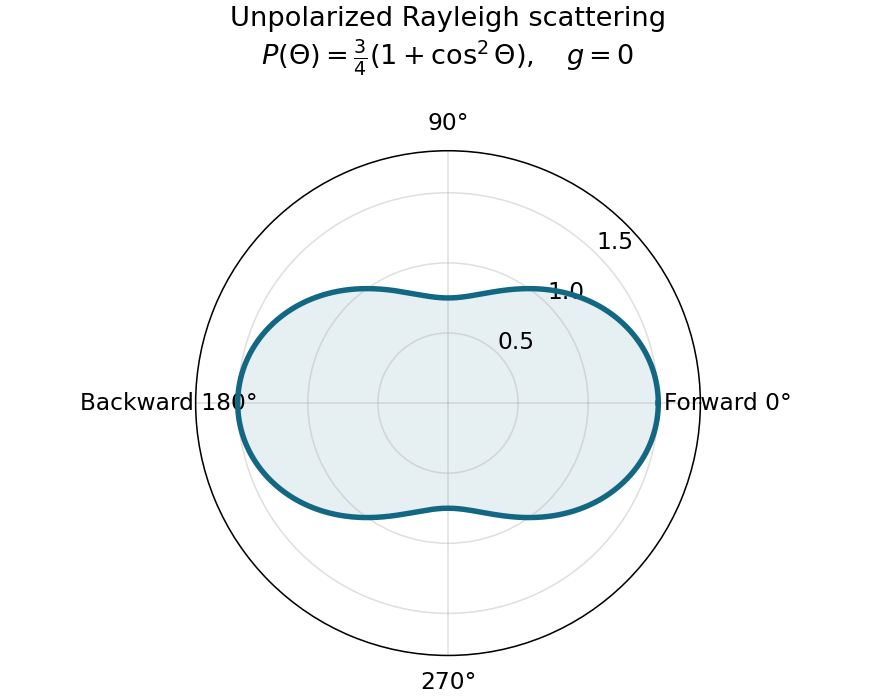
Normalized Rayleigh phase function for an unpolarized incident beam
. Details. 
Optically thick transmission. In a nonabsorbing two-stream or transport approximation, it is the transport optical depth that controls the loss of forward directional memory. Using the same idealized albedo closure as in option 1 gives total forward-hemisphere transmittanceFor the same large but finite extinction optical depth,The respective transport-depth factors are , and . The water cloud scatters most strongly forward and returns the least light backward. All transmittances tend to zero in the infinite-depth limit. The strictly unscattered direct-beam transmittance is instead , identical in the three cases: the ranking concerns total transmitted radiation, including forward-scattered light, not that direct component alone. Full radiative transfer can also depend on higher angular moments beyond .
Past exam of the physics of atmospheres and oceans course of the University of Oxford 2016 2 Solution by Codex 0 2026-10-25
Codex 0 2026-10-25Potential temperature and a parcel. For a dry ideal gas of fixed composition, the first law of thermodynamics per unit mass isA reversible adiabatic process has . Taking constant gives , where . Integrating to a fixed reference pressure defines the potential temperatureIt is the temperature a parcel would have after reversible dry adiabatic process taking it to . Equivalently under these assumptions, making potential temperature a thermodynamic entropy label useful for diagnosing stratification and air-mass motion. Latent heating, radiation, mixing and variable composition require modifying the conservation statement.
An air parcel is a small material volume followed with the flow. The parcel model treats it as internally approximately uniform, large compared with molecular scales and small compared with environmental variation scales. Rapid acoustic wave adjustment makes its pressure approximately equal to the surrounding pressure, while slower heat and mass exchange can be neglected during an idealized displacement. It is not a rigid container or an isolated molecule.
At the parcel's height, environmental hydrostatic pressure supplies an upward pressure force per unit volume. Dividing by parcel density gives the upward accelerationThe last steps use equal pressure, equal gas constants and the same reference pressure. Moisture-dependent density requires virtual temperature or its potential-temperature counterpart. Nonhydrostatic pressure perturbations and entrainment are excluded from this elementary buoyancy expression.
The convective available potential energy is the positive buoyancy work per unit mass between the level of free convection and the equilibrium level:One sums positive-buoyancy layers when there is more than one. Negative work below free convection contributes convective inhibition rather than positive CAPE. In a lossless parcel estimate, conversion of CAPE to vertical kinetic energy gives ; pressure work beyond this model, mixing and precipitation can change that speed.
Linear stability. Let denote displacement from a neutrally buoyant reference altitude. Dry motion through an adiabatic process retains , while . The linear vertical momentum equation is thereforeFor , : stable buoyancy oscillations with period . For , : neutral stratification with no restoring force. For , growing and decaying exponentials occur, indicating convective instability. The growing solution is generic unless the initial data select only the decaying branch. These are local small-displacement results with an approximately constant environmental gradient.
Lapse-rate estimate. Define . Hydrostatic balance and the ideal gas law imply , soIn the free-parcel-oscillator interpretation, identifying the ridge encounter interval with the buoyancy period gives and . With , and ,The frequency identification is an extra modeling assumption. A stationary mountain gravity wave generally obeys without rotation, with . Ridge spacing fixes , not the vertical wavenumber . For example, allows the same spacing and wind with , and a lapse rate about . Thus is the requested parcel-period estimate, not a uniquely identifiable lapse rate for every possible mountain-wave field; a resolved wave field needs its vertical structure as well.
Past exam of the physics of atmospheres and oceans course of the University of Oxford 2016 1 Solution by Codex 0 2026-10-25
Codex 0 2026-10-25Optical response at fixed cloud structure. Put and write the two-stream cloud albedo as . At fixed scattering asymmetry parameter,At zero optical depth the last quotient is understood by its finite limiting value. Optical depth counts extinction along a ray. For an approximately homogeneous, monodisperse cloud,This uses spherical droplets, independent extinction, representative constant , and the geometric optics limit in which the droplet radius greatly exceeds the relevant visible wavelength and . Diffraction supplies part of the extinction cross-section; it is not legitimate to obtain the factor two from geometric interception alone. A size distribution requires its second moment rather than an arbitrary mean radius.
With liquid-water density and cloud liquid-water content , the volume constraint gives . ConsequentlyThis provesKeeping fixed isolates the Twomey effect:It is a partial response, not a claim that cloud water and cloud geometry stay unchanged under every real aerosol perturbation.
Absolute and fractional susceptibility. Choose so that there, and put . ThenThe cloud albedo susceptibility per added droplet decreases monotonically. Its small- asymptote is proportional to , while its large- asymptote is proportional to . Thus a fixed absolute droplet-number addition has much more leverage in a clean cloud than in an already droplet-rich cloud. The formal divergence as is not a physical infinite response: fixed water content would require indefinitely large drops, eventually invalidating the optical and cloud assumptions.
For a fixed fractional number addition the response is instead , maximal at and small at either very low or nearly saturated albedo. This distinction is essential when comparing interventions specified by an absolute particle addition with those specified by a percentage increase.
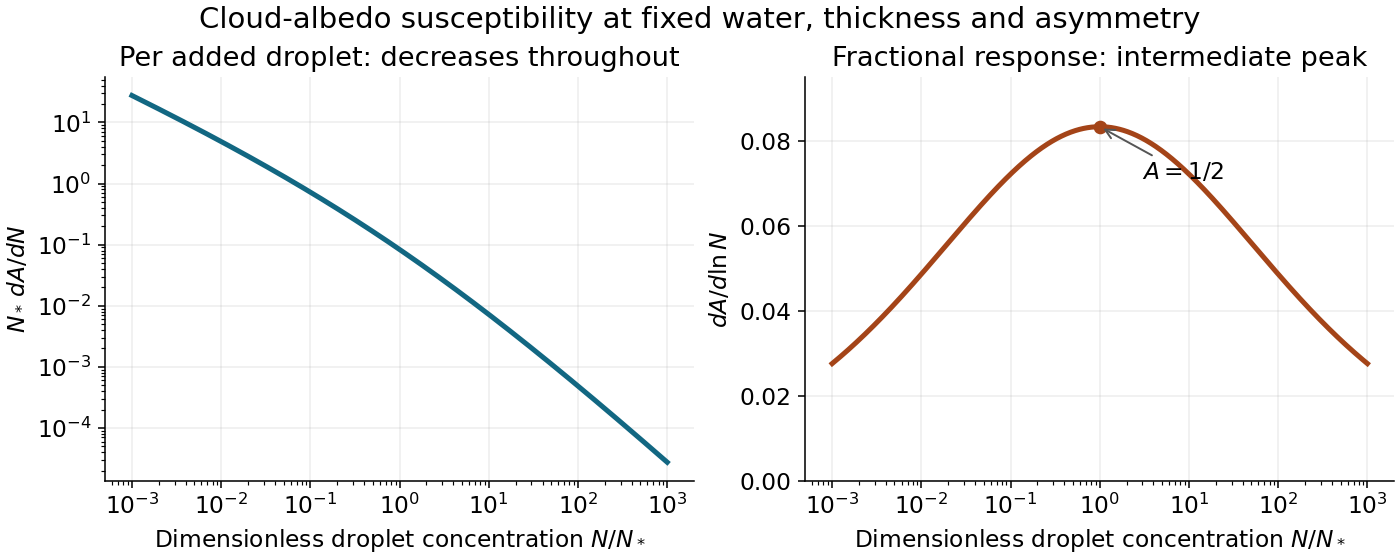
Absolute and fractional cloud-albedo responses under fixed liquid-water and thickness assumptions
. Details. 
Brightening and net radiation. Marine cloud brightening would increase the population of suitable cloud condensation nuclei, for example by producing sea-salt aerosol from seawater and allowing transport into susceptible marine boundary-layer clouds. Activation depends on particle size, hygroscopicity and the cloud's attained supersaturation; adding particles does not guarantee a one-for-one increase of droplets. At fixed cloud water, more activated droplets mean smaller radii, larger total extinction area, larger shortwave optical depth and more reflected sunlight.
Promising physical conditions combine relatively clean, persistent low clouds, appreciable incident sunlight and a dark underlying ocean. The extensive marine stratocumulus regions over the eastern subtropical oceans are examples of this combination. An already polluted, optically saturated cloud has little remaining shortwave leverage. Bright clouds over snow or ice also add relatively little contrast with the surface. Low clouds have temperatures closer to the surface than high clouds, so their extra longwave greenhouse effect is generally less able to offset the shortwave cooling. Sunlit seasons and latitudes matter; no shortwave benefit occurs at night.
Schematically, the fixed-cloud shortwave perturbation is , where is the local incident solar flux and the affected cloud fraction. Changes in cloud fraction, precipitation, entrainment, liquid water and longwave emission must also be evaluated before equating the positive derivative above with a guaranteed net cooling. The derivative identifies susceptibility, not a complete climate-response calculation.
Past exam of the physics of atmospheres and oceans course of the University of Oxford 2015 Source page 9 Solution by Codex 0 2026-10-25
Codex 0 2026-10-25TODO: source page 9 has no content stream. The held PDF and documented archive parent are blank at this page. Its question text, subparts, marks, equations and any illustrations are unavailable. No question number or requested result is inferred from the page position; there is insufficient source content to formulate a solution.
Past exam of the physics of atmospheres and oceans course of the University of Oxford 2015 Source page 8 Solution by Codex 0 2026-10-25
Codex 0 2026-10-25TODO: source page 8 has no content stream. The held PDF and documented archive parent are blank at this page. Its question text, subparts, marks, equations and any illustrations are unavailable. No question number or requested result is inferred from the page position; there is insufficient source content to formulate a solution.
Past exam of the physics of atmospheres and oceans course of the University of Oxford 2015 Source page 7 Solution by Codex 0 2026-10-25
Codex 0 2026-10-25TODO: source page 7 has no content stream. The held PDF and documented archive parent are blank at this page. Its question text, subparts, marks, equations and any illustrations are unavailable. No question number or requested result is inferred from the page position; there is insufficient source content to formulate a solution.
Past exam of the physics of atmospheres and oceans course of the University of Oxford 2015 Source page 6 Solution by Codex 0 2026-10-25
Codex 0 2026-10-25TODO: source page 6 has no content stream. The held PDF and documented archive parent are blank at this page. Its question text, subparts, marks, equations and any illustrations are unavailable. No question number or requested result is inferred from the page position; there is insufficient source content to formulate a solution.
Past exam of the physics of atmospheres and oceans course of the University of Oxford 2015 Source page 5 Solution by Codex 0 2026-10-25
Codex 0 2026-10-25TODO: source page 5 has no content stream. The held PDF and documented archive parent are blank at this page. Its question text, subparts, marks, equations and any illustrations are unavailable. No question number or requested result is inferred from the page position; there is insufficient source content to formulate a solution.
Past exam of the physics of atmospheres and oceans course of the University of Oxford 2015 Source page 10 Solution by Codex 0 2026-10-25
Codex 0 2026-10-25TODO: source page 10 has no content stream. The held PDF and documented archive parent are blank at this page. Its question text, subparts, marks, equations and any illustrations are unavailable. No question number or requested result is inferred from the page position; there is insufficient source content to formulate a solution.
There are unlisted articles, also show them or only show them.