Past exam of the thermal and statistical physics course of the University of Cambridge 2014 Paper 1 3 Solution by  Codex 0 2026-10-20
For one three-dimensional quadratic branch, the density of states per unit volume isWith , changing integration variable to givesA degeneracy factor multiplies both densities if additional equivalent branches are present. The first expression is the noncondensed density: a macroscopically occupied ground state must be counted separately.
Bose-Einstein condensation occurs when the excited states can no longer hold all particles and the ground-state occupation becomes macroscopic. At fixed total density,For field-induced triplon condensation, write , so . At fixed reference , the three requested dispersions have gaps , and zero respectively. Their curvature is unchanged. Because the actual thermodynamic chemical potential is zero, the Bose distribution requires . At , the minimum reaches zero and the noncondensed population saturates, permitting macroscopic occupation.
For the triplon condensation field scaling, the critical density at onset is . ThereforeThe low-temperature phase boundary rises from ; the condensed phase lies on the higher-field side.
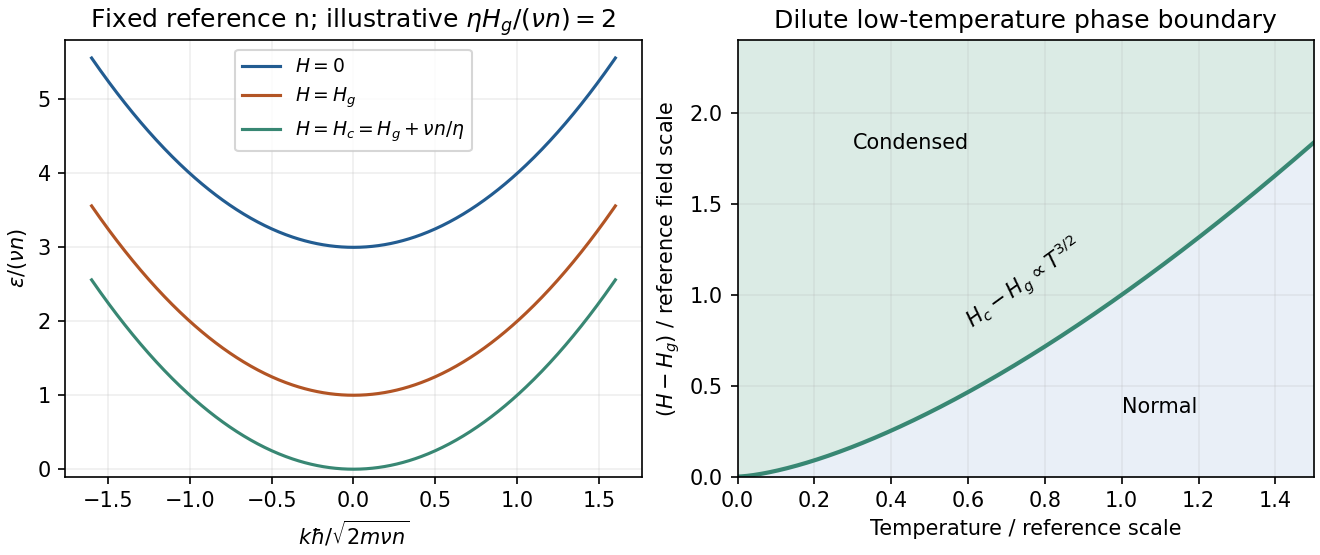
Original shifted-parabola triplon dispersions and low-temperature field–temperature phase diagram; model choices are dimensionless and illustrative
. Details. For , simply continuing the gap below zero would give unphysical Bose occupations. For the condensate density in a shifted-parabola triplon model, added condensate density keeps the minimum at zero: . At fixed temperature this giveswith below onset. At zero temperature it becomes within that model.
This prefactor is conditional on continuing the stated single-density mean-field shift into the condensed phase. A microscopic interacting Bose condensate has collective Bogoliubov excitations , with , which are linear at small . The normal-state shift alone does not fix the condensed interaction closure or identify with . The gap closes and the condensate density grows linearly with excess field in the simple mean-field description; the detailed collective dispersion needs that additional interaction model. A dilute-boson treatment of field-induced magnetic ordering makes this normal/condensed distinction explicitly.[ref]
Past exam of the thermal and statistical physics course of the University of Cambridge 2013 Paper 1 4 Solution by Codex 0 2026-10-20
Codex 0 2026-10-20At zero applied field, time-reversal symmetry interchanges and without changing the free energy, so the analytic expansion contains only even powers. The term breaks this symmetry at fixed nonzero H. Stationarity and local stability requireFor at small field, the cubic term is higher order and . Thus the susceptibility as defined in the question isThe three requested free-energy sketches and their minima are given separately above.
For the plotted isotherms, divide the equation of state by nonzero M and rearrange:This is an Arrott plot: its slope determines b, and the isotherm through the origin identifies the mean-field Curie temperature.[ref]
Criterion for Ferromagnetism from Observations of Magnetic Isotherms by Anthony Arrott. 1957, abstract: molecular-field criterion from cubic magnetisation versus internal field at the Curie temperature
Under the paper's stated uniform-field Landau model, use H as supplied on its axis.The ordinate unit is . Reading the original graph gives slopes about – ordinate units per unit H/M, so the physical slope is approximately . ConsequentlyApproximate horizontal intercepts and the corresponding are:
The sign change brackets the transition between 19 and 25 K. A linear fit of across the four read-offs gives approximately andInterpolating only the two nearest isotherms also gives about 22 K. These are graph estimates, not exact recovered measurements.
Below at zero field, the stable branches have . Substitution gives the free-energy density relative to the omitted smooth background:The equilibrium excess heat-capacity density is below and zero above it. ThereforeThe all-isotherm linear fit gives about . Estimating the slope only between the 19 K and 25 K curves instead gives and a jump near . The lines are not exactly parallel and the intercepts are not perfectly linear in T, so a jump of order a few is supported; finer precision is not. This is per volume because F is a density; no sample volume is given to convert it to a total heat capacity.
If , the quartic truncation is unbounded below. Add a positive sixth-order term with . At zero field the coexistence conditions giveThus the zero-field transition is generically first order, with a discontinuous spontaneous magnetisation and possible metastability. It occurs before the quadratic coefficient reaches zero. The case is the tricritical boundary of this mean-field model; no value of c is invented.
Past exam of the thermal and statistical physics course of the University of Cambridge 2013 Paper 1 3 Solution by Codex 0 2026-10-20
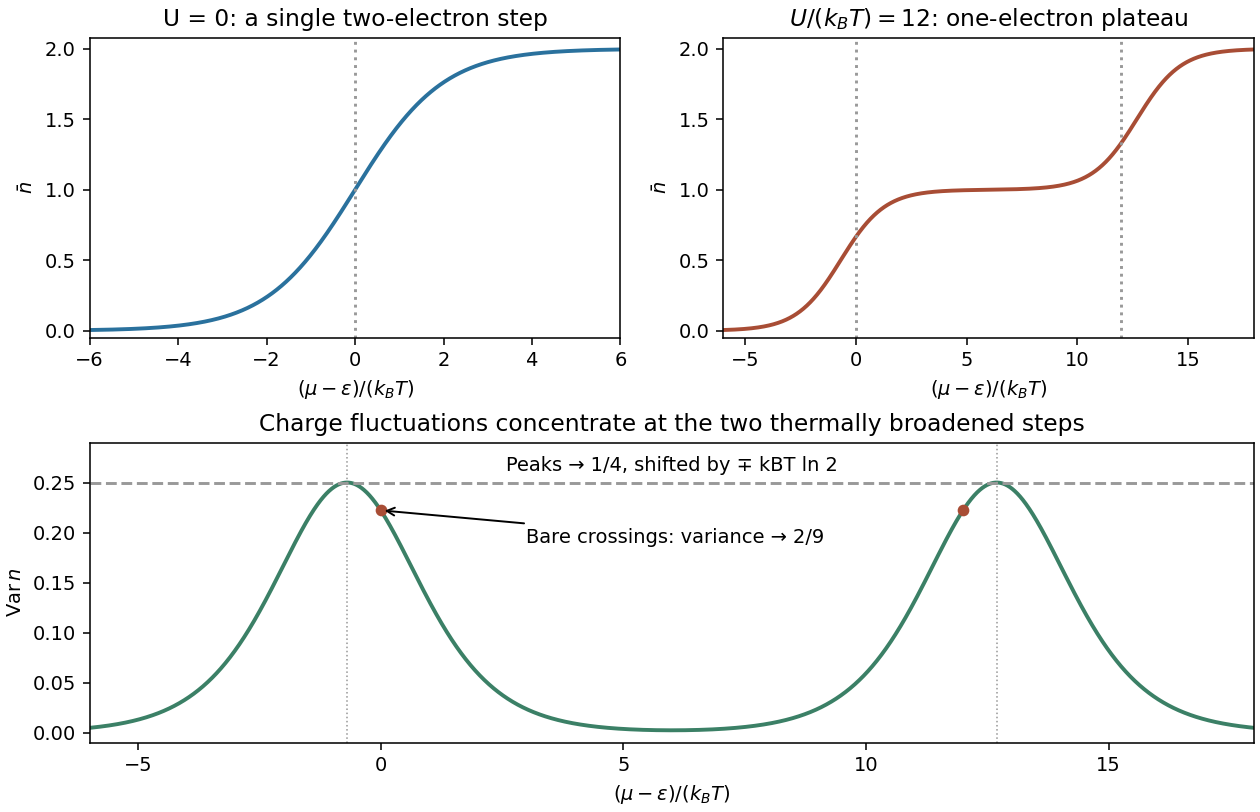
Codex 0 2026-10-20Write . For one nondegenerate fermionic quantum state, the allowed occupations 0 and 1 give . For a bosonic state, summing all nonnegative occupations gives , requiring or . Differentiating the logarithm,The interacting point defect has two distinct spin states, not one fermionic state. Its four microstates have grand-canonical weights , with . The first two single-electron weights are separate up/down spin possibilities; the double state has one electron of each spin. ThusFor , and . The sketch is a single smooth step from 0 to 2, centred on , where . As its width tends to zero.
For positive U with , the lowest grand energies are successively , and . Away from the two crossings,Finite temperature smooths each step over an energy range of order . Near the lower step double occupation is exponentially suppressed, so . Near the upper step put and neglect the empty state, giving . Spin degeneracy shifts the half-step positions to and .
For a grand-canonical probability , differentiation gives . Multiplying by and summing provesFor this defect, direct state counting givesAt , and thereforeThe same limit gives : empty, up and down states have equal weights, while the double state is suppressed. Replacing this degeneracy by a two-outcome equal-weight model would incorrectly give variance at this chemical potential.
Across the full chemical-potential range the variance has two well-separated narrow peaks and tends to zero on the 0, 1 and 2 plateaux. The limiting shapes are near the lower step and near the upper one. Each peak has height , at the shifted half-step position; the variance at the unshifted crossings is instead .


There are unlisted articles, also show them or only show them.