
A region of cerebral cortex folded within the lateral sulcus. Named anatomical regions can contain heterogeneous populations; activation of the insular cortex is not uniquely diagnostic of one mental process.
The anterior portion of cingulate cortex. Its subregions and task responses should be distinguished; a response to both self-pain and others' pain does not alone establish identical neural representations.
Cortical regions involved in processing bodily sensory information. A contrast between responses to self-pain and others' pain tests a particular operational distinction rather than all possible forms of affective empathy.
A region around the meeting of temporal and parietal cortex. Tests of selectivity for theory of mind require nonmental controls matched for relevant alternatives such as language, attention and representational demands.
A major part of mammalian cerebral cortex with a layered organization. In complementary learning systems accounts it supports overlapping representations that integrate regularities across experiences, while its actual learning speed depends on prior knowledge, task and circuit conditions.
A cerebral lobe containing sensory and association regions involved in spatial attention, body-related processing and transformations used to guide action. Symptoms depend on subregion, brain lesion extent and connections.
Cortical regions involved in producing and controlling movement. Contributions vary across primary and nonprimary areas; an area-level perturbation does not selectively manipulate a hypothetical cell class.
A family of models in which an instructive signal changes the influence of recently active inputs on cerebellar output. In a smooth-pursuit experiment, complex-spike duration predicted subsequent simple-spike depression and eye-movement learning; matching preceding simple-spike activity provided a control. This supports graded instruction during behaviour without proving an exact delta rule at every synapse.[ref]
Purkinje-cell plasticity and cerebellar motor learning are graded by complex-spike duration by Yan Yang and others. Figures 1–4 and Methods; author manuscript at PMC4132823: smooth pursuit, trial-over-trial plasticity and controls for prior simple-spike activity
A system whose mutual gravity confines its constituents rather than letting them separate indefinitely. In an isolated two-body problem, the relative specific orbital energy is negative exactly for bound, noncollisional Kepler orbits; is the marginal escape case. External forces, collisions and time-dependent potentials require additional qualifications. The separation of a gravitationally bound system is determined by its equations of motion and need not follow the cosmological Hubble flow.
The gravitational motion of three interacting bodies under their coupled Newtonian mechanics equations. When one body's mass is negligible, the restricted three-body problem neglects its influence on the other two while retaining both forces on its trajectory.
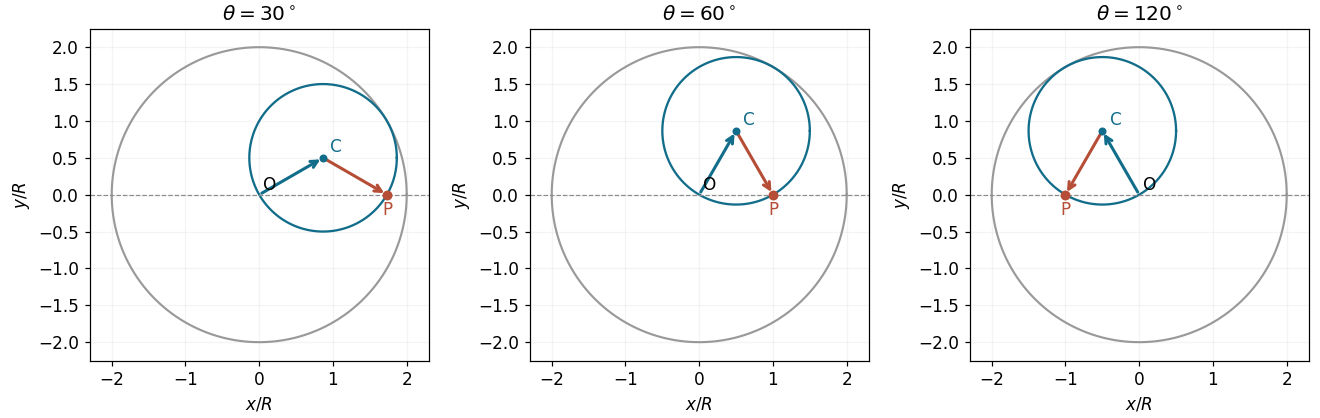
Two uniform circular motions of radius and opposite angular rates sum to rectilinear oscillation: . Geometrically, a circle of radius rolls inside one of radius ; a marked point traces a diameter. This plane construction must be distinguished from spherical variants, which need their own geometric argument.[ref]
The Spherical Case of the Tūsī Couple by George Saliba and E. S. Kennedy. research abstract: distinction between plane and spherical versions

The patched conic approximation models different portions of a spacecraft trajectory by separate two-body Kepler orbits, matching position and velocity where one attracting body gives way to another. For a surface departure from a nonrotating planet, conservation of energy gives , where is surface launch speed, is the planet's surface escape speed, and is the planet-relative hyperbolic excess speed. Adding that excess velocity vector to the planet's orbital velocity supplies the heliocentric initial condition. It neglects the simultaneous full gravitational action of both bodies near the matching region.
For flat spacetime with periodic of circumference , lift endpoints of causal curves to the covering Minkowski spacetime. A signal can choose any winding, so the causal future and causal past use the shortest circular distance rather than a fixed coordinate separation. After a duration , every point on the circle is reachable. A constant tangential electric field has a nonzero loop electromotive force; maintaining it while a charge gains energy each lap requires an energy reservoir, not a single-valued electrostatic potential.
A study design seeking causal information without individual random assignment, using a structured comparison or assignment mechanism. The relevant identifying assumptions should be stated rather than replaced by the label “quasi-experimental.”
Necessity and sufficiency are conditional on the task, state and intervention. A selective loss-of-function effect can support necessity under those conditions; an imposed pattern producing an effect can support sufficiency. Neither automatically proves the naturally used code, and compensation can make a null loss-of-function result inconclusive.
A distribution on a plane open set with is represented by a holomorphic function. Indeed , and elliptic regularity makes smooth. For a direct proof, mollify locally with a radial mollifier . The resulting smooth functions are harmonic. Their mean value property gives on a smaller ball for fixed small . Passing to the weak convergence of distributions limit gives there. This proves smoothness without assuming local integrability beforehand. The ordinary Cauchy-Riemann equations now prove holomorphy.
The equation similarly characterizes antiholomorphic functions. On the whole plane, the homogeneous solutions are respectively arbitrary entire functions and the functions with entire. Consequently any two fundamental solutions for one of these Wirtinger derivatives differ by the corresponding homogeneous solution.
There are unlisted articles, also show them or only show them.