Past exam of the materials science course of the University of Cambridge 2022 Paper 1 6 b ii Solution by  Codex 0 2026-10-20
With fixed, bending strength requires . Substitution into the cantilever mass givesThe material performance index to maximize is thereforeChanging the free geometric variable changes the strength exponent. A stiffness-limited problem would instead involve Young's modulus; the supplied modulus does not enter this strength-only index.
Past exam of the materials science course of the University of Cambridge 2022 Paper 1 6 b i Solution by Codex 0 2026-10-20
Codex 0 2026-10-20The rectangular second moment of area is . The maximum bending stress in the cantilever is . If is fixed, choose the minimum allowed width . Its mass is thenThus the material performance index to maximize isFor unequal tensile and compressive strengths, use the smaller permissible stress in this symmetric section. The derivation assumes bending-strength control, not a separate deflection, shear, buckling or existing-crack constraint.
Past exam of the materials science course of the University of Cambridge 2022 Paper 1 5 b iii Solution by Codex 0 2026-10-20
Codex 0 2026-10-20Burgers vector conservation gives two candidate reactions, depending on the relative signs of the approaching segments:Initially . The sum product has , while the difference product has . Thus the product is favoured by Frank's rule; the product is disfavoured. The result is not annihilation, because the two supplied vectors are not opposite. The same ordering survives a simple character correction: with , line energy proportional to gives the two parent segments a combined coefficient , whereas any character of the sum product has coefficient between and and any character of the difference product at least , comparing equal lengths and common logarithmic factors. A favourable dislocation junction can obstruct further glide and harden the crystal. Its actual mobility requires the junction line and allowed glide plane: the second screw can occupy several planes containing , so geometry is not unique. For instance, its plane intersects along ; an junction on that line would glide geometrically on , not either original plane. Dislocation cross-slip, junction unzipping or bypass can compete under load. An energy inequality alone is not a universal proof of a permanently sessile product.
Past exam of the materials science course of the University of Cambridge 2022 Paper 1 5 b ii Solution by Codex 0 2026-10-20
Codex 0 2026-10-20At small load the deformation is elastic: , and, using isotropic elasticity with , gives lateral contraction . At maximum load,For the specified slip system, the tensile direction is proportional to , the slip direction to and the plane normal to . Hence the Schmid factor isSchmid's law predicts glide when this reaches the critical resolved shear stress. Before that, unloading reverses the strain; after activation, glide produces permanent strain and may generate work hardening and additional slip. The supplied data do not fix the yield load. Neither the adjective “ultra-strong” nor supplies a critical shear stress or an absolute modulus. Other slip systems must also be checked before claiming which activates first. In particular, the specimen remains elastic through the maximum load if every relevant system stays below its activation threshold.
Past exam of the materials science course of the University of Cambridge 2022 Paper 1 5 b i Solution by Codex 0 2026-10-20
Codex 0 2026-10-20The cosine of the angle between Burgers vector and line direction is , so the angle is : the dislocation is mixed. Both vectors must lie in its dislocation glide plane. Their cross product is proportional toso the plane is , a member of . The screw component magnitude is and the edge component magnitude is .
Past exam of the materials science course of the University of Cambridge 2022 Paper 1 4 b ii Solution by Codex 0 2026-10-20
Codex 0 2026-10-20As-quenched martensite generally has greater hardness and strength, but lower ductility and toughness, than ordinary pearlitic steel. Its supersaturated carbon and distorted lattice impede dislocation glide; quench stresses also promote cracking. Pearlite combines hard cementite lamellae with more deformable ferrite, with finer spacings generally giving greater strength. Austenitize, quench to martensite, then temper to obtain a useful compromise between indentation resistance and resistance to fast fracture. Tempering below the austenitizing range relieves stresses and develops a fine carbide-containing microstructure. It trades some maximum hardness for improved toughness; the temperature and time must suit the required balance.
Past exam of the materials science course of the University of Cambridge 2022 Paper 1 4 b i Solution by Codex 0 2026-10-20
Codex 0 2026-10-20At the undercooling below the eutectoid temperature is small, so the free-energy driving force for forming pearlite is weak and nucleation is difficult. At the driving force is larger, but carbon diffusion is slow, limiting the coupled growth of ferrite and cementite. Their competition produces the nose of the isothermal transformation diagram near and . A roughly linear quench from – must pass left of this nose, requiring a rate of order –, then continue below the martensite-start region near . The tangent to the full start curve, rather than just the nose, refines this estimate; a true continuous-cooling diagram would be preferable. Martensite forms by a coordinated lattice-shape change without long-range carbon partitioning, so its formation is a displacive transformation. The tetragonal-to-monoclinic transformation of zirconia is a nonmetallic example.
Past exam of the materials science course of the University of Cambridge 2022 Paper 1 3 b ii Solution by Codex 0 2026-10-20
Codex 0 2026-10-20Keep the matrix spots and add precipitate reflections at all integer with . Even-even spots are fundamental; every other allowed position in this zone is a superlattice reflection. The added positions are and their symmetry-related signs. Each position actually denotes the corresponding signed index pair, not one radial ring. The precipitate grid spacing is ; the nearest fundamental separation is . If matrix and precipitates are coherent and similarly oriented, their fundamental spots approximately coincide, with finite mismatch potentially giving splitting or broadening. The sketch assumes common orientation, small strain, appreciable sampled precipitate volume and predominantly single scattering; electron diffraction can have dynamical intensity effects.
Past exam of the materials science course of the University of Cambridge 2022 Paper 1 2 b iii Solution by Codex 0 2026-10-20
Codex 0 2026-10-20Write the Arrhenius equation as . Eliminating the prefactor with two temperatures givesUse absolute temperatures and . Because the input is a vacancy diffusion coefficient, this is a migration activation energy inferred from that diffusivity; an additional vacancy-formation energy should not automatically be added.
Past exam of the materials science course of the University of Cambridge 2022 Paper 1 2 b ii Solution by Codex 0 2026-10-20
Codex 0 2026-10-20An oxygen vacancy has effective carrier charge . Combining its density with its own diffusion coefficient in the Nernst-Einstein relation givesat . The oxygen ions move oppositely to the vacancies and carry the same conventional current. This estimate assumes independently migrating vacancies, negligible correlation corrections, and negligible electronic contribution to the reported ionic conductivity.
Past exam of the materials science course of the University of Cambridge 2022 Paper 1 2 b i Solution by Codex 0 2026-10-20
Codex 0 2026-10-20There are four cation sites per conventional unit cell, hence Gd substitutions per cell on average. Two substitutions of Gd for Ce require one oxygen vacancy for charge neutrality, so the cell contains vacancies. Equivalently, the composition is . ThereforeThis uses the supplied lattice parameter literally and treats it as the conventional fluorite-cell edge.
Past exam of the materials science course of the University of Cambridge 2022 Paper 1 1 a ii Solution by Codex 0 2026-10-20
Codex 0 2026-10-20A motif can have fivefold symmetry. For example, repeat an identically oriented regular pentagonal molecular motif at every point of a square translation lattice. Each isolated motif has fivefold rotational symmetry, while the crystal structure as a whole does not: rotating about one motif fails to map the other motif centres onto lattice points. The symmetry of an atomic basis of a crystal need not be a symmetry of its Bravais lattice.
Past exam of the materials science course of the University of Cambridge 2022 Paper 1 1 a i Solution by Codex 0 2026-10-20
Codex 0 2026-10-20A periodic crystal cannot have a fivefold crystallographic rotation axis. The crystallographic restriction theorem permits rotation orders for a periodic Bravais lattice. A rotation cannot preserve such a lattice. This restriction concerns exact symmetry of the infinite crystal structure; an isolated finite cluster with fivefold symmetry is a different object.
Past exam of the materials science course of the University of Cambridge 2019 Paper 1 6 a iv Solution by Codex 0 2026-10-20
Codex 0 2026-10-20 Past exam of the materials science course of the University of Cambridge 2019 Paper 1 6 a iii Solution by Codex 0 2026-10-20
Codex 0 2026-10-20Control rods absorb neutrons. Changing their insertion changes the neutron balance and hence reactor reactivity; sufficiently strong insertion makes the chain reaction subcritical. They provide control and shutdown functions. Continued decay heat means that shutdown does not remove the need for cooling.
Past exam of the materials science course of the University of Cambridge 2019 Paper 1 6 a ii Solution by Codex 0 2026-10-20
Codex 0 2026-10-20Nuclear fuel cladding separates the fuel and most fission products from the coolant, provides mechanical containment, and transfers heat across the fuel boundary. It must retain useful mechanical integrity and corrosion resistance during irradiation while avoiding excessive neutron absorption.
Past exam of the materials science course of the University of Cambridge 2019 Paper 1 6 a i Solution by Codex 0 2026-10-20
Codex 0 2026-10-20The nuclear fuel supplies nuclei whose nuclear fission releases energy. Most of that energy becomes heat in the fuel and neighbouring material. The reactor transfers this heat to a working fluid; the fuel's chemical form and geometry must also remain compatible with its thermal and irradiation environment.
Past exam of the materials science course of the University of Cambridge 2019 Paper 1 4 c ii Solution by Codex 0 2026-10-20
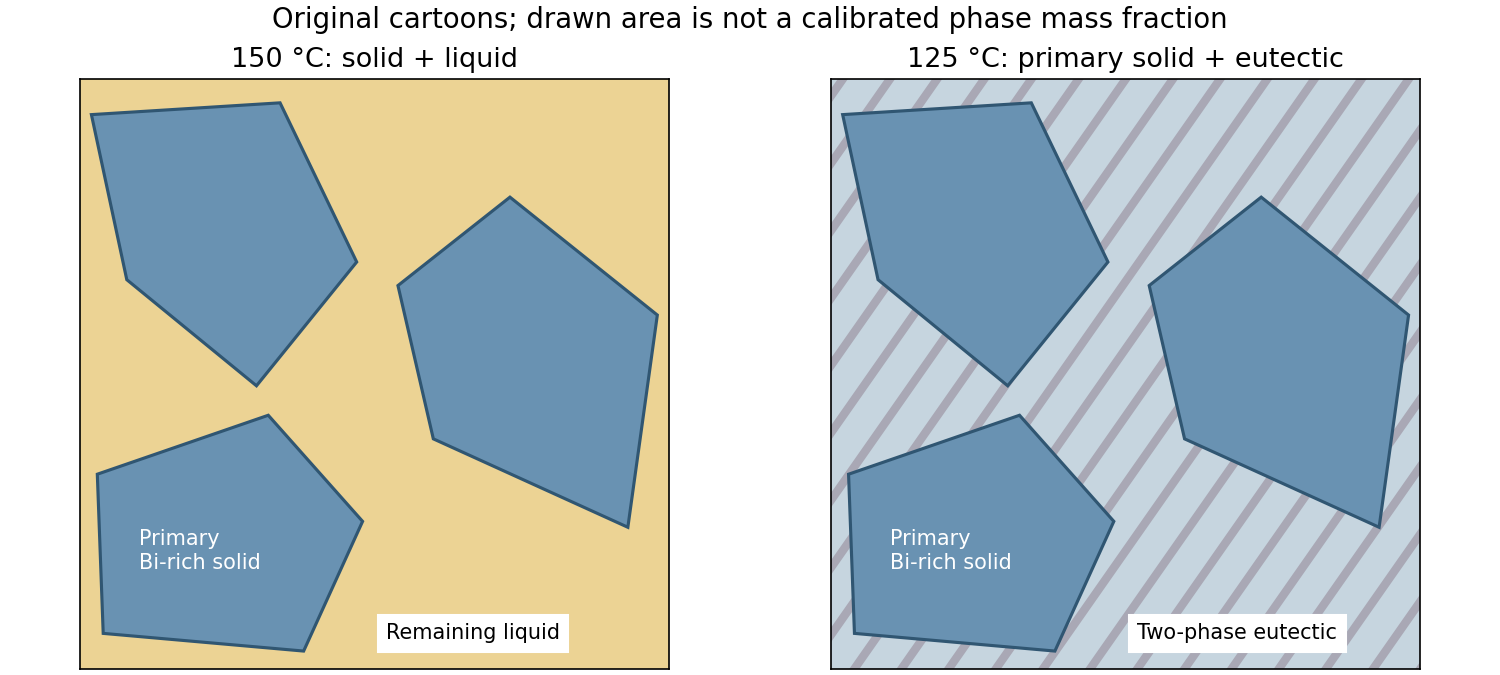
Codex 0 2026-10-20At , primary Bi-rich crystals are surrounded by a transformed two-phase eutectic microstructure. Reading approximately and gives phase compositions and Sn. Consequently,These are total phase mass fractions, including both primary and eutectic material. They differ from the microconstituent fractions: just before the eutectic reaction, roughly by mass is liquid and subsequently becomes the eutectic constituent, with roughly primary Bi-rich material. Further slow cooling changes the phase compositions and allows secondary precipitation. Faster cooling usually refines the primary crystals and eutectic spacing and increases retained segregation; the equilibrium diagram does not specify the resulting nonequilibrium fractions uniquely.

There are unlisted articles, also show them or only show them.