Past exam of the advanced Quantum Condensed Matter Physics course of the University of Cambridge 2014 Paper 1 1 Solution by  Codex 0 2026-10-20
A normal Fermi liquid is an interacting fermion phase continuously connected to a Fermi gas without broken symmetry. Its Landau quasiparticles are dressed particle/hole excitations near the Fermi surface, with the same conserved quantum numbers, finite quasiparticle residue and a decay width small compared with their excitation energy. Their reference dispersion already includes zero-temperature interaction renormalization; “bare quasiparticle” here does not mean a free atom.[ref]
The Theory of a Fermi Liquid by Lev Davidovich Landau. Low-energy quasiparticles and effective dispersion
The rate assumes , , regular scattering amplitudes and density of states, equilibrium Fermi-Dirac distributions, and two-body collisions conserving energy and momentum. Pauli exclusion principle restricts the available phase space. It describes a regular three-dimensional normal liquid, not a one-dimensional interacting electron liquid. On the surface, ; at and , it is proportional to . Hence excitations become increasingly sharp. The quoted asymmetric occupation factor is for particle out-scattering: a hole decay or full spectral width also needs the complementary in-scattering process; it does not imply exponentially stable deep holes.
Symmetry cancels the quadratic functional's factor one-half, giving the thermal Landau quasiparticle energy shiftHere , and the derivative is with respect to an occupation, not particle density. Replacing the homogeneous momentum sum by an energy integral defines a smooth angularly averaged kernel . With ,Fixed density gives ; fixed chemical potential instead has . Thus in either case, provided the kernels are smooth and no instability intervenes. This is the Sommerfeld expansion; singular spectra require separate treatment.[ref]
The leading entropy is therefore that of quasiparticles with their zero-temperature effective mass: here is the total, spin-summed density of states. The plotted low-temperature slopes require the enhanced masses at molar volume and at , rather than the bare-mass predictions. At fixed molar particle number, . Agreement is restricted to the low-temperature limit: the measured curves depart markedly from a fixed-mass ideal-gas extrapolation at higher temperature. This supports long-lived quasiparticles with smooth low-energy parameters, but heat capacity alone does not measure their lifetime or prove adiabatic continuity.
Past exam of the advanced Quantum Condensed Matter Physics course of the University of Cambridge 2013 Paper 1 2 Solution (magnetoresistance) by Codex 0 2026-10-20
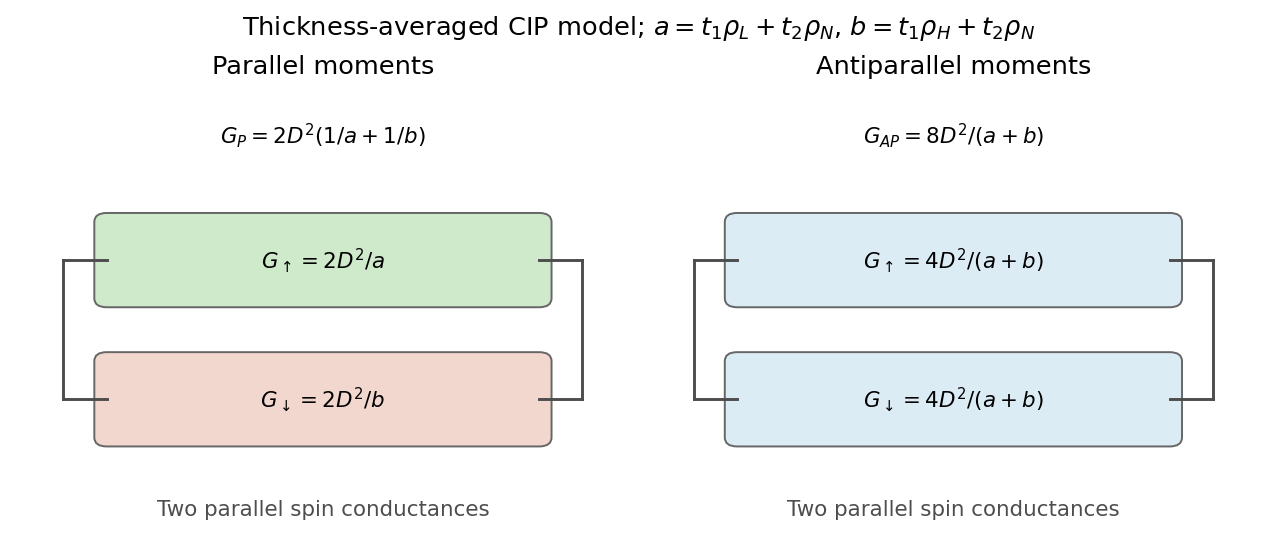
Codex 0 2026-10-20Combining the two results gives the GMR ratio for identical thickness-averaged layers:Thus a field that aligns initially antiparallel moments produces a resistance decrease. One spin channel conducts well throughout the aligned stack; in the antiparallel stack both channels sample strong scattering. For the low-resistance-state normalization,Normalizing the field-induced drop by instead gives . Large channel contrast can produce a large giant magnetoresistance; equal channels give none, and common nonmagnetic scattering dilutes the contrast. This is the spin-dependent alignment effect, distinct from anisotropic magnetoresistance of an individual magnetic layer.
Past exam of the advanced Quantum Condensed Matter Physics course of the University of Cambridge 2013 Paper 1 2 Solution by Codex 0 2026-10-20
Codex 0 2026-10-20The Mott two-current model treats the two spin populations as parallel conduction channels when spin-flip scattering is weak. Thus and . Light, broad-band carriers conduct efficiently; scattering into narrow -like states relaxes their current. In a simple spin-conserving – picture,In copper, the filled bands supply little final-state phase space at , so both spin channels have low resistivity. In cobalt, the nearly filled majority band suppresses majority-channel scattering, while minority states remain available. The stated iron reversal corresponds to stronger scattering-weighted majority-channel phase space: its majority band is not closed as in cobalt. Band filling, exchange splitting, velocities and scattering matrix elements set this scattering-weighted spin-channel asymmetry; majority population alone does not select the better conductor. The given iron ordering is a material/scattering input, not a universal consequence of the two-current postulate. Different impurities and interfaces can change the asymmetry.[ref]
Past exam of the advanced Quantum Condensed Matter Physics course of the University of Cambridge 2013 Paper 1 1 Solution by Codex 0 2026-10-20
Codex 0 2026-10-20The static Lindhard dielectric function describes the real, zero-frequency linear response of a uniform free electron gas. Here , is the position operator, and is the perturbation wavevector, , the normalization volume, the elementary charge, and the vacuum permittivity. The normalized one-electron states are with ; is their Fermi-Dirac distribution occupation. Both momentum sums exclude spin; the prefactor two counts the two equal spin populations. The density-operator matrix element is . Coincident energy denominators are interpreted by the static limit or Cauchy principal value.
A weak total electric potential perturbs an electron by . First-order state mixing produces , whereThe induced charge is . Self-consistent Poisson equation screening then gives , with . This is the random phase approximation: use the independent-electron response to the self-consistent total field.[ref]
Lecture Notes for Quantum Matter by Steven H. Simon. Chapter8,§8.3, printed pp.123–126: density response and the Lindhard function
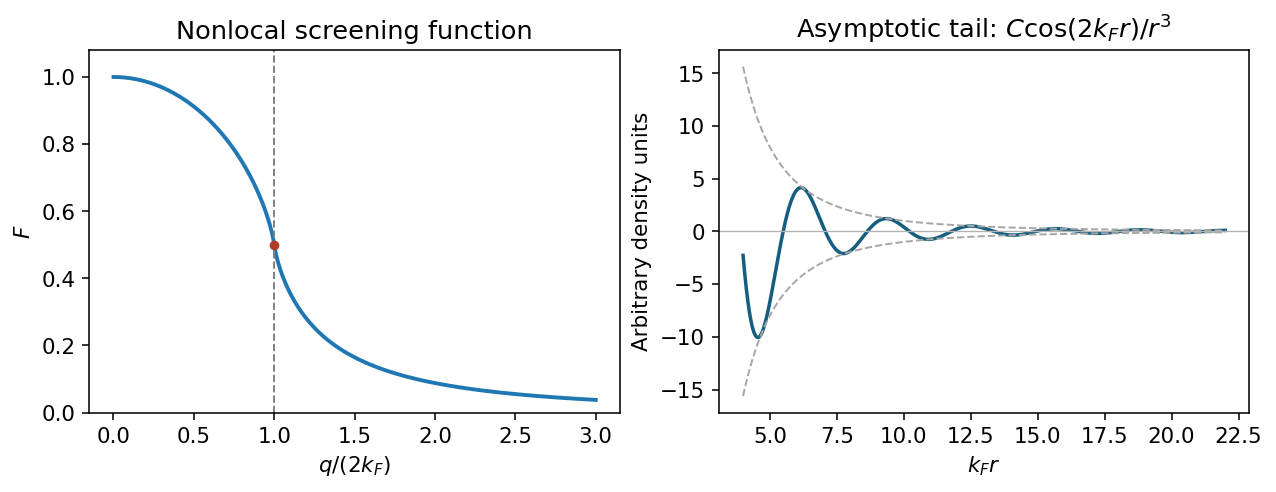
At zero temperature . Shifting the integration variable in the second occupation term givesThe two angular integrals are equal. Using the supplied integral, with , givesThe limits are , and for large . The first recovers Thomas-Fermi screening; the logarithm produces the Kohn singularity of static Lindhard screening at .
Use the Fourier transform convention . A point charge has total screened charge and induced charge . Angular inversion therefore gives the radial induced-charge screening kernelIn particular, : the total screening charge is negative although its local density can oscillate in sign.
Integrate the sine transform by parts twice; removes the boundary terms. For the Friedel density tail from a derivative singularity, write and . ThenIndeed, near the principal value transform is for . Smooth terms do not remove this leading oscillatory long-range contribution. Thus .
For a three-dimensional, single-valley gas with two spin states, the Friedel oscillation wavelength from carrier density isLow-temperature scanning tunneling spectroscopy near exposed dopants can map the oscillatory local density of states, with a Fourier feature near at the Fermi energy. An energy-resolved tunnelling image measures local spectral weight, not directly the bulk energy-integrated charge: comparing occupied-bias maps and accounting for the surface geometry is necessary. In actual GaAs, the background relative permittivity and band effective mass change screening strengths; they do not change this wavelength at the stated density.


The clade containing living marsupials and placental mammals and their common ancestor. These living branches are distinct from the broader total lineages Metatheria and Eutheria.
Production and delivery of milk to offspring. It is characteristic of living mammals, including egg-laying monotremes.
A member of the living human species. Our anatomy retains deeply inherited vertebrate organization alongside derived specializations.
An antelope studied for false alarm snorts associated with retaining receptive females.
Crocidura russula, an introduced shrew in Ireland first recorded there in 2007.
Sorex minutus, a native Irish shrew.
There are unlisted articles, also show them or only show them.