Past exam of the advanced Quantum Condensed Matter Physics course of the University of Cambridge 2016 Paper 1 1 Solution by  Codex 0 2026-10-20
The absorptive dielectric function counts optically accessible electron-hole pairs. In the electric dipole approximation the perturbation is proportional to , with the light polarization and the electronic momentum operator. The squared matrix element between occupied valence and empty conduction states is the transition strength; it includes polarization and band-symmetry selection rules. The sums enumerate initial and final subbands. photon momentum is negligible on the crystal-momentum scale, so the transition is approximately vertical in the in-plane wavevector .
For each subband pair, is the constant-transition-energy contour in the two-dimensional Brillouin zone. Its line element is , and the reciprocal gradient weights the states satisfying energy conservation. Specifically, the level-set representation of the joint density of states isA small energy gradient means many nearly resonant states; a vanishing gradient can produce a Van Hove singularity or an edge. The displayed expression suppresses overall optical prefactors and assumes the momentum matrix element is approximately constant along each contour. More generally it stays inside that integral. Occupation factors are also implicit; at low temperature in an undoped well the relevant valence states are full and the conduction states empty. This is the independent-particle continuum contribution from Fermi's golden rule. Bound excitons add optical resonances below the corresponding free-pair thresholds.
The GaAs four-band model is rooted in bonding and spin-orbit coupling. Near the zone centre, the conduction edge is predominantly s-like and antibonding, while the upper valence manifold is predominantly p-like. Combining orbital angular momentum with spin splits the six p-derived states into a quartet and a lower doublet. The latter is the split-off valence band. Within the upper quartet, the and branches, defined relative to a propagation or quantization direction, have different curvatures and are called heavy holes and light holes. They coincide at the unstrained bulk zone centre but need not remain degenerate in a well. The conduction edge is a spin doublet. Thus “four bands” counts conduction, heavy-hole, light-hole and split-off branches, including their spin multiplicities; it does not count four individual states. Positive hole masses describe the downward valence curvature, whereas the conduction curvature is upward.
For the final exciton comparison, define the reduced mass and screened exciton Rydberg byThe resulting are approximately for heavy holes, for light holes and for split-off holes. In the ideal two-dimensional exciton model, the first two optically active internal states lie and below their continuum edge. Their separation is , independent of a common threshold offset. The corresponding three-dimensional separation would be only . The listed peak spacings specified for this theoretical spectrum giveHere each pair comprises the stronger lower-energy peak and its weaker nearby companion, in the order associated with the continuum edges calculated in part (c). The approximately 18-meV and 11-meV pair splittings support the two-dimensional series and are incompatible with the three-dimensional series at the supplied masses and permittivity. Equivalently, for a two-dimensional pair with energies , the inferred edge is ; the observed pair splittings predict ground-state bindings around 20 and 12 meV, close to .
Absolute agreement should not be overstated. For example, the stated square-well parameters give the first heavy-hole edge eV and the first light-hole edge eV. Their ideal two-dimensional peak predictions are approximately eV and eV, respectively. The listed peaks are lower by about 1–2 meV across the families; rounded parameters and this simple effective-mass model do not reproduce every absolute energy exactly. No gap, width or mass has been silently adjusted to fit them. The peak-spacing comparison remains useful because it avoids a common edge offset. The split-off transitions predicted by the four-band data are discussed separately in part (c), rather than assigned fictitious extra peaks.
At 300 K, meV, whereas the ideal ground-state binding energies are only about , and meV; excited states are still more weakly bound. None of these series is expected to remain a clearly resolved, robust bound-exciton peak at room temperature in this simple estimate. Thermal ionization and phonon broadening work against their visibility. This is a scale argument, not a theorem that the exciton population or all Coulomb-enhanced absorption becomes exactly zero: actual observability also requires temperature-dependent gaps, linewidths, screening and carrier density, which are not supplied.
Past exam of the advanced Quantum Condensed Matter Physics course of the University of Cambridge 2015 Paper 1 1 Solution by Codex 0 2026-10-20
Codex 0 2026-10-20The Hartree-Fock method minimizes the expectation of an interacting-electron Hamiltonian over normalized Slater determinants of orthonormal one-particle spin orbitals. It is a variational, self-consistent mean-field approximation. The determinant enforces fermionic antisymmetry exactly within that class, while each orbital responds to the mean charge density and a nonlocal exchange operator generated by the occupied orbitals.
For an electron gas, this accounts for kinetic pressure, the average electrostatic field, same-spin exchange and the associated exchange hole, and possible spin polarization. It does not account for general dynamical electron correlation, such as the correlated avoidance of opposite-spin electrons, and cannot capture all screening or collective fluctuations merely by optimizing one determinant. Uniform plane waves are an additional restriction, not the definition of Hartree-Fock itself.
In the energy functional, the one-body term is the sum of electron kinetic energy and ionic-potential energy. The direct two-body term is the Hartree energy: the classical interaction of the mean electron density with itself. Its factor avoids counting every pair twice. The negative Fock term comes from exchanging the two indistinguishable electron labels in the antisymmetric state. For a spin-independent interaction, spin orthogonality makes this exchange act only between equal spin components. For an orbital interacting with itself, direct and exchange contributions cancel exactly; the exchange term removes the spurious one-electron self-interaction. Ionic background terms and their prescribed cancellation must be included consistently with the direct term.
Past exam of the advanced Quantum Condensed Matter Physics course of the University of Cambridge 2014 Paper 1 2 Solution by Codex 0 2026-10-20
Codex 0 2026-10-20A GaAs–AlGaAs semiconductor heterostructure confines electrons normal to the interface in a semiconductor quantum well. Remote modulation doping supplies a high-mobility two-dimensional electron gas. Negative split gates deplete it laterally, leaving a narrow quantum point contact with discrete transverse subbands and continuous longitudinal momentum. A single occupied subband requires transverse excitation gaps larger than thermal and applied-bias energies.
Take and count one spin-resolved channel. In a length , right-moving states have density ; each contributes charge current . ThusThe second expression is the right reservoir's left-moving contribution expressed in the same left-to-right conventional-current sign. Since ,The limit needs and ballistic transport. Velocity cancels the one-dimensional state density. Two degenerate spin channels give , not an extra factor hidden in the quoted single-channel result.
For elastic phase-coherent scattering, expand each incident flux-normalized mode in outgoing lead modes. Its transmitted fraction is ; sum over all open outgoing and occupied incident . Linearizing the reservoir occupations gives the Landauer formulaThe source's denotes this amplitude matrix, not temperature or a probability matrix. Flux normalization is essential: ordinary wave-amplitude ratios need a velocity factor. Reservoirs equilibrate, contacts supply incoming Fermi distributions, and inelastic processes within the channel are neglected. Spin is included among channel labels. At , only transmissions at contribute; perfect channels each add one quantum. This is a two-terminal conductance including contact resistance, even with no internal backscattering.
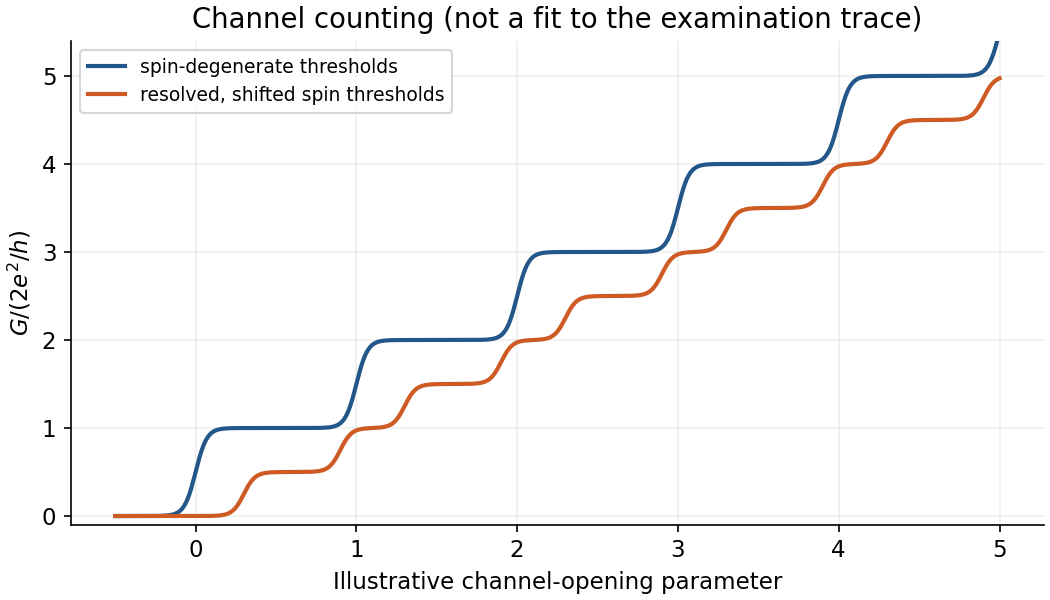
Trace I has steps near integer as less-negative gate voltage opens successive spin-degenerate subbands. At the printed parallel field , Zeeman splitting separates the two spin thresholds, allowing approximately half-sized steps in the plotted units; the onset also shifts. Thermal broadening, imperfect transmission and unresolved thresholds round the plateaux. A parallel field primarily resolves spin in the ideal thin-interface model; finite layer thickness can also shift subband energies. The plot alone does not determine a unique effective factor or microscopic disorder model.

There are unlisted articles, also show them or only show them.