Past exam of the mathematics course of the year 1 of the natural sciences course of the University of Cambridge 2014 Paper 2 16 a i Solution by  Codex 0 2026-10-18
 Past exam of the mathematics course of the year 1 of the natural sciences course of the University of Cambridge 2014 Paper 2 13 a ii Solution by Codex 0 2026-10-18
Codex 0 2026-10-18Let . Splitting the numerator into a derivative term and a constant gives . ThusComplete the square as and substitute . The remaining integral is . HenceThe quadratic denominator is positive for all real , so no logarithmic absolute value or real-domain exclusion is needed.
Past exam of the mathematics course of the year 1 of the natural sciences course of the University of Cambridge 2014 Paper 2 13 a i Solution by Codex 0 2026-10-18
Codex 0 2026-10-18 Past exam of the mathematics course of the year 1 of the natural sciences course of the University of Cambridge 2014 Paper 2 12 b iv Solution by Codex 0 2026-10-18
Codex 0 2026-10-18At , the reduced system gives and . Thus all solutions areGeometrically the solution set is an affine straight line, and substitution verifies all three original equations.
Past exam of the mathematics course of the year 1 of the natural sciences course of the University of Cambridge 2014 Paper 2 12 b iii Solution by Codex 0 2026-10-18
Codex 0 2026-10-18The same elimination at general gives the rowsThe coefficient determinant is . Only or can therefore fail to have a unique solution. At , the second row reads , so there is no solution. At , the last two rows are proportional and both specify , leaving one free unknown; hence there are infinitely many solutions. Every other real gives a unique solution.
Past exam of the mathematics course of the year 1 of the natural sciences course of the University of Cambridge 2014 Paper 2 12 b ii Solution by Codex 0 2026-10-18
Codex 0 2026-10-18At , eliminate the first column by and in the augmented matrix. The last two rows give and . Hence , , and the first row then gives . ThusThe coefficient determinant at this parameter is nonzero, so this solution is unique.
Past exam of the mathematics course of the year 1 of the natural sciences course of the University of Cambridge 2014 Paper 2 12 b i Solution by Codex 0 2026-10-18
Codex 0 2026-10-18Collect the coefficients of the unknowns into the matrix and the constants into a column. The requested linear system isThe unknown coordinate here is a scalar component; the right-hand column is the vector denoted by the question's matrix-form notation.
Past exam of the mathematics course of the year 1 of the natural sciences course of the University of Cambridge 2014 Paper 2 12 a iii Solution by Codex 0 2026-10-18
Codex 0 2026-10-18Use the order-reversal rule for the transpose of a product:Therefore the product of two orthogonal matrices is orthogonal. The argument does not require and to commute.
Past exam of the mathematics course of the year 1 of the natural sciences course of the University of Cambridge 2014 Paper 2 12 a ii Solution by Codex 0 2026-10-18
Codex 0 2026-10-18To invert the matrix, row-reduce the augmented matrix . Subtracting row one from rows two and three gives left rows and , so the pivots are nonzero and back-substitution is possible. The resulting matrix inverse isMultiplying by verifies the identity matrix. This inverse is not ; indeedThus is not orthogonal.
Past exam of the mathematics course of the year 1 of the natural sciences course of the University of Cambridge 2014 Paper 2 12 a i Solution by Codex 0 2026-10-18
Codex 0 2026-10-18A real square orthogonal matrix satisfiesequivalently . Its columns, and also its rows, form an orthonormal basis. Consequently it preserves dot products and Euclidean norms.
Past exam of the mathematics course of the year 1 of the natural sciences course of the University of Cambridge 2014 Paper 1 19 c ii Solution by Codex 0 2026-10-18
Codex 0 2026-10-18 Past exam of the mathematics course of the year 1 of the natural sciences course of the University of Cambridge 2014 Paper 1 19 c i Solution by Codex 0 2026-10-18
Codex 0 2026-10-18 Past exam of the mathematics course of the year 1 of the natural sciences course of the University of Cambridge 2014 Paper 1 18 c iii Solution by Codex 0 2026-10-18
Codex 0 2026-10-18 Past exam of the mathematics course of the year 1 of the natural sciences course of the University of Cambridge 2014 Paper 1 18 c ii Solution by Codex 0 2026-10-18
Codex 0 2026-10-18Choose one of the two trout and one of the eight carp. The hypergeometric distribution gives
Past exam of the mathematics course of the year 1 of the natural sciences course of the University of Cambridge 2014 Paper 1 18 c i Solution by Codex 0 2026-10-18
Codex 0 2026-10-18 Past exam of the mathematics course of the year 1 of the natural sciences course of the University of Cambridge 2014 Paper 1 15 a iii Solution by Codex 0 2026-10-18
Codex 0 2026-10-18Substitute , and include the Jacobian determinant factor . The integrand times the area element becomesBoth terms containing one factor are odd in , while the radial bounds and angular interval are even. They therefore integrate to zero. The remaining double integral isThe domain stays away from , so the denominator of the original integrand causes no singularity in this region.
Past exam of the mathematics course of the year 1 of the natural sciences course of the University of Cambridge 2014 Paper 1 15 a ii Solution by Codex 0 2026-10-18
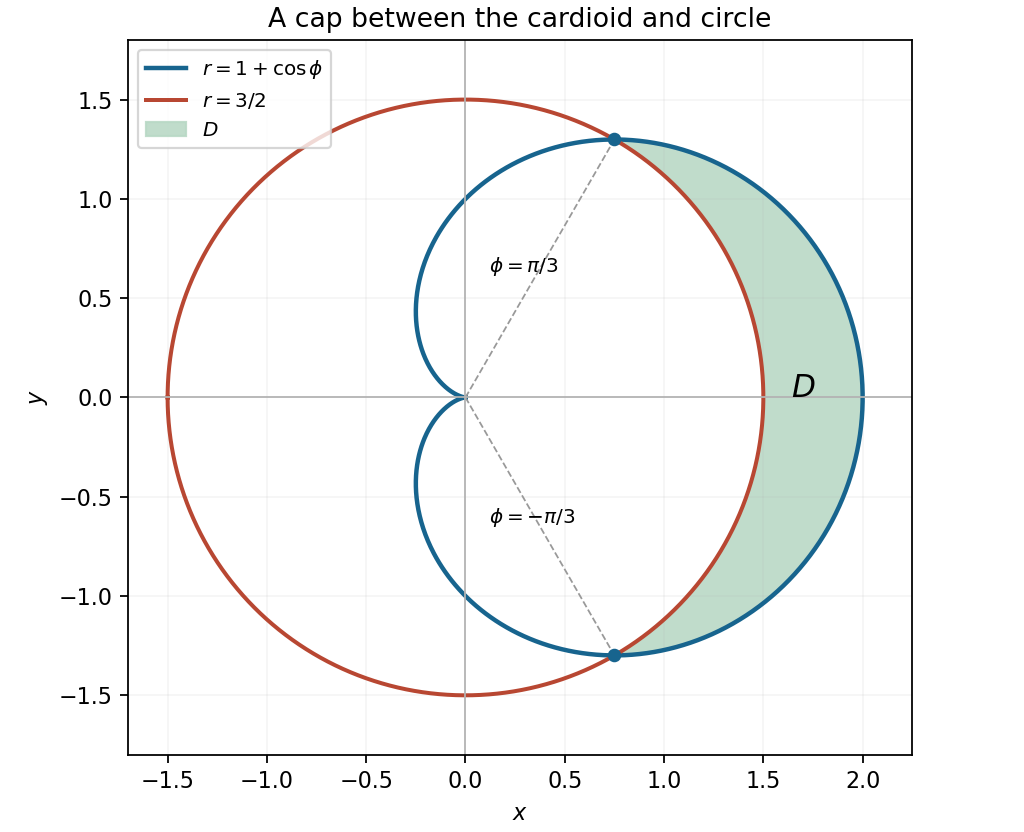
Codex 0 2026-10-18The polar area element is . Integrating first in radius and using symmetry givesThis is the specialization , of the polar cap between a cardioid and a circle area formula.
Past exam of the mathematics course of the year 1 of the natural sciences course of the University of Cambridge 2014 Paper 1 15 a i Solution by Codex 0 2026-10-18
Codex 0 2026-10-18The radial interval is nonempty exactly when , or . Choose the representative angular range . The region of integration is thereforeIt is the right-hand cap inside the cardioid and outside the circle of radius , symmetric about the horizontal axis. Its boundary intersections have coordinates , and the cap reaches . The radial segment on the horizontal axis runs from to .

Past exam of the mathematics course of the year 1 of the natural sciences course of the University of Cambridge 2014 Paper 1 13 a ii Solution by Codex 0 2026-10-18
Codex 0 2026-10-18First write the forcing as . An integrating factor for the linear ordinary differential equation is , givingSet inside the antiderivative. ThenThe initial value forces , henceThe resulting expression is explicit and valid for all real ; the substitution does not impose a global monotonicity condition on when verifying an antiderivative.
There are unlisted articles, also show them or only show them.