Past exam of the mathematics course of the year 1 of the natural sciences course of the University of Cambridge 2013 Paper 1 16 b ii Solution by  Codex 0 2026-10-18
Choose . The two travelling profiles then add by the sine addition identity:This is a standing wave. At and it vanishes for all . At its displacement is , and its time derivative is zero. Also and , directly checking the original equation.
Past exam of the mathematics course of the year 1 of the natural sciences course of the University of Cambridge 2013 Paper 1 16 b i Solution by Codex 0 2026-10-18
Codex 0 2026-10-18For a classical solution take twice differentiable, so that the second derivatives exist. Direct use of the chain rule giveswith the two profile arguments as specified. Thus .
To prove generality, introduce characteristic coordinates , , whose Jacobian determinant is . For the differential operator isThe equation becomes . Integrating once in each variable yieldsThis is the countertravelling decomposition of the one-dimensional wave equation, with wave speed . Once differentiability alone is not sufficient for a classical second-order equation; the displayed argument uses the required second derivatives.
Past exam of the mathematics course of the year 1 of the natural sciences course of the University of Cambridge 2013 Paper 1 15 c ii Solution by Codex 0 2026-10-18
Codex 0 2026-10-18For positive constant mass density , reflection symmetry makes the horizontal coordinates of the centre of mass zero. The total mass and the vertical first moment areTheir ratio givesThis is the centre of the liquid volume, rather than of the curved wall. The density cancels because it is uniform; the larger disks near the top place the centre above half-height.
Past exam of the mathematics course of the year 1 of the natural sciences course of the University of Cambridge 2013 Paper 1 15 c i Solution by Codex 0 2026-10-18
Codex 0 2026-10-18The liquid occupies and . A horizontal slice is a disk of area . Integrating these areas givesEquivalently, the triple integral is , including the cylindrical Jacobian determinant factor .
Past exam of the mathematics course of the year 1 of the natural sciences course of the University of Cambridge 2013 Paper 1 11 a ii Solution by Codex 0 2026-10-18
Codex 0 2026-10-18Choose Cramer's rule, the permitted alternative to finding an inverse. The determinant isReplacing each column by the right-hand side givesConsequentlyThe nonzero determinant also proves uniqueness.
Past exam of the mathematics course of the year 1 of the natural sciences course of the University of Cambridge 2013 Paper 1 11 a i Solution by Codex 0 2026-10-18
Codex 0 2026-10-18Use Gaussian elimination on the augmented matrix. First take and , then :By back substitution, the last row gives , the second gives and hence , and the first gives . ThusThe right-hand side has been transformed in every row operation, preserving the solution set.
Past exam of the mathematics course of the year 1 of the natural sciences course of the University of Cambridge 2012 Paper 2 14 a iii Solution by Codex 0 2026-10-18
Codex 0 2026-10-18The normal from (ii) gives the plane equation . The distance from a point to a plane is the absolute value of the normalized plane equation at that point. At the origin this givesFor a geometric check, the perpendicular foot is , parallel to the normal and satisfying the plane equation. Its Euclidean norm is the same distance.
Past exam of the mathematics course of the year 1 of the natural sciences course of the University of Cambridge 2012 Paper 2 14 a ii Solution by Codex 0 2026-10-18
Codex 0 2026-10-18For the triangular face, take the cross product of two edges and divide by two:The origin lies on the opposite side from this normal, since . Thus this is already the outward vector area, withThe vector areas of a closed polyhedron sum to zero, so the sum for the remaining three faces is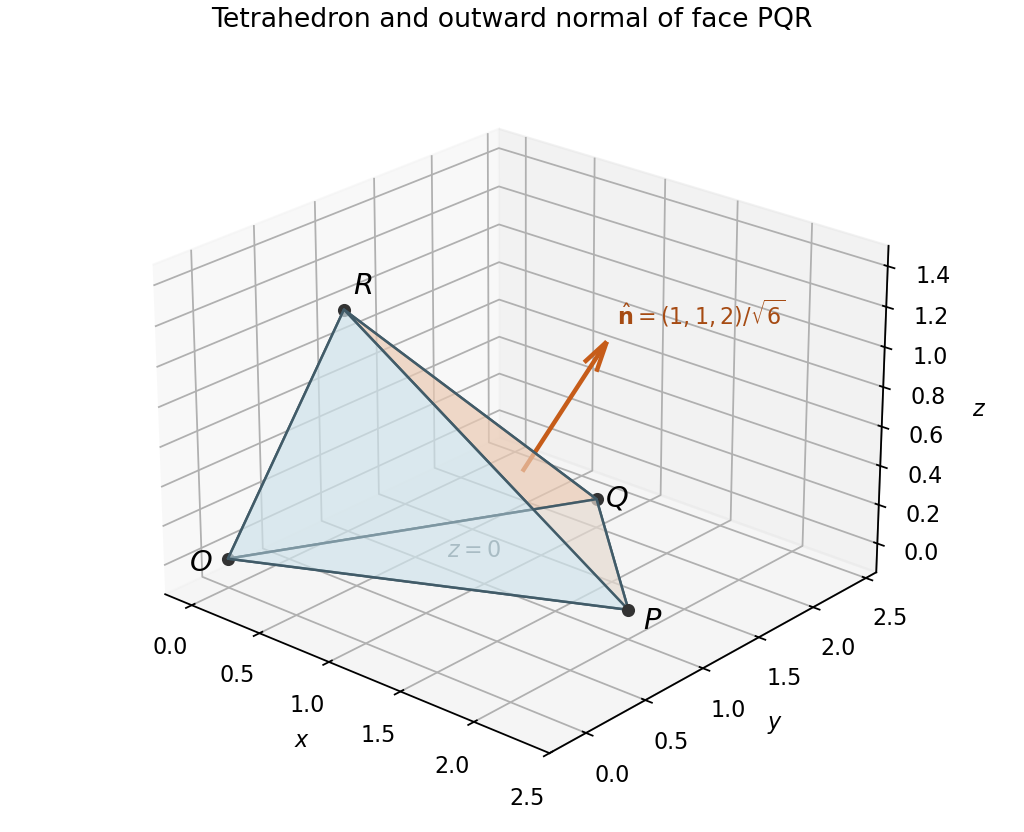
Figure 1.
Tetrahedron with its highlighted face PQR and outward unit normal
. Details. Past exam of the mathematics course of the year 1 of the natural sciences course of the University of Cambridge 2012 Paper 2 14 a i Solution by Codex 0 2026-10-18
Codex 0 2026-10-18Use outward normal vectors to the two faces. The cross productspoint away from the opposite vertices, since and . Their Euclidean norms are and , and their dot product is . The interior dihedral angle of a convex polyhedron is supplementary to the outward-normal angle, soThis also equals the cosine of the acute angle between the unoriented face planes. The outward-normal angle itself has cosine ; keeping that distinction avoids a sign ambiguity.
Past exam of the mathematics course of the year 1 of the natural sciences course of the University of Cambridge 2012 Paper 1 20 b ii Solution by Codex 0 2026-10-18
Codex 0 2026-10-18Minimize the squared distance , which has the same minimizers as the distance. The Lagrange multiplier equations for the constraint areThe constraint gradient cannot vanish on this branch, since its second component is . Eliminate to obtain . Put ; then , so . But the constraint says , requiring and selecting . It follows thatTo prove a global minimum on the whole branch, substitute into :The arithmetic-geometric mean inequality proves this bound, with equality only when , namely . Thus the stationary point is the unique closest point on the required branch. Numerically it is approximately and its distance is in coordinate units.
Past exam of the mathematics course of the year 1 of the natural sciences course of the University of Cambridge 2012 Paper 1 20 b i Solution by Codex 0 2026-10-18
Codex 0 2026-10-18The curve has and can be written . It is a hyperbola with vertical asymptote and oblique asymptote , crossing the horizontal axis at . It is symmetric under .
On each branch . For , the branch descends from as , passes through , and approaches from above as . The negative branch follows by the central symmetry.
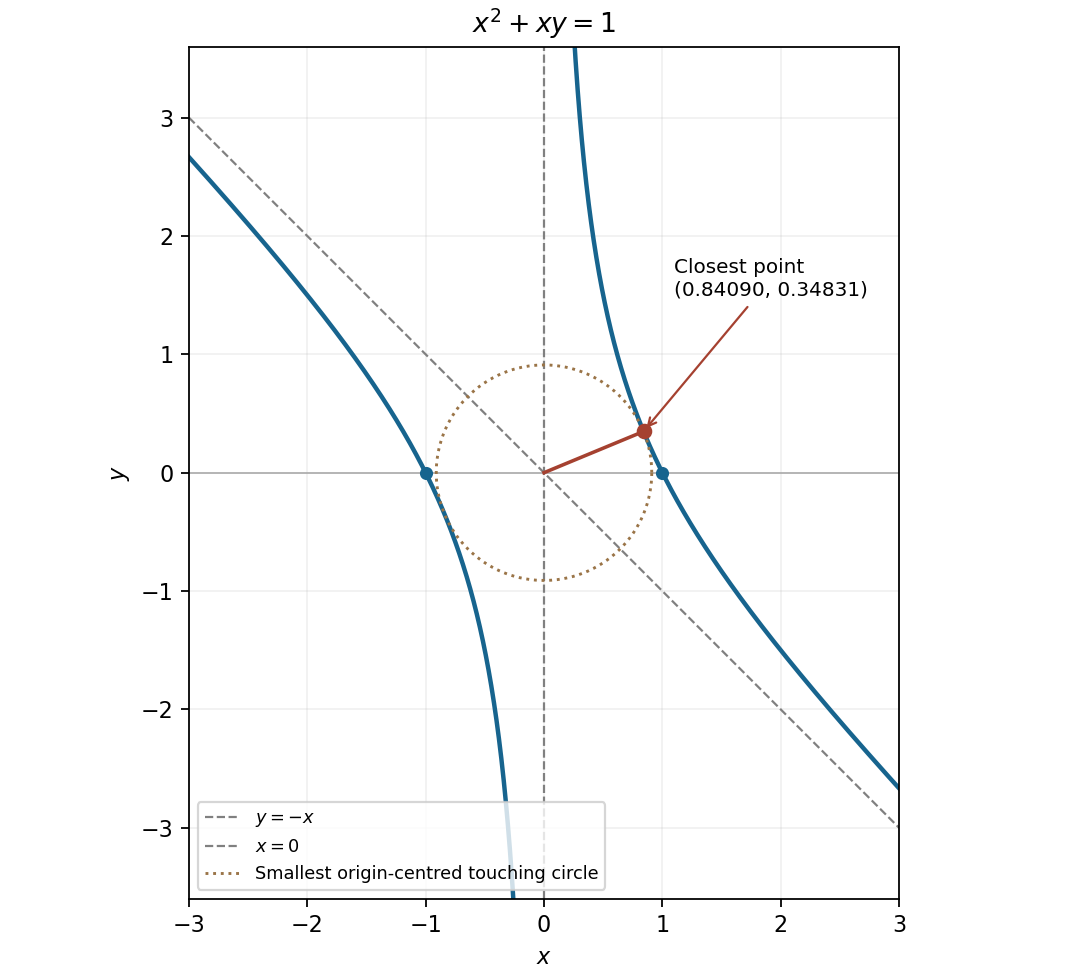
The two hyperbola branches and their asymptotes, with the nearest point on the positive-horizontal branch marked
. Details. Past exam of the mathematics course of the year 1 of the natural sciences course of the University of Cambridge 2012 Paper 1 19 b ii Solution by Codex 0 2026-10-18
Codex 0 2026-10-18The cobweb plot uses the curve and the diagonal . From a point on the diagonal, a vertical step to the curve computes the next iterate; a horizontal step returns its value to the diagonal.
For , , so . Thus a start below gives a strictly increasing sequence bounded above by . For the inequalities reverse to , giving a strictly decreasing sequence bounded below by . Both types of staircase approach the same intersection.
The bounded monotone sequence theorem proves existence of a limit, and continuity then makes it a nonnegative fixed point. Part (i) givesThis proves the global convergence of a square-root iteration; the graph below illustrates both cases without relying on a finite numerical sample as proof.
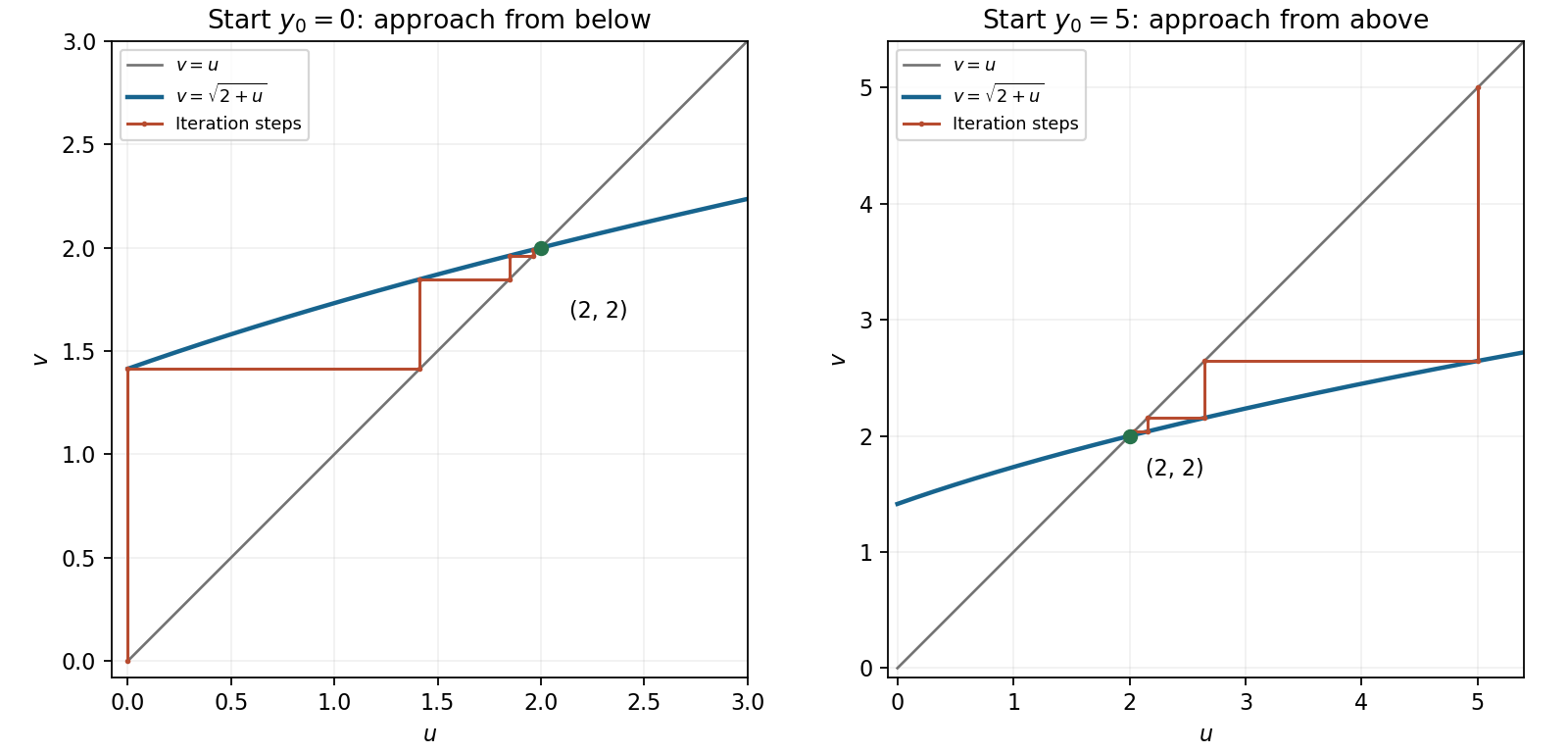
Iteration staircases approaching the positive fixed point from below and from above
. Details. Past exam of the mathematics course of the year 1 of the natural sciences course of the University of Cambridge 2012 Paper 1 19 b i Solution by Codex 0 2026-10-18
Codex 0 2026-10-18A constant sequence must satisfy the fixed point equation . The square root forces . Squaring gives , so the negative algebraic root is inadmissible. HenceStarting at produces the constant sequence .
Past exam of the mathematics course of the year 1 of the natural sciences course of the University of Cambridge 2012 Paper 1 19 a v Solution by Codex 0 2026-10-18
Codex 0 2026-10-18The flat function is an even function, has its unique zero and global minimum at the origin, and approaches the horizontal asymptote as . It decreases for negative and increases for positive , meeting the origin with a horizontal tangent line.
Its derivative is an odd function: off zero, with . It is negative to the left and positive to the right, tends to zero both at the origin and at infinity, and has one negative trough and one positive crest. Indeed away from zero, so the change in slope of occurs once on each side. The exact crest and trough coordinates are not needed for the sketch.
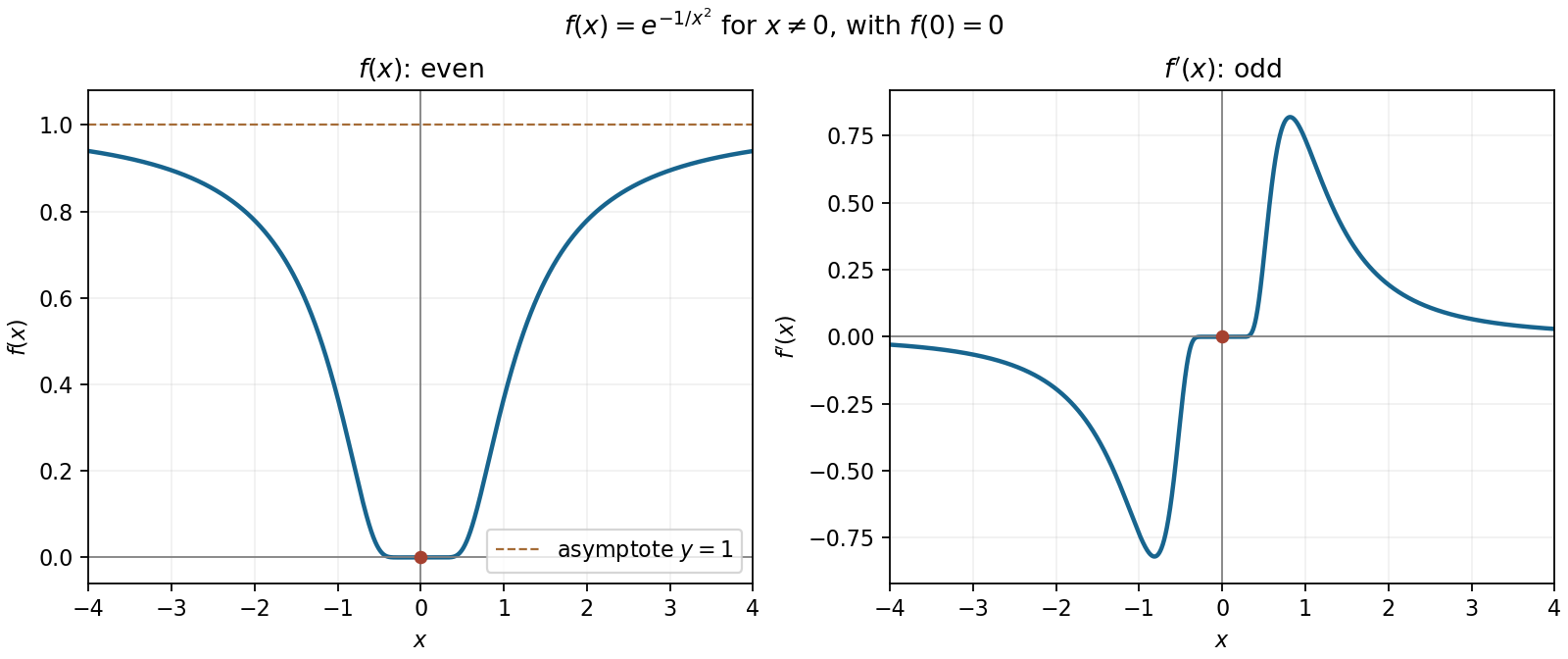


Past exam of the mathematics course of the year 1 of the natural sciences course of the University of Cambridge 2012 Paper 1 19 a iv Solution by Codex 0 2026-10-18
Codex 0 2026-10-18Insert into the exponential series . For every fixed , this gives the expansion with absolute convergenceThis is a Laurent series in inverse powers of , as requested. It is not a Maclaurin series about zero: that series has every coefficient zero and cannot equal on a punctured neighborhood of zero. There is no contradiction, since the inverse-power expansion does not apply at .
Past exam of the mathematics course of the year 1 of the natural sciences course of the University of Cambridge 2012 Paper 1 19 a iii Solution by Codex 0 2026-10-18
Codex 0 2026-10-18For , induction giveswhere each is a polynomial. This recurrence follows from the product rule and . Since Gaussian decay dominates every power,These limits also describe the derivatives of the extension at zero. If , its next difference quotient is , which again tends to zero. Induction proves existence and continuity of every derivative, all zero there. This is a flat function, covered more generally by polynomial multiples of a Gaussian flat function.
Past exam of the mathematics course of the year 1 of the natural sciences course of the University of Cambridge 2012 Paper 1 19 a ii Solution by Codex 0 2026-10-18
Codex 0 2026-10-18For the derivative at zero use its definition, rather than substituting into a formula obtained away from zero:Indeed, putting makes the absolute value , which tends to zero since Gaussian decay dominates every power. Therefore is continuous and differentiable at zero, with . Away from zero, the chain rule gives .
Past exam of the mathematics course of the year 1 of the natural sciences course of the University of Cambridge 2012 Paper 1 19 a i Solution by Codex 0 2026-10-18
Codex 0 2026-10-18Continuity. The function is continuous at when . Equivalently, for every there exists such that within the domain of a function implies ; this is the epsilon-delta definition of continuity.
Differentiability. At an interior point , the difference quotient must have a finite two-sided limit of a function:This defines differentiability and the derivative. At an endpoint one may instead state a one-sided definition relative to the interval. Differentiability implies continuity, because the increment is times a quotient with finite limit, but continuity alone does not guarantee differentiability.
Past exam of the mathematics course of the year 1 of the natural sciences course of the University of Cambridge 2012 Paper 1 18 c iii Solution by Codex 0 2026-10-18
Codex 0 2026-10-18For , evaluate the survival function directly:At , this becomesThe parameter cancels because the threshold scales with the distribution. Also lies outside the support, so in this particular case the two-sided event has the same probability as the stated upper-tail event.
There are unlisted articles, also show them or only show them.