Past exam of the mathematics course of the year 1 of the natural sciences course of the University of Cambridge 2016 Paper 1 14 b ii Solution by  Codex 0 2026-10-18
Insert the eigenvalues and eigenvectors into the inverse spectral decomposition. The first two projections contributeAdding the third projection givesMultiplication by gives the identity; in particular the upper block satisfies .
Past exam of the mathematics course of the year 1 of the natural sciences course of the University of Cambridge 2016 Paper 1 14 b i Solution by Codex 0 2026-10-18
Codex 0 2026-10-18The third coordinate is decoupled, giving the unit eigenvector with eigenvalue . In the first two coordinates, the symmetric direction has eigenvalue , and the antisymmetric direction has eigenvalue . Their normalized forms areThey are an orthonormal basis of ; independent sign reversals are equally valid choices.
Past exam of the mathematics course of the year 1 of the natural sciences course of the University of Cambridge 2016 Paper 1 14 a iv Solution by Codex 0 2026-10-18
Codex 0 2026-10-18The inverse fails to exist exactly when at least one eigenvalue is zero. In that case a nonzero eigenvector lies in the kernel of a linear map, so is not one-to-one. Equivalently, its determinant is zero. Conversely, if every eigenvalue is nonzero, the preceding construction gives an inverse.
Past exam of the mathematics course of the year 1 of the natural sciences course of the University of Cambridge 2016 Paper 1 14 a iii Solution by Codex 0 2026-10-18
Codex 0 2026-10-18If every eigenvalue is nonzero, define , where . Using the mutually orthogonal projection identity ,The same calculation gives . Thus the matrix inverse is
Past exam of the mathematics course of the year 1 of the natural sciences course of the University of Cambridge 2016 Paper 1 14 a ii Solution by Codex 0 2026-10-18
Codex 0 2026-10-18 Past exam of the mathematics course of the year 1 of the natural sciences course of the University of Cambridge 2016 Paper 1 14 a i Solution by Codex 0 2026-10-18
Codex 0 2026-10-18By the spectral theorem for real symmetric matrices, choose the normalized eigenvectors to form an orthonormal basis. With , orthonormality gives and . For every vector , expand and apply :Since this equality holds for every , the spectral decomposition isEach is the rank-one orthogonal projection onto its eigenvector direction. In a degenerate eigenspace, normalized eigenvectors must be chosen mutually orthogonal; normalization alone does not guarantee this resolution of the identity.
Past exam of the mathematics course of the year 1 of the natural sciences course of the University of Cambridge 2016 Paper 1 12 b ii Solution by Codex 0 2026-10-18
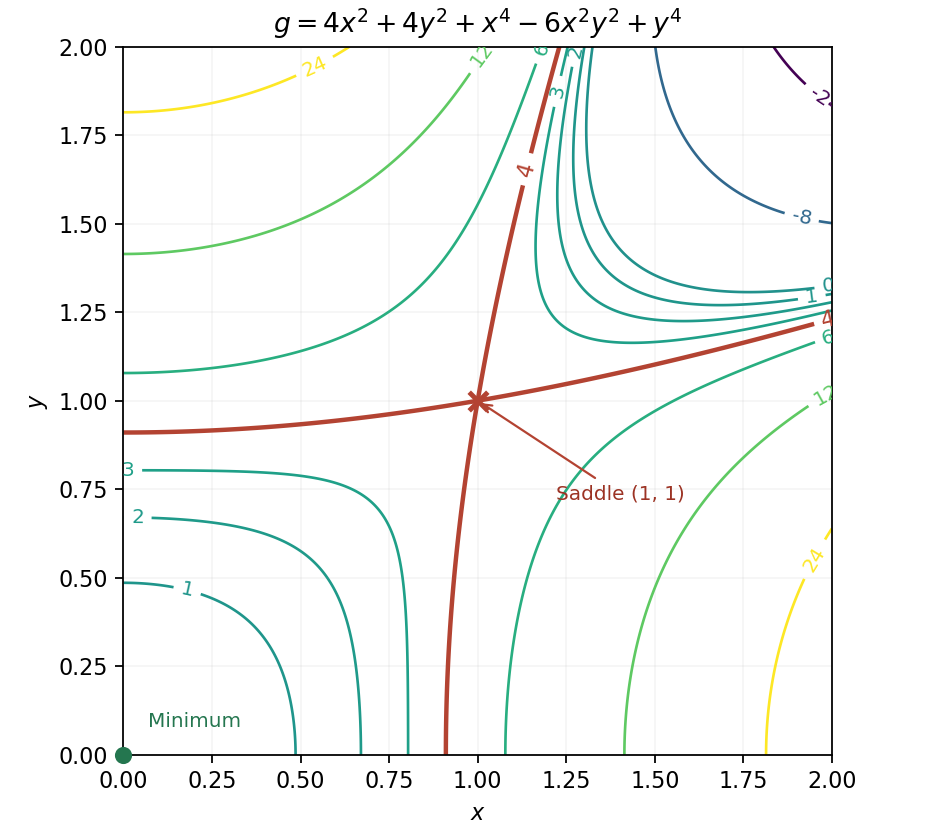
Codex 0 2026-10-18Within the requested first-quadrant square, the stationary points visible in the contour plot are the corner minimum and the saddle . Near the origin, , so the low positive contours look like quarter-circles. Along either coordinate axis, rises monotonically. Along the diagonal, rises to at , returns to zero at , then becomes negative.
The saddle contour crosses at and separates the central positive contours from the outer diagonal region. Negative contours occur toward , where , while the axis corners and have . These checks determine both the contour ordering and the change of connectivity at the saddle; the figure shows these level sets.

Past exam of the mathematics course of the year 1 of the natural sciences course of the University of Cambridge 2016 Paper 1 12 b i Solution by Codex 0 2026-10-18
Codex 0 2026-10-18The first partial derivatives factor asIf either coordinate vanishes, the other equation forces the other coordinate to vanish as well. If both are nonzero, subtracting the two bracket equations gives , and then . Thus the complete list of stationary points is and the four points .
The Hessian matrix isAt the origin it is , which is a positive-definite matrix. At the four other points its eigenvalues are and , independently of the signs. The second-derivative test therefore givesThere are no local maxima. The minimum at the origin is not global, since as .
Past exam of the mathematics course of the year 1 of the natural sciences course of the University of Cambridge 2016 Paper 1 11 d iii Solution by Codex 0 2026-10-18
Codex 0 2026-10-18No finite choice of and gives a line. The coefficient of is fixed at one, so completing the square always gives a circle, a point, or the empty set. A general equation could describe a line when and , but changing the fixed quadratic coefficient is not permitted here. A limiting sequence of increasingly large circles does not make any one of these finite equations a line.
Past exam of the mathematics course of the year 1 of the natural sciences course of the University of Cambridge 2016 Paper 1 11 d ii Solution by Codex 0 2026-10-18
Codex 0 2026-10-18The same completed square gives . A nondegenerate circle therefore occurs exactly whenFor completeness, gives an empty locus because a squared complex modulus cannot be negative.
Past exam of the mathematics course of the year 1 of the natural sciences course of the University of Cambridge 2016 Paper 1 11 d i Solution by Codex 0 2026-10-18
Codex 0 2026-10-18 Past exam of the mathematics course of the year 1 of the natural sciences course of the University of Cambridge 2015 Paper 2 16 a ii Solution by Codex 0 2026-10-18
Codex 0 2026-10-18Here and . Their derivatives giveThus on intervals with , choose the integrating factor . The multiplied form isConsequentlyThis implicit family includes and the branch when . Where the coefficient of is nonzero, its differentiated form directly recovers the original equation. A useful equivalent relation is . At , the original equation requires ; continuation there must be checked in that original equation rather than justified by the singular integrating factor. In particular the zero solution extends everywhere, and extends smoothly across the cosine zeros where it is defined.
Past exam of the mathematics course of the year 1 of the natural sciences course of the University of Cambridge 2015 Paper 2 16 a i Solution by Codex 0 2026-10-18
Codex 0 2026-10-18Write the equation as , with and . Thenso a suitable integrating factor is on either half-line. For example, on the resulting exact form isHence the solution, written to cover either sign of , isThe original equation remains meaningful at , where it requires . Only gives a finite differentiable extension across zero, namely .
Past exam of the mathematics course of the year 1 of the natural sciences course of the University of Cambridge 2015 Paper 2 15 a ii Solution by Codex 0 2026-10-18
Codex 0 2026-10-18Use the same general solution. The first two conditions now give and , so , . HenceAt , its value is , so the third condition is also satisfied. This is the unique consistent solution.
Past exam of the mathematics course of the year 1 of the natural sciences course of the University of Cambridge 2015 Paper 2 15 a i Solution by Codex 0 2026-10-18
Codex 0 2026-10-18The characteristic equation has roots , and a trial multiple of gives the particular solution . ThusThe first two conditions give and , hence . At , the exponentials equal . ThereforeNo solution satisfies all three conditions. The first two initial data already determine a unique solution of the second-order linear differential equation; the extra condition is inconsistent with it.
Past exam of the mathematics course of the year 1 of the natural sciences course of the University of Cambridge 2015 Paper 2 11 b iii Solution by Codex 0 2026-10-18
Codex 0 2026-10-18Geometrically the image of is still the plane , while this is outside it. Thus the failure is inconsistency, rather than a unique solution with a singular denominator.
Past exam of the mathematics course of the year 1 of the natural sciences course of the University of Cambridge 2015 Paper 2 11 b ii Solution by Codex 0 2026-10-18
Codex 0 2026-10-18The original PDF has here; the transcription loses its minus sign. Now and , so the scalar condition becomes and leaves arbitrary. ConsequentlyThe solution set is a straight line parallel to , equivalently the intersection of and .
Past exam of the mathematics course of the year 1 of the natural sciences course of the University of Cambridge 2015 Paper 2 11 b i Solution by Codex 0 2026-10-18
Codex 0 2026-10-18Set . Taking the dot product of the vector equation with givesHere and , so . Substitution then givesGeometrically the possible vector must lie on the line , and the scalar constraint picks one point. Equivalently the rank-one matrix update is invertible because . This is the nonsingular case of solvability of an affine rank-one vector equation.
Past exam of the mathematics course of the year 1 of the natural sciences course of the University of Cambridge 2015 Paper 1 17 b ii Solution by Codex 0 2026-10-18
Codex 0 2026-10-18Complete the square in the denominator and split the numerator into a multiple of its derivative plus a constant:ThusThe natural logarithm needs no absolute-value correction because its quadratic argument is strictly positive for every real . The second term is an inverse tangent antiderivative.
Past exam of the mathematics course of the year 1 of the natural sciences course of the University of Cambridge 2015 Paper 1 17 b i Solution by Codex 0 2026-10-18
Codex 0 2026-10-18Set with , so and . The integration by substitution givesThis uses the principal inverse sine; the chosen angle interval keeps the square root positive.
There are unlisted articles, also show them or only show them.