Past exam of the mathematics course of the year 1 of the natural sciences course of the University of Cambridge 2014 Paper 1 20 a Solution by  Codex 0 2026-10-18
Maximizing the squared distance avoids differentiating a square root. The Lagrange multiplier equations for areAdding and subtracting the first two gives and . The feasible stationary points therefore lie on or . The first case gives and squared distance . The second gives and , with squared distance .
Past exam of the mathematics course of the year 1 of the natural sciences course of the University of Cambridge 2014 Paper 1 2 b Solution by Codex 0 2026-10-18
Codex 0 2026-10-18Set , so . The real domain is , ensuring . The integration by substitution followed by integration by parts givesThus
Past exam of the mathematics course of the year 1 of the natural sciences course of the University of Cambridge 2014 Paper 1 2 a Solution by Codex 0 2026-10-18
Codex 0 2026-10-18For positive , write . Differentiating by the chain rule givesThe natural logarithm of the constant base supplies the factor; it must not be omitted when .
Past exam of the mathematics course of the year 1 of the natural sciences course of the University of Cambridge 2014 Paper 1 19 d Solution by Codex 0 2026-10-18
Codex 0 2026-10-18Index the terms from :Its absolute successive-term ratio tends to zero for every fixed , so it converges everywhere. Divide by temporarily and use the exponential series divided by a shifted index with :ThereforeAt both the original series and this formula are zero, so the temporary division loses no value. The termwise integration is justified by uniform convergence of the exponential series on the finite integration interval.
Past exam of the mathematics course of the year 1 of the natural sciences course of the University of Cambridge 2014 Paper 1 19 b Solution by Codex 0 2026-10-18
Codex 0 2026-10-18Multiply the Maclaurin series by the binomial series . The constant, linear and quadratic coefficients are therefore
Past exam of the mathematics course of the year 1 of the natural sciences course of the University of Cambridge 2014 Paper 1 19 a Solution by Codex 0 2026-10-18
Codex 0 2026-10-18Write the formal Maclaurin series as , where . If the successive nonzero coefficient ratios have a limit, the ratio test givesso the series converges absolutely for , whereIf that ratio does not exist, the Cauchy-Hadamard theorem gives the general formula . The radius of a Maclaurin series from successive derivatives concerns convergence of the series; equality to the original function additionally requires analyticity or a vanishing Taylor remainder. Mere differentiability, or even smoothness, does not ensure that equality.
For the specified logarithm,The absolute successive-term ratio tends to , so the interval of absolute convergence is . At the nonconstant terms are the alternating harmonic series, which converges conditionally to , giving the full sum . At all nonconstant terms are , so the series diverges to ; the original logarithm is also undefined there. Thus the full real convergence interval is .
Past exam of the mathematics course of the year 1 of the natural sciences course of the University of Cambridge 2014 Paper 1 18 d Solution by Codex 0 2026-10-18
Codex 0 2026-10-18When only a tiny fraction of either species is removed, the trout fraction among the remaining fish stays nearly constant at . Successive catches are then approximately independent trials with that fixed success probability. The count therefore approaches the binomial distributionThe approximation comes from negligible depletion, not from an exact independence property of sampling without replacement.
Past exam of the mathematics course of the year 1 of the natural sciences course of the University of Cambridge 2014 Paper 1 18 c Solution by Codex 0 2026-10-18
Codex 0 2026-10-18The three preceding probabilities satisfyTheir expected value and second moment areSubtracting the squared mean givesThe value also follows from linearity of expectation. The variance includes the finite-population reduction caused by sampling without replacement.
Past exam of the mathematics course of the year 1 of the natural sciences course of the University of Cambridge 2014 Paper 1 18 b Solution by Codex 0 2026-10-18
Codex 0 2026-10-18Count unordered sets of distinct labelled fish: there are possible hauls. To obtain exactly trout, choose labels from the trout and from the carp, giving possibilities. Uniform sampling without replacement therefore gives the hypergeometric distributionOutside this integer range the probability is zero. If ordered catches were counted instead, every haul would have orders and that factor would cancel from the probability ratio.
Here equal catchability means equal selection probability for each individual remaining fish. It does not mean that the two species have probability on each draw regardless of their populations. This interpretation is the one that yields the stated hypergeometric law.
Past exam of the mathematics course of the year 1 of the natural sciences course of the University of Cambridge 2014 Paper 1 18 a Solution by Codex 0 2026-10-18
Codex 0 2026-10-18Write , with . The expected value, variance, and strict lower-tail probability areThe upper summation limit is essential because the inequality is strict and the variable is integer-valued.
Past exam of the mathematics course of the year 1 of the natural sciences course of the University of Cambridge 2014 Paper 1 17 c Solution by Codex 0 2026-10-18
Codex 0 2026-10-18Take the odd extension on and then extend with period . It agrees with the required arch for and is continuous at its joins. Its Fourier sine series hasFor clarity, let , so and . Two integrations by parts, with the first endpoint term zero, giveConsequently : the even coefficients vanish and the odd ones are . This provesThe Fourier sine series of an odd quadratic arch converges to this continuous extension; its coefficients are also absolutely summable. Finally evaluate at . The left side is and the sine factors are , soThe evaluation is at a continuity point, so it does not invoke a jump midpoint.
Past exam of the mathematics course of the year 1 of the natural sciences course of the University of Cambridge 2014 Paper 1 17 b Solution by Codex 0 2026-10-18
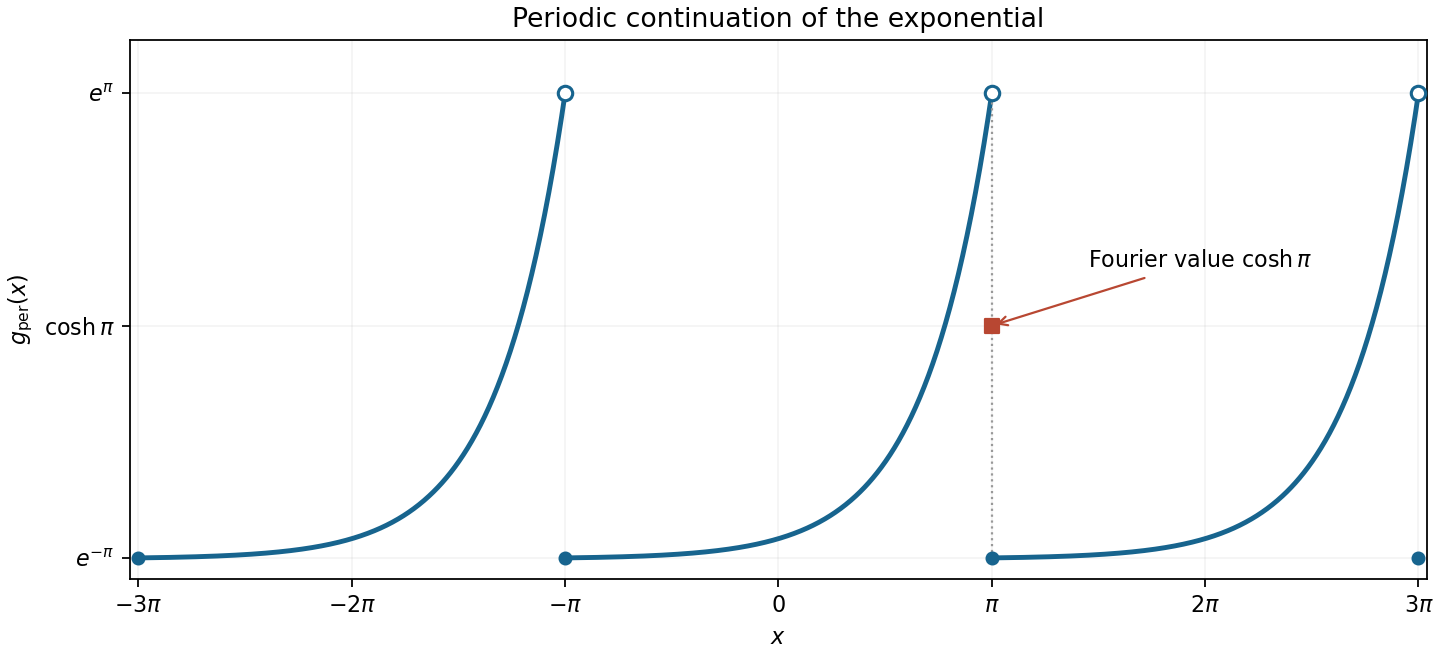
Codex 0 2026-10-18The periodic continuation is on each interval . Thus the plot repeats an increasing exponential segment on each of the three requested periods, jumping down from to at odd multiples of .
At , the left and right limits are and . The Dirichlet-Jordan convergence theorem therefore makes the Fourier series converge toThe actual half-open periodic definition has ; the Fourier value at the jump need not equal that assigned endpoint value.

Past exam of the mathematics course of the year 1 of the natural sciences course of the University of Cambridge 2014 Paper 1 17 a Solution by Codex 0 2026-10-18
Codex 0 2026-10-18With the usual real normalization, the Fourier series iswith Fourier coefficientsThese formulas follow from Fourier orthogonality. Integrability is needed to define the coefficients, and periodicity alone does not guarantee pointwise equality with the series. For a piecewise smooth periodic function, the Dirichlet-Jordan convergence theorem gives the average of the one-sided limits at a jump and the function value at a continuity point.
Past exam of the mathematics course of the year 1 of the natural sciences course of the University of Cambridge 2014 Paper 1 16 b Solution by Codex 0 2026-10-18
Codex 0 2026-10-18The partial derivatives give and . If either coordinate is zero, both vanish. Otherwise substitution gives , so the real stationary points are , and .
The Hessian matrix isAt the origin its eigenvalues are and , so it is a saddle at level zero. At either of the other points its eigenvalues are and , so both are strict minima at level . In fact,with equality only at those two points. HenceFor levels , two separate closed contours surround the two minima. At the contours form two lobes, in the first and third quadrants, meeting at the origin. Their limiting tangent directions there are the coordinate axes because the leading term is . On the diagonal the outer zero-level points are . Positive levels form one closed outer contour enclosing both wells; there are no contours below . The graph is symmetric under exchanging and under reversing both signs, but not under a quarter-turn. These features are the case of the quartic double well with bilinear coupling.
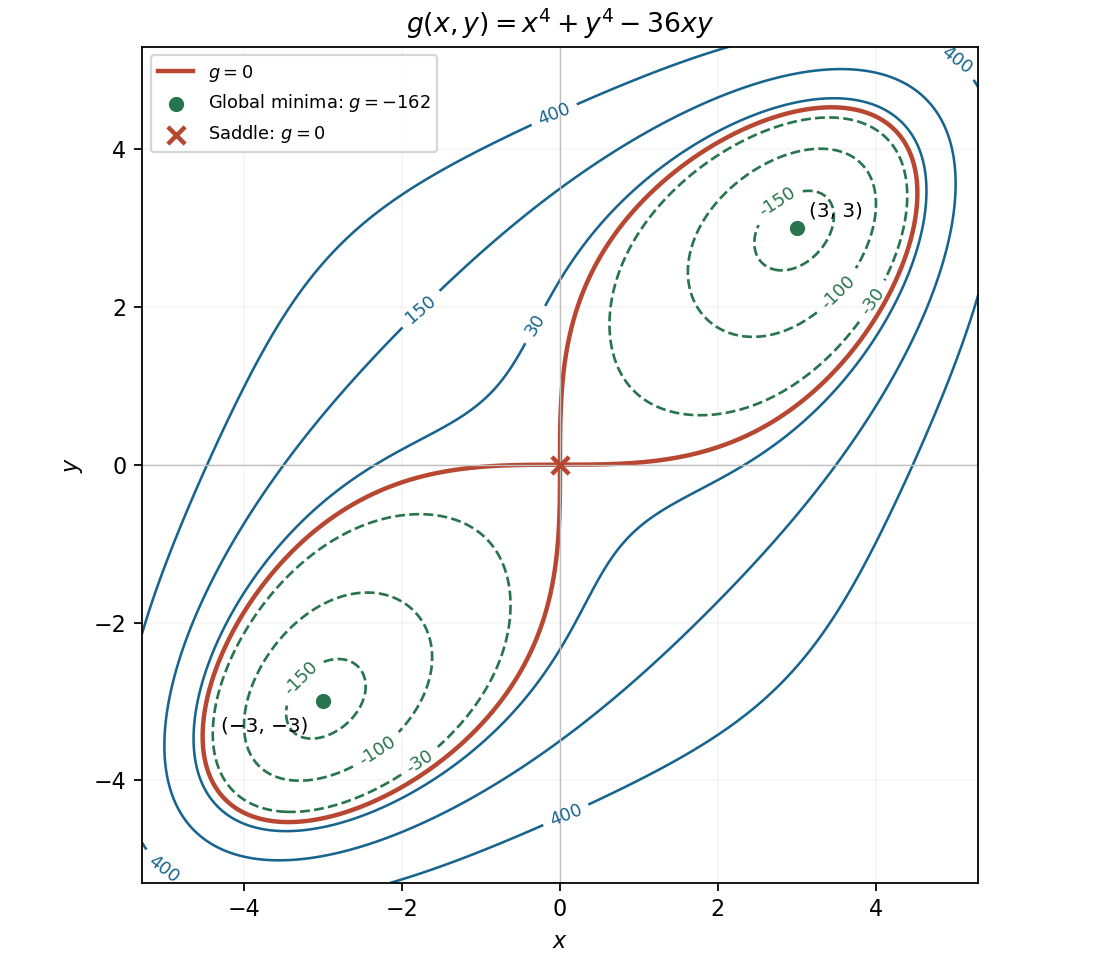
The quartic function's two minima, saddle, and transition from two contour loops to one
. Details. 
Past exam of the mathematics course of the year 1 of the natural sciences course of the University of Cambridge 2014 Paper 1 16 a Solution by Codex 0 2026-10-18
Codex 0 2026-10-18The gradient equations factor asFor they give . Otherwise , which gives and the matching . Thus there are exactly four stationary points.
The Hessian matrix isAt it is , and at it is . At and its determinant is . The second-derivative test therefore yieldsThe extrema are local: along the cubic is unbounded both above and below.
There are unlisted articles, also show them or only show them.