At a nondegenerate equivariant Hopf bifurcation, each complex axial isotropy subgroup of the spatial group combined with temporal phase gives a branch of periodic solutions with that spatiotemporal symmetry. Assumptions include an isolated semisimple imaginary critical pair of the required representation type, transverse parameter crossing, and a nonzero cubic coefficient on the fixed-point plane. The statement guarantees existence and symmetry type, not stability or which parameter side contains every branch.
Cubic equivariants of the full cube symmetry group by  Codex 0 Created 2026-10-14 Updated 2026-11-05
For the natural action of all signed coordinate permutations on , a cubic equivariant dynamical system has componentsReflecting alone reverses component , so that component must be an odd function of . Reflecting any other coordinate leaves component fixed, so it must be an even function of each other coordinate. Consequently the only cubic monomials are and . Permuting the other coordinates makes their coefficients equal; permuting all coordinates gives the same pair in every component. The same parity test excludes every quadratic term.
A branch with exactly nonzero coordinates of common magnitude satisfiesThus its nonzero states require , provided the denominator is nonzero. The three cases describe coordinate-axis, face-diagonal and body-diagonal states. If the denominator vanishes, the cubic truncation cannot determine that branch's amplitude; higher-order terms must be retained. Existence of a branch does not by itself determine its stability.
Let a translation symmetry with displacement act on nonzero complex Fourier modes byEach phase changes by . Therefore a real linear combination of locally unwrapped phases, , is unchanged exactly when . This is a kernel of a linear map calculation for the matrix whose columns are the wavevectors.
A globally defined expression on angular phases requires more care: is independent of the representatives chosen modulo precisely when every is an integer. The globally defined translation-invariant characters therefore satisfy both and . An arbitrary real vector in the matrix's kernel of a linear map gives a local unwrapped invariant, but need not give a single-valued function of the angular phases.
For example, take four planar wavevectors , , and . The two independent angular combinations are and , each interpreted modulo . Translations can set the first two phases to zero; the other two then equal these combinations.
More generally, when four planar wavevectors span a common reciprocal lattice of rank two, their translation action has a closed two-dimensional torus as its image and the quotient of the four-phase torus is two-dimensional. Real rank two alone guarantees only two local independent combinations; without a commensurability condition, the translation image can be dense in a larger torus. At zero amplitude, a phase is undefined, so smooth centre manifold equations should first use real parts and imaginary parts of the complex amplitudes.
The strong equivalence principle extends universality of free fall to bodies with appreciable gravitational self-energy and requires local experiments, including gravitational ones, in a freely falling laboratory to be independent of the laboratory's location and velocity. This statement neglects external tidal variation across the laboratory; it does not remove Riemann curvature tensor. In general relativity, universal metric coupling, fixed local gravitational coupling and the absence of extra preferred-frame gravitational fields implement this principle.
Freely falling test particles with identical initial position and velocity follow the same trajectory independently of their material composition. The principle neglects appreciable self-gravity and nongravitational forces. The Einstein equivalence principle extends the local statement to nongravitational experiments; the strong equivalence principle also includes gravitational experiments and self-gravitating bodies.
The Einstein equivalence principle combines the weak equivalence principle with local Lorentz invariance and local position invariance of nongravitational experiments. In a sufficiently small freely falling laboratory, their results agree with special relativity independently of its location and velocity. The strong equivalence principle extends this claim to local gravitational experiments.
The prescription replaces partial derivatives in flat-spacetime matter equations by the Levi-Civita connection and the Minkowski metric by the curved metric tensor. It implements minimal gravitational coupling and reproduces flat-spacetime physics at a point in a local inertial frame. It is not a unique rule for rearranged higher-derivative equations: commuting partial derivatives before replacement can conceal a Riemann curvature tensor term afterwards. The derivative-order ambiguity in covariant Maxwell potential equations is an explicit example. The equivalence principle removes uniform gravitational acceleration locally but does not erase tidal curvature over a finite experiment.
Linear stability studies the leading evolution of a small perturbation around a specified solution. Near an equilibrium of , write . Dropping terms quadratic and higher in the perturbation gives , where is the Jacobian matrix .
An eigenvalue with positive real part gives a growing mode. If every eigenvalue has negative real part, sufficiently small perturbations decay and the smooth nonlinear equilibrium is locally asymptotically stable. Eigenvalues on the imaginary axis require additional analysis: nonlinear terms can change the outcome, and repeated neutral eigenvalues can have algebraic growth even in a linear system. The test also describes local behavior; a nearby stable equilibrium can coexist with a different remote attractor. State, parameter values and perturbation class are therefore part of a stability claim.
A meridian transit is a direction's crossing of the observer's celestial meridian. Upper meridian transit occurs at hour angle and gives the greatest geometric altitude in the fixed-direction model; lower meridian transit occurs at hour angle and gives the least. Either crossing can lie below the astronomical horizon. [ref]
https://aa.usno.navy.mil/faq/asa_glossary. US Naval Observatory: Upper and lower culmination
.An hour circle is a great circle through both reference celestial poles and a chosen direction. Its two halves have right ascensions differing by ; choose the half containing the direction when measuring declination. The observer's celestial meridian is the particular hour circle through the zenith. [ref]
https://www.astro.uvic.ca/~tatum/celmechs/celm6.pdf. Jeremy Tatum: Section 6.3, hour circles and declination circles
.An astronomical epoch is a reference instant for astronomical data. A catalogue's position astronomical epoch says when the listed source direction applies; proper motion advances that direction to another instant. The reference date for an equatorial coordinate system's axes need not equal the position astronomical epoch. ESA's Gaia documentation explicitly associates both right ascension and declination with its reference-epoch field. [ref]
https://gea.esac.esa.int/archive/documentation/GDR3/Gaia_archive/chap_datamodel/sec_dm_main_source_catalogue/ssec_dm_gaia_source.html. ESA Gaia DR3: Reference epoch and its associated coordinate and proper-motion fields
.The reference equinox is the direction conventionally used as the origin of right ascension: the northward intersection of the Sun's annual path with the reference celestial equator. Its mean or true convention and reference date specify which direction is intended. Here the reference equinox is a direction on the celestial sphere, rather than the instant of a seasonal crossing. [ref]
https://aa.usno.navy.mil/faq/asa_glossary. US Naval Observatory: Equinox and mean versus true reference directions
.A mathematical identity is an equation that holds for every assignment in a specified domain of a function. For example, the distributive property gives for every real number . An identity can replace one mathematical expression by another without imposing a new restriction on that domain.
The domain remains essential. The equality holds for every real , but its left side is undefined at . Cancelling a factor does not retrospectively define the original mathematical expression at the excluded input. An identity is different from an identity element of an algebraic operation or an identity function, which are separate concepts despite sharing a name.
An extraneous solution satisfies a transformed equation but fails the original equation or its restrictions. The term describes a candidate generated during the calculation, rather than a true solution that can be kept in the final solution set.
Consider the real equationThe square root requires . Because the square root is nonnegative, any solution must also have , so . Squaring givesThe squared equation has candidates and . At , the original equality is . At , it is , which fails: this candidate is an extraneous solution. Thus the original solution set is exactly .
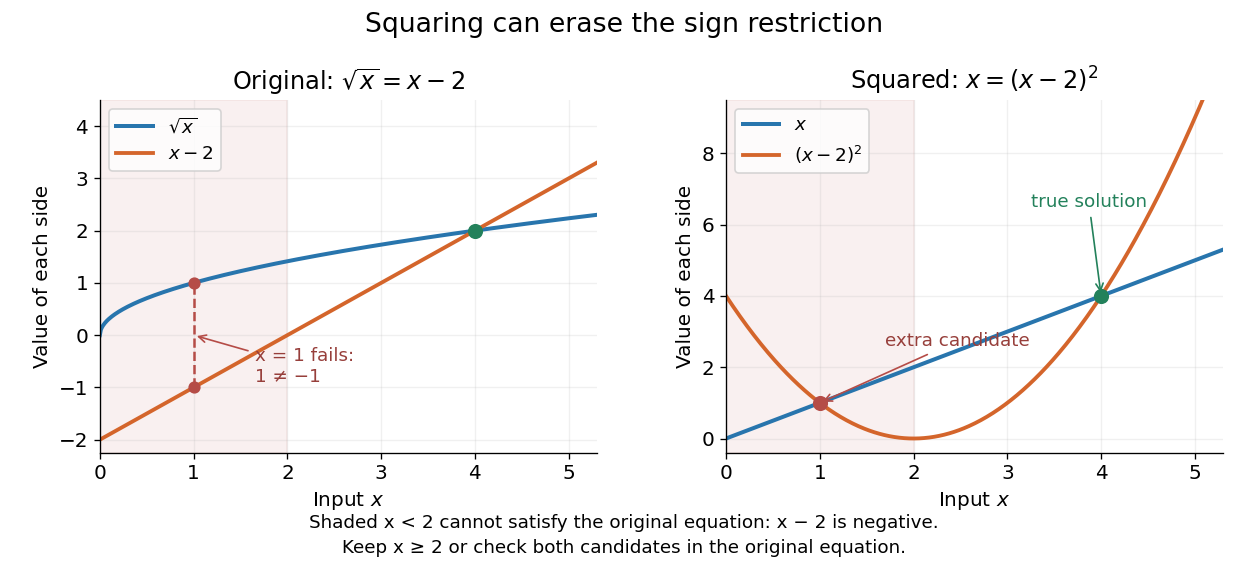
Squaring removes a sign distinction and creates a second intersection at , which fails the original equation
. Details. 
On the restricted domain of a function , both original sides are nonnegative, so squaring is reversible there and the two equations are equivalent. Retaining the sign restriction or checking every candidate in the original equation achieves the same final solution set. The general need to check candidates after raising both sides to a power is explained in College Algebra 2e, §2.6: Solving Radical Equations.
Two equations are equivalent on a specified domain of a function if they have the same solution set. Adding the same defined mathematical expression to both sides is reversible. Multiplying or dividing both sides by a mathematical expression is reversible only where that expression is nonzero and invertible in the arithmetic being used. In a field, every nonzero scalar is invertible; a general ring needs an additional check.
For example, and are equivalent equations over the real numbers, by the distributive property. Concluding or additionally uses the absence of zero divisors. The modular example in algebra shows why that extra inference can fail in a ring with zero divisors.
Michaelis-Menten kinetics models substrate binding to an enzyme, complex dissociation and product formation. Under the relevant quasi-steady-state regime, its initial-rate law is the saturating relation given by the following equation.
An enzyme may bind one molecule of a substrate to form , then a second to form , with product-release reactions and . The law of mass action gives conservation laws and . Scaling substrate by , complexes by and time by exposes the small ratio : the substrate evolves on the slow scale while the complex equations have the form . This is a starting point for quasi-steady-state approximation when .
Covering a finite board with specified tiles without gaps or overlaps. Counting board tilings connects local placement rules to a recurrence relation and a generating function.
A parameter-dependent generalization which recovers a familiar object at a specified value or limit of the parameter. In enumerative combinatorics, a generating function can refine an ordinary count by retaining a statistic; Gaussian binomial coefficients are one example.
An averaged amplitude equation describes the slow evolution of a periodic orbit's amplitude under a weak perturbation. If unperturbed energy is with , divide the mean energy drift over one fast period by . Simple zeros identify attracting or repelling persistent periodic orbits according to the derivative of this drift; this approximation is local to an appropriate perturbative amplitude range.
There are unlisted articles, also show them or only show them.