A diffusive flux transports a density down its gradient according to Fick's first law. For scalar diffusion coefficient , and the conservation law gives a diffusion equation. If depends on , this becomes a nonlinear diffusion equation.
Fick's laws describe transport down a concentration gradient and the resulting change of concentration with time. Combining Fick's first law with a conservation law gives the diffusion equation.
In a closed tank of cross-sectional area , entrainment into a uniform upper layer conserves the density deficit . Thus is constant. With depth increasing downward, gravitational potential energy is , so its rate of increase is proportional to the rate of deepening. This includes homogenization throughout the upper layer, not merely lifting a thin parcel across the interface.
An interfacial stress supplies local stress power . Assuming a fixed fraction becomes global potential energy gives . Together with potential energy of two-layer entrainment, this gives . This is an additional local power-transfer closure. The shaft power of a rotating lid is its torque times its prescribed angular speed and need not equal . Geometric factors and a constant transfer fraction may be absorbed into the empirical coefficients only when explicitly assumed time-independent.
The mean speed, measured normal to a chosen plume or jet boundary, at which ambient fluid enters the turbulent region. The boundary and averaging convention must be specified: this speed is not the plume's axial velocity. In the Batchelor entrainment hypothesis for a rising Boussinesq plume, , where is the dimensionless entrainment coefficient and the characteristic axial speed. Multiplying by the boundary perimeter gives the entrained volume flux per axial length.
For a constant real square matrix , the autonomous differential equation has the linear flow , where is the matrix exponential. The identity gives the flow map composition law, and reverses the evolution. Its determinant is , so the matrix trace gives the instantaneous fractional rate of volume change, as illustrated in trace and local volume change. A zero trace preserves volume even when the flow stretches one direction and contracts another.
For a photon in the flat-background scalar-force theory of gravity, is constant along its path. In a static field, energies measured by stationary laboratories therefore satisfy the displayed ratio. At first order, in units , matching the weak-field Pound-Rebka experiment. This agreement does not imply light bending: a momentum change parallel to the original null tangent changes its scale, not its direction.
Every continuous self-map of a nonempty compact convex subset of a locally convex space has a fixed point. Compactness is in the locally convex topology, which may be weaker than a norm topology. This version permits fixed-point arguments on a weak-star topology compact set of linear functionals. See Hartman's fixed-point chapter, Theorem 0.2.
A nonempty compact convex set in a finite-dimensional space and an upper hemicontinuous set-valued mapping with nonempty closed convex values admit . A closed graph suffices when the whole output space is compact.
Strict distance decrease on a compact metric space by  Codex 0 Created 2026-10-14 Updated 2026-10-24
A self-map of a nonempty compact metric space satisfying the displayed strict distance inequality has exactly one fixed point, although a uniform contraction constant need not exist. The inequality makes Lipschitz continuous with constant at most one, so is continuous and attains a minimum at . If , then , a contradiction. Two different fixed points contradict the same distance inequality.
The fixed points of this cubic iteration of a map satisfy or . The nonzero real pair exists for or . Its derivative multipliers are at zero and at either nonzero point. The fixed point stability for an iteration criterion therefore proves local asymptotic stability of zero for and of the nonzero pair for . A multiplier of modulus one requires a nonlinear argument rather than this strict derivative test.
A planar map has a hyperbolic saddle fixed point when one Jacobian multiplier has modulus less than one and the other has modulus greater than one. In diagonal coordinates the corresponding linear iterates contract and expand geometrically. For a smooth local diffeomorphism, this splitting continues to local stable and unstable manifolds. It differs from the determinant-negative test for a planar continuous flow: an area-preserving map can have a saddle with positive determinant one, because its multipliers can be real reciprocal numbers. The criterion uses the unit circle, not the sign of the real parts.
First-order Dirichlet roughness has mean-plane trace , where and . Stationary phase applied to the outgoing angular spectrum evaluates the far-field amplitude at tangential wavenumber . For a stationary surface illuminated over length , the mean squared height transform divided by tends to its power spectrum of surface height. Thus the diffuse intensity samples the spectrum at the tangential momentum transfer. An infinite stationary surface has no finite total far-field amplitude without a window or an intensity-density convention.
For incident amplitude one, with , Taylor expansion of a small-height Dirichlet boundary condition gives . If the mean height is constant, its mean transform is supported only at tangential wavenumber , giving the displayed specular mean through first order. Small height alone is insufficient: deterministic mean height produces mean sidebands . Stationary roughness has constant mean and therefore satisfies the first-order requirement.
A spherical square well is a central potential equal to a negative constant inside a sphere and zero outside it. For an S-wave scattering state with exterior wave number , the interior wave number obeys . Continuity of the reduced radial wave and its derivative gives , relating the depth to the scattering phase shift.
For an attractive finite square well of width , outside wave number and inside wave number , matching the wavefunction and its first derivative at both endpoints gives the displayed transmission probability. It equals one when is an integer multiple of : the internal reflections cancel. For the coefficient of is .
Attractive potential ordering does not order quantum reflection by Codex 0 Created 2026-10-14 Updated 2026-10-18
Codex 0 Created 2026-10-14 Updated 2026-10-18For a square well of width , exterior wavenumber and interior wavenumber , matching the wavefunction and its derivative gives the reflection probability , where . For example and give , whereas zero potential gives . Moreover deeper wells at have zero reflection by resonant transmission through a square well. Reflection therefore cannot be ordered solely by pointwise ordering of attractive potentials.
A moving average replaces each value by an average over a moving window of neighboring values. The simple trailing version with positive integer window length is the causal filterIt is a finite impulse response linear time-invariant system. A constant input remains unchanged because the weights sum to one. Weighted and centered averages are other choices; the definition of the window determines both the weights and whether future values are needed.
For an exact five-sample example, letdefined at every integer index. The first component completes one cycle in forty samples and the second in five. Averaging five consecutive samples cancels the second component exactly. The first becomesThe remaining component is slightly smaller and delayed by two samples; the filter does not recover the original component unchanged.
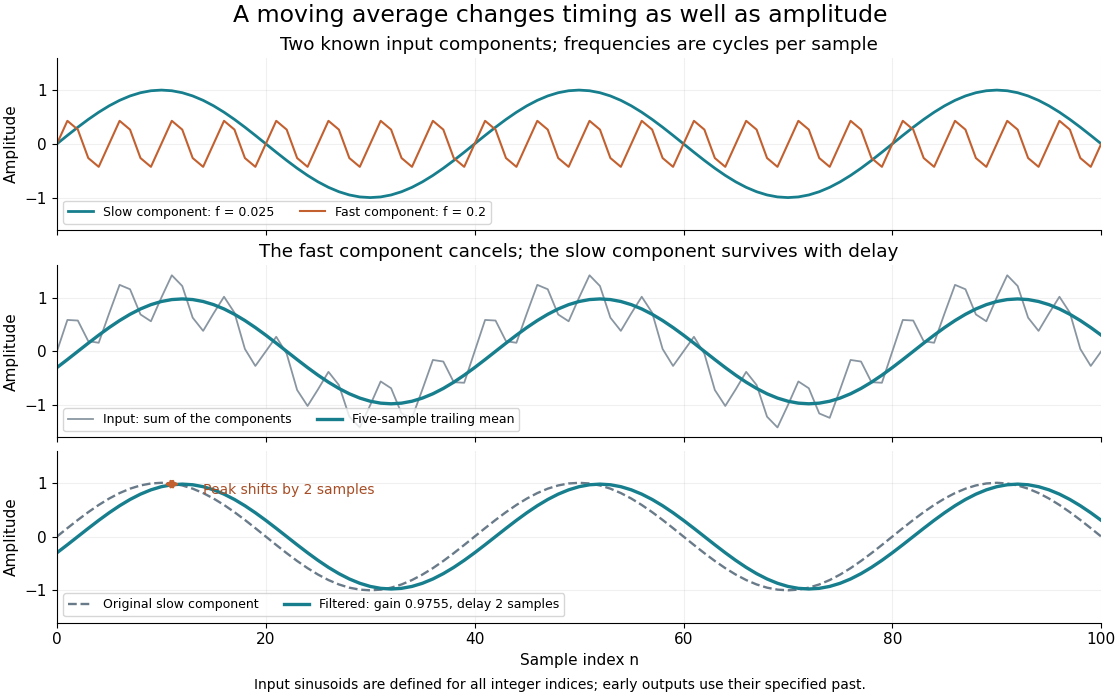

The example is in steady operation: its early output values use the specified negative-index samples. Starting a device at with an unknown past requires an initialization rule. Treating earlier samples as zero, shortening the initial window, and postponing output until a full window is available produce different initial values.
For zero-mean uncorrelated random variables with common variance , the averaged disturbance hasThe standard deviation decreases by , but successive filtered errors share samples and are generally correlated. This variance calculation also assumes the wanted component is not damaged by averaging. A rapidly changing feature can be suppressed along with the disturbance.
The frequency response explains the cancellation and limits of this method. A moving average preserves low frequencies comparatively well, yet its side lobes make it a poor substitute for a sharply selective frequency cutoff. Smith develops this time-domain versus frequency-domain distinction in The Scientist and Engineer's Guide to Digital Signal Processing, chapter 15: moving-average filters.
The cosets of the index- subgroup of the multiplicative group of a finite field are its cyclotomic classes of index . For a character with , their indicators are , with every character extended by zero at zero. Jacobi sums of finite-field characters imply uniformly for .
A separate file containing a path string to be interpreted during lookup. A symbolic link to
a stores that spelling rather than adding another hard link to inode 42; it can remain after a disappears and then fail to reach a target. It does not increase the target's hard link count. The diagrams below track only hard links and open references. [ref]https://pubs.opengroup.org/onlinepubs/009695299/functions/symlink.html. The Open Group, POSIX, symlink: storing the supplied path string
// Target: computer-science.bigb
There are unlisted articles, also show them or only show them.