
A directory entry associating a name directly with an existing file. In the inode-based example, successful
link("a", "b") adds the second name for inode 42 and increases its hard link count from 1 to 2. Both directory entries have equal status; removing a leaves b usable. This example assumes both names are in the same file system, the destination name is unused, and the operation is permitted. [ref]https://pubs.opengroup.org/onlinepubs/9699919799/functions/link.html. The Open Group, POSIX.1-2017, link: adding a directory entry and incrementing the link count
Which contents pass through the journal and which persistence dependencies accompany them. The ext4 documentation distinguishes these modes: file metadata and contents both pass through the journal in
data=journal; only file metadata is journaled in data=ordered, with associated contents forced to final locations before metadata commit; only file metadata is journaled in data=writeback, without that data-before-commit dependency.[ref]For our append, full data journaling uses the three-record model. Ordered metadata journaling protects in the journal and first persists directly in free block 9. Before commit, changing an unreferenced free block does not change the visible old file; after commit, journal replay supplies the new file metadata and the new contents are already durable. Without that dependency, recovery can produce correct allocation and size but stale contents in block 9. Ordered metadata journaling does not give general all-or-nothing contents for overwrites of already allocated file data blocks, nor does it combine arbitrary application writes into a file-system transaction. The choice of protected records determines the scope of the guarantee.
Making a recoverable journal entry durable before installing its protected updates at their final locations. In this article the journal contains new record images, so recovery redoes committed changes rather than undoing uncommitted changes. The diagrams assume one isolated file-system transaction, fresh journal slots with unambiguous record identities, no other writer, and atomic storage writes for each record and marker. A crash loses volatile state; previously durable contents remain intact. Storage flushes are honored, and recovery finishes before the file system is exposed. These are model assumptions, not a claim that every physical file data block write is indivisible on arbitrary hardware.
A group of updates treated as one unit for file-system crash consistency. The three-record append above is one explicitly chosen group. Real file-system journaling can batch several system calls or split large work across several groups; it does not automatically make an application's several writes into one file-system transaction. An atomic operation for competing software threads likewise does not by itself provide file-system transaction durability.
Creation shows why the group must include every related change. In a toy file-system directory with space for one more name, creating
notes with contents EFGH needs a directory entry mapping notes to newly allocated inode 42, an inode allocation bitmap marking 42 in use, that inode with size 4 and a reference to block 9, a block allocation bitmap allocating 9, and file data block 9 with the contents. An exposed directory entry must reach an allocated inode, and its content references must reach allocated file data blocks. Protecting just the inode leaves these relationships outside the file-system transaction. This simplified five-record creation excludes parent-directory growth, timestamps and allocation counters; a real file system must include its own additional dependencies.The guarantee that recovery produces a valid file system state under a specified crash model. For the protected file-system transaction in our full-data example, the observable file is either
ABCD or ABCDEFGH; it never names a free block or exposes a half-applied protected append after recovery. This concerns the recovered state. The intermediate final-location records during a journal checkpoint may disagree until journal replay finishes, and live concurrent access requires separate synchronization.An association between a name in a file-system directory and a file. In the toy file system, the pairs are
(a, 42) and (b, 42): each name resolves to the same inode. The name belongs to the directory entry, rather than being the single authoritative name stored in that inode.A file-system allocation bitmap for storage blocks. In the append model, the bit for file data block 9 changes from 0, free, to 1, allocated.
A record of an open access to a file, including its current position and access mode. Each file descriptor reaches one open file description, but several file descriptors can share it. Separately opening the same ordinary file creates separate open file descriptions with independent positions while still reaching the same inode. Thus file descriptors, open file descriptions and hard links have different counts. [ref]
// Target: computer-science.bigb
FAT32 is a File Allocation Table filesystem variant using 32-bit table entries with fewer bits available for cluster numbers. A directory entry stores file size in a 32-bit unsigned field, limiting one ordinary file to bytes. This limit is distinct from a volume's capacity, which also depends on sector and cluster layout and implementation restrictions. FAT32 is widely interoperable but lacks native per-file security ACLs and metadata journaling of the kind provided by NTFS. Filesystem limits should be distinguished from a formatting tool's additional limits.[ref]
https://learn.microsoft.com/en-us/windows/win32/fileio/filesystem-functionality-comparison. Microsoft, file-size limits and security comparison
// Target: computer-science.bigb
A triangular number counts rows of objects, with a nonnegative integer:The first values are . The empty arrangement contributes zero, by the empty sum convention. Adding one more row gives the triangular number recurrence for . The row lengths form an arithmetic progression, while their running totals are triangular numbers.
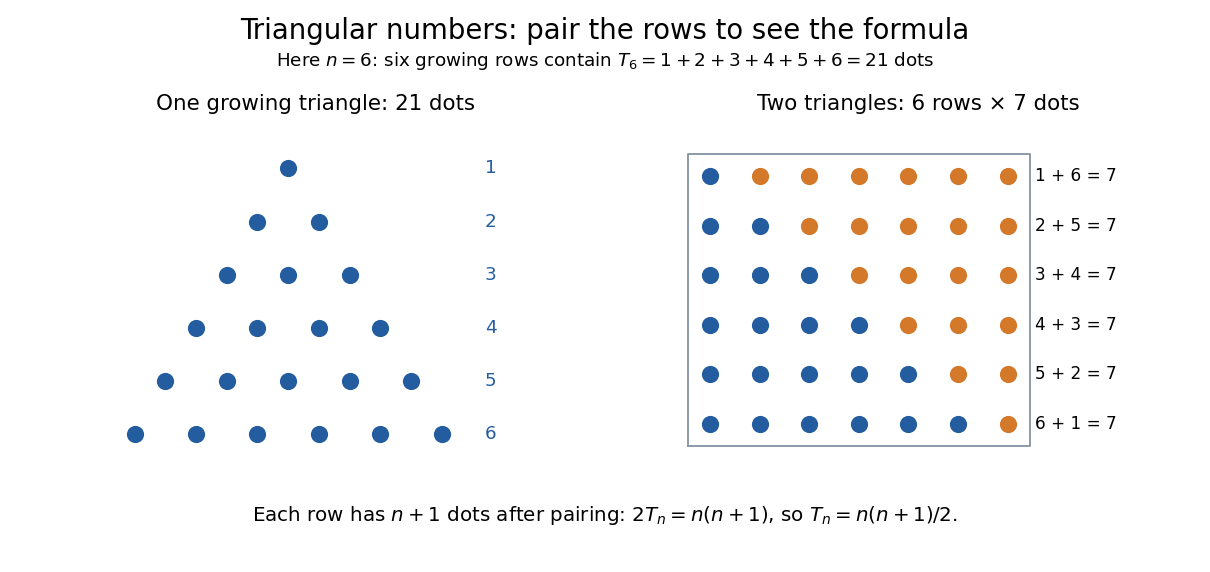
Pair the rows with a reversed copy: . There are such pairs, so two copies contain dots. Dividing by two proves the formula. This rectangle picture explains the factor one-half without requiring a formula for a long summation. For example, one hundred rows contain dots.
The same count appears whenever every pair of different objects must be considered once. Five participants make ten possible handshakes; five sensors have ten different pairwise comparisons; a complete graph on five vertices has ten edges. These are the triangular number pair-counting identity, with one fewer row than objects. The distinction prevents a common error: counts all pairs from six objects, whereas five objects give .
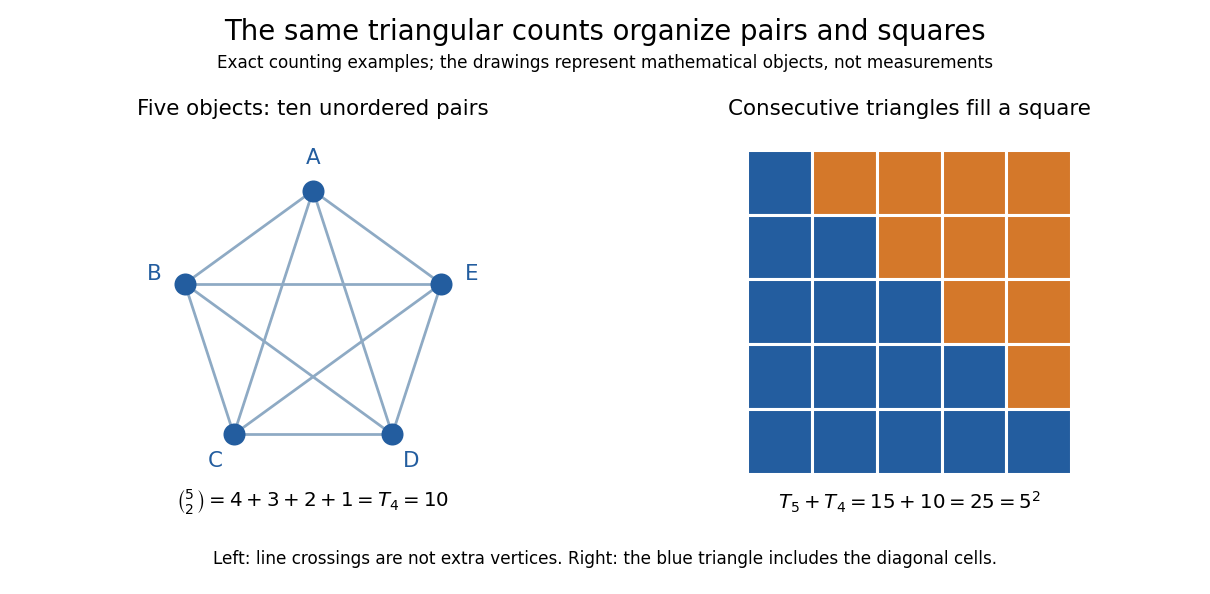


The triangular number square-complement identity says that two neighboring triangular numbers fill a square. Combining that identity with the one-row difference makes the difference of squares equal to . It leads to Nicomachus's theorem: the sum of the first cubes of numbers is the square of a number . A change in the way one groups objects exposes a relation between summation, multiplication and geometry.
This geometric view is already visible in Nicomachus's Introduction to Arithmetic by Nicomachus (Hahn teacher edition): Book II, Chapter 8 describes growing triangular rows, Chapter 12 combines successive triangular counts into squares, and Chapter 20 groups successive odd integers into cubes of numbers.[ref]
Introduction to Arithmetic by Nicomachus (Hahn teacher edition). Book II, Chapters 8, 12 and 20, printed pp. 63–64, 70 and 75
The linked edition uses Martin Luther D'Ooge's translation, revised with modern teaching material by Nathanael Hahn. Our empty-row index is a modern convention; the historical passage starts from unity and calls three the first actual triangle.K-essence is a cosmological scalar-field mechanism in which noncanonical kinetic dynamics supply negative pressure or accelerated expansion. Its action is a particular use of a P(X, phi) scalar field theory; that general action also includes theories without kinetic dark energy.
A field extension is algebraic if every element of is an algebraic element over . Every finite field extension is algebraic, but algebraic extensions can have infinite degree.
A field extension obtained by adjoining finitely many square roots in characteristic different from two. If the classes of are independent in , the extension has degree and Galois group : each square root's sign can be changed independently. The products of distinct square roots form a basis over .
The algebraic conjugates of an algebraic element over a field are the polynomial roots of its algebraic minimal polynomial over in an algebraic closure.
The algebraic conjugates of an algebraic number are the polynomial roots of its algebraic minimal polynomial, equivalently its images under field embeddings of its number field into an algebraic closure.
A field is Hilbertian if each finite family of polynomials irreducible over and separable in its root variable remains irreducible of the same degree at infinitely many , after any finitely many prescribed bad parameter values are excluded. Equivalently, every finite separable extension of has infinitely many unramified -rational places whose residue extension retains its full degree.
For each positive integer , the product of the preceding Fermat numbers is two less than the next:For example, . The identity telescopes by repeated difference of squares: . Its usefulness is that a huge integer product exposes a tiny difference, two, from the next term.
The set of all feasible points of an optimization problem. It depends on the optimization constraints and the decision domain; the objective function ranks its members.
Think of three successive questions. Which decisions can be represented in the model? Which satisfy every optimization constraint? Which of those receive the best objective function value? For decisions in a domain , inequalities and equations define the feasible regionThe domain must be contained in the domain of a function for every function being evaluated; choosing integers rather than real numbers as decisions can also change the feasible set. Constraint satisfaction determines membership of . Minimizing an objective function then compares its members by , with optimal value . Changing the scores while keeping and the optimization constraints fixed leaves unchanged, provided the new objective function is defined throughout . These distinctions separate an allowed decision from a best decision.[ref]
Convex Optimization by Stephen Boyd and Lieven Vandenberghe. §4.1.1, printed pp. 127–128: problem domain, feasible set, optimal value and attainment
Let be nested normal linear models with full-rank design matrices of ranks , where , and observations. Under the reduced model,The difference of the orthogonal projection matrices onto the two model spaces is an orthogonal projection of rank , orthogonal to the full-model residual projection. Independent normal distribution projections therefore give independent chi-squared numerators and denominators after division by . This proves the ratio law. The test evaluates the extra terms conditional on all reduced-model terms, and estimates the unknown common variance from the full model.
A set family on a finite set separates ordered pairs if each ordered pair of distinct points has a member containing the first point and omitting the second. If its members are , assign each point the characteristic vector of its incidences, or equivalently . Separation in both directions says precisely that the form an antichain in the Boolean lattice on coordinates. Thus the Sperner theorem gives . Conversely, any antichain of distinct subsets of supplies such a set family by transposing its incidence table.
There are unlisted articles, also show them or only show them.