If all members of a set family on have odd size and all distinct pairwise intersections have even size, its characteristic vectors over the finite field are linearly independent. Their pairwise dot products are zero, and each vector has dot product one with itself. Taking the dot product of a linear combination with each vector makes every coefficient vanish, so there are at most vectors. The set family of all singleton sets attains this bound.
If every member of a set family on and every distinct pairwise intersection has even size, its characteristic vectors span a self-orthogonal binary subspace. The standard dot product is nondegenerate, so implies . Thus the set family has at most members. All unions of disjoint pairs of points attain this bound.
For the optimized left-to-right exponentiation by squaring algorithm, let be the length of the binary expansion of a positive integer , and let be its Hamming weight, the number of digits equal to one. There are exactly digits after the leading one, and exactly remaining ones. Therefore the count isHere counts squarings and counts further multiplications by the base; every squaring counts as one multiplication in . Assignment, digit reading, and any inversion are outside this count. The formula includes , which requires zero multiplications; define separately.
For a fixed length , the bounds are . A power of two reaches the lower bound because its Hamming weight is one; reaches the upper bound because all digits are one. For , and , giving . Thus the arithmetic operation count is in Big O notation, but inputs of similar magnitude can have different counts.
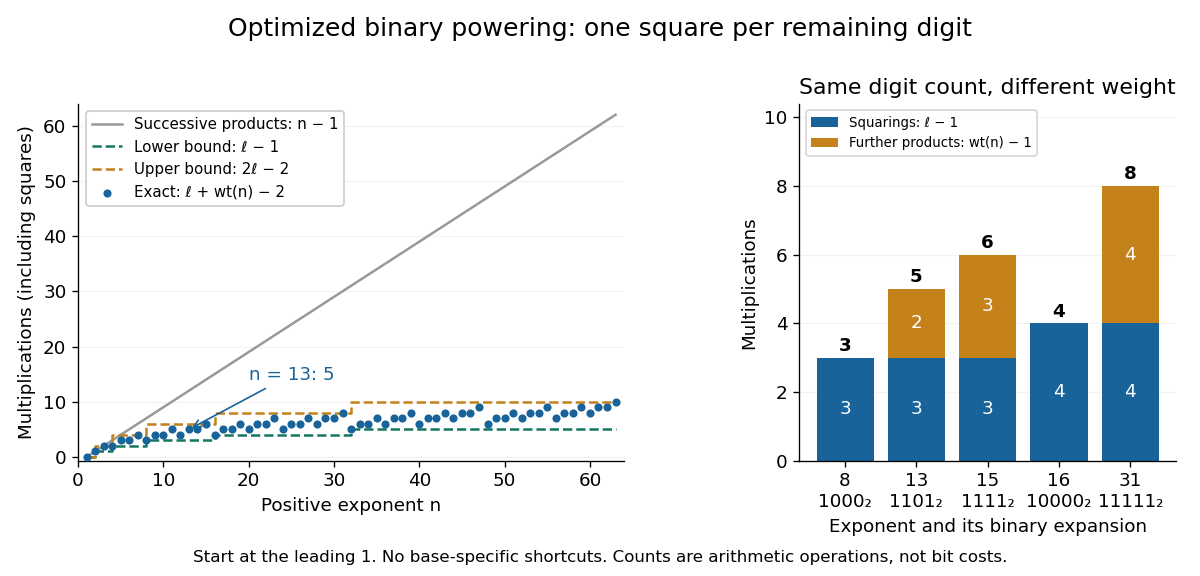
Exact multiplication counts for optimized exponentiation by squaring depend on binary length and Hamming weight
. For positive exponents through , dots show , including each squaring. The dashed curves bound all counts at each binary length. Successive multiplication needs operations. The second panel compares squarings and further multiplications for exponents . These are exact counts, not timing measurements. Details.
This is a count for the specified algorithm, not a claim that it always minimizes multiplications among all methods. For instance, at the count is six, but the powers with exponents can be built in five multiplications: square, multiply by , square, square, then multiply by the already stored . Saving operations this way uses a different schedule and stored intermediate powers.
A stretched exponential has the form with and . A boundary cost proportional to the square root of an enclosed area naturally produces exponent .
Methods of detecting exoplanets infer or resolve an exoplanet through its effects on the host star's light or through its own light. The observable determines what can be learned:
- Doppler spectroscopy measures changes in a star's line-of-sight velocity from its spectral lines, constraining a companion's mass, orbital period, and orbital eccentricity, with an orbital inclination ambiguity.
- Exoplanet transit photometry measures a repeating dip in the star's observed radiative flux, constraining the exoplanet's radius relative to the star and its orbital period. It requires a suitably aligned orbit.
- Astrometry measures a star's changing position on the sky from stellar reflex motion; with adequate orbital coverage it can constrain orbital inclination and the companion's true mass.
- Gravitational microlensing detects a companion's perturbation of the temporary brightening of a background star. Such alignments are usually not repeatable, and additional information is needed to turn fitted ratios into absolute masses and separations.
- Exoplanet direct imaging spatially separates an exoplanet's light from its host star's light, enabling studies of an exoplanet atmosphere and, over time, its orbit.
An exoplanet secondary eclipse measures the loss of the exoplanet's light when it passes behind its star, complementing exoplanet transit photometry. A detection method also selects which systems are easiest to find: deeper exoplanet transits favour larger radius ratios, and larger stellar radial-velocity semi-amplitudes favour more massive companions, shorter orbital periods, and larger . These preferences must be accounted for when inferring the underlying exoplanet population.
In an economy with a measure space of consumers, a consumption allocation is a measurable, integrable function assigning each consumer a feasible bundle. Exact aggregate feasibility means .
A demand correspondence assigns a nonempty set of chosen consumption bundles to each price and wealth pair. Every chosen bundle satisfies the budget constraint. A utility function rationalizes the demand correspondence when the chosen bundles are exactly its maximizers over the budget set.
A price quasi-equilibrium with transfers is an exactly feasible consumption allocation and a nonzero price vector for which, almost everywhere, every strictly preferred bundle has cost at least . The transfer-adjusted wealth is ; transfers sum to zero. Equal-cost strict improvements may remain, which distinguishes a quasi-equilibrium from a utility-maximizing equilibrium. Nonnegative prices need extra assumptions if goods may be undesirable.
Aggregate excess demand subtracts total endowment from the sum of consumers' demand correspondences. A market-clearing price satisfies . Under Walras law, one equation is redundant after price normalization.
An exchange economy is regular when the derivative of its reduced aggregate excess demand has full rank at every equilibrium. For two goods and normalized prices , this means at every zero of first-good excess demand. Regular equilibria are locally isolated and persist smoothly under small parameter changes.
Write and , with . The prime-power formula for the Euler totient function gives an integer contribution to from each prime: it is when , and when . Multiplying proves the divisibility assertion, including with .
If is odd, its Euler totient function is even and cannot divide . Otherwise write with odd primes and . Comparing powers of two in gives . Thus there is at most one odd prime , with . Since divides , it divides , and is coprime to ; with only the prime factors available it must be a power of two. Hence and . Conversely, for the prime-power totient formula verifies divisibility for , and is immediate.
The map is a bijection of the integers between one and that are coprime to . If their sum is , this bijection gives , so . This works even at , where the single residue is fixed. The same identity follows from the weighted inclusion-exclusion principle by excluding multiples of the prime factors of .
The divisor sum of Euler's totient function is the identity arithmetic function:Equivalently, under Dirichlet convolution, with the constant-one arithmetic function. [ref]
Floor and arithmetic functions by Darij Grinberg. Darij Grinberg, MIT 18.781 lecture notes, Propositions 2.4.4 and 2.4.5
To see why, group the integers by . Each is a positive integer divisor of . Within its group, with and , by the scaling identity for greatest common divisors. Dividing by gives a bijection with the integers counted by . The groups form a partition of a set, soFor , the groups with greatest common divisor are respectively . Their sizes are , totaling . Möbius inversion reverses this divisor sum to recover Euler's totient function from .
For a unit modulo n and a nonnegative integer , division with remainder writes with . Euler's theorem then givesThis replaces a potentially enormous exponent by a small remainder. The exponent itself is reduced modulo Euler's totient function, while the powers are reduced modulo : these are different integer moduli.
For a worked modulo-fifteen calculation, seven is coprime to fifteen and . ThereforeUse exponentiation by squaring on the remaining exponent , reducing after each multiplication:Thus . Modular exponentiation supplies the computation; Euler's theorem supplies the optional shortening of its exponent. Exponentiation by squaring also works for nonunit bases, without using this shortening.
The guaranteed exponent is a common return exponent and an upper bound on the shortest period; it need not be that period. The multiplicative order is the least positive return exponent for the chosen unit. The Carmichael function is the least positive return exponent that works for every unit. Their precise relation isEither smaller return exponent can replace in exponent reduction for units. Modulo fifteen, , so gives immediately. For base four the multiplicative order is only two, smaller even than . A return at exponent eight alone does not prove that the multiplicative order is eight.[ref]
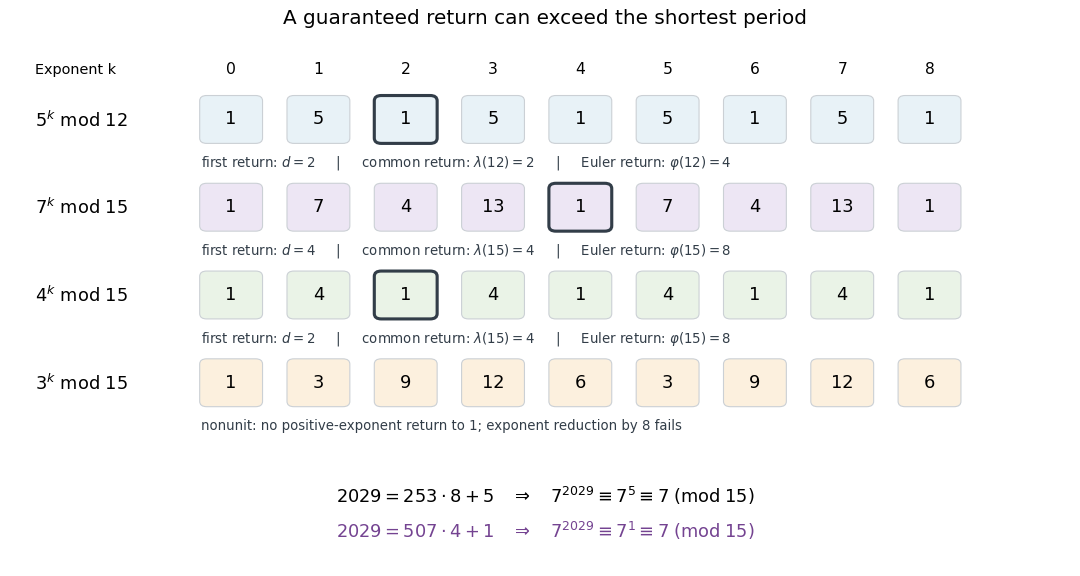
Actual power periods, Carmichael function exponents and Euler return exponents
. Each row lists powers from exponent zero through eight. Highlighted first returns identify multiplicative orders; the accompanying labels distinguish a chosen base's shortest period, the common exponent for all units, and Euler's totient function. Powers of the nonunit three modulo fifteen repeat after an initial term but never return to one at a positive exponent. The final calculation compares reduction of modulo eight and modulo four. Details.
Choose a reduced residue system . For a unit modulo n , the bijection on the unit group has inverse . Comparing products before and after this permutation givesThe product is a unit; its modular inverse cancels it, proving Euler's theorem. Merely being nonzero would not justify cancellation.[ref]
Euler’s Theorem by Keith Conrad. pp. 2–3, Section 2: permutation of the units, comparison of products, cancellation
In the modulo-twelve example, . The permuted representatives have the same product, while the unreduced products equal . Equating these products modulo twelve exposes the fourth power without calculating it directly. Using all nonzero congruence classes instead would include nonunits, whose product need not permit cancellation.
The Bernoulli principle relates pressure, kinetic energy per unit volume and Newtonian gravitational potential along a streamline of steady flow with inviscid flow. For constant mass density, the Bernoulli equation gives constant along that streamline. Constancy across different streamlines requires further hypotheses, such as irrotational flow.
Precisely, suppose a fluid of constant positive mass density obeys the Euler equations for an inviscid fluid, its velocity field and pressure are steady, and the body force per unit mass is . ThenEvery term has units of energy per unit mass. For a uniform gravitational field, Newtonian gravitational potential is , up to an additive constant. The pressure term represents work by surrounding fluid, so acceleration can exchange pressure work with kinetic energy. Dotting the steady Euler equations with gives the displayed directional derivative: this is why constancy follows a streamline. [ref]
https://www.damtp.cam.ac.uk/user/mem2/FLUIDS-IB/dyn.pdf. Cambridge, Fluid Dynamics IB, Dynamics, section 2.4
Continue the horizontal water constriction example from incompressible flow. Assume negligible viscous losses, steady flow and approximately uniform flow at both measurement sections, so the streamline speeds there equal the mean speeds and . Equal height cancels the Newtonian gravitational potential terms. The ideal pressure drop isThis is the Venturi effect in its ideal limit: the gain in kinetic energy density is supplied by pressure work. Cambridge's treatment uses this relation to connect a measured pressure difference to volumetric flow rate. [ref]
https://www.damtp.cam.ac.uk/user/mem2/FLUIDS-IB/dyn.pdf. Cambridge, Fluid Dynamics IB, Dynamics, section 2.5
The result is conditional, rather than a prediction of the actual viscous pipe. Mass conservation fixes and the ratio of mean speeds even with viscosity, but nonuniform velocity profiles require an integrated energy balance, and wall friction dissipates mechanical energy. A pump would supply additional work. In particular, constant mean speed in a straight pipe does not imply constant pressure: Poiseuille flow needs a continuing pressure gradient to overcome viscosity. [ref]
https://uclnatsci.github.io/2021/Electromagnetism-Fluids-and-Waves/fluids/bernoulli.html. UCL, Bernoulli's equation, assumptions and boundary limitations
For a fixed-composition inviscid fluid, specific enthalpy satisfies . Combining this identity with the vorticity cross-product identity gives the displayed equation, with and . It exposes entropy gradients as the thermodynamic source of a mismatch between Bernoulli function gradients and the vorticity term. In a steady adiabatic process, its projection along a streamline makes constant there.
Conservative energy flux of a polytropic ideal gas by  Codex 0 Created 2026-10-14 Updated 2026-11-05
For an unmagnetized ideal gas without gravity, the pressure equation gives internal-energy balance , where . The momentum equation gives kinetic-energy balance with source . Their sum is conservative with the displayed total-energy flux. Tangential velocities contribute to kinetic energy even when all derivatives are in the normal direction. Smooth polytropic flow advects its entropy parameter; a physical shock need not preserve that parameter across the discontinuity.
The linearized Euler equations retain only first-order perturbations about a specified inviscid fluid state. Together with the linearized continuity equation and a pressure-density constitutive relation, they describe small-amplitude acoustic waves. About a uniform resting state, , , and an isentropic pressure perturbation has . Gradients and advection of a moving background must be retained when its variation is not negligible.
There are unlisted articles, also show them or only show them.