
A researcher whose team investigated how fluorescent microsphere size affects measurements of a confocal point spread function. A finite bead is an extended object, so its image includes both optical blur and its own dimensions. The study combines numerical calculations with measurements to assess that calibration bias.[ref]
Measurement of point-spread function (PSF) for confocal fluorescence microscopy by InCheon Song and others. Abstract and §§2–3: bead-size effects, numerical predictions and experimental comparison
A physics researcher whose joint demonstration used a Stirling engine with a copper-wool regenerator. Gas passing between hot and cold regions temporarily transfers heat to this material and retrieves it on the return passage. The apparatus gives a concrete illustration of internal heat recovery during a thermodynamic cycle.[ref]
Demonstration experiments with a Stirling engine by Christopher G Deacon and others. p. 180 and Fig. 1: central regenerator and alternating heat exchange
A contributor to experiments that use a Stirling engine to demonstrate both a heat engine and refrigeration. Driving the apparatus mechanically reverses its function: instead of extracting work from a temperature difference, it moves heat between regions. The same machine therefore connects two thermodynamic operating modes.[ref]
Demonstration experiments with a Stirling engine by Christopher G Deacon and others. pp. 180–183: engine operation and refrigerator/heat-pump demonstrations
A researcher whose joint teaching experiment displayed the pressure-volume cycle of a Stirling engine. Heating one part of the cylinder and water-cooling another drives repeated expansion and compression. The resulting diagram lets students distinguish a complete engine cycle from a single gas-expansion process.[ref]
Demonstration experiments with a Stirling engine by Christopher G Deacon and others. pp. 180–181: heated and cooled regions and pressure-volume demonstration
A physics educator whose joint work turned a Stirling engine into a quantitative thermodynamics demonstration. A moving mirror and laser spot trace changes in pressure and volume. The enclosed loop makes pressure-volume work visible, connecting the engine’s moving pistons with an energy balance.[ref]
Manfred Bayer coauthored the 2014 observation of Rydberg excitons in cuprous oxide. The electron-hole bound states reached principal quantum numbers up to 25, with spatial extents measured on micrometre scales. Their large size strengthens interactions between excitations, and the experiment found evidence that one excitation suppresses creation of another nearby. The result brings highly excited atomic-like states and collective optical effects into a solid.[ref]
Giant Rydberg Excitons in Cuprous Oxide by Tomasz Kazimierczuk and others. Nature Materials 13 (2014), abstract: high principal quantum numbers, size and blockade
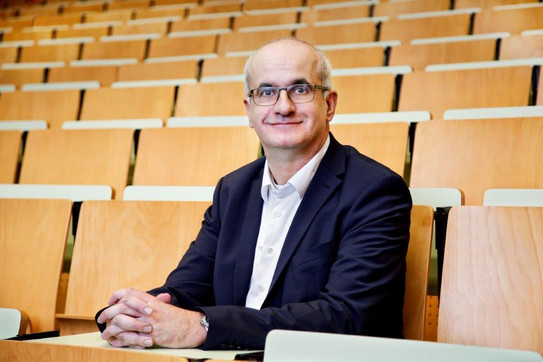
Portrait of Manfred Bayer
. Benito Barajas / TU Dortmund. External portrait hosted by TU Dortmund University. Source.A researcher whose team studied large excitons in cuprous oxide. The 2014 result showed that electron–electron hole bound states can have spatial extents thousands of times larger than a typical ground-state exciton, opening an experimental route to strongly interacting optical excitations within a solid.[ref]
A researcher in quantum optics whose joint work on Rydberg excitons connects highly excited atomic states with optical excitations in semiconductors. The 2014 study found evidence of Rydberg blockade: the presence of one large exciton suppresses the creation of another nearby.[ref]
Giant Rydberg Excitons in Cuprous Oxide by Tomasz Kazimierczuk and others. Abstract: dipole interactions and suppression of nearby excitation
A researcher who contributed to the 2014 observation of Rydberg excitons in a semiconductor. Their large spatial extent strengthens interactions between excitations, making these states useful for studying collective optical behavior in a crystal rather than only the properties of isolated electron–electron hole pairs.[ref]
Giant Rydberg Excitons in Cuprous Oxide by Tomasz Kazimierczuk and others. Abstract: large exciton size, interactions and possible ordered phases
A researcher in semiconductor optics whose team observed Rydberg excitons in cuprous oxide in 2014. These bound electron–electron hole pairs reached principal quantum numbers as high as 25 and extended over micrometers, allowing a crystal to host excitations resembling highly excited hydrogen atoms.[ref]
Matjaž Humar explained how quantum confinement changes the optical properties of semiconductor quantum dots. Confinement raises electronic energy scales and modifies exciton states, so changing a dot's size can shift its absorption and fluorescence spectra. His treatment distinguishes regimes by comparing the dot size with the exciton's internal size and the wavelength of its motion. This prevents a bulk bound-pair model from being applied unchanged to a much smaller nanocrystal.[ref]
Excitons in Semiconductor Quantum Dots by Matjaž Humar. abstract and section 4, weak/intermediate/strong confinement regimes

Portrait of Matjaž Humar
. External portrait hosted by Humar Lab, Jožef Stefan Institute. Source.A researcher whose joint acoustics experiment uses the two channels of a stereo sound interface as a shared time base. Delays between recordings of a pulse at two microphones determine the speed of sound. The method also shows why sampling rate, path-length measurements and reflected pulses matter: a plausible-looking delay is useful only if it corresponds to the intended propagation path.[ref]
A time of flight method to measure the speed of sound using a stereo sound card by Carlos C. Carvalho and others. Abstract; Apparatus and Results, pp. 2–3: sampling interval, pulse delays and reflection limitations
João M. B. Lopes dos Santos coauthored an inexpensive speed of sound experiment using two microphones and a computer's stereo sound input. A pulse reaches microphones at different distances at different times; dividing the path difference by the arrival-time difference estimates the propagation speed. Recording both channels together makes the relative delay directly accessible. The apparatus turns wave propagation into a quantitative measurement using familiar audio equipment.[ref]
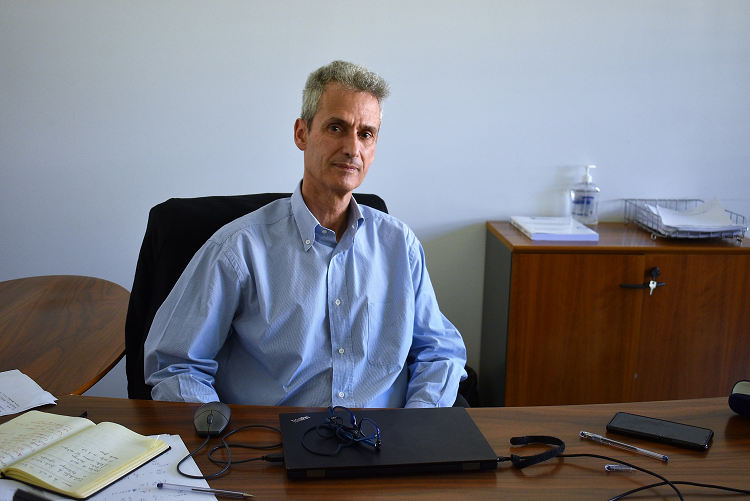
Portrait of João M. B. Lopes dos Santos
. SICC/RS (credit printed beneath the source photograph). External portrait hosted by University of Porto, Faculty of Sciences. Source credit: SICC/RS. Source.A physics educator whose team built a simple time of flight measurement of the speed of sound. Two microphones at different distances record the same pulse through a stereo sound interface. Dividing the difference in path lengths by the arrival-time difference gives the propagation speed, while a common recording clock avoids having to synchronize two independent timers. The apparatus converts inexpensive audio hardware into a quantitative wave experiment.[ref]
A time of flight method to measure the speed of sound using a stereo sound card by Carlos C. Carvalho and others. Abstract and Principle and Apparatus, pp. 1–2: two microphones, stereo acquisition and differential travel time
An applied mathematics educator whose partial differential equation notes derive the wave equation on a string from a physical model and then connect its solutions with initial and boundary data. D'Alembert's formula decomposes an initial disturbance into profiles traveling in opposite directions. The construction lets a reader predict how an initially plucked string evolves before accounting for reflections at its ends.[ref]
An engineer who helped connect spacecraft operations with teaching about celestial mechanics. NASA identifies him as the author of the 2017 edition of Basics of Space Flight (2017 edition) by Dave Doody and as a flight-operations engineer for the Cassini mission. His navigation chapter explains how radio Doppler effect measurements constrain spacecraft velocity while signal travel times constrain distance, turning received radio signals into information for orbit determination.[ref]
Basics of Space Flight (2017 edition) by Dave Doody. Editorial page: authorship and flight-operations role
[ref]A researcher identified with James G. Williams and Slava G. Turyshev on their 2012 lunar laser ranging study. Their analysis tests the equivalence principle by fitting precise Earth–Moon distance measurements to a model of the lunar orbit and checking whether different analysis choices change the inferred result.[ref]
Lunar Laser Ranging Tests of the Equivalence Principle by James G. Williams and others. Author list; abstract and §§3–4: data analysis and robustness checks
A physicist working on experimental tests of gravity. His joint work with James G. Williams and Dale Boggs uses lunar laser ranging to compare the ratios of gravitational mass to inertial mass for Earth and the Moon. The comparison probes the equivalence principle using bodies with different compositions and gravitational binding energies.[ref]
Lunar Laser Ranging Tests of the Equivalence Principle by James G. Williams and others. Abstract and §1: weak and strong forms of the equivalence principle

Portrait of Slava G. Turyshev
. Source. A researcher in lunar laser ranging and tests of gravity. With Slava G. Turyshev and Dale Boggs, he analyzed whether Earth and the Moon fall toward the Sun at the same rate. Timing laser pulses reflected by lunar retroreflectors turns the Earth–Moon system into an experiment on the equivalence principle.[ref]
Lunar Laser Ranging Tests of the Equivalence Principle by James G. Williams and others. Author affiliation; abstract and §2: ranging apparatus and equivalence-principle test
There are unlisted articles, also show them or only show them.