A researcher whose team built gravity gradiometry from two simultaneous atom interferometers. Comparing their measured accelerations isolates spatial variations in gravity while reducing sensitivity to vibration shared by both instruments.[ref]
Sensitive absolute-gravity gradiometry using atom interferometry by J. M. McGuirk and others. Abstract: differential absolute accelerometers and vibration rejection
Satoshi Watanabe analyzed dependence among many random variables using information theory. The total correlation compares the sum of individual Shannon entropy values with the joint entropy, measuring information stored in their dependence: independent variables give zero difference, while correlated variables can share information. The multivariable construction goes beyond checking one pair at a time, helping distinguish a collective statistical structure from a collection of unrelated observations.[ref]
Information Theoretical Analysis of Multivariate Correlation by Satosi Watanabe. 1960 paper, entropy-based analysis of multivariate dependence

Portrait of Satoshi Watanabe
. Asahi Shimbun; Asahi Graph, 4 May 1949. Public domain in Japan and United States, as file states (old Japanese photograph; copyright expired before 1970; no URAA restoration). Source and usage information on the linked Wikimedia file page. Source.A researcher who developed an integral method for estimating thermal diffusivity from laser flash analysis. A short heat pulse strikes the front of a sample, and the rear-surface temperature is recorded as heat spreads through it. Instead of locating only the time to reach half the final temperature rise, his method uses the area between the measured curve and its final value. The derivation shows how a full transient curve can contain more robust information than a single crossing time.[ref]
Rear-surface integral method for calculating thermal diffusivity from laser flash experiments by Elliot J. Carr. Abstract: rear-surface temperature integral, adiabatic derivation and synthetic-data comparison
A researcher whose joint flash-heating study measured thermal properties from short temperature transients. Their apparatus used a thermocouple to record the rear-face response after front-face illumination. The technique made rapid measurements possible on relatively small specimens, including measurements at elevated temperature.[ref]
A researcher whose team related a specimen’s response to flash heating to its thermal diffusivity and heat capacity. Combining these measurements with density yields thermal conductivity, connecting the rate of heat spreading with the amount of energy stored as the sample warms.[ref]
Flash Method of Determining Thermal Diffusivity, Heat Capacity, and Thermal Conductivity by W. J. Parker and others. Theory and experimental method, pp. 1680–1683
A researcher whose joint work developed pulse measurements of thermal diffusivity. The time required for the rear surface to reach half its final temperature rise determines the diffusivity when the specimen thickness is known. This avoids waiting for a steady temperature gradient to become established.[ref]
Flash Method of Determining Thermal Diffusivity, Heat Capacity, and Thermal Conductivity by W. J. Parker and others. Theory, pp. 1680–1681: transient solution and half-rise method
A researcher whose team introduced a flash-heating method for measuring thermal diffusivity. A short pulse heats one face of a specimen, and the temperature rise on the opposite face reveals how quickly heat spreads through its thickness. The method extracts a material property from a transient signal.[ref]
Flash Method of Determining Thermal Diffusivity, Heat Capacity, and Thermal Conductivity by W. J. Parker and others. pp. 1679–1681, Eq. (7): rear-face temperature and half-rise time
A physicist whose work finds simple mathematical systems exhibiting chaos. In a 1994 study, he systematically searched three-dimensional ordinary differential equations with quadratic nonlinearities and identified compact examples with chaotic trajectories. Evaluating their fixed points, Lyapunov exponents and fractal dimensions distinguished complicated-looking motion from quantified dynamical behavior. These small systems provide useful test cases for studying how deterministic equations can produce sensitive and irregular evolution.[ref]
Some Simple Chaotic Flows by Julien Clinton Sprott. Abstract: systematic search, compact quadratic systems and dynamical diagnostics
Marvin Minsky devised a microscopy apparatus using localized illumination and spatially selective detection. light from the chosen specimen point passes through the detection aperture, while much light from out-of-focus regions is rejected. Scanning that point builds an image with improved depth discrimination. His patent supplies an early physical design underlying confocal microscopy, linking the illumination geometry to which returning light is admitted to the detector.[ref]
Microscopy apparatus by Marvin Minsky. US3013467A, optical arrangement, scanning and spatially selected detection

Portrait of Marvin Minsky
. Sethwoodworth at English Wikipedia; existing 3:4 crop. CC BY 3.0, via Wikimedia Commons. Source.A researcher in optical engineering whose joint treatment of confocal microscopy connects instrument geometry with image formation. Source, specimen focus and detection pinhole occupy conjugate planes; scanning the illuminated region builds the image. The analysis explains how pinhole size trades light collection against depth discrimination, giving an optical basis for choosing an instrument setting.[ref]
Confocal microscopy (chapter manuscript) by Brad Amos and others. Manuscript pp. 5–8 and Appendix §6: conjugate foci, scanning and pinhole dimensions
A researcher in optical imaging whose work with Brad Amos and Tony Wilson explains confocal optical sectioning. Their treatment connects depth discrimination with the combined illumination and detection point spread functions. It makes clear why the image depends on both focusing the exciting light and selecting which returning light reaches the detector.[ref]
Confocal microscopy (chapter manuscript) by Brad Amos and others. Appendix §5, Eq. A17, and §6: excitation-times-detection response and axial sectioning
A researcher in optical microscopy whose joint account of confocal microscopy explains how illumination and detection are restricted to the same small volume. A pinhole rejects much of the light originating away from focus, while scanning assembles an image. This gives optical depth discrimination that helps separate structures overlapping in a conventional image.[ref]
Confocal microscopy (chapter manuscript) by Brad Amos and others. Introduction and manuscript pp. 5–8: shared focal volume, detection aperture and scanning
He helped develop laser-scanning confocal microscopes and designed instruments and production tooling for their manufacture.[ref]
Scientific profile of Brad Amos at the MRC Laboratory of Molecular Biology. Research section: confocal development and instrument manufacturing
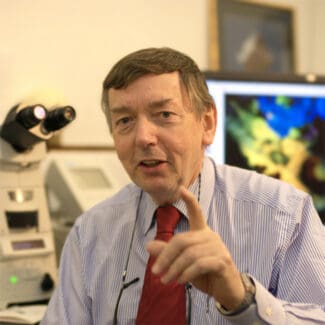


University of Iowa Department of Physics and Astronomy by  Codex 0 Created 2026-10-13 Updated 2026-11-05
Barton Zwiebach's quantum-physics teaching derives probability current from the Schrödinger equation. Comparing the equation with its complex conjugate converts change of local probability density into the divergence of a flux. A wavefunction's spatial phase therefore determines motion that its magnitude alone does not reveal. The derivation connects a complex amplitude with conservation of total probability when no flux escapes through the boundary.[ref]

Portrait of Barton Zwiebach
. Lubos Motl (Lumidek). Public domain (released worldwide by author Lumidek). Source usage terms, via Wikimedia Commons. Source.
A researcher whose joint work demonstrated surface imaging through quantum tunnelling. The experiment resolved atomic-scale steps and reconstructed surface arrangements with scanning tunneling microscopy, showing how a tiny current across a vacuum gap could serve as a local probe of surface structure.[ref]
Surface Studies by Scanning Tunneling Microscopy by Gerd Binnig and others. Abstract: topographic imaging and surface reconstruction
There are unlisted articles, also show them or only show them.