The Turing degree of a set is its equivalence class under mutual Turing reducibility. Degrees inherit the partial order induced by Turing reducibility. The Friedberg–Muchnik theorem gives incomparable degrees represented by computably enumerable sets.
A Turing functional is a partial computation performed by an oracle machine, viewed as a function of both the oracle and input . Oracle programs admit an effective enumeration. Every convergent computation inspects only a finite part of its oracle, recorded by its oracle use.
An Euler structure fixes the lift ambiguity in refined Turaev torsion. Changing it can multiply the torsion by an element of the first homology group.
A homology orientation chooses an orientation of the real vector space . It fixes the sign in refined Turaev torsion.
A basis of a topology is a family of open sets such that every open set is a union of members of that family. Equivalently, every point of every open set lies in a basis member contained in it. The rectangles form a basis for the product topology of two spaces. This topological meaning differs from a linear-algebra basis.
The boundary of a subset of a topological space consists of the points whose every neighbourhood in meets both and its complement . Equivalently,Here the two operations are closure and interior. The second formula shows that the boundary is a closed set and that and its complement have the same boundary. It locates precisely the points where membership cannot be decided from a small neighbourhood alone. [ref]
For in the usual real line, the interior is , the closure is , and the boundary is . In particular, belongs both to and to its boundary, while belongs to the boundary but not to . A boundary point need not be excluded from the original set: open sets exclude all their boundary points, closed sets contain all theirs, and this half-open interval does one of each.
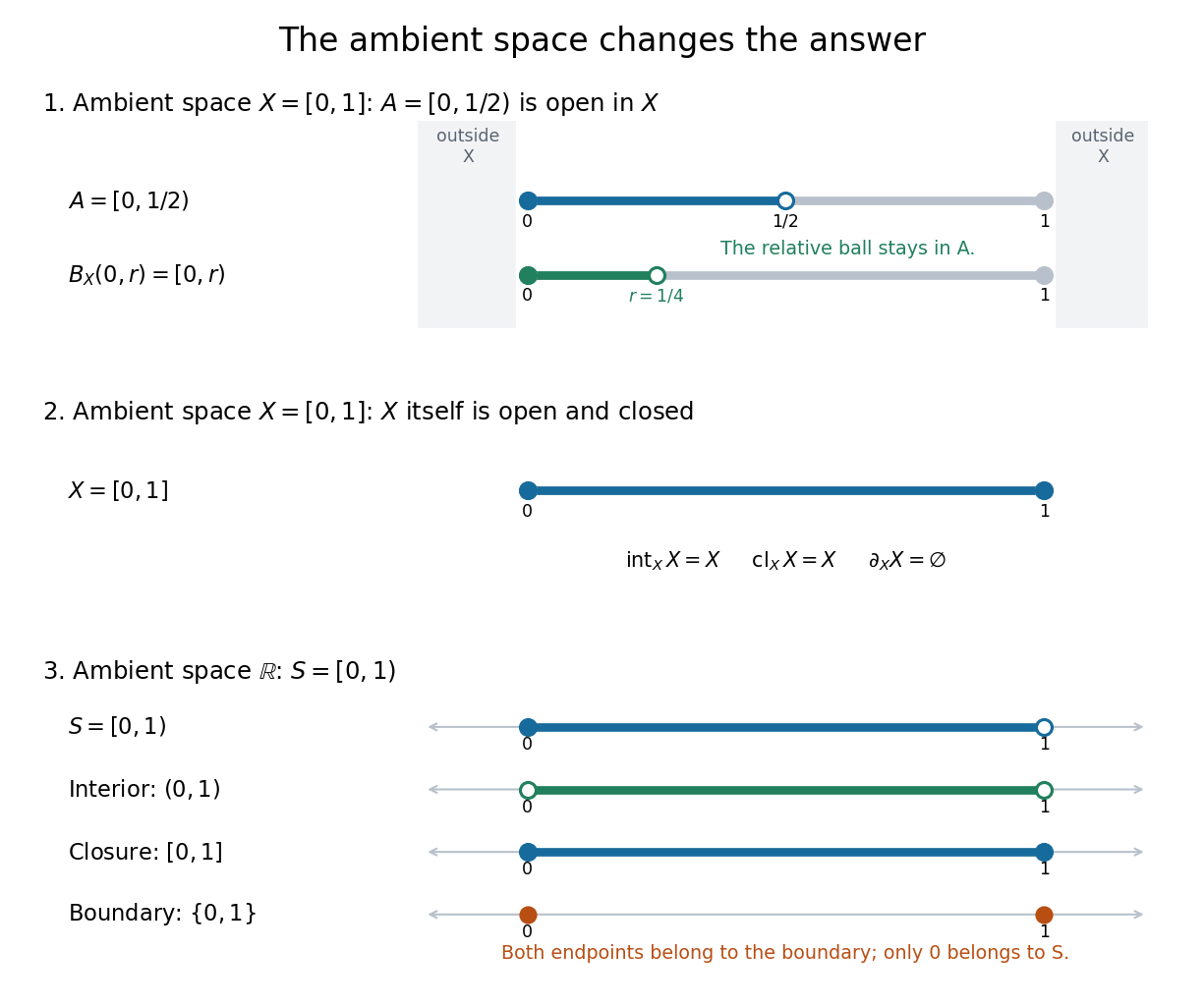

The upper panel visualizes the relative example from open set: for and , an open ball about zero in is when . This open ball stays in ; points outside are not required. The middle panel shows that is clopen in itself, with interior and closure both and empty boundary, although its boundary in the real line is . The lower panel returns to ambient space and separates the interior, closure, and boundary of ; both marked boundary points are included in the boundary itself.
A topological space has local connectedness when every point has a neighborhood basis of connected open sets. In particular, a planar domain has local connectedness, but its domain boundary need not be. Local connectedness of the boundary is the condition governing a continuous extension of a conformal bijection to the parametrizing circle.
Attaching an index- handle to an -dimensional manifold with boundary glues along . The complementary replaces the attaching region in the boundary.
A topological manifold has dimension when its manifold charts have coordinate domains open in . For a smooth manifold, each tangent space has dimension , and a tangent bundle has vector bundle rank .
A smooth manifold carrying a nondegenerate bilinear form on each tangent space, with one negative and all remaining positive eigenvalues, or the overall reversed-sign convention. Its nonzero null vectors have vanishing metric quadratic form.
For a pair of CW complexes, relative topological K-theory and Bott periodicity give the cyclic exact sequence
For a nonempty subcomplex , relative Topological K-theory is , where the collapsed subcomplex is the basepoint. It fits into the K-theory six-term exact sequence.
The rank of a vector bundle is locally constant on the base. Taking the difference of the ranks extends to the Grothendieck group of vector bundles, giving the rank map in Topological K-theory. For a finite CW complex, its kernel consists of classes of rank zero on every connected component.
For a finite covering map , define the fiber of the transferred vector bundle by . Local trivializations of the covering map make this a vector bundle, and compatibility with direct sums extends it to Topological K-theory.
Complex K-theory of odd-dimensional real projective space by  Codex 0 Created 2026-10-05 Updated 2026-10-14
If is the complexification of a real vector bundle of the tautological bundle and , thenRealizing Real projective space as the circle bundle of the square of the tautological bundle on Complex projective space gives this through the K-theory Gysin sequence of a sphere bundle.
For a turbulent plume in a homogeneous ambient of density , define actual sectional mass flux, momentum flux and density-weighted buoyancy flux by , and . With non-Boussinesq Batchelor entrainment , their balances areHere is sectional mass, is sectional density-deficit buoyancy, and the entrained ambient initially has zero vertical momentum. The last equation follows by subtracting mass conservation from times volume conservation. Scase, Caulfield, Dalziel and Hunt's time-dependent plume model derives the equivalent system with the common factor suppressed.
Dividing the mass flux, momentum flux, and density-weighted buoyancy flux by ambient mass density gives the kinematic fluxes , , and . This convention makes dimensional similarity solutions independent of the arbitrary ambient density unit.
The spinor matrix obeys , with and . Conjugating the explicit and three spatial matrices also gives . With spin phases and identities , relabeling spin and momentum in the mode expansion of a Dirac field gives , because . That last relation is phase-convention dependent; the quantum time-reversal operator itself is not just a spinor matrix.
The vector Dirac current has an even temporal component and odd spatial components under time-reversal symmetry. Invariance of its real minimal coupling therefore gives the displayed transformation of the gauge field, up to a gauge transformation. Differentiation at yields , with . Thus the electric field is even and the magnetic field is odd.
There are unlisted articles, also show them or only show them.