
An antiunitary operator between complex Hilbert spaces is a surjective antilinear map satisfying the displayed inner product identity. It preserves norms but conjugates scalars. In a chosen orthonormal basis it is , with a unitary operator and coefficientwise complex conjugation. Conversely any such is antiunitary. Antilinearity by itself does not preserve norms.
An anti-symplectic involution is an anti-symplectic map whose square is the identity. Its nonempty fixed-point set is a Lagrangian submanifold; the linear version has complementary and Lagrangian subspaces.
A meromorphic continuation extends a holomorphic function from a connected open set to a larger connected domain as a meromorphic function, allowing isolated poles. Equality on the initial open set determines the extension uniquely by the identity theorem. Integral formulas whose integrands depend holomorphically on a parameter often supply such an extension after contour deformation or subtraction of singular terms.
Zeta function regularization assigns a finite value to a divergent spectral sum by first forming a convergent complex-power series and then using its analytic continuation. For positive frequencies , continue to to define a regulated frequency sum, when that continuation is regular there. This does not turn the divergent positive-term sum into an ordinary convergent sum. It is a useful subtraction convention for the normal-ordering constant of a string and for vacuum energies.
In the maximal-dimension convention, a totally real submanifold of has half the real dimension of and . Every Lagrangian submanifold is totally real for a compatible almost complex structure, but the converse fails in complex dimension at least two.
The arithmetic genus of a proper curve is . For an integral projective curve over an algebraically closed field, , so . Its finite normalization has . Hence arithmetic genus zero forces the curve to be smooth and rational.
Any submultiplicative algebra norm on all of dominates its supremum norm, even when the new norm is incomplete. Every evaluation character extends continuously to the completion: the restrictions of the completion's character space form a closed subset of , and an omitted point would give a nonzero function annihilated by an invertible function in the completion.
For a monad , the free algebra functor sends to and to . It is a left adjoint to the forgetful functor , via and between and .
A compact smooth -manifold with nonempty boundary embedded in is a proper compact locally contractible subset. Alexander duality therefore expresses the reduced homology of its complement by the reduced cohomology of the abstract manifold. Thus these groups do not depend on its particular smooth embedding.
For a closed connected -manifold smoothly embedded in , with and , its complement hasand zero reduced homology for , where negative-index groups are zero. The Thom isomorphism theorem for the normal bundle and the pair's exact sequence give this formula. The top ambient fundamental class maps isomorphically to the fundamental class of , canceling the exceptional top term.
For on , define and let be the time Laplace transform of . The transformed solution with spatial decay isOnly one characteristic root has negative real part, so one scalar boundary derivative fixes the remaining homogeneous mode. The Bromwich inversion formula supplies an integral representation involving only the initial and boundary data. For general linear differential equations on a half-line, the number and form of the necessary boundary data depend on the decaying spatial roots; Fokas and Wang study the corresponding boundary maps for linear dispersive equations.
The equation is inverted by the displayed formula: differentiating twice produces the endpoint contribution , since and . If , there are four independent constants . This reconstructs the velocity from the Airy reduction of the Orr-Sommerfeld equation in constant shear; four no-slip and no-flux conditions determine the boundary eigenproblem.
For a scalar discrete-time affine process, the conditional cumulant-generating function of is affine in . Backward effective parameters , give coefficients and .
An autoregressive process of order one with independent and identically distributed random variables as innovations is an affine process when the innovation exponential moments are finite. Its one-step coefficients are and , where is the innovation cumulant-generating function.
For affine varieties over an algebraically closed field , their product in a category is affine, with coordinate ring , where and . Presenting and identifies this ring with . If both varieties are irreducible, this is an integral domain: express a nonzero tensor using linearly independent second factors. The points where its specialization is nonzero form a nonempty open subset of . For two nonzero tensors , choose in the intersection of these open subsets; then in the domain . The Hilbert Nullstellensatz identifies with the defining ideal of . The universal property follows from the universal property of the tensor product of modules as a tensor product of commutative algebras.
On , the differential operator with homogeneous Neumann boundary conditions is self-adjoint in the weighted inner product with weight . Its eigenfunctions and nonnegative decay rates areTheir squared norms are and . The Sturm-Liouville eigenfunction expansion givesThis kernel acts against the measure , not Lebesgue measure alone. It is symmetric in ; the transition density against Lebesgue measure is .
Adiabatic expansion increases the accessible volume without heat transfer. In a loaded piston expansion of the fixed-composition ideal gas considered in adiabatic process, positive outward work comes from internal energy, so the final temperature decreases. This provides a cooling mechanism without removing heat during the stroke. In the Carnot cycle, reversible adiabatic expansion connects two different temperatures between its isothermal processes.[ref]
For the same constant- reversible ideal-gas adiabat, put . The scaling and first law of thermodynamics giveWith the figure's stipulated , and , the final ratios are and . Outward work is and . Reversing this particular path from its cooled endpoint would require the same work input; the figure's separate compression starts at the original state, so its input is different. Endpoint entropy supplies another independent check:The two logarithm terms cancel using , confirming the reversible path is an isentropic process. [ref]
https://web.mit.edu/16.unified/www/FALL/thermodynamics/notes/node40.html. MIT Unified Engineering, §5.4: ideal-gas endpoint entropy and constant-entropy scaling
PASCO's expansion demonstration first compresses trapped air and waits for thermal equilibrium before the rapid expansion. Its manual warns that friction-warmed cylinder regions contact the gas during expansion, compromising quantitative comparison. [ref]
https://cdn.pasco.com/product_document/Adiabatic-Gas-Law-Apparatus-TD-8565-Manual.pdf. PASCO scientific, guide 012-05110D, p. 3: expansion preparation and frictional wall-heating limitation
The hold separates cooling caused by expansion from simply undoing the earlier hot compression. As proposed controls, observe the temperature dip and subsequent warming, compare rapid and slow strokes from matched initial states, and assess wall heat transfer and probe lag before fitting a reversible model.Cooling is not a universal consequence of adiabatic expansion: free expansion of an ideal gas has no outward work and returns to the same equilibrium temperature. Its entropy increases, so the reversible power laws do not describe it. Reuse free expansion, Joule's free-expansion experiment and temperature sensitivity of a free-expansion experiment for that apparatus, its energy budget and the real-gas qualifications. The useful distinction is the load: expansion cools this ideal gas when it must spend internal energy doing work.
Adiabatic compression decreases the volume of a sample without heat transfer across its boundary. For the fixed-composition ideal gas and endpoint assumptions in adiabatic process, compression work increases internal energy; positive heat capacity at constant volume then means a higher final temperature. The effect comes from supplied work, even though no heat enters. The amount of temperature increase depends on the work actually delivered to the gas, not on the adiabatic process condition alone.
The reversible ideal-gas adiabat supplies a particularly useful quantitative benchmark. Assume a fixed amount of substance , a quasistatic process, negligible friction, only pressure-volume work, and constant heat capacity ratio . Here and are the whole sample's heat capacity at constant pressure and heat capacity at constant volume. With the molar gas constant, Mayer's relation gives . The proof outline is from the first law of thermodynamics, followed by from the ideal gas law and integration. The result isThese finite power laws belong to this reversible, constant- ideal gas model. If heat capacity ratio varies, use the integral relation in heat capacity ratio; if the compression is irreversible, use the actual work balance, as in irreversible adiabatic piston compression. A short stroke by itself justifies neither power law. [ref]
https://openstax.org/books/university-physics-volume-2/pages/3-6-adiabatic-processes-for-an-ideal-gas. Ling, Moebs and Sanny, University Physics Volume 2, §3.6: quasi-static ideal-gas adiabat
Writing for the compression ratio, the reversible model predictsAll temperatures in these ratios are absolute. The larger pressure rise than in an isothermal compression, where , explains the greater local stiffness described by isentropic compressibility.
For an original stipulated example, set , and . Then and . The input work and internal energy increase are both , while . No initial temperature or apparatus performance is implied by the chosen energy scale. Independent integration gives the signed outward workwhich is negative during compression and agrees with . This integral uses equilibrium gas pressure only because the path is reversible.
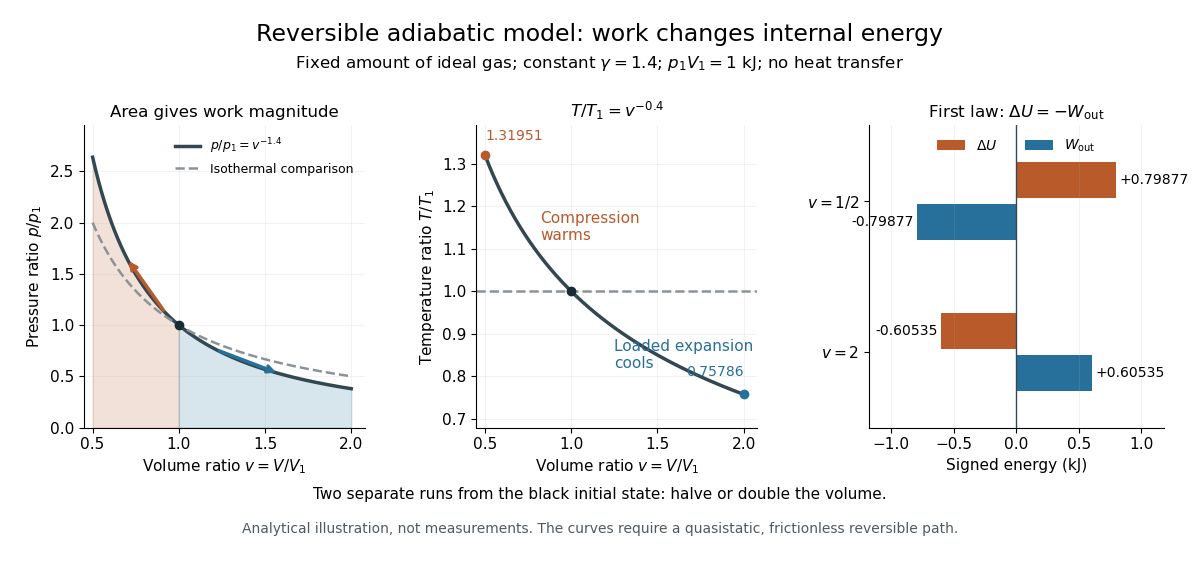

In the sensor experiment of adiabatic process, compare the pressure-volume integral with as an energy check only when internal pressure is sufficiently uniform and piston dynamics permit that boundary-work estimate. Account for friction separately before comparing it with hand input work. PASCO's manual supplies a compression procedure and an illustrative logarithmic-slope result , compared with the model value for a diatomic gas; that is its sample result, not new measurements here. [ref]
https://cdn.pasco.com/product_document/Adiabatic-Gas-Law-Apparatus-TD-8565-Manual.pdf. PASCO scientific, guide 012-05110D, pp. 5–6: work comparison and sample fitted exponent
In magnetically channelled accretion, a strong magnetic field guides an accretion flow along flux tubes. The component of the Lorentz force density parallel to the magnetic field vanishes, so the longitudinal flow can be treated hydrodynamically while the field controls the transverse geometry. A magnetic dipole field near a neutron star channels matter toward small polar caps.
When the only nonpotential force points radially, its curl has no radial component. The radial absolute vorticity therefore obeys a local flux conservation law, although vortex stretching can change it along a fluid trajectory.
There are unlisted articles, also show them or only show them.