
For , , , set . The exact equation becomes . Let , using the Kummer function. It is regular at and tends to one. The Wronskian obeys , with . Integration gives the displayed exact late slope. The other local solution grows at most logarithmically in , so and . This provides a check on a WKB approximation even near phases where its leading predicted slope vanishes.
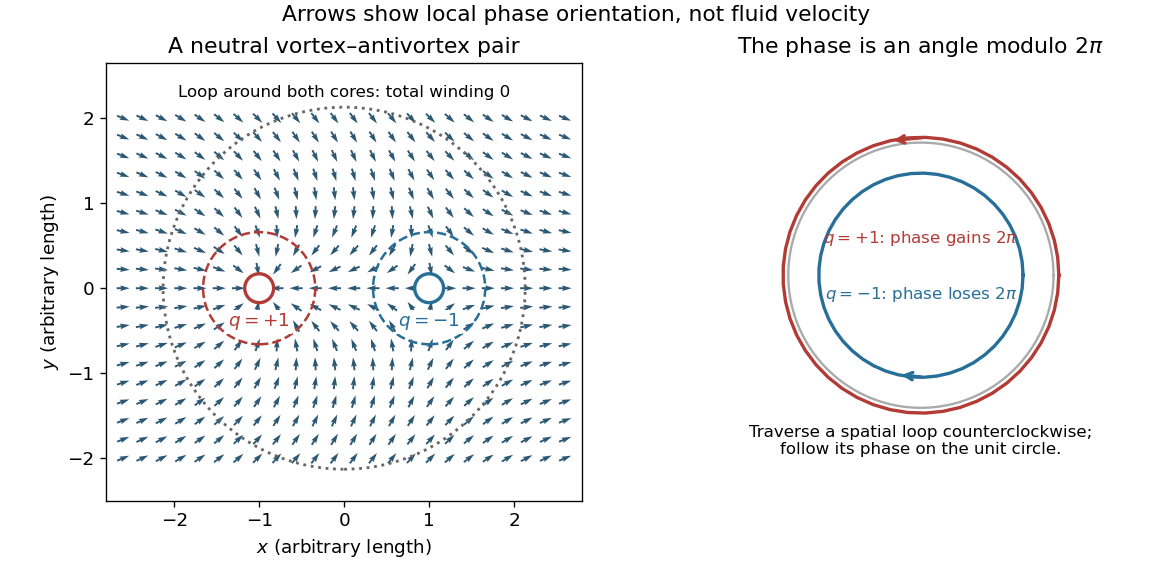
In the phase with quasi-long-range order, vortex defects of opposite winding remain bound in pairs. Their unbinding produces the disordered phase with a finite correlation length.
For two unit vortices of opposite charge separated by , the vortex Coulomb gas gives before screening. At distances much greater than , their phase gradients cancel at leading order: the pair field decays as , whereas a lone phase vortex has a gradient. A neutral pair therefore has finite energy as at fixed . Bound does not mean absent: small pairs remain thermally excited and reduce the phase stiffness through their response to a twist.

The renormalized phase stiffness has this discontinuity at the Berezinskii–Kosterlitz–Thouless transition. The algebraic correlation function has exponent at the transition from the ordered side.
The stiffness here is an energy in two dimensions, not an areal mass density. For a neutral superfluid of particles of mass , let be the superfluid number density per unit area. Substituting the superfluid velocity into the kinetic energy gives . Consequently the jump can also be writtenwhere is the thermal wavelength. It is the large-distance superfluid number density, rather than the total density or a locally inferred condensate density, that enters this relation.
Within the vortex-pair renormalization flow, changes from irrelevant to relevant at , with the large-distance dimensionless phase stiffness. Combining this with the spin wave result gives . Above the transition the homogeneous equilibrium phase stiffness vanishes at infinite observation scale. A discontinuous response coefficient is compatible with a diverging correlation length; it does not imply a latent heat.[ref]
Topological Defects and Phase Transitions by John Michael Kosterlitz. Section 3, pp. 92–94: fugacity flow and renormalized superfluid-density jump
A posterior predictive probability averages a future-event probability over the Bayesian posterior. For a Bernoulli distribution with unknown parameter , it is . Under Beta-binomial conjugacy with posterior , the predictive success probability is .
For independent observations , put , , , and . Integrating the likelihood function against a flat improper prior on gives, up to the arbitrary prior constant,Indeed , and the remaining one-dimensional Gaussian integral is . The conditional Bayesian posterior of is .
A Gaussian Bayesian network specifies a linear normal conditional model at each node of a Bayesian network: . Independent local errors and an acyclic ordering generate a joint multivariate normal distribution. Positive conditional variances give a nonsingular joint multivariate normal distribution. The graph constrains regression coefficients and hence conditional independence.
For observations and graph , Bayes' theorem gives . Here is the graph prior distribution and the local distribution statistical parameters. The integral is Bayesian model evidence; it averages over nuisance parameters with a proper statistical parameter prior distribution. For independent complete observations, the node-factorized likelihood function and independence of local statistical parameter prior distributions make the evidence factor over nodes; suitable conjugate priors can make the local integrals analytic. With missing node observations, integrating out unobserved values can couple the local parameters, so independence of local prior distributions alone does not guarantee this factorization. Proper priors and coherent hyperparameters matter for comparing different graphs.
The standard basis of the vector space consists of the vectors whose th coordinate is one and whose other coordinates are zero. Every vector has the unique expression in this basis.
For constant buoyancy frequency , the log-pressure quasi-geostrophic potential vorticity equation has modes withThe prefactor compensates the density decrease in the energy weight. For , vertical propagation occurs for . An outgoing radiation condition selects the root with positive vertical group velocity; bounded weighted amplitude alone does not select between two propagating roots.
A Banach space is separable when it has a countable dense subset for its norm topology. It then has a countable base of norm balls and a countable norming family. Its continuous dual space need not be norm separable.
For an arbitrary set and scalar field , this is the space of bounded functions with the supremum norm . Uniform limits of Cauchy sequences prove it is a Banach space. For it is the l-infinity sequence space; for the empty index set it is the zero space, with norm zero.
For a uniform annular sheet attached to a fixed outer rim , two surface tension pulls give at the hole radius . The zero-pressure radial equation gives , with and . The thickness remains uniform by conservation of mass. With negligible initial hole volume, andA positive seed hole grows initially exponentially. An exactly zero initial radius remains zero within this continuum evolution law.
For external pressure and edge condition , the fixed-volume similarity solution is a uniformly thick disc:Conservation of mass fixes the similarity velocity. The radial equation then forces a differentiable thickness profile to be constant, and the edge stress fixes that constant. The singular point-release solution describes the spreading scaling; a finite initial uniform disc corresponds to shifting time.
The atmospheric carbon-to-oxygen ratio compares the elemental abundances of carbon and oxygen in the atmosphere. It influences molecular composition under chemical equilibrium, but condensation, disequilibrium chemistry in an exoplanet atmosphere, and incomplete spectral coverage complicate its inference from molecular bands.
Anisoplanatism is the loss of correlation between wavefront errors along different viewing directions. Correcting a guide star therefore leaves a larger residual for a sufficiently separated target.
The Fried parameter is the atmospheric coherence length for optical phase. In the standard inertial-range model, the phase structure function is . For unchanged atmospheric turbulence, . The NACO manual, section 3.1 describes this scaling and its role in adaptive correction.
The length of a piecewise smooth curve is its arc length: , using either the Euclidean space norm or the norm from a specified Riemannian metric. A straight segment from to in Euclidean space has length , while a route that bends or retraces can be longer. On a Riemannian manifold, comparing these lengths over all routes defines Riemannian distance.
In this game the higher of two chosen integers wins one unit if they are consecutive, but pays two units if their difference is at least two. Ties pay zero. For any choices with , both players can optimally choose with probabilities and assign zero probability to larger numbers. If is this vector, is zero in its first three entries, in its fourth when present, and in all later entries. Thus and , proving the zero value and both security guarantees.
There are unlisted articles, also show them or only show them.