
A group presentation describes the quotient of the free group by the normal closure of the relators . It is finite when both and are finite.
The free group on a set consists of reduced words in letters , with multiplication followed by cancellation. Every map from to a group extends uniquely to a homomorphism from .
A Yang-Mills instanton is a finite-action Euclidean gauge field with self-dual or anti-self-dual curvature. On , its asymptotic pure gauge defines a map whose degree is the instanton number.
It is a gauge-field instanton solving the Euclidean Yang-Mills equations, with additional finite-action and duality conditions.
The Abelian Higgs model couples a complex scalar field to a gauge field and permits magnetic vortex solitons in two spatial dimensions.
The AdS/CFT correspondence identifies a conformal field theory with quantum gravity on an asymptotically anti-de Sitter spacetime. Boundary sources couple to CFT operators and equal boundary values of bulk fields.
A dominated strategy can be replaced by another strategy that performs at least as well against every opponent action.
In a zero-sum game, the players' payoffs sum to zero at every pure strategy strategy profile. For two players this means : maximizing the column player's payoff is minimizing the row player's. A single payoff matrix therefore specifies a finite two-player matrix game, and independent mixed strategies give expected payoffs and .
Matching pennies and the usual rock paper scissors are two-player zero-sum games. The asymmetric coordination example is not: its total payoff is when choices match and otherwise. Applying a two-player minimax theorem to general bimatrix games would discard this possibility of shared gains. For a two-player zero-sum game, however, optimal mixed strategies guarantee the value of a zero-sum game, and pairing any two opposing optimal strategies gives a Nash equilibrium.
A mixed strategy is a probability distribution over a player's pure strategies. For a finite game with such strategies, the possible mixed strategies form the probability simplexA pure strategy is included as a mixed strategy placing all probability on one choice. The support of a mixed strategy consists of the choices with positive probability. In a sequential game, sampling a complete pure strategy once is the definition; it is not automatically equivalent to fresh randomization at every move.
In a bimatrix game, write for the row player's payoff matrix and for the column player's, and write for their probability vectors. Independent randomization gives expected payoffsFor example, in matching pennies, choosing heads with probabilities and gives joint probabilities for . The row player's expected payoff is , and the column player's is .
Randomization can prevent an opponent exploiting a predictable choice. It does not mean every choice is equally good against every opponent: only best responses belong in the support of a mixed strategy at a Nash equilibrium. A shared random signal can instead produce a lottery over joint action profiles whose joint probabilities do not factor into independent mixed strategies.
For a Galton-Watson process with one ancestor and offspring probability generating function , the branching extinction probability is the smallest fixed point of in . A direct way to find it is to compute extinction by generation :Zero is an absorbing state, so extinction by generation is exactly the event . [ref]
https://ocw.mit.edu/courses/18-445-introduction-to-stochastic-processes-spring-2015/27aaeb9eb9a9cecce93d9ad74413ddf5_MIT18_445S15_lecture19.pdf. Hao Wu, MIT 18.445, Lecture 19, slide 4
For , the equation isBoth and are fixed points, but iteration from zero selects . The first values are , , , and . Iteration started at would stay at forever and would give the wrong extinction answer for this offspring distribution.
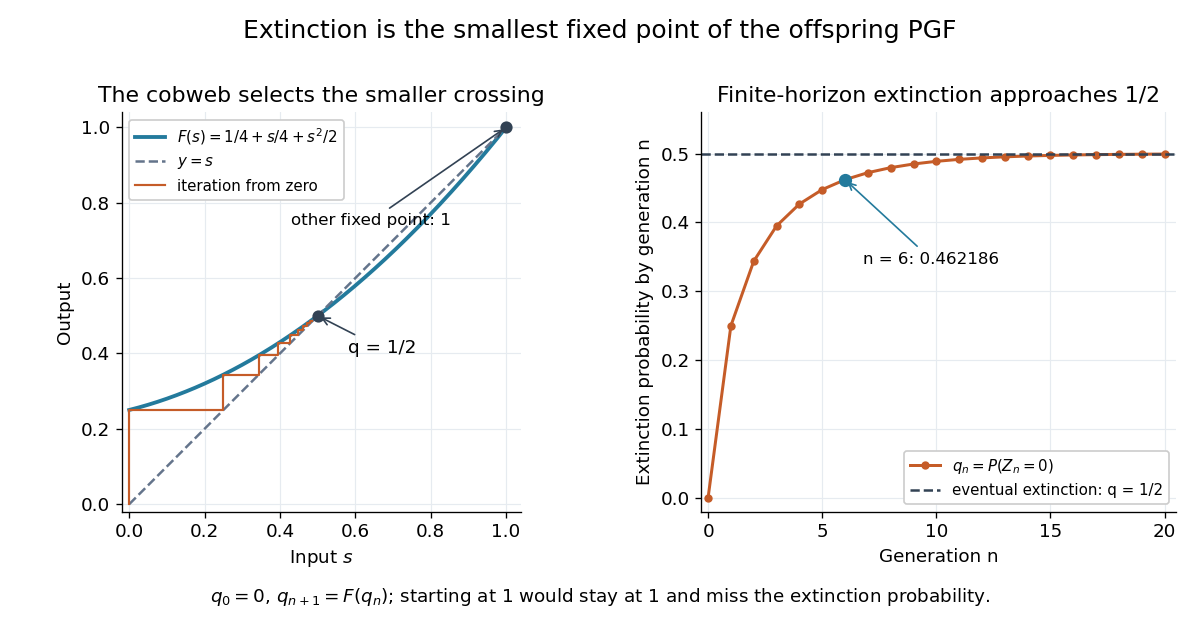
The smallest extinction fixed point selected by iteration from zero
. Details. 
The vertical steps in the figure apply the offspring probability generating function; horizontal steps return to the diagonal to start the next iteration. This gives a useful numerical calculation even when solving explicitly is difficult. For the displayed law, every finite iteration is a lower bound for the eventual branching extinction probability; at generation six, about additional extinction probability remains beyond the current empty families.
Why the smallest fixed point? The ancestor's children's descendant families are independent; given children, all are empty generations later with probability . Averaging gives . The increasing extinction events give the limit , and continuity of the probability generating function yields . For any other fixed point , and monotonicity of imply at every step; hence . [ref]
https://www.uni-muenster.de/Stochastik/lehre/WS1011/SpezielleStochastischeProzesse/Ch_1.pdf. University of Münster branching-process notes, Section 1.4, Theorem 1.7
Let be the roots of the separable polynomial in characteristic two. The cyclic sumsare the distinct roots ofEven root permutations fix , while odd permutations interchange them. The cubic Galois group is therefore contained in exactly when this quadratic splits over the base field.
An irreducible cubic over a field of characteristic other than two has Galois group when its discriminant is a square and otherwise.
A polynomial is solvable by radicals when its roots lie in a tower obtained by adjoining successive roots; equivalently, its Galois group is solvable.
For a finite Galois extension, subgroups correspond in reverse order to intermediate fields by taking fixed fields and field-fixing subgroups.
If a finite group acts faithfully by automorphisms on a field , then is Galois, has degree , and has Galois group .
This theorem constructs a Galois extension from a finite group of field automorphisms; it is not an alternative name for the extension itself.
For a group of automorphisms of a field , the fixed field isFor one automorphism , it is also written .
There are unlisted articles, also show them or only show them.