
A subgroup is a normal subgroup when for every . In other words, conjugation by any group element preserves the subgroup as a set, although it may exchange its individual elements. Equivalently, for every : the left and right cosets of agree. Write .
Every subgroup of an abelian group is a normal subgroup, because conjugation fixes each element. Normality can also hold in a nonabelian group: in , the three even permutations form the alternating group , a normal subgroup as the group kernel of the sign of a permutation. Its two cosets separate the even and odd permutations.
In contrast, is a subgroup of but is not a normal subgroup. With function composition of permutations acting rightmost first, choose . Thenwhich are different cosets. Also , directly contradicting invariance under conjugation. Thus a subgroup alone does not suffice for quotient group multiplication.
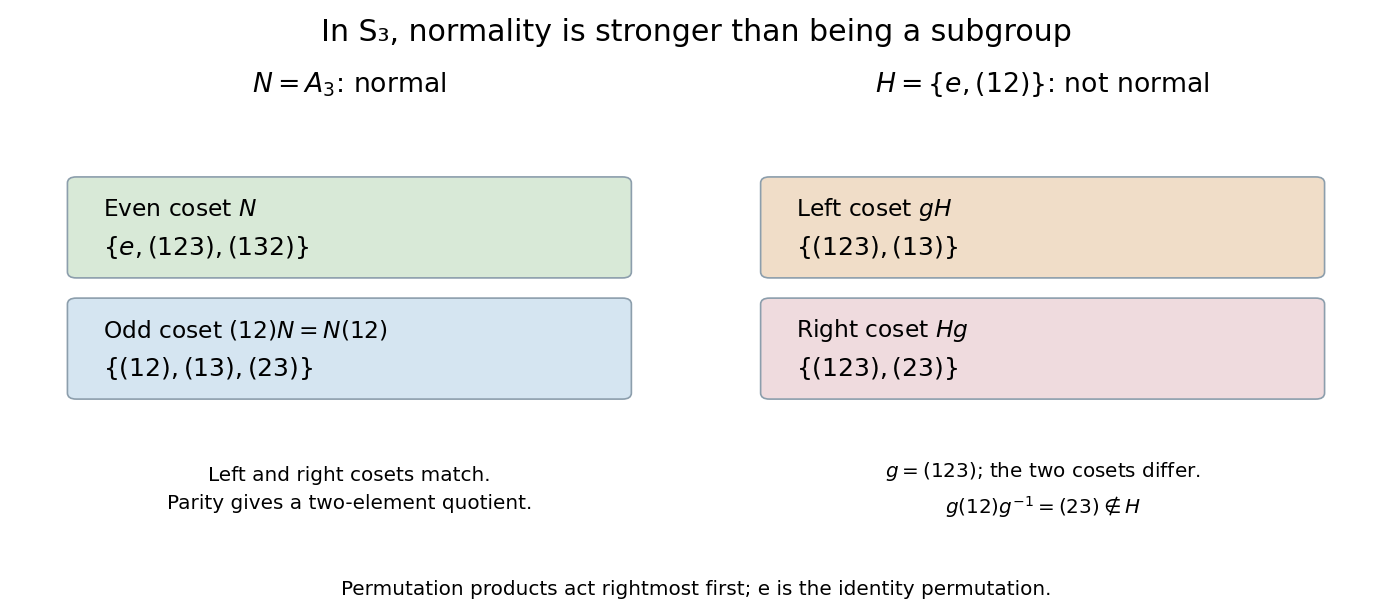
A normal subgroup gives matching left and right cosets, while a nonnormal subgroup can give different ones
. Details. The practical value of normality is coset multiplication is well-defined exactly for normal subgroups. Each coset can act as one element of a quotient group, with results independent of representatives. Conversely every normal subgroup is the group kernel of its quotient map of groups, so normality also identifies which distinctions a group homomorphism can consistently forget.
A torsion element has finite order.
Finite group theory studies groups with finitely many elements.
A group homomorphism is a map preserving the group operation: . It also preserves the identity element and inverse elements. In an additive group, the same requirement reads . A group homomorphism preserves a way of combining inputs, even when several inputs have the same output.
Reduction modulo three from to is a group homomorphism: reducing a sum agrees with adding the reduced residues. For example, modulo six, and both sides reduce to one modulo three; the outputs and also add to one modulo three. This map is surjective but not injective, since zero and three both map to zero.
The sign of a permutation gives another example, from the symmetric group to the multiplicative group . A product of two odd permutations is even, matching . Its group kernel is , the alternating group of even permutations. This shows how a group homomorphism can retain a useful feature while forgetting other details.
The general linear group is the group of invertible linear maps from a vector space to itself, with composition as its operation.
For a group and a normal subgroup , the quotient group is the set of cosets , with operationIts identity element is the coset , and the inverse element of is . A quotient group treats all elements within one coset as the same input while retaining a consistent operation on the classes. The normal subgroup condition is what makes this operation independent of which representatives are chosen. [ref]
https://ocw.mit.edu/courses/18-703-modern-algebra-spring-2013/ecdbd211f736b3ac92379dea05b34491_MIT18_703S13_pra_l_9.pdf. McKernan, MIT 18.703, Theorem 9.1: quotient-group construction
.Take the additive group and . Since is an abelian group, is a normal subgroup. There are three elements in the quotient group:Adding two copies of gives ; adding and gives . Hence the quotient group has the addition table of . It does not select one representative and discard the others: its elements are the entire cosets.
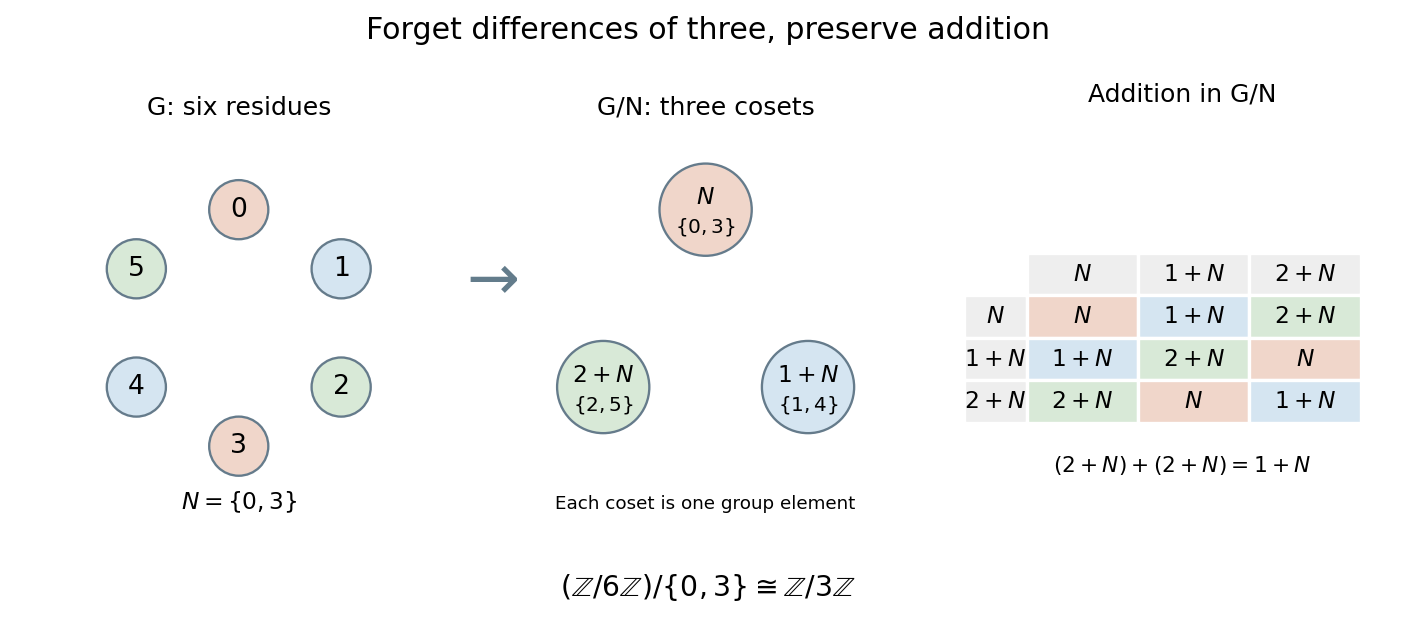
Identifying residues differing by three turns a six-element cyclic group into a three-element quotient group
. Details. This is useful whenever distinctions within a normal subgroup should be ignored. For example, the sign of a permutation retains only even or odd parity of a permutation in . Its group kernel is the alternating group , and the quotient group has two elements. The first isomorphism theorem explains why a group homomorphism's image is a quotient group of its domain.
The order of a group element is the least positive integer for which is the identity. If no such integer exists, has infinite order.
For an abelian group , the generalized dihedral group is the semidirect product in which the nonidentity element of acts on by inversion.
A group embedding is an injective group homomorphism. It identifies its domain with an isomorphic subgroup of its codomain.
For a finite group and a subgroup , the group order of divides the group order of :Here is the index of a subgroup, the number of distinct left cosets. It is also the number of distinct right cosets: inversion gives a bijection between the two collections. No normal subgroup assumption is needed for Lagrange's theorem. The normal subgroup condition matters when constructing a quotient group, rather than when counting a partition of a set.
The beauty of Lagrange's theorem is that an arithmetic restriction follows from a structural picture. A group can be tiled by equal-sized cosets of any subgroup. To see the count, choose one representative from each left coset. Every group element has exactly one expression for these chosen representatives and : different rows do not overlap, and multiplication by is a bijection from to its row. Counting rows times row size gives the formula. See MIT's symmetries notes, section 2.
The additive cyclic group above gives from . Another subgroup, , has cosets and , giving . In , the subgroup also gives , despite its distinct left and right coset partitions. Thus equal row sizes persist in a nonabelian group. A proposed subgroup of size four in either group is impossible: four does not divide six. This filters possible subgroups before any search for group generators.
Apply Lagrange's theorem to the cyclic subgroup generated by a group element . Its size is the order of a group element, so and . In the additive example, has order of a group element , since modulo six; the corresponding multiplicative statement becomes . A group of prime group order is consequently a cyclic group: any nonidentity group element generates a subgroup whose size is greater than one and divides that prime, forcing it to be the whole group. See MIT's cyclic-group notes. The same counting idea underlies the orbit-stabilizer theorem: the orbit of a group action is parametrized by cosets of its stabilizer subgroup.
Historically, Lagrange's theorem grew from investigations of permutations of roots of a polynomial; see St Andrews' account of Lagrange's early work. The modern statement about arbitrary finite groups should not be read back into the early work. Carmichael's 1921 review explicitly cautioned against attributing the full result to Lagrange; see Carmichael's historical note, reproduced by St Andrews. Finally, Lagrange's theorem supplies a necessary size condition; the failure of the converse to Lagrange's theorem below explains its limit.
For a subgroup of a group , a left coset is ; a right coset is . The name refers to the side on which the representative multiplies . Think of a coset as a translated copy of a subgroup: it remembers the relative differences allowed by , while moving the whole collection to another location in the group.
Two left cosets of the same subgroup are either equal or disjoint. Thus distinct left cosets form a partition of a set covering ; the same statement holds separately for right cosets. The useful membership test isThis also defines an equivalence relation: changing a representative by right multiplication with a member of leaves its left coset unchanged. These facts hold even for infinite groups. See MIT's coset notes, definitions 3.6 and 3.9.
For an explicit additive example, take the cyclic group , with modular arithmetic, and the subgroup . Adding each representative to both members gives exactlyRepresentatives repeat these three cosets, respectively. For example, , since . Every residue appears once in the displayed partition of a set. Each coset has two members, so the group order of is and its index of a subgroup is . Left and right cosets coincide here because is an abelian group.
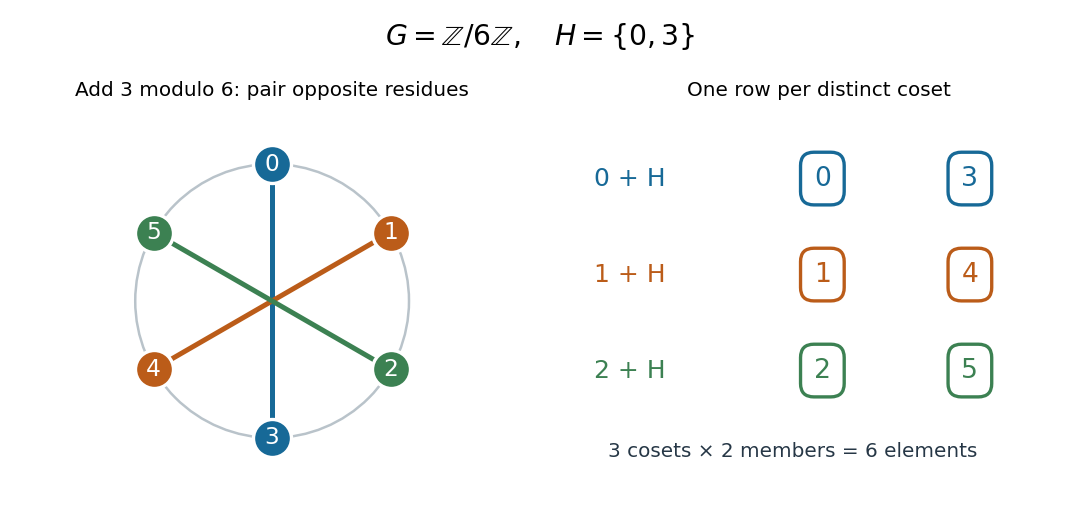
A coset need not be a subgroup. In this example, lacks the identity element , and leaves it. In fact, the only left or right coset of that is a subgroup is itself: a subgroup must contain the identity element, and the coset containing that element is . Equal sizes come instead from the bijection , whose inverse is ; for right cosets, use and .
The nonabelian group , the symmetric group on three letters, separates the two sides. Use function composition with the rightmost permutation applied first, and let . Then but , giving the differing pairThe complete partition of a set into left cosets consists of , and ; the complete partition of a set into right cosets consists of , and . Each lists all six permutations exactly once. Both have three parts of size two, although their parts differ.
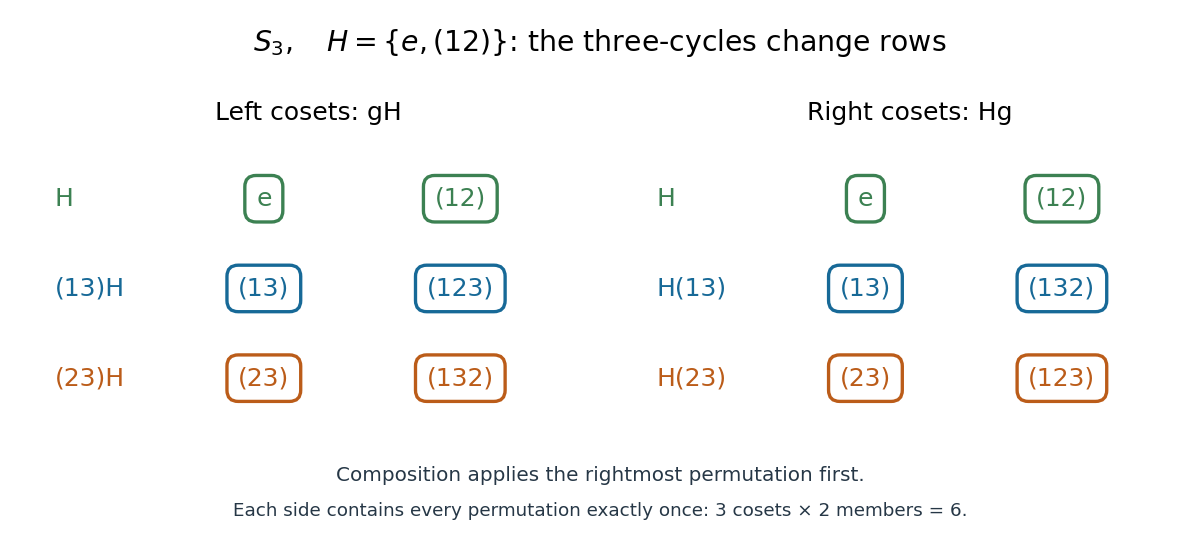


Left cosets support a group action by for every subgroup, as in the coset action. Multiplication of representatives defines a quotient group operation precisely when is a normal subgroup. Otherwise the answer can depend on the representatives: in this example, and represent the same coset , yet and differ. In the additive example, is a normal subgroup, making valid. See MIT's quotient-group notes, theorem 9.1.
A left group action of a group on a set is a function satisfyingwhere is the identity element of . The second rule means that moves the point first and moves it next. These rules let group multiplication describe consistent rearrangements of a set; see Ackerman's algebra notes, definition 0.4.1.1.
For each , the function is a bijection: its inverse is , using the inverse element of . Equivalently, a group action is a group homomorphism into the symmetric group of all permutations of , with and . See MIT's group-action notes, definition 23.1.
For a concrete group action, put the vertices of a polygon of a square at , , and . Let be a counterclockwise quarter-turn rotation and let be a reflection. Their eight permutations of the vertices of a polygon form the dihedral groupHere means the symmetry group of a four-sided polygon, with group order eight; the alternative convention calls this same group . Products apply the rightmost operation first. For example, and . The same group also has separate group actions on the sides of a polygon, the diagonals of a polygon, and the singleton set containing the centroid of the square. Specifying matters: changing what is moved changes the orbits of a group action and the stabilizer subgroups.
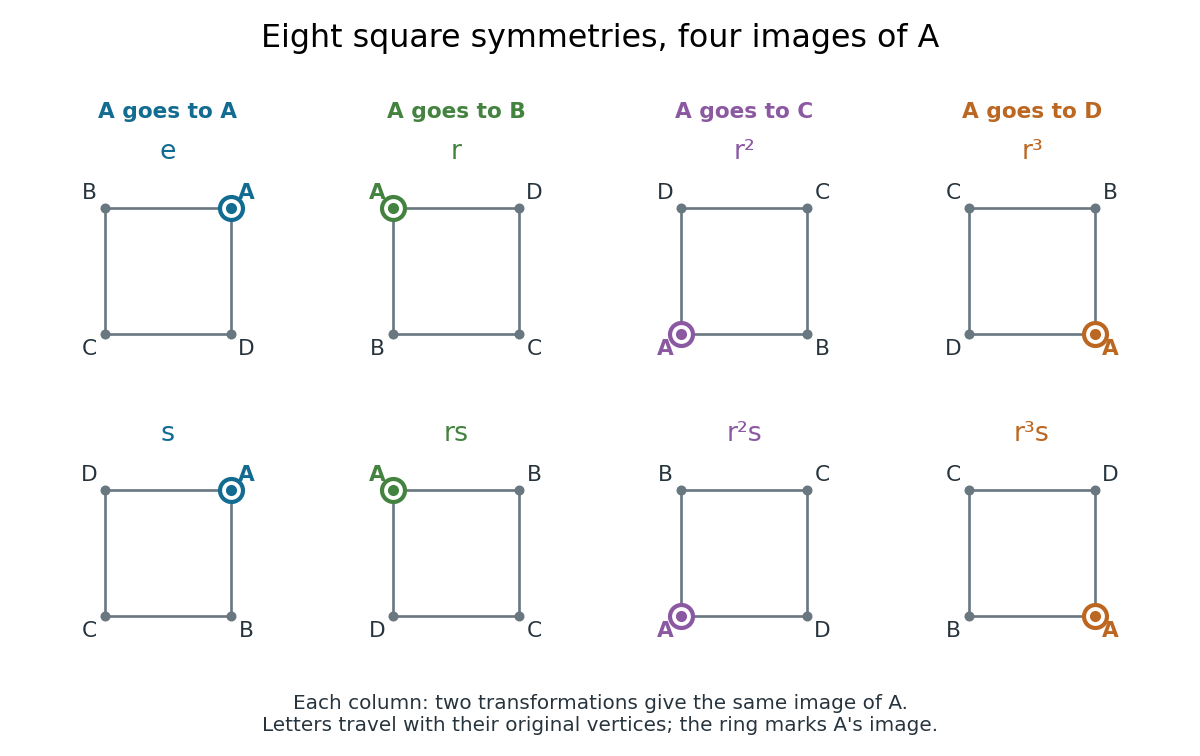

A group action need not be a faithful group action. For example, the cyclic group acts on by , using modular arithmetic. Only the parity of matters: fix both points and exchange them. The associated group homomorphism has group kernel , of group order two. Either point has a group orbit of size two and a stabilizer subgroup of group order two, so the orbit-stabilizer theorem gives .
The useful questions are which positions can be exchanged, and which transformations survive after imposing a constraint such as keeping one marked point fixed. An orbit of a group action answers the first question; a stabilizer subgroup answers the second. This turns a list of transformations into a count of distinct configurations, and explains why several transformations can produce the same configuration.
For a subgroup of a group and , the conjugate subgroup is the conjugate subsetIt is a subgroup because conjugation is a group automorphism. Restricting that group automorphism gives a group isomorphism from to , so conjugate subgroups have the same group order. This describes the same operations after moving their reference configuration. Conjugacy of subgroups is an equivalence relation. [ref]
For an equilateral triangle with vertices of a polygon labeled counterclockwise, its symmetry group is the symmetric group , also the dihedral group of group order six. Let be the counterclockwise rotation through degrees, and let be the reflection fixing vertex of a polygon . Products apply the rightmost permutation first. The cyclic subgroup contains the identity element and one reflection. Relabeling a transposition by conjugation givesThus the conjugation action moves among the three subgroups , , and . Geometrically, the rotation moves the axis of the reflection to the next axis. Each reflection fixes a different vertex of a polygon, although group isomorphisms relate all three subgroups.
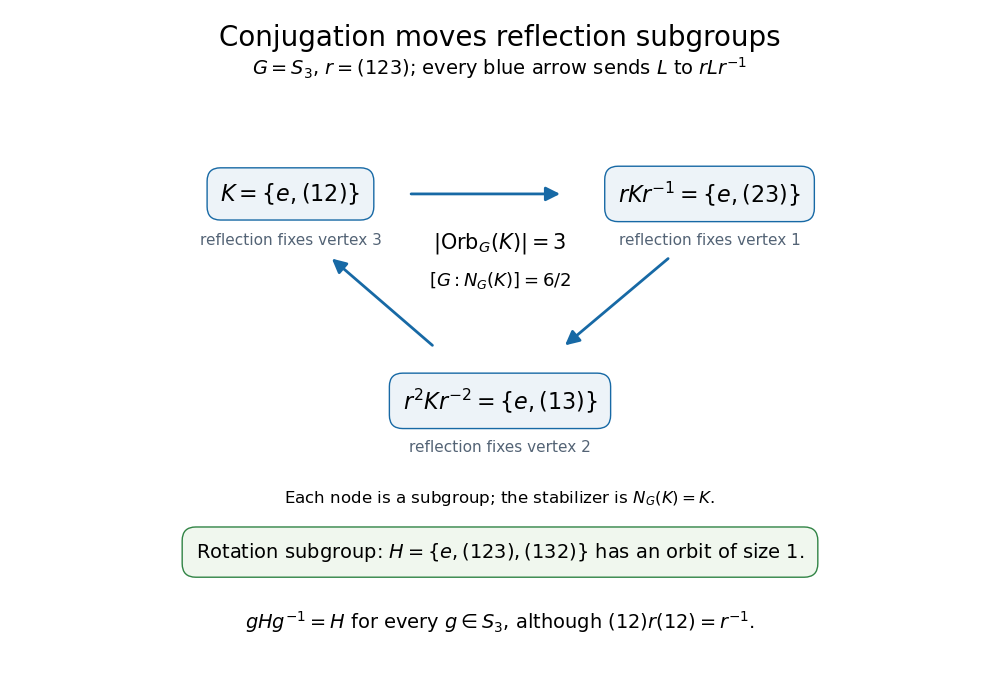

The normalizer tells when this change of reference leaves the subgroup unchanged. For any group and subgroup , there is a bijectionTwo choices give the same conjugate subgroup exactly when . Consequently the index of a subgroup counts the distinct conjugate subgroups, even for an infinite group. For a finite group the count is . These are cosets; they need not form a quotient group, since need not be a normal subgroup of . In the triangle example there are conjugate subgroups, while the cyclic subgroup has only one. [ref]
The center of a group consists of the elements that commute with every element of that group:where is the centralizer of . These are operations whose position in any product can be changed freely. The center is an abelian group and a characteristic subgroup, hence a normal subgroup. A group is an abelian group precisely when .
For the symmetric group , the conjugacy classes areAn element belongs to the center precisely when its conjugacy class has one element, so . Yet commutator subgroup of the symmetric group on three letters gives , with three elements. Thus belonging to the commutator subgroup does not mean commuting with everything. The alternating group is an abelian group as a subgroup, but its nonidentity elements do not commute with the transpositions in the surrounding .
For the dihedral group of group order eight in abelianization of the square symmetry group, the center is . A rotation commutes with precisely when , which requires even. No reflection commutes with , since whereas . ConsequentlyThe half-turn can be performed before or after any square symmetry with the same result. Its appearance both here and in the commutator subgroup is a feature of this example, rather than a general equality. See Conrad, Dihedral groups I, theorem 3.4 and example 3.5.
The center and the commutator subgroup answer different useful questions: which operations already commute with everything, and which operations must disappear for the entire group to commute. In an abelian group these answers are and . Another way to use the center is through conjugation: the group homomorphism has group kernel , so the first isomorphism theorem gives , the inner automorphism group. The quotient group by the center thus records the distinct conjugation operations; it need not be an abelian quotient.
A nontrivial finite p-group always has a nontrivial center. In the class equation, each noncentral conjugacy class has size divisible by , so . The identity element ensures is nonempty, hence it has at least elements. See McKernan, MIT 18.703, lemmas 23.6–23.7 and definition-lemma 23.10.
The commutator subgroup of a group is the subgroup generated by all its group commutators:Here and throughout, . A group commutator is the identity element precisely when and commute. The generated subgroup includes finite products of group commutators and their inverse elements; an element of need not itself be a single group commutator. Thus precisely when is an abelian group.
The useful idea is to record exactly what must disappear to make multiplication commutative. The identity shows how a group commutator corrects a change in multiplication order. Setting every such correction equal to produces the abelianization , while preserving every piece of information that a group homomorphism to an abelian group can detect. This connects a local comparison of two operations to a canonical quotient group of the whole group.
The commutator subgroup is a characteristic subgroup, hence a normal subgroup: a group automorphism sends to . For any normal subgroup ,Indeed, the group commutator of and is . This makes the smallest normal subgroup whose quotient group is an abelian group. See Conrad, Subgroup series I, section 4: commutators and abelian quotients.
A direct product combines two groups into one while keeping their operations in separate coordinates. Its underlying set is the Cartesian product , and its group operation isThe identity element is , and the inverse element of is . Associativity follows coordinate by coordinate. For finite groups, the multiplication principle gives .
For example, write the cyclic group as the additive group of residue classes modulo . In ,since each coordinate reduces with its own integer modulus. A pair can track two cyclic counters that advance independently. Updating the first coordinate does not alter the second, and vice versa.
This independence has an algebraic form. The embedded factor elements always commute:The coordinate maps and are group homomorphisms, so one can analyze either component separately. This does not make the full product an abelian group when one of its factors is nonabelian: two arbitrary pairs need not commute.
The construction is useful in both directions. It builds a larger group from familiar pieces, while the internal direct product theorem recognizes when an existing group can be separated into such pieces. A cyclic group can sometimes be split this way; whether two finite cyclic factors combine into one cyclic group is decided by the cyclicity of a product of two finite cyclic groups. Definitions and the basic recognition theorems are developed in Thomas Judson, Abstract Algebra: Theory and Applications, §9.2, Direct Products.
For a group homomorphism , the group isomorphism givesThe group kernel records which inputs become indistinguishable, and the image records which outputs actually occur. The first isomorphism theorem says that identifying precisely those indistinguishable inputs gives a group isomorphic to the image. It is one of the general isomorphism theorems. [ref].
For example, reduction modulo three gives a surjective group homomorphism from the additive cyclic group to . Its group kernel is . The three cosets , , and become the three outputs zero, one, and two, respectively. ThusThe quotient group diagram shows both the identification and the resulting operation. More generally, fibres of a group homomorphism are cosets of its kernel explains why this map is well-defined and injective; it is surjective onto the image by definition.
There are unlisted articles, also show them or only show them.