
If , then its Fourier transform is continuous and tends to zero as . Approximate in by a compactly supported smooth function; integration by parts makes the approximant's transform decay, while transfers the conclusion.
Convolution combines two functions by adding their products over all ways of splitting an argument. For Lebesgue integrable functions on the real line, their convolution isThe arguments and always add to . For in the L1 space, the integral exists almost everywhere and defines another element of the L1 space, with by Young's convolution inequality. Particular examples below have a value at every .
To see what the integral counts, take the indicator function . The product equals one exactly when belongs to both intervals and . Its integral is their overlap length, soAt , the overlap is and the output is ; at , the two intervals coincide and the output is one. The result is the shifted triangular function . As changes, is a reflected and translated copy of : the moving overlap makes the entire graph visible without a difficult integration.
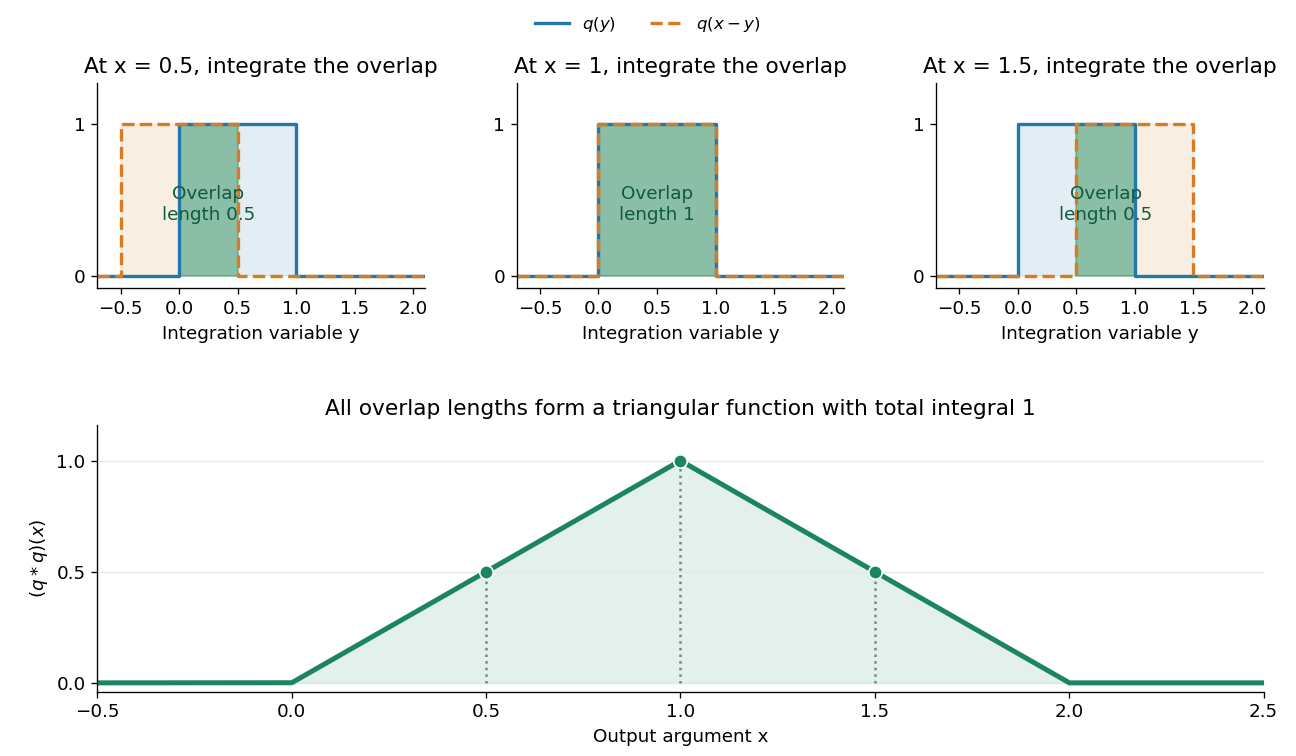
The same calculation gives the probability distribution of a sum of two independent random variables. If are independent random variables with the continuous uniform distribution on , each has probability density function . Their sum has probability density function by convolution of probability densities. The probability density function at one is larger than near zero or two because there are more combinations of the two inputs giving that sum. Its total integral is one; its expected value is one and its variance is . These follow equally from integrating the triangular function or from linearity of expectation and variance additivity for independent random variables.
Convolution also gives a useful averaging operation. For , let . Thenthe mean of in a neighborhood of . A smaller examines a smaller neighborhood. For a continuous function , this mean tends to as , an example of an approximate identity. Integrating a sharp input against a distributed convolution kernel can produce a smoother output; the triangular example turns two discontinuous inputs into a continuous output.
In signal processing, a linear time-invariant system combines shifted copies of its impulse response by the same rule. In discrete time, an input value at index contributes a scaled response at index , and discrete convolution sums these contributions. This is the superposition interpretation developed in Oppenheim, MIT Signals and Systems, Lecture 4, convolution sums and integrals. The convolution theorem then gives another description: transform both inputs with a Fourier transform and multiply their transforms. Combining shifts, combining independent quantities and multiplying frequency descriptions are three faces of the same operation.
The Fourier inversion theorem makes decomposition into frequencies reversible: a complete Fourier transform, including its wave phases, determines the original function up to equality almost everywhere. With the angular-frequency conventionif and belong to the L1 space, thenalmost everywhere. The right side is a continuous representative of . If itself is continuous, equality holds everywhere, as explained by the continuous version of Fourier inversion. The integrability hypotheses ensure that both displayed integrals are ordinary absolutely convergent integrals. For arbitrary elements of the L2 space, the Plancherel theorem instead supplies inversion in the L2 space norm.
Each factor is a Fourier mode; the inverse integral adds them with the complex weights . The normalization is part of the recipe. In one dimension, writing ordinary frequency as gives the equivalent pairwhere . Reversing both exponential signs gives another equivalent convention, but the forward and inverse formulas must use opposite signs consistently.
For example, the Fourier transform of a Gaussian givesFourier inversion says that a weighted continuum of oscillations reconstructs this smooth Gaussian function. Narrowing the original Gaussian function by increasing broadens its frequency spectrum. This is a concrete demonstration that a sharply localized shape needs a wider range of frequencies.
Inversion is what makes a frequency calculation useful: transform a function, solve the simpler problem there, then return to the original variables. A brief proof outline is to multiply by , . The inverse integral becomes convolution with a normalized Gaussian function, an approximate identity. As tends to zero, dominated convergence gives the unregularized inverse integral, while the approximate identity recovers almost everywhere. Joseph Fourier's Théorie analytique de la chaleur (1822), Chapter IX, article 417, contains a cosine double-integral representation antecedent to this modern formula; the hypotheses above are the modern statement.[ref]
https://fr.wikisource.org/wiki/Th%C3%A9orie_analytique_de_la_chaleur/Chapitre_9. Fourier 1822, Chapter IX, article 417: cosine integral representation
The Schwartz space consists of smooth functions whose derivatives decay faster than every inverse polynomial. Its Fréchet topology is generated by the seminormsIt is dense in every .
A Fourier mode is a single complex oscillatory component . Its real and imaginary parts are a cosine and a sine; is the spatial angular frequency. Every constant-coefficient differential operator acts on it by multiplication: . In particular, . These eigenfunctions reduce a partial differential equation such as the heat equation to separate equations for each frequency. On the real line a pure Fourier mode is not in the L2 space; the Fourier transform uses such modes in a continuous superposition.
The associated four-force uses proper time instead of coordinate time and is a different, four-dimensional object.
The Wess–Zumino model contains chiral superfields with a polynomial superpotential. It is the simplest interacting four-dimensional supersymmetric field theory.
An objective-collapse theory treats wave-function collapse as a physical process localized in spacetime, rather than only as an observer's update of information.
Bell's theorem shows that no theory assigning outcomes through local hidden variables can reproduce every quantum correlation.
The Einstein–Podolsky–Rosen criterion says that if one can predict a physical quantity with certainty without disturbing the system, then there is an element of physical reality corresponding to that quantity.
The axioms of an abstract family of languages require particular closure properties of formal languages. A language class is closed under an operation when applying that operation to members always produces another member of the class.
A language is regular exactly when indistinguishability by all suffixes has finitely many equivalence classes; these classes form its minimal DFA.
For a deterministic finite automaton with states, every accepted word with has a decomposition such that , , and is accepted for every integer .
A nondeterministic finite automaton allows a set of possible destinations for each automaton state and input symbol. Without the extra moves permitted in an Epsilon-NFA, replace the DFA function by , where is the power set. A word is accepted when at least one path consumes all its symbols and ends in an accepting automaton state. These choices express existential quantification, not probability: no chance of choosing a particular path is assigned. One successful path suffices even if other paths fail.
Consider a three-state NFA accepting exactly the words of binary digits ending in . Its initial automaton state loops on both and ; it also has an automaton transition , followed by . Only is accepting, and all unlisted automaton transitions are absent. Staying at skips an arbitrary beginning; leaving it guesses that the current zero starts the final two symbols.
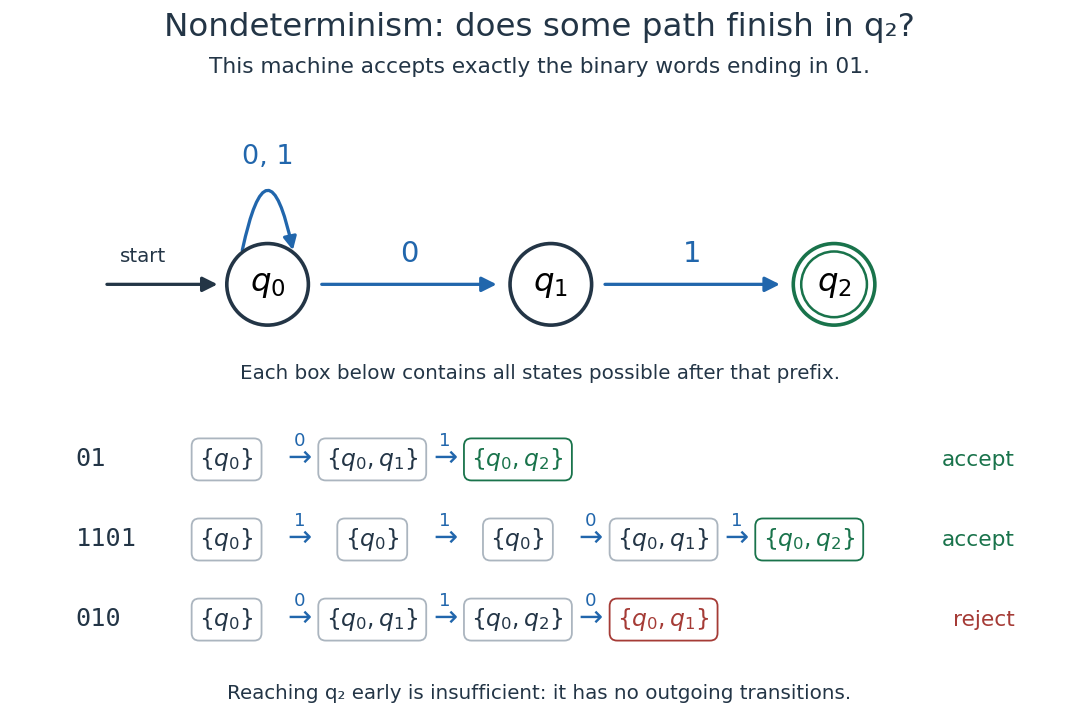


The word accepts along . The word accepts along . The word rejects: a path reaching after cannot consume the remaining zero, while the other paths end outside . Thus finding somewhere is insufficient; it must occur at the end.
To simulate the NFA deterministically, retain the set of all currently possible automaton states. The powerset construction updates by taking the union of the destinations of its members. Here only , , and are reachable, although the full power set has eight members. Reading gives , which rejects. In general, an -state NFA yields a DFA with at most automaton states. Nondeterminism can simplify a description, while the powerset construction keeps the memory finite.
The second generator checks all 511 words of up to eight binary digits against the direct test of whether their final two symbols are . Exactly 127 accept, and only the three listed sets of automaton states occur. In particular, the empty word rejects for this NFA.
Michael O. Rabin and Dana Scott's 1959 paper studied finite-state machines as recognizers with finite internal memory. Its section 5 defines NFAs through successful paths, and theorem 11 proves their equivalence to DFAs by the powerset construction. This gives a historical source for the distinction between many possible paths and greater recognition power: [ref]
https://www.cs.cmu.edu/~lblum/flac/Handouts_pdf/rs.pdf. Rabin and Scott, Finite Automata and Their Decision Problems, pp. 120–121
. There are unlisted articles, also show them or only show them.