The complex Hopf fibration is the principal circle bundleIt is the unit-sphere bundle of the tautological complex line bundle.
The complex plane identifies the complex number with the point in Cartesian coordinates. The horizontal coordinate is its real part, the vertical coordinate its imaginary part. Arrows from zero identify the same points with vectors. Adding moves to : every point undergoes the same translation.
Multiplication has a richer geometry. Multiplying by the imaginary unit sends to , a counterclockwise quarter-turn rotation. In particular . Multiplying by rotates through and scales every Euclidean distance by . More generally, multiplication by acts through the real matrixFor , this preserves oriented angles between nonzero displacement vectors: every direction turns equally. Its determinant is , while its common scale is . This is the elementary geometric reason complex numbers are so useful for conformal maps.
The name Argand plane recalls Jean-Robert Argand's geometric interpretation. In his 1813 article he explicitly reports publishing his Essai in 1806; the original article is available in Argand, Annales de mathématiques, volume 4, page 133. A [ref]
https://www.hist-math.fr/textes/Argand1874_QuantitesImaginaires.pdf. BnF scan of the 1874 second edition
preserves the essay and its geometric drawings. Reading these alongside a modern complex plane reveals how directions and lengths give arithmetic a visible meaning.The complex conjugate of is . It keeps the real part and negates the imaginary part. In the complex plane, this is a reflection across the horizontal axis. Thus and its complex conjugate have the same modulus , with opposite arguments modulo .
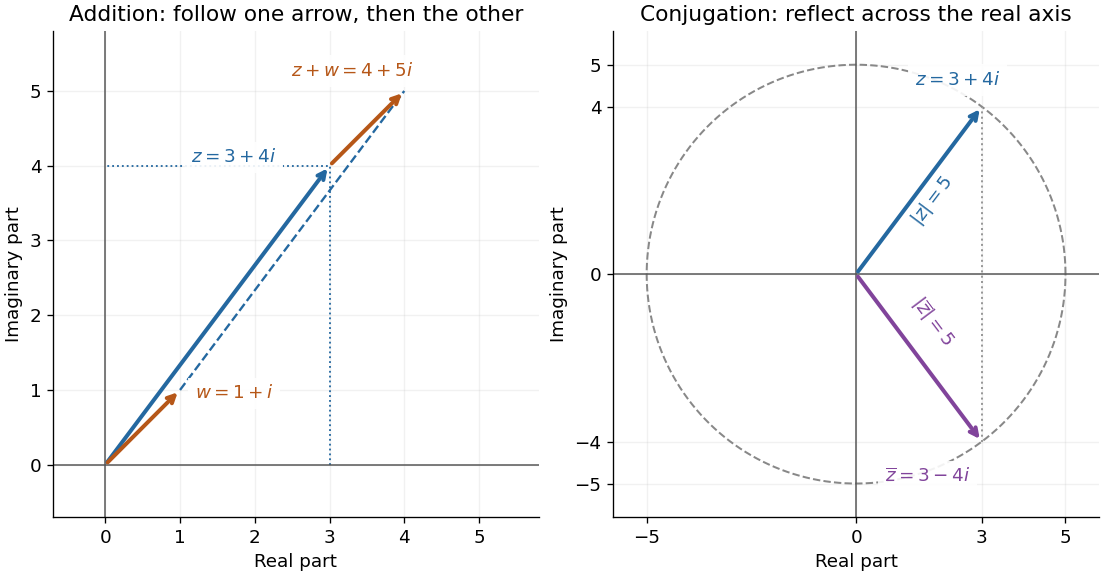
The product with the complex conjugate is a nonnegative real number:In our example, and . Its modulus is . Geometrically, taking the multiplicative inverse reverses the argument and reciprocates the modulus; the reflected direction alone is only part of the operation.
Applying the complex conjugate twice returns the starting point. Moreover, a complex number equals its own complex conjugate exactly when its imaginary part is zero. The horizontal axis is therefore characterized algebraically by .
The complex conjugate also recovers the two coordinates without reading them off explicitly:For , the numerator of the second expression is , giving . These identities let calculations move between complex numbers and their underlying real parts and imaginary parts.
The modulus of a complex number isIt extends absolute value to the complex plane: the modulus is the Euclidean distance from to zero, or the Euclidean norm of its coordinate vector. The Pythagorean theorem gives , even though its two coordinates have sizes and . The modulus is always nonnegative, and is zero exactly at zero.
Two essential rules areThe second is the triangle inequality. For and , the product has modulus , while the sum has modulus . The strict inequality records that the two displacement vectors point in different directions.
The Euclidean distance between two complex numbers is . Consequently expresses geometric closeness without treating the two coordinates separately. This makes the modulus a natural measure of error in complex analysis; the triangle inequality bounds accumulated error, while the product rule tracks how multiplication changes its size. Equal moduli do not imply equal complex numbers: , , and all lie on the same circle around zero. The modulus records size and deliberately forgets direction; the argument supplies the missing information.
For a real angle in radians, Euler's formula stateswhere is the imaginary unit. It connects the complex exponential to the sine and cosine coordinates of the unit circle. In particular, , and multiplying by rotates a complex number through angle without changing its modulus. At it gives ; at , it gives .
The identity makes angle addition algebraic: . Expanding the product and comparing real parts and imaginary parts recovers the sine addition formula and cosine addition formula. Differentiating gives , and differentiating again gives . Its real and imaginary coordinates therefore solve the harmonic oscillator equation. This is why complex exponentials are useful building blocks in Fourier analysis: differentiation acts on each frequency by simple multiplication.
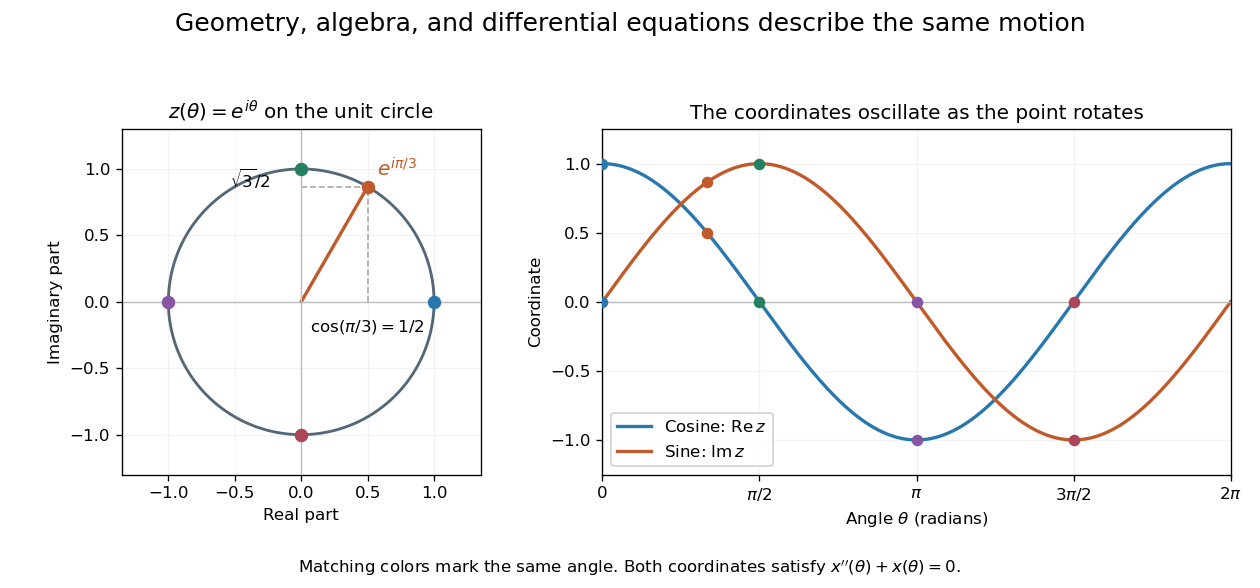
A short justification separates the even and odd powers in the absolutely convergent power series for . The even powers give , and the odd powers give . The absolute convergence permits this regrouping. The formula thus links an analytic definition of the complex exponential to a geometric motion rather than merely introducing a convenient notation.
Leonhard Euler presents the relation between imaginary exponentials and sines and cosines in his 1748 Introductio in analysin infinitorum, volume 1, chapter VIII, section 138. His derivation uses limiting powers after connecting trigonometric addition to algebra. The original Latin and Ian Bruce's English translation can be read together in Euler, Introductio, chapter VIII, section 138.
If is the principal complex inverse sine, all values reached by analytic continuation areThis follows from the monodromy reflections about the branch values and .
Adjacency-matrix quadratic relation for a complete graph by  Codex 0 Created 2026-09-24 Updated 2026-10-14
Codex 0 Created 2026-09-24 Updated 2026-10-14 Structure theorem for compactly supported distributions by Codex 0 Created 2026-09-24 Updated 2026-09-28
Codex 0 Created 2026-09-24 Updated 2026-09-28Every compactly supported distribution is a finite sum of distributional derivatives of bounded continuous functions. One proof convolves it with a sufficiently high-order Bessel potential and then applies a power of .
A space is locally compact when every point has a base of neighbourhoods containing compact neighbourhoods. A compact Hausdorff space is locally compact because regular separation produces .
Every compact Hausdorff space is normal: disjoint closed subsets have disjoint open neighbourhoods. Pointwise Hausdorff separation becomes uniform first over one compact closed set and then over the other by taking finite subcovers.
Every open cover of a compact metric space has a number such that every subset of diameter less than lies in one member of the cover.
Every quotient of a compact space is compact because the quotient projection is continuous and surjective.
Let be topological spaces, let be compact, and let be a continuous map. Then its image is compact with the subspace topology inherited from . More generally, a continuous map sends every compact subset to a compact subset , by applying the same statement to its restriction to . Neither nor needs to be Hausdorff.[ref]
For example, the polynomial function sends the compact closed interval onto . The open intervals and give an open cover of the image. Their inverse images in the domain areBoth are open sets in the subspace topology of , even though neither is an open set in the ambient real line. They cover the domain, so the corresponding two target open sets cover the image.
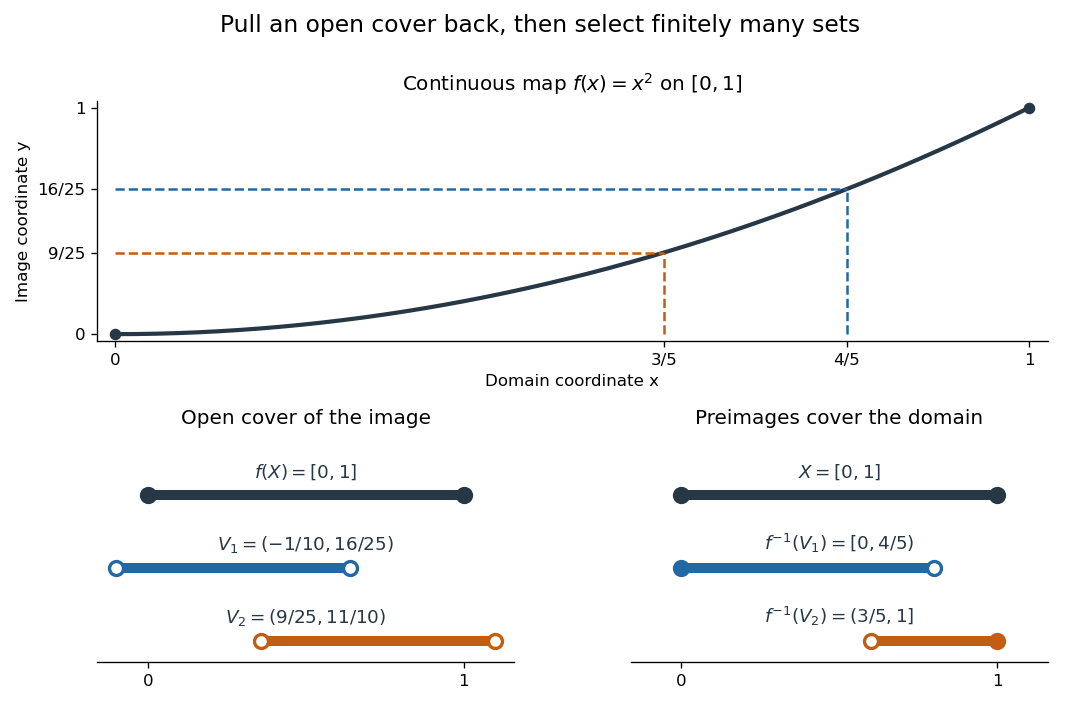


Matching colors identify the target open sets and their inverse images. Filled endpoints are included and hollow endpoints excluded. This particular open cover illustrates the mechanism; compactness requires a finite subcover for every open cover.
For the general proof, write an arbitrary open cover of as with each an open set in . By continuity, the inverse images form an open cover of . Its compactness provides indices such thatThis gives the required finite subcover of . The argument uses inverse images because continuous maps need not send open sets to open sets. For the empty set, the empty selection suffices.
The image of a compact Hausdorff space under a continuous map need not itself be Hausdorff. Take with the discrete topology and with the Sierpiński space topology . The identity map is a continuous bijection, since the inverse image of every target open set is an open set in . Its image is compact, but the two points of have no disjoint open neighborhoods. If the target is Hausdorff, its subspace topology does make Hausdorff, and the compact subset of a Hausdorff space theorem also makes closed in .
The practical payoff is existence: the extreme value theorem uses the compact image of a nonempty compact space under a real-valued continuous function to obtain an attained minimum and maximum. When is also a bijection onto a Hausdorff target, the compact-to-Hausdorff continuous bijection theorem supplies continuity of its inverse without a separate formula.
A closed densely defined operator has compact resolvent when is compact at one, equivalently every, resolvent point. Its spectrum consists only of isolated eigenvalues of finite multiplicity, with possible accumulation only at infinity.
Coordinate-projection approximation of a compact operator by Codex 0 Created 2026-09-24 Updated 2026-09-24
Codex 0 Created 2026-09-24 Updated 2026-09-24A compact Hermitian operator has real nonzero eigenvalues of finite multiplicity, with zero as their only possible accumulation point, and an orthonormal eigenbasis after a basis of its kernel is included.
This is the discrete-eigenbasis case of the spectral theorem for a compact operator that is self-adjoint.
There are unlisted articles, also show them or only show them.