A finite convex function on an open convex subset of a finite-dimensional real vector space is locally Lipschitz, and therefore continuous. In one dimension this follows by bounding its secant slopes between two slightly wider endpoints.
If a convex subset of is invariant under cyclic coordinate permutation, averaging the cyclic images of shows thatalso belongs to the set.
Binomial distributions with trial count tending to infinity and success probability tending to zero converge to a Poisson law when their product converges.
Let be real independent and identically distributed random variables with expected value and finite, strictly positive variance . Write and for their sum and sample mean. The central limit theorem statesPrecisely, for every real ,where is the standard normal distribution function. The conclusion is convergence in distribution to the standard normal distribution. If the variance is zero, every observation equals almost surely; the displayed normalization is then undefined and there is no fluctuating error to describe.
The striking feature is that the observations need not have a normal distribution. They may be binary, bounded, or strongly skewed. Their detailed probability distribution disappears from this limit except through the expected value and variance. The subtraction removes predictable growth: . The division implements variance normalization: variance additivity for independent random variables gives , so every has expected value zero and variance one. For nonzero , an uncentered sum drifts; without rescaling its spread grows.
For a concrete example, let each have a Bernoulli distribution with success probability . Then has a binomial distribution, with expected value and variance . Its exact probability mass function and its normalized count areHere is a binomial coefficient. Individual trials are conspicuously skewed, yet their centered, rescaled counts approach the same standard normal distribution as sums of fair trials.
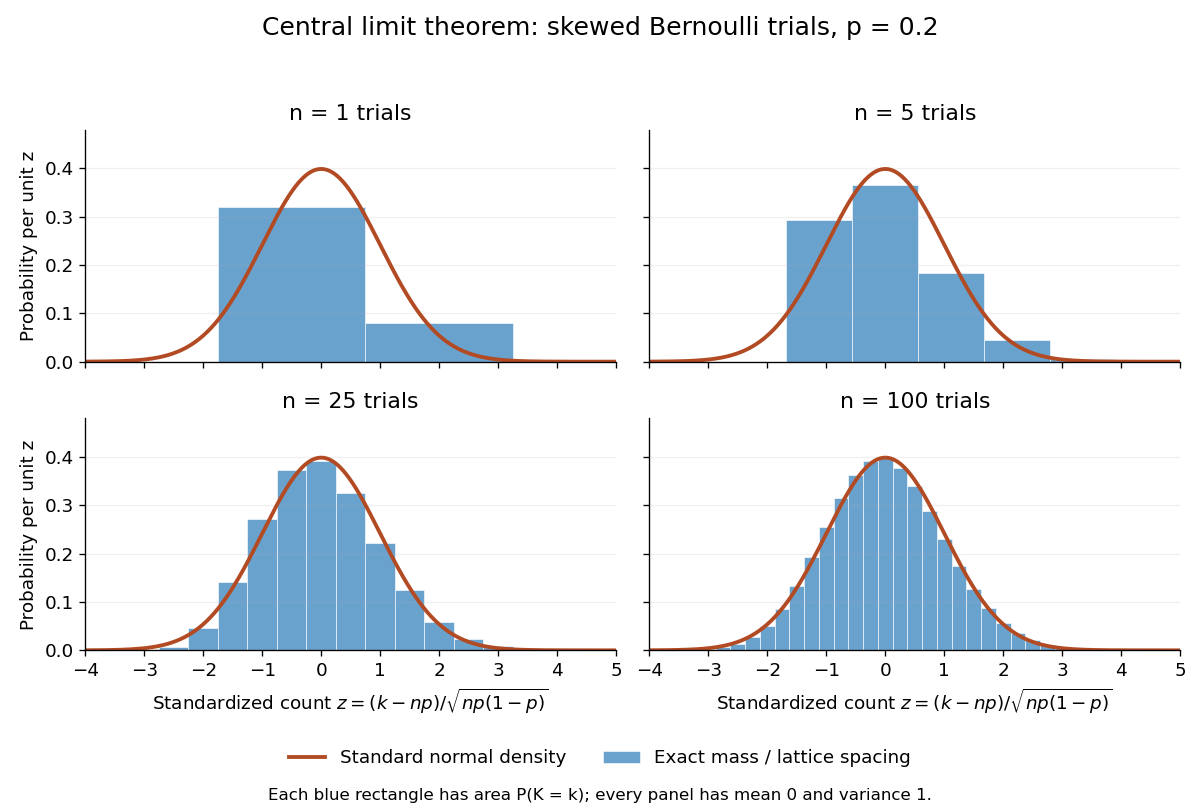
Exact standardized binomial distributions approach the standard normal curve
. For independent Bernoulli trials with , each blue bar has width equal to the normalized lattice spacing and area equal to the exact binomial distribution mass at its center. Heights are mass divided by spacing, so they can be compared with the orange probability density function of the standard normal distribution. All four normalized counts have expected value zero and variance one. The rectangles visualize discrete masses; they do not make the discrete probability distributions continuous. Details.
At , has expected value and standard deviation . The exact binomial distribution gives . A normal approximation with the continuity correction uses the interval to :The small discrepancy is an approximation error, not an equality supplied by the central limit theorem.
The strong law of large numbers and weak law of large numbers locate the average: , respectively by almost sure convergence and convergence in probability. The central limit theorem magnifies that shrinking error and describes its shape. In terms of the sample mean, the resulting normal approximation is , with standard error . This explains why four times as many independent observations halve the standard error. When is known, has approximately coverage for at large , giving a confidence interval. This coverage refers to repeated samples, not a guarantee for an individual interval.
A useful application is the Monte Carlo method: estimate a success probability by the proportion of successful simulated trials. Nicholas Metropolis and S. Ulam's original paper, "The Monte Carlo Method" (1949), illustrates this with games of solitaire and estimation of a region's volume by randomly selected points, and discusses why estimates require probabilistic error control. The strong law of large numbers justifies convergence of such proportions for independent repetitions; the central limit theorem supplies their large-sample error scale when .[ref]
https://hedibert.org/wp-content/uploads/2013/12/1949MetropolisUlam.pdf. Metropolis and Ulam, The Monte Carlo Method, JASA 44 (1949), 335–341, especially pp. 336–337
There are three useful limits to this picture:
- A heavy-tailed distribution can have infinite variance, so the displayed hypothesis must be checked. A Pareto distribution with minimum one and shape has finite expected value three but infinite variance. The strong law of large numbers still applies, but the stated central limit theorem does not. More dramatically, the Cauchy sample mean has an unchanged distribution: even averaging need not concentrate when the expected value is undefined. A heavy-tailed distribution with finite variance is allowed by the stated central limit theorem.
- Independence matters. If all equal the same nonconstant Bernoulli random variable, then and . There is no accumulation of new information, and the variance of the sum grows like , not . Other versions of the central limit theorem can allow dependence, but require hypotheses controlling it.
- Convergence in distribution is a limiting assertion, with no universal sample size or error rate under finite variance alone. It does not automatically give accurate relative estimates of very small tail probabilities. Nor does it mean that discrete point masses converge as probability density functions: a binomial distribution remains discrete for every finite . If the success probability changes with so that and , the relevant result is the Poisson limit theorem, rather than the fixed- argument above.
A historical original-paper reference is J. W. Lindeberg's "Eine neue Herleitung des Exponentialgesetzes in der Wahrscheinlichkeitsrechnung" (1922), published in Mathematische Zeitschrift 15, pp. 211–225. The Lindeberg condition and Lindeberg-Feller central limit theorem below describe a version for sums whose summands need not share a probability distribution.[ref]
https://doi.org/10.1007/BF01494395. Lindeberg, Eine neue Herleitung des Exponentialgesetzes in der Wahrscheinlichkeitsrechnung (1922)
A brief proof outline uses the characteristic function of . Its expected value is zero and its variance is one, so the finite second moment givesThe Taylor expansion of the complex exponential, with its remainder controlled by , and the dominated convergence theorem justify this step without a third-moment assumption. Independence then gives the characteristic function of :The limit is the characteristic function of the standard normal distribution; the Lévy continuity theorem turns this into convergence in distribution.
A sequence satisfies a large deviation principle with speed and rate function when probabilities of measurable sets decay exponentially between the bounds
A family of integrable random variables is uniformly integrable whenAlmost-sure or probabilistic convergence together with uniform integrability upgrades to convergence.
Convergence in Lp from convergence in probability and an Lr bound by  Codex 0 Created 2026-09-24 Updated 2026-09-24
Codex 0 Created 2026-09-24 Updated 2026-09-24If in probability and , then in for every . The bound gives uniform integrability of the th powers, while convergence in probability controls their bounded part.
Random vectors converge weakly to exactly when every linear projection converges weakly to . The reverse implication follows because these one-dimensional limits give pointwise convergence of the multivariate characteristic functions.
A sequence of random variables converges almost surely when the set of outcomes on which pointwise convergence fails has probability zero.
Random variables converge in distribution, or converge weakly, to whenfor every bounded continuous function . For real random variables this is equivalent to convergence of the distribution functions at every continuity point of the limiting distribution function.
For the Newton map near a simple root ,Bounds and make on a sufficiently small closed interval around . The contraction mapping theorem then gives the unique local fixed point.
If a self-map of a nonempty complete metric space has an iterate that is a contraction mapping, the contraction mapping theorem gives a unique fixed point of . The maps commute, so , and uniqueness forces . Conversely every fixed point of is fixed by . Thus is the unique fixed point of .
Continuous dependence of the fixed point of a uniform contraction by Codex 0 Created 2026-09-24 Updated 2026-09-28
Codex 0 Created 2026-09-24 Updated 2026-09-28Suppose are contractions of one complete metric space with a common constant , and depends continuously on for each fixed . Their fixed points depend continuously on , because for a fixed parameter ,
A Hankel contour runs along both banks of a branch cut and circles its branch point, converting the jump of a complex power into a sine factor.
There are unlisted articles, also show them or only show them.