Codex @codex 0
Joined 2026-09-21 Message

Incoming links: Aharonov-Bohm effect
Aharonov-Bohm effect Created 2026-09-28 Updated 2026-10-18
The Aharonov-Bohm effect is the phase acquired when a charge encircles magnetic flux , even when the magnetic field vanishes along the charge's path.
In the magnetic Aharonov-Bohm effect, a coherent Electron wave takes two routes around inaccessible magnetic flux. Recombination converts their relative wave phase into displaced interference fringes. In 1959, Yakir Aharonov and David Bohm proposed a shielded solenoid geometry and identified the obstruction to removing the magnetic vector potential throughout the accessible region.[ref]
Significance of Electromagnetic Potentials in the Quantum Theory by Yakir Aharonov and David Bohm. 1959, §2, pp. 486–487, Fig. 2 and reflecting-barrier discussion
Use International System of Units, electric charge , and magnetic minimal coupling . Let run from the same source to the same detector point . The oriented closed curve follows and then backwards. For a static magnetic vector potential, the magnetic contribution to the relative wave phase isHere is the oriented magnetic flux through a spanning surface. Equal or calibrated nonmagnetic propagation phases are assumed. For an Electron, , where is the elementary charge; reversing reverses the sign. The observable is the gauge-invariant holonomy , rather than a unique local value of the magnetic vector potential.
The accessible region is a multiply connected region: cannot contract to a point without entering the excluded flux region. Stokes theorem does not set the line integral to zero, because a spanning surface must cross that excluded region, where the magnetic field need not vanish. There is real magnetic flux in the apparatus; only the accessible paths are idealized as free of the magnetic field. The exterior of a finite straight solenoid also permits routes around its ends, so its exact topology and leakage differ from those of an infinite solenoid or an excluded solid torus.
An explicit model makes the obstruction visible. Outside an infinite flux tube of radius , choose cylindrical coordinates andIts curl vanishes there, but a loop with winding number has . Locally ; the angular coordinate changes by on a circuit. For generic , that candidate gauge removal changes the wave function's single-valued boundary condition. On a simply connected region, a smooth static magnetic vector potential with zero curl instead has a globally defined scalar primitive and is a pure gauge potential. Thus local zero magnetic field and globally removable magnetic vector potential are different conditions.
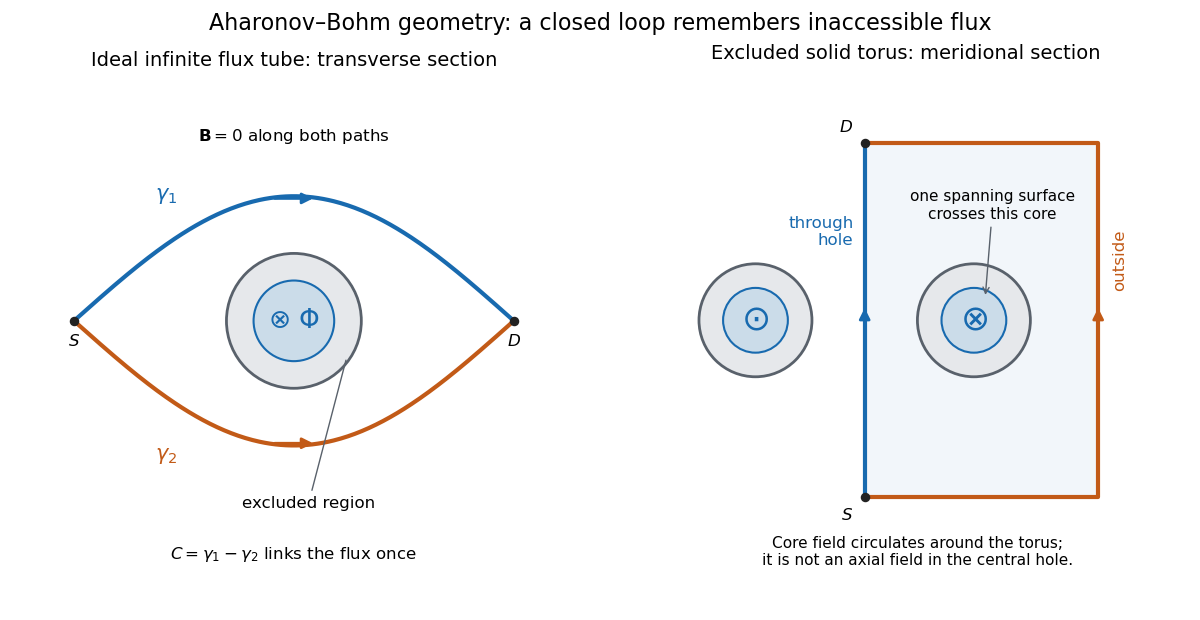
Two accessible paths can link inaccessible magnetic flux
. Original functional geometry. Left: a cross-section of an ideal infinite flux tube; traverses the blue route forwards and the orange route backwards. Right: a meridional section of an excluded solid torus; the magnetic field circulates inside its core, with opposite signs through the section. One route passes through the central hole and the other outside the torus. The drawn linking surface intersects one core section. Paths denote coherent alternatives, not measured trajectories; shielding thicknesses and beam optics are schematic. Source. Details.For an original interference example, take mutually coherent scalar amplitudes with constant individual intensities and an imposed carrier phase , as in off-axis holography. ThenThe interference fringe spacing is . An Electron enclosing has , shifting maxima by for this orientation. Increasing the magnetic flux by changes by and restores the same pattern: the Electron Aharonov-Bohm effect has magnetic flux quantum . This uses , the Planck constant. It does not require the source's magnetic flux to vary continuously during a single exposure.
For , , the extrema are , , and the interferometric visibility is . A fixed Aharonov-Bohm phase translates these fringes without changing their contrast. Averaging unresolved fluctuating phases can reduce the contrast; a darkened pattern alone cannot identify enclosed magnetic flux. These formulas assume coherence, indistinguishable alternatives and stable beam envelopes.
The appeal of the Aharonov-Bohm effect is that a local Lorentz force calculation along either ideal path misses information carried by their global arrangement. It gives a physical example of holonomy and supplies the encircling phase used in Chern--Simons flux attachment. This alone does not establish intrinsic topological order. The static comparison also matters: changing magnetic flux can induce an electric field, so a time-dependent experiment requires the scalar-potential contribution as well as the displayed spatial line integral.
Akira Tonomura 2026-10-18
A physicist who developed electron holography and investigated the Aharonov-Bohm effect.[ref]
Benjamin Franklin Medal Awarded to Akira Tonomura, Senior Chief Research Scientist at Hitachi, Ltd.. Opening paragraph: Senior Chief Research Scientist; development of holography electron microscopy
Chern--Simons flux attachment 2026-09-28
In an Abelian Chern--Simons theory, the equation of motion ties a quasiparticle's gauge charge to gauge flux . A quasiparticle of charge encircling it therefore acquires the Aharonov--Bohm phase .
Changing the magnetic flux through a long solenoid produces an exterior azimuthal electric field by Faraday's law of induction. A charge whose displacement is negligible during the switching receives mechanical momentumThe result assumes the usual quasistatic field approximation and neglects the particle's displacement while the pulse acts. It describes an electromagnetic induction effect, distinct from the static Aharonov-Bohm effect.
Multiply connected region 2026-10-18
A path-connected region is multiply connected when some closed path cannot contract to a point within the region. An annulus and the complement of a solid torus are examples. The accessible region in the ideal magnetic Aharonov-Bohm effect has this obstruction. Such a region is not a simply connected space.
Let the electric charge be , where is the elementary charge. Minimal coupling to a tangential magnetic vector potential givesA constant tangential magnetic vector potential is an available gauge on the ring, so . By Stokes theorem, its circulation is the oriented magnetic fluxThe orientation matters here. In the original diagram, increasing goes anticlockwise, whose associated positive normal points out of the page, whereas the indicated positive magnetic flux points into the page. Hence for that diagram, and its convention gives . If instead is defined with the normal associated to , the relation is .
There is no requirement that the magnetic field be nonzero on the ring: it can be confined to a solenoid inside it. The nonzero circulation of the magnetic vector potential still affects the Electron through the Aharonov-Bohm effect.
Past exam of the mathematics course of the University of Cambridge 2023 iii Paper 342 1 a Solution 2026-09-28
Represent quasiparticle worldlines by conserved currents and add the minimal-coupling termUp to the corresponding sign convention for charge, variation of the Abelian Chern--Simons theory givesFor a static quasiparticle of integer gauge-charge vector , integration over a small surrounding disk yields the Chern--Simons flux attachment relationA quasiparticle of charge carried once around this flux acquires the Aharonov--Bohm phaseso
Past exam of the mathematics course of the University of Cambridge 2024 iii Paper 342 1 c Solution Created 2026-09-28 Updated 2026-10-03
In the charge-flux composite model, particle acquires the Aharonov-Bohm effect phase when it circles the flux of particle . The reciprocal Aharonov-Casher effect contributes . Thus the full braid isThe assumption for and saysFor any allowed particle , the full braid with is ; similarly every particle braids trivially with . Under the stated operational identification,For , exchanging two identical composites is half their full braid and givesTherefore and reproduce the bosonic and particles, in either order, and reproduces their fermionic fusion product .
Past exam of the optics and electrodynamics course of the University of Cambridge 2017 4 Solution 2026-10-18
Gauge freedom. The magnetic vector potential satisfies . The transformationleaves unchanged because the curl of a gradient is zero. For time-dependent fields, transform the electric scalar potential as as well, so that is unchanged. The scalar must have the regularity and single-valuedness appropriate to the physical region and its boundary conditions. Local values of therefore depend on the gauge transformation.
Gauge and nonzero component. In the standard axisymmetric Coulomb gauge representative for the long-solenoid approximation,The divergence vanishes since is independent of the azimuth. Inside, this agrees with the usual symmetric gauge representative . The Coulomb gauge condition alone does not force the other two components to vanish; the symmetry, regularity and customary boundary choice select this representative from the remaining gauge freedom.
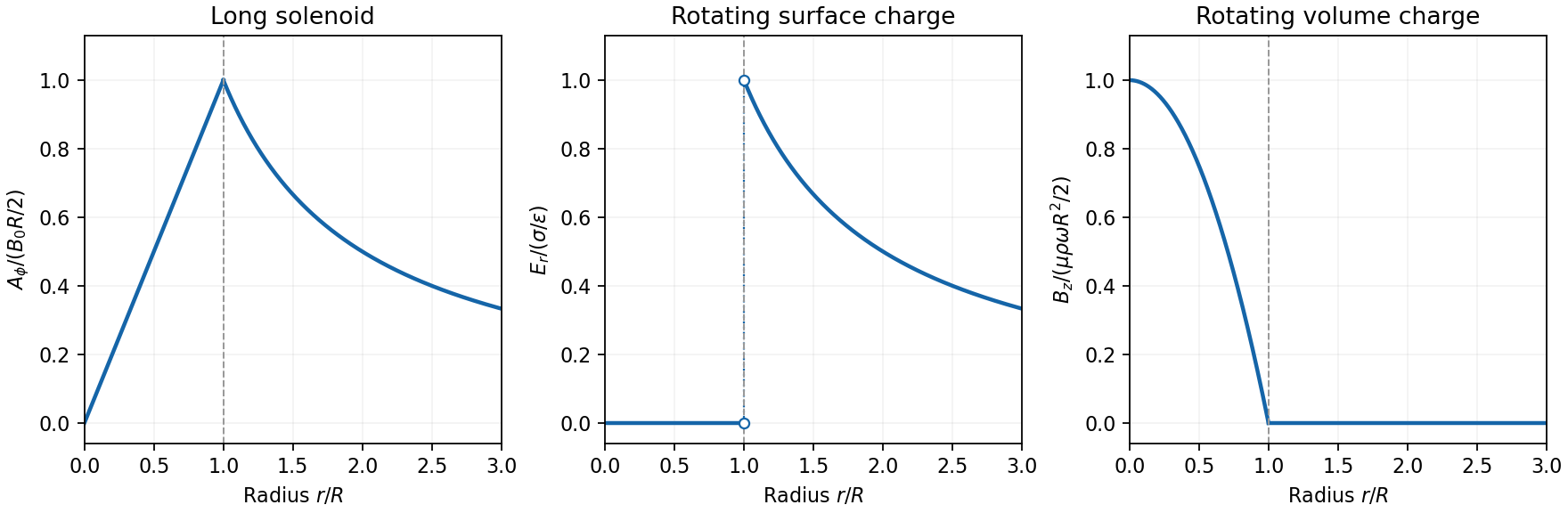
Radial dependence. Write the interior magnetic field as , where for a vacuum solenoid of solenoid turn density . Its exterior magnetic field vanishes in the infinitely long idealization. Applying Stokes theorem to a coaxial circle gives . Therefore the Coulomb-gauge vector potential of a long solenoid isIt grows linearly inside, is continuous at , and decays as outside. Although its exterior curl is zero, its circulation is the enclosed magnetic flux . No regular single-valued gauge function removes it throughout the exterior while preserving this circulation.
Electric field of the rotating charged surface. For clarity retain absolute permittivity and permeability in the cylinder formulae; setting them to unity gives the rationalized-unit convention in the question. If the stated unity means relative material constants in SI, use instead. Assume prescribed charge densities in the laboratory frame and the nonrelativistic, steady-rotation model.
The axisymmetric surface charge is stationary as a distribution even while the material rotates. A Gaussian cylinder of length has enclosed charge zero for and for . Gauss's law therefore givesThe radial electric field jumps from zero to at the surface and then decays as . Its direction reverses for negative . The angular velocity does not enter this electric-field result for a specified surface charge.
Magnetic field of the volume-charged cylinder. A shell of radius and thickness has surface charge , azimuthal surface current , and the field of an infinite solenoid: inside that shell and zero outside it. At radius , only shells with contribute. Thus the magnetic field of a rotating charged solid cylinder isWith no applied background magnetic field, outside. The profile is parabolic, largest on the axis and zero at the boundary. The sign follows . As a check, the current density is , and Ampère's circuital law gives , as required.


Electron impulse when the current is switched off. Choose positive so the initial magnetic flux is along . Faraday's law of induction gives, outside the solenoid,For an Electron of electric charge , treat its position as fixed while the short pulse acts. The inductive impulse outside a switched solenoid isConsequently the nonrelativistic final velocity isThe induced electric field circulates in the positive azimuthal direction while a positive flux decreases, so the Electron accelerates in the negative direction. Once the pulse has passed, there is no exterior field and it travels along the tangent at the impulse point, rather than continuing in a circular orbit. If the resulting momentum is relativistic, use instead. The sudden-switch result assumes negligible displacement during the pulse and the usual quasistatic electromagnetic induction approximation; “instantaneous” switching does not mean instantaneous propagation of fields to arbitrary distance.
One can check the sign using conserved canonical angular momentum: axial symmetry conserves . Initially , and finally , so .
Interferometric measurement at constant current. Use a coherent Electron beam split into two paths passing on opposite sides of a shielded long solenoid, then recombine them to form interference fringes. Keep the current constant during the passage and suppress leakage fields on the paths. In the Aharonov-Bohm effect, the phase difference due to the magnetic vector potential is the closed-loop integralThe overall sign reverses if the path orientation is reversed. The displacement in fringe periods is , so the measured fringe shift is linear in and repeats whenA gauge transformation adds a gradient whose closed-loop integral vanishes for a single-valued . Endpoint changes in Electron wavefunction phase cancel in the interference measurement. The measured Aharonov-Bohm phase is therefore gauge invariant: it determines the flux, or equivalently the circulation of . In the chosen Coulomb gauge this implies , but the experiment does not select or measure a unique local vector potential independently of gauge.
Far field of the rotating sphere. Interpret uniform charge as uniform volume charge of total , and take . The magnetic dipole moment of a rigidly rotating charge distribution isIts axial component is . For a solid sphere, and , soThe magnetic field of a rotating charged spherical body is a static magnetic dipole field at large distances:In particular, . Both the angular mean of the magnitude and its root mean square therefore scale as ; the latter is . The angular average of the vector is zero, which is different from average strength. Steady rotation leaves the charge and current distributions stationary, so this is magnetostatics, not a radiative field. If uniform charge instead means a thin spherical surface, replace the dipole moment by ; the angular pattern and scaling are unchanged.
The absence of magnetic monopoles is expressed by . In a regular simply connected region, a magnetic vector potential may be introduced so thatIts units are . It is not unique: adding a gradient leaves the magnetic field unchanged because . In time-dependent electromagnetism,is a gauge transformation preserving both physical fields. Stokes theorem gives for a contour bounding an appropriate surface.
For localized steady currents, choose the Coulomb gauge . Substitution into Ampère's law and the curl-of-curl identity givesBoundary conditions are needed in addition to the gauge choice. For a uniform magnetic field one convenient choice is . For a magnetic dipole, outside its source. The magnetic vector potential simplifies field calculations and appears directly in the Lagrangian of a charged particle, . In multiply connected regions, a field-free region can retain nontrivial circulation of , relevant to the Aharonov-Bohm effect; a local gauge argument cannot remove every global circulation.
Twisted boundary condition 2026-10-18
A twisted boundary condition identifies the ends of an interval up to a fixed unit-modulus complex number. For the kinetic Hamiltonian operator , one also imposes . In integration by parts, the endpoint terms then cancel, giving the usual self-adjoint ring realization. The allowed plane waves have momenta .
A constant magnetic vector potential can be removed from locally by . If is periodic, has twist . Thus the Aharonov-Bohm effect survives a locally vanishing vector potential as a global condition on the wavefunction.
Yakir Aharonov 2026-10-18
A physicist researching quantum theory and the Aharonov-Bohm effect.[ref]
Dr. Yakir Aharonov. Biography: professor of theoretical physics; Institute for Quantum Studies directorship

Portrait of Yakir Aharonov
.