Source release: Oxford examination archive release thread, Part C bundle pages 305–308. This combined PDF covers both topology and set theory. The cover cross-lists Mathematics, Mathematics and Computer Science, and Mathematics and Philosophy, all Part C, Monday 7 June 2010, 2.30pm–5.30pm.
Answer availability checked on 28 October 2026: bounded official Oxford searches by exact year, paper label and both course names found no advertised exact-paper answers. The official syllabus for the 2010 examination identifies the combined unit. No later answer-release policy was assumed applicable.
A T0 space distinguishes any two distinct points by an open set containing one and not the other. A Tychonoff space, also called a completely regular Hausdorff space, is a space in which a point outside a closed set can be separated from it by a continuous function: after rescaling, and with values in .
The product topology has the subbasis of a topologyA map into the product is continuous exactly when each coordinate map is continuous. One direction follows by composition with the continuous product projections; the other follows by taking inverse images of the displayed subbasic sets.
Define the diagonal evaluation map . Its coordinates are continuous, so the map is continuous by continuity into a product space. Point separation makes it injective. For a basic open set ,Every open subset of is a union of such , so its image is open in . The inverse on the image is continuous, and . If is , any two distinct points are distinguished by an open set and then by one basic neighborhood within it. Equality of all coordinates would prevent that distinction. Thus the basis hypothesis alone implies point separation in a space. The unsubscripted in the printed separation hypothesis is understood as the chosen coordinate .
For the Sierpiński space with opens , each open gives a continuous characteristic map with . These inverse images form the whole topology, hence a basis. In a space they separate points, proving the embedding into .
For a Tychonoff space, use all continuous maps . Given with open, complete regularity supplies and on . Then is an open neighborhood of contained in . These inverse images form a basis. The diagonal theorem gives an embedding into a product of closed unit intervals.
A three-point space works even without any separation axiom. TakeFor each open of an arbitrary space, let on and elsewhere. It is continuous. For each point , let at and elsewhere. It is also continuous, because its image lies in the subspace of , which has the indiscrete topology; equivalently . The supply every open set as an inverse image, and the distinguish every pair of points. Using the diagonal evaluation map for their combined family gives a universal three-point space for product embeddings:
Finally embed the given completely regular Hausdorff space into a cube . The Tychonoff theorem makes compact; it is Hausdorff and hence normal. The image of the compact subset is compact, so closed in . The Tietze extension theorem says that a continuous bounded real-valued function on a closed subset of a normal space extends continuously to the whole space. The given function on is bounded by compactness, so apply this theorem to its transported function on the image of in . Restrict the extension to the image of and pull it back along the embedding. This yields . This proves that compact subsets of Tychonoff spaces are C-embedded, using normality of the compact cube.
For , every neighborhood of in the subspace is of the form with an ambient open neighborhood. Since , this meets exactly when meets . Thus
A Hausdorff compactification is a topological embedding with dense image in a compact Hausdorff space . Define the domination preorder byIt is reflexive by the identity map and transitive by composition. Any comparison map is onto: its image is compact and hence closed in , and contains the dense set . Two compactifications are equivalent if a homeomorphism satisfies .
Such a homeomorphism and its inverse give domination both ways. Conversely, if comparison maps exist in both directions, each composite agrees with the identity on the dense embedded copy of . Two continuous maps to a Hausdorff space agreeing on a dense set agree everywhere. The comparison maps are therefore inverse homeomorphisms. Thus equivalence is exactly mutual domination.
The Stone-Čech extension property says that every continuous map from into any compact Hausdorff space extends continuously to the compactification. The extension is unique by density. For two compactifications with this property, extend each embedding through the other compactification. This gives comparison maps both ways, hence equivalence by the preceding argument.
For the perfect-map characterization by Stone-Čech remainders, the universal property first gives a unique continuous extending the composite . The required remainder condition is equivalent toOne inclusion is already forced by the extension property; the other forbids any point of the remainder mapping into .
Suppose first that is a perfect map. Fix and let , a compact subset of and hence a closed subset of . If , normality of supplies an open with and . Because is closed,is an open neighborhood of and . Choose an open of with . The open set contains , and its intersection with the dense subset lies in . Every point of that open set is consequently in , contradicting the choice of . Therefore for every , proving the remainder condition. This argument also handles an empty fiber.
Conversely suppose the remainder condition holds. Every fiber is a closed subset of , hence compact, and lies in . To show that is closed, let be closed in and set . The initial closure identity gives . Compactness makes closed in , and the remainder condition givesIndeed any preimage in of a point of must belong to and hence to . Thus is closed in . Together with compact fibers this proves
The open sets and cover . A finite subcover exists by compactness, and taking complements yieldsfor a finite index set. This is the finite intersection characterization of compactness in a neighborhood form; the finite index set may be empty when .
The Šura-Bura lemma states that in a compact Hausdorff space the connected component of a point equals its quasi-component, the intersection of all clopen neighborhoods of that point. It also follows that each component has a neighborhood basis of clopen sets. Here is a proof of both assertions.
Let be the intersection of the clopen neighborhoods of . Every connected set containing lies in each such neighborhood, so . The set is closed and compact. If were disconnected, write it as the disjoint union of nonempty relatively closed sets , choosing . Both are compact and closed in . Normality gives disjoint open sets containing them. By the finite-intersection result, a finite intersection of clopen neighborhoods of satisfies . Then is clopen in , hence clopen in , and contains while excluding . This contradicts the definition of . Thus is connected and equals . Given any open neighborhood of the component, the same finite-intersection argument supplies a clopen neighborhood inside it. This proves the neighborhood-basis form as well.
For an explicit noncompact counterexample to the Šura-Bura lemma, put , , and for . Let be the polygonal arc with successive verticesand give its subspace topology from the plane. The arcs are pairwise disjoint: a higher arc has its vertical sides outside the horizontal span of any lower arc. Each is compact and relatively open in , so is clopen. For relative openness, all sufficiently high arcs have vertical sides close to and horizontal sides above a fixed bounded neighborhood of ; the remaining finitely many compact disjoint arcs have positive distance from it.
A connected subset containing cannot meet any of these clopen arcs, so it lies in and is just . But any clopen neighborhood of contains the left endpoints of all sufficiently high arcs. Connectedness of each arc forces the entire arc into that neighborhood, and closedness then forces the limit of their right endpoints into it. Conversely the clopen set excludes every point of . ThereforeThe compact set containing the endpoints has lost the connection supplied by arcs escaping to arbitrarily large height; compactness of the ambient space is essential to the lemma.
Now let for the decreasing compact connected sets in the compact Hausdorff setting. Every finite intersection is one of the nonempty , so the finite intersection property gives . It is closed and hence compact. If it were disconnected, its two nonempty compact pieces would have disjoint open neighborhoods in . Since , the initial finite-intersection result and the decreasing property give for some . This set meets both neighborhoods because it contains , contradicting its connectedness. ThusThe argument does not need connectedness of the whole ambient space.
For the requested failure without ambient compactness, add the central ray to the previous example and put . For defineEach graph formed by the displayed arcs and ray is connected: each arc meets the ray at its top. Adding , which are limit points of the graph, preserves connectedness because the closure of a connected set is connected. Its relative closure in adds exactly these two points, so is closed in . To check that no omitted point is a further limit, a bounded neighborhood away from the lines meets only finitely many arcs; the deleted initial arcs are disjoint compact sets, and the deleted ray segment lies strictly below the remaining ray. All other planar limit points on are outside .
The sets are decreasing and nonempty, and is connected and Hausdorff. Every individual arc and every point of finite height on the ray disappears from sufficiently late sets. Consequentlya nonempty compact disconnected set. Reindexing by gives the source's indexing by . The graph is unbounded, so the ambient subspace is not compact. This is an explicit decreasing closed connected sets with disconnected compact intersection example.
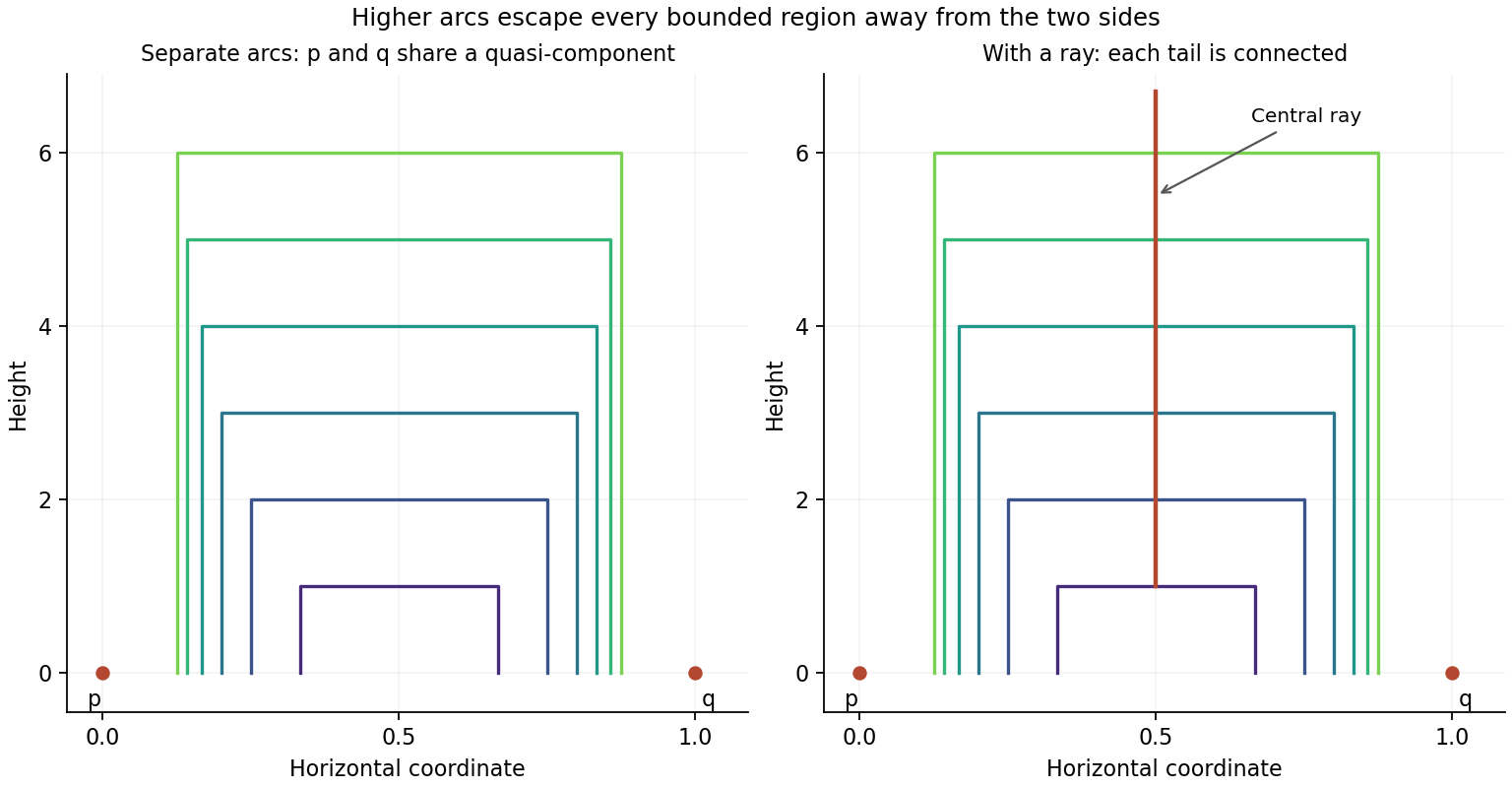
Arcs escaping to infinity: distinct components in the left space and connected tails in the right space
. Details. 
For a set , its definable power set consists of the subsets of definable by a first-order formula over using finitely many parameters from . The quantifiers range over ; this is generally much smaller than its full power set.
The constructible universe is defined by transfinite recursion:The last union denotes a definable proper class, not a set-sized union over a set of all ordinals. At a successor stage, only definitions over the previously constructed stage are permitted.
Use transfinite induction. The assertion is immediate at stage zero, and at a limit stage it follows by taking the increasing union of the earlier stages.
Assume . Any ordinal is a subset of , since members of the definable power set are such subsets. Every element of is an ordinal, sowhich implies . This gives the upper bound on the ordinals appearing at the successor stage.
For the reverse inclusion, the smaller ordinals are already in and hence in . The remaining ordinal itself is the definable subset . The fact used here is absoluteness of ordinalhood between a transitive set and the universe: ordinalhood has a bounded definition, and bounded formulas are absolute for transitive sets. Thus the formula asserting that a member is an ordinal, interpreted over , defines exactly . Therefore .
The axiom of infinity fails. First prove for every finite ordinal . The base stage is empty in both hierarchies. If , that stage is a finite set. Every one of its subsets is definable over it with finitely many parameters, by a disjunction of equalities to the selected elements; the empty subset is defined by a false formula. HenceInduction and the limit-stage definitions givethe set of all hereditarily finite sets. Every member of this set is finite externally.
If this transitive structure satisfied the axiom of infinity, it would contain an inductive set : zero belongs to , and whenever , its successor belongs to . These operations are the actual empty set and actual set successor, since they are absolute for this transitive structure and all relevant finite-rank sets lie in it. External induction would then place every finite ordinal in , contradicting the finiteness of .
Every individual finite ordinal does belong to , but the set of all finite ordinals does not. The distinction between containing each finite ordinal and containing one inductive set is precisely the issue.
The cardinal sum is the cardinality of a disjoint union, and the cardinal product is the cardinality of the set of choice functions:Here the cardinals are represented by initial ordinals. Tagging by makes the summands disjoint even when their underlying sets overlap. For an empty index set the sum is zero and the product is one, because there is exactly one empty function. If any factor in a nonempty product is zero, that product is empty.
This is König theorem for cardinal numbers. Let and . For any proposed map , consider the values of the th coordinates on the th summand:This set has cardinality at most . Choose , using the axiom of choice, and assemble . For any , its image disagrees with at coordinate . Thus is outside the image of , and no such is surjective.
Every is nonzero. The product is nonempty by choice; if is empty, strict inequality is immediate. Otherwise cardinal comparability principle in ZFC says that would yield a surjection from onto the nonempty , which the diagonal argument excludes. ThereforeThe diagonal coordinate is tied to the summand containing the argument; this is why a sum on the left pairs naturally with a product on the right.
The aleph numbers enumerate the infinite initial ordinals by transfinite recursion:Here is the least cardinal strictly larger than . The Generalized continuum hypothesis isequivalently for every ordinal in ZFC.
Constant functions give the lower bound . By the Generalized continuum hypothesis, . The currying law for cardinal exponentiation and infinite cardinal arithmetic therefore giveHence .
Put . Apply König theorem for cardinal numbers to the sequences :The sum is because the countable union has cardinality at most and its summands are cofinal in . Thus the power is strictly larger than , a fact that cannot be replaced by the regular-cardinal calculation of the preceding part.
For an upper bound, use and the currying law for cardinal exponentiation:where the last step is GCH at . There is no cardinal strictly between and its successor, so
For , monotonicity of cardinal exponentiation givesThe middle equality uses the currying law for cardinal exponentiation, and the final one uses . Hence , even before assuming GCH. Applying the Generalized continuum hypothesis yields
The membership induction theorem is the following schema, for every formula with any fixed set parameters:Its hypothesis says the property is progressive under membership. In ZF it follows from the Axiom of foundation: if a counterexample exists, take the nonempty set of counterexamples in the transitive closure , which contains . A membership-minimal counterexample supplied by the Axiom of foundation has no counterexample among its elements, contradicting progressivity. The transitive closure ensures that all elements relevant to this argument remain in the set being considered.
Compose the two assumed isomorphisms to obtain a membership-preserving and membership-reflecting bijectionTransitivity of both targets implies, for every ,For one inclusion use preservation of membership. For the other, if , transitivity puts in ; surjectivity gives for , and reflection gives .
Apply the membership induction theorem to the assertion that every is fixed. If all members of are fixed, the displayed equation gives . Thus is the identity on . Its range is , so , and the definition of givesThis proves uniqueness of the Mostowski collapse theorem. Existence of the two isomorphisms already supplies the membership structure needed in this argument.
Read epsilon as actual set membership restricted to , the interpretation in which ambient ZF makes the relation well-founded. The structure's axiom of extensionality assumption meansBy well-founded recursion on membership, defineThe recursion theorem applies because the Axiom of foundation makes the restricted relation well-founded and each predecessor collection is a set. The Axiom schema of replacement gives the set .
To prove injectivity, use membership induction on for the property that and with imply . Suppose this property holds for every . Equality of the two images means that each has some with , so the induction hypothesis gives . Conversely every has the same image as some , and the same induction hypothesis again makes them equal. Hence , and the structure's axiom of extensionality gives .
The map is onto by definition. The recursion immediately preserves membership, and its injectivity makes membership reflection valid as well. Moreover if then for a predecessor , so . Therefore is transitive and is the required membership isomorphism. This proves the existence direction of the Mostowski collapse theorem.
An arbitrary binary relation must also be well-founded. Axiom of extensionality alone is insufficient in that interpretation: the one-element relation with a self-loop is extensional, but any collapse onto a transitive set would produce a set containing itself, contrary to Axiom of foundation. The actual-membership interpretation above supplies precisely the hypothesis otherwise missing; no analogous claim is made for a general ill-founded relation.
The cumulative hierarchy is defined by transfinite recursion:This recursion on ordinals is available without assuming the Axiom of foundation for all sets. The stages are increasing and transitive, by transfinite induction using their definitions.
Work internally in the specified model of ZF without the Axiom of foundation, and assume the membership induction theorem. Apply it toSuppose every member of lies in some stage. Assign to each such the least ordinal for which . The Axiom schema of replacement gives a set of these ordinals, and let be their supremum, taking for the empty collection. Monotonicity gives , and therefore .
This proves progressivity of , so membership induction gives it for every set of the model. Every stage already consists of sets in that model. ConsequentlyThe equality is internal to the given model; its ordinals and power sets are computed there.
Assume a nonempty set has no membership-minimal element, so for every there is . Consider the formula .
It is progressive: if every element of is outside but , the assumed absence of a minimal element supplies , contradicting that hypothesis. The membership induction theorem therefore implies for every set . This contradicts .
Thus every nonempty set contains an element with , exactly the Axiom of foundation:Only the induction schema and elementary set reasoning were needed; no prior use of Axiom of foundation occurs in the proof.
This University of Oxford Part C paper combines Analytic Topology in section A and Axiomatic Set Theory in section B, cross-listed for Mathematics, Mathematics and Computer Science, and Mathematics and Philosophy. [ref]
https://www.whatdotheyknow.com/request/maths_past_papers_3. Source release
The archive retains the complete editable four-page transcription. Bounded official-source searches found no advertised answers for this exact paper. The solution to A1(iv) replaces a faulty printed radial hint with a proved rectangular construction.Let be the set of separately continuous real-valued functions on the plane. Take as a subbasis all sets , where and is open in the usual real line. Unions of finite intersections of these sets form a topology, and every is continuous for it by construction. Conversely every topology making every continuous must contain the subbasis, hence this entire generated topology. Thus the required coarsest topology exists and is unique: it is the initial topology of the family .
The family is a set, being a subset of , so this construction has no proper-class issue. The coordinate projections belong to ; consequently this topology contains the ordinary Euclidean topology. This last observation will also make convergence in the new topology imply ordinary coordinatewise convergence.
Fix a horizontal line . The restriction of every member of to is continuous in its usual topology. Therefore every subbasic open set intersects in a usual open set, so the induced topology is no finer than the usual one. Conversely the first coordinate projection is continuous for the initial topology, and its inverse images induce every usual open set on . The two topologies on are equal. The second projection gives the identical argument for a vertical line.
Write . For every nonzero rational , the intersection of with is dense in that vertical line, since the nonzero rational numbers are dense in the real line. Hence . For each real , it follows that contains and is closed in that line. This dense subset forces the whole horizontal line into . Thus : is a countable dense subset. The two successive uses of line density are necessary; the initial topology is finer than the Euclidean topology, so Euclidean density alone would not suffice.
For a fixed nonzero second coordinate , the rational expression defining is continuous on the half-line where . On the opposite half-line it is constant. At the ratio tends to , agreeing with the value on the other side. If the entire restriction is constant. By symmetry the restrictions with the first coordinate fixed are continuous too. Hence is separately continuous, and so is for every real .
On the diagonal , , while for . ThereforeEach diagonal singleton is open in the induced topology; arbitrary unions show that has the discrete topology.
If were metrizable, its countable dense subset from the preceding part would make it second countable. Indeed balls with rational radii about dense points contain a countable basis after the usual smaller-ball argument. Every subspace of a second-countable space is second countable. A discrete second-countable space is countable, since each singleton must itself occur as a basis member. But is uncountable. This contradiction proves is not metrizable.
Suppose for contradiction that converges to the origin in the initial topology. The coordinate projections then give and in the usual real line. Rectangular bumps detecting nonconvergence, using anisotropic supports, avoids any unsupported regularity assertion about a radial maximum. SetThe radii are positive since neither coordinate of vanishes. Each rectangular support misses both coordinate axes, so vanishes on those axes. For a fixed , all but finitely many vertical support intervals miss , because their centres and radii tend to zero. Hence is a finite maximum of continuous functions of , and is continuous. At it is identically zero. The same argument with the coordinates exchanged proves separate continuity everywhere. Thus is continuous for the initial topology.
However for every , whereas . This contradicts preservation of convergent sequences by a continuous function. Therefore no sequence from converges to the origin.
The radial hint in the scan is not separately continuous for every candidate sequence: for , its value at the origin is zero, while its value at is at least , which tends to one. The rectangular construction supplies the needed valid proof independently of that hint.
If the origin had a countable local basis , replace it by the decreasing local basis . Each meets the dense set , so choose . Given any neighbourhood of the origin, some is contained in ; for every we then have . Thus converges to the origin, contradicting the preceding part. Consequently first countability fails already at the origin, and is not first countable.
Urysohn's lemma states that if is normal and are disjoint closed subsets, there is a continuous function with and . The values on the rest of remain in that interval. Interchanging or composing with an affine function gives any two prescribed real endpoint values. This is functional separation of closed sets, stronger than merely choosing disjoint open neighbourhoods.
A C-embedded subset is one when every continuous real-valued function on extends continuously to . It is a Cb-embedded subset when this is required for every bounded continuous real-valued function, with a bounded extension. These definitions concern the subspace topology on .
Here is the bounded Tietze extension construction from Urysohn's lemma. Let be continuous with . The case has the zero extension. For , the sets and are disjoint and closed in , since is closed. Urysohn's lemma gives a continuous taking the endpoint values on . On ,Indeed on or this follows from the prescribed endpoint; on their complement both and are at most .
Repeat on the residual. With , choose continuous satisfying and reducing the residual on to at most . The series converges uniformly by the geometric majorant. Its sum is continuous, has , and restricts to , since the residual tends uniformly to zero. Thus every bounded continuous function extends, with its bound preserved, proving -embeddedness without assuming the extension theorem being proved.
For a strict-range modification of a continuous extension, the closed sets and are disjoint. Choose by Urysohn's lemma a continuous with and , and defineThis function is continuous and agrees with on . On it vanishes. Off we have and , so . Hence its range lies strictly inside on all of . The construction also covers empty or empty by a constant separating function where appropriate.
Let be continuous, without a boundedness assumption. The homeomorphism maps the real line onto , with inverse . The bounded function extends by the preceding bounded construction to a continuous real-valued on . Since on , the strict-range modification gives a continuous with range in and the same restriction to . Thereforeis continuous everywhere: its denominator is pointwise positive. On it equals . Thus is -embedded. It is important to modify the extension before applying the inverse: an extension allowed to attain or outside would make this formula undefined there.
Take the natural numbers as the dense discrete subspace of their Stone-Čech compactification . The ambient compact Hausdorff space is normal, and the Stone-Čech extension property makes this subspace -embedded. It is not -embedded: the continuous function is unbounded, whereas every continuous real-valued function on a compact space is bounded. The subspace is not closed, so this does not contradict the preceding closed-subspace theorem.
A filter base on a set is a nonempty family of nonempty subsets such that for every there is with . Repeated application gives a member contained in any specified finite intersection. In particular every finite intersection is nonempty, so the family has the finite intersection property. Its upward closure is the corresponding proper filter.
For a connected intersection of a closed filter base, the filter-base property implies the finite intersection property. Compactness, in its closed-set formulation, therefore gives . It is closed in , hence compact.
Suppose additionally that each base member is connected but is disconnected. Write with disjoint nonempty closed subsets of . They are compact, hence closed in the Hausdorff space . Normality of a compact Hausdorff space gives disjoint open sets containing , respectively. The compact set misses . For every some misses , so the open sets cover . A finite subcover gives . Choose inside this finite intersection. If is empty, choose any base member instead.
Since contains , it meets both and ; but it lies in their disjoint union. These two relatively open nonempty pieces disconnect , a contradiction. Thus the intersection is nonempty and connected. Compactness is used to pass from an infinite exclusion condition to a single base member.
A Hausdorff compactification of is an embedding into a compact Hausdorff space with dense image. The complement is the remainder; a one-point or two-point compactification has a remainder of that cardinality.
For one point, take the unit circle andThe angle runs over , so this is a homeomorphism onto the circle with removed. That image is dense, and the circle is compact Hausdorff. For two points, take and . This is a homeomorphism onto its dense open interval, leaving exactly the two endpoints. Therefore both required compactifications exist; in the first the positive and negative ends meet, whereas in the second they remain distinct.
Write , making explicit that these are subsets of . If and is an open neighbourhood of , then is compact and hence closed in . The open set still contains and meets the dense image of . Such an intersection point belongs to , so for every .
Conversely, if choose an integer . Since is an embedding, there is an open neighbourhood of in whose intersection with is . It misses , so . HenceFor the two ends of a real-line compactification, let and . Each is nonempty compact and connected, being the closure of a connected image. The two nested families therefore have nonempty connected intersections and . Since closure commutes with finite unions, . MoreoverFor if a point fails both intersections, it fails one positive member and one negative member, hence both members at the larger index by nesting.
If the remainder were a finite three-point set, its Hausdorff subspace topology would be discrete. Each nonempty connected subset would then be a singleton, so their union would have at most two points. This contradiction proves there is no three-point Hausdorff compactification of the real line. The argument does not assert that every possible remainder is finite.
The cumulative hierarchy is defined by transfinite recursion on the ordinals:The recursion theorem of ZF supplies each set stage. The whole universe is , a proper-class union. Equivalently, exactly when the rank of is less than , where .
A set is transitive if every element of an element of is itself in , equivalently each element of is a subset of . Proceed by transfinite induction. The empty set is transitive. If is transitive and , then gives , and transitivity of gives . Thus , proving the successor stage transitive. A union of transitive sets is transitive: if , choose with and infer . This proves the limit step and hence every is transitive.
For , transitivity of gives . Therefore , provingTogether with the union definition at limits, transfinite induction now gives whenever . No rank theorem is needed for this monotonicity argument.
Induct on . For every , the induction hypothesis says , and monotonicity gives . Thus every element of the ordinal lies in , so . Taking its power set givesFor the inclusion is vacuous and supplies the base case. This argument uses ordinal membership as strict order and the previously proved hierarchy monotonicity.
Take a nonzero limit ordinal and . Choose with . Transitivity gives . Hence every actual subset of belongs to , and the actual set belongs to . Since is a limit, , so . Thus the internal power set contains every actual subset of , and the power-set axiom holds in .
Here the absoluteness fact used is: every bounded formula is absolute between transitive sets or classes with the actual membership relation. In particular , expressed by , has the same meaning internally and externally. The argument supplies the actual power set as an internal witness. If zero is included in one's convention for limit ordinals, its empty stage has no nonempty first-order domain; the assertion is understood for nonzero limits.
If also , the preceding ordinal-membership result gives . The actual set contains the empty set and is closed under . These bounded membership and successor conditions are absolute in the transitive stage, so is an internal inductive set. Therefore Infinity holds as well. In contrast has only hereditarily finite sets and cannot use as an element.
To prove replacement failure at V omega plus omega, put . The set belongs to , and for every the ordinal also belongs to . The relation saying that is obtained by taking successive ordinal successors of is definable, with parameter , and is single valued in .
For clarity this does not assume Replacement inside . For each finite its finite computation sequence exists in : its entries have rank below , and the finite coding overhead still has rank below . The bounded formula verifying this finite successor chain is absolute between and the universe. The ordinary finite induction identifying its unique last entry uses the actual finite ordinals, which are the same in . This justifies the internal definable function without invoking the axiom being tested.
If Replacement held there, its range would be an element of . But ordinal rank equals the ordinal, soEvery element of has strictly smaller rank. This contradiction proves Replacement fails in . Each individual output is present; the missing object is the set collecting all outputs.
König's theorem for cardinal numbers states that, for a set-indexed family with at every index,Here the sum is the cardinality of a disjoint union and the product is the cardinality of a Cartesian product. Work in ZFC. Choose disjoint sets of sizes and sets of sizes . For any function , its th coordinate values on form a subset of of cardinality at most . Choose outside that subset, using choice. Then cannot equal for any : if , its th coordinate was specifically excluded. Thus there is no surjection from the disjoint union onto the product.
Cardinal comparability under choice now implies the displayed strict inequality. Empty index set gives directly; empty individual cause no difficulty, since the corresponding coordinate excludes an empty image. This is the cardinal diagonal theorem, rather than the finitely branching tree result also bearing König's name.
The generalized continuum hypothesis isEquivalently, for every ordinal , . Here is the cardinality of the power set of a set of cardinality , and is the least strictly larger cardinal. The hypothesis says that no intermediate cardinal lies between an infinite set and its power set.
For GCH arithmetic at aleph omega, let . Use monotonicity of cardinal exponentiation, the law , and for infinite cardinals in ZFC. Since ,Thus , and the generalized continuum hypothesis yieldsThe lower bound embeds binary-valued functions into -valued ones; the upper bound codes each value by a subset and combines the resulting pairs of indices. In particular the equality before applying the hypothesis is a ZFC equality.
Articles were limited to the first 100 out of 230 total.
Articles by others on the same topic
There are currently no matching articles.