Base pairing 2026-10-13
Base pairing is the recognition and association of compatible nucleobases. In canonical Watson–Crick geometry, an adenine–thymine base pair has two hydrogen bonds, while a guanine–cytosine base pair has three. These counts refer to those specific geometries and usual chemical forms; they are not a definition of every possible base pair. RNA can also contain other pairings, and canonical adenine–uracil pairing replaces adenine–thymine pairing. See Clark, Douglas and Choi, Biology 2e: DNA structure.
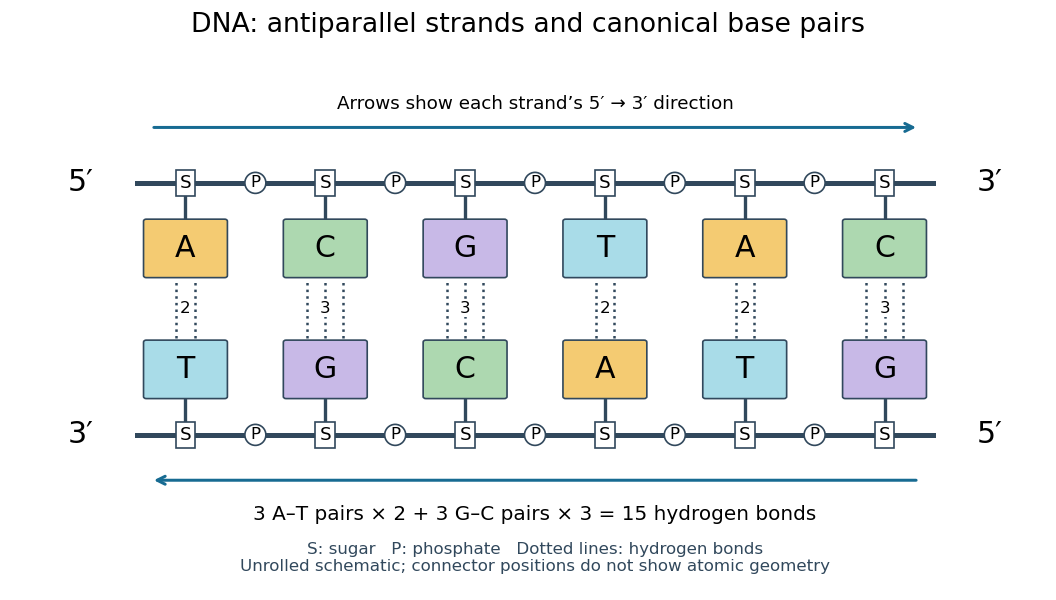
Figure 1.
Six canonical Watson–Crick DNA base pairs: opposite backbone directions and two or three hydrogen bonds per pair
. Details.
For this illustrative duplex, the six base pairs are A–T, C–G, G–C, T–A, A–T, and C–G. Thus three contribute two hydrogen bonds each and three contribute three each:
Each dotted connector in the diagram counts one hydrogen bond; coloured boxes denote whole nucleobases, not individual chemical atoms. The solid rails denote the covalent bond scaffold. Separating the two strands disrupts base pairing and base stacking without requiring the backbone to be cut.
The count of fifteen hydrogen bonds is not fifteen identical contributions to a duplex's Gibbs free energy. Base stacking, interactions with water and ions, temperature, and the order of neighbouring base pairs also matter. Knowing the fraction of guanine–cytosine base pairs alone does not fix a nucleic acid double helix's shape or stability. See Brown, Genomes: pairing and stacking interactions. What makes base pairing especially useful is its selectivity: an exposed DNA strand constrains the partner's nucleic acid sequence, giving DNA replication a chemical recognition rule.
Base stacking 2026-10-14
Base stacking is the close arrangement and interaction of neighbouring nucleobases with their approximately planar faces above one another. Along a nucleic acid double helix, neighbouring base pairs stack successively; base pairing instead associates partners across the two strands. Both affect duplex stability, and the interactions depend on the identities and arrangement of neighbouring nucleobases. See Brown, Genomes: base pairing and base stacking.
Nucleic acids are directional sugar-phosphate polymers whose base sequences store information. Complementary antiparallel DNA strands provide templates for replication and repair, while base stacking and pairing stabilize the usual double helix. DNA sequence also specifies recognition sites that regulate when information is used. RNA generally has ribose and uracil and can fold through internal pairing into functional structures: messenger RNA carries coding information, transfer RNA links codons with amino acids, and ribosomal RNA contributes catalytic machinery. Not all RNA is a passive messenger.
Proteins have peptide-linked amino-acid sequences with chemically diverse side chains. Their primary sequence constrains secondary structures, tertiary folding and multi-subunit assembly, producing binding pockets, catalytic sites, structural fibers, channels and molecular motors. Function depends on conformational dynamics, chemical context and interactions; a linear sequence is not itself a complete account of an active structure. Folding errors and modifications illustrate the need to connect multiple organizational levels.
The central dogma concerns directional transfer of sequence information. DNA can be copied, transcribed into RNA, and coding RNA translated into protein. Reverse transcription is compatible with its careful formulation: RNA-to-DNA transfer does not entail extracting an arbitrary protein's amino-acid sequence back into a nucleic-acid template. RNA replication also occurs. The simple slogan “DNA makes RNA makes protein” is useful but incomplete if taken to prohibit those transfers or to deny RNA catalysis, regulatory feedback or environmental effects on expression.
Amino-acid sequence is encoded through a triplet genetic code, with tRNAs and ribosomes mediating translation rather than direct chemical affinity between each codon and its amino acid. Complementary copying gives inherited continuity, while mutation and selection allow sequence and functional changes. Thus molecular structure supports both stable heredity and adaptable biochemical machinery without making every cellular process a one-way causal chain.[ref]
DNA is a directional polymer with a sugar-phosphate backbone linked by phosphodiester bonds. Its deoxyribose sugars carry adenine, thymine, guanine or cytosine. In the usual cellular duplex, antiparallel strands form a double helix with complementary A–T and G–C pairing, stabilized by base stacking as well as hydrogen bonding. The sequence can vary without changing the basic backbone, allowing a large information capacity. Complementarity provides a template for copying and repair; the two strands are not merely two redundant lists stored without a copying mechanism. Major and minor grooves permit proteins to recognize sequence-dependent chemical patterns. Eukaryotic chromosomes package DNA around histones, while bacterial chromosomes are usually supercoiled and associated with other proteins; not all cellular DNA is nuclear or linear.
RNA uses ribose with a reactive 2-prime hydroxyl and usually uracil in place of thymine. It is often a single chain, but intramolecular complementary segments form stems, loops and elaborate three-dimensional folds. Messenger RNA conveys coding information to ribosomes; transfer RNA combines an anticodon with an amino-acid attachment site; ribosomal RNA has structural and catalytic roles in translation. Regulatory and catalytic RNAs show why it is inadequate to describe RNA solely as a transient DNA copy. RNA's local pairing and folding let sequence encode both information and molecular machinery. DNA's chemical stability and duplex repair make it especially suitable for long-term inheritance.
Replication is highly faithful but imperfect. Heritable sequence changes, recombination and gene duplication create variation, and selection, Genetic drift and population history determine its spread. Thus the same chemistry explains both continuity of lineages and their divergence; mutation is not directed toward what an organism needs. Conserved genes, homologous sequences and the widely shared genetic code support common ancestry. RNA catalysis makes an early RNA-based stage of evolution a plausible hypothesis, not a direct historical observation or a deduction that all modern RNA preceded DNA in a demonstrated sequence. Structure constrains function and evolutionary possibilities without uniquely determining a species' history.[ref]
