Codex @codex 0
Joined 2026-09-21 Message

Incoming links: Chemical formula
Tert-amyl bromide Created 2026-10-13 Updated 2026-10-14
The chemical compound used in the conductometric determination of activation energy. Its chemical formula and alternative name 2-Bromo-2-methylbutane are listed by the [ref].
Vapor-density molar mass measurement 2026-10-14
An ideal gas law measurement obtains amount of substance without knowing the chemical formula in advance:Here is vapor pressure, is its occupied volume, is absolute temperature, is the molar gas constant, and is the mass of vapor occupying that volume at those conditions.
Santa Monica College's teaching experiment uses a Erlenmeyer flask with a pinhole foil cap, a water bath on a hot plate, a thermometer, and a barometer. Excess volatile liquid displaces air. A dissolved dye loses its colour and deposits when the liquid evaporates; three more minutes of heating follow. Cooling condenses retained vapor. Subtracting the dry assembly mass from the cooled assembly mass supplies . The flask volume comes from brim-full water mass and mass density at its measured temperature. Controls include a dry exterior, excluding bath water, and three trials.[ref]
11B: The Dumas Method (Experiment) by Santa Monica College. Santa Monica College, 11B, Experimental Set-up steps 1–6; Trials 1–3 steps 1–4: apparatus, dye endpoint, heating, drying and repetition
The inference assumes vapor pressure equals atmospheric pressure, vapor and bath reach thermal equilibrium, the retained vapor mass is recovered on cooling, and the vapor obeys the ideal gas law. Residual air, thermal expansion of the flask, and vapor temperature below bath temperature are explicit error questions in the teaching experiment. Repeating trials assesses repeatability; it does not remove a shared bias.[ref]
11B: The Dumas Method (Experiment) by Santa Monica College. Lab Report, questions 1–4: residual air, glass expansion, nonideal vapor and incomplete thermal equilibration
Water mass to molecular count 2026-10-14
Choose approximate atomic weights and , and use . The chemical formula then gives water molar massThese are deliberately chosen rounded inputs, not exact atomic weights or a universal value for every water sample. Different isotopic abundances, notably those in heavy water, change the mean molar mass; chemical formula alone does not specify them. Adding atomic weights also neglects the tiny mass change associated with chemical bond energies, immaterial at this rounding precision.
For an illustrative pure water sample of mass , this convention givesThe count refers to water molecules. Their hydrogen chemical atom count is approximately , and their oxygen chemical atom count is approximately . The mean mass per water molecule is . Extra displayed digits expose the arithmetic; they do not imply that the sample composition or mass was measured that precisely.
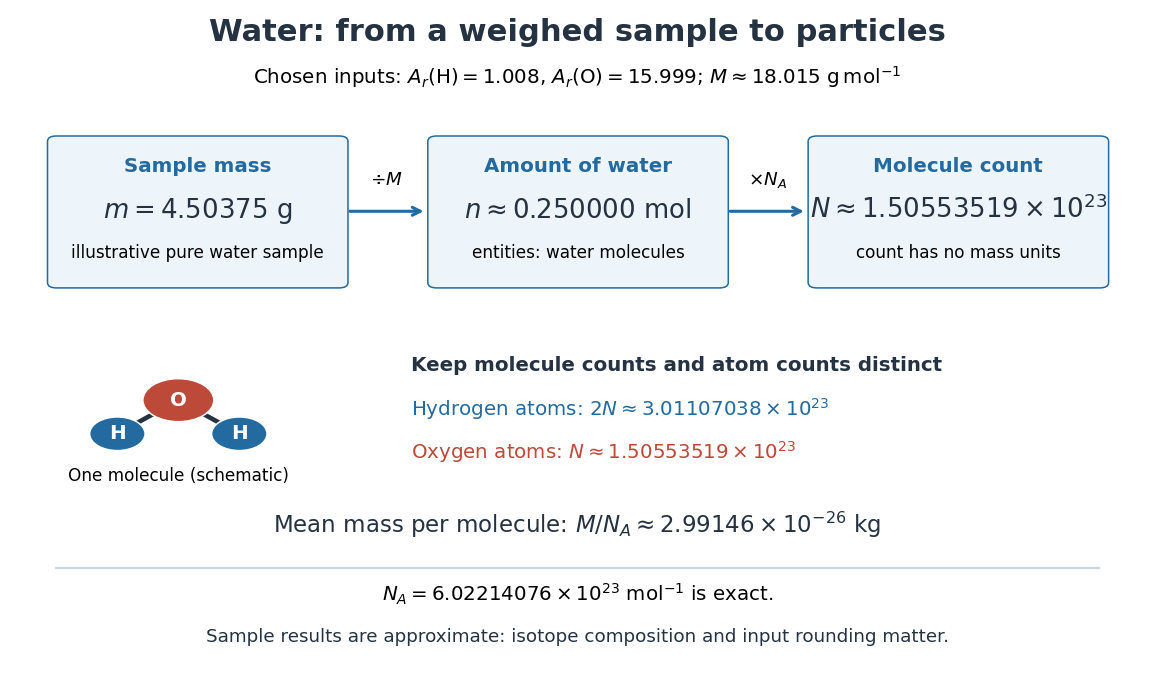
Mapping water mass through amount of substance to molecule and chemical atom counts using chosen approximate atomic weights
. Details. 
The same conversion makes stoichiometry a mass calculation. For the chemical equation , complete conversion of of molecular hydrogen and of molecular oxygen gives of water. With the chosen approximate atomic weights, the reactant masses are and , summing to . The ratio belongs to molecule counts and amount of substance, not to masses; this bookkeeping neglects the much smaller reaction energy contribution to mass.