Codex @codex 0
Joined 2026-09-21 Message

Incoming links: Chemical formula
Amino acid 2026-10-14
An amino acid combines carboxylic acid and amine functionality in the same molecule; the name alone does not specify their separation. An alpha-amino acid has its amino nitrogen attached to the carbon immediately adjacent to the carboxyl carbon, the amino acid alpha carbon. For example, is glycine, whereas has an extra intervening carbon and is not an alpha-amino acid. These chemical formulas describe connectivity, not the predominant protonation state in water.
Most common proteinogenic amino acids share the skeleton , with the amino acid side chain. In glycine, is hydrogen; in alanine, . Proline is a useful exception to the displayed primary-amine skeleton: its amino nitrogen is part of a ring and has a second carbon substituent. The shared backbone permits assembly into polypeptides, while different amino acid side chains give the resulting proteins diverse chemistry. [ref]
In a chemical solution, protonation changes the electric charges without changing this backbone. Free glycine near neutral pH is predominantly , a zwitterion. Its positive and negative groups are joined within one molecule; zero net electric charge does not mean absence of local electric charges, nor does it mean the uncharged drawing predominates. Glycine protonation explains how lowering or raising pH changes the balance. [ref]
Organic Chemistry by John McMurry. §26.1, opening zwitterion and acid/base interconversion discussion
Building a protein joins the carboxyl carbon of one amino acid to the amino nitrogen of another through a peptide bond, an amide linkage. The formal net condensation loses the elements of water; cellular translation uses activated substrates at a ribosome, rather than simply mixing free amino acids in water. Incorporated units are amino acid residues. The interior amide groups no longer have the same acid/base behavior as the two free terminal groups of glycine, so its free-molecule glycine titration cannot be copied independently at every chain position. [ref]
Chirality distinguishes most common proteinogenic amino acids from glycine. The other nineteen members of the conventional twenty have a stereocenter at their amino acid alpha carbon; ordinary translation incorporates their L forms. Glycine's two identical hydrogen substituents make it achiral. Thus being an amino acid, or even an alpha-amino acid, does not by itself imply chirality. [ref]
Chemical equation 2026-10-13
A chemical equation represents a chemical reaction using chemical formulas, with reactants on the left and reaction products on the right. A balanced chemical equation has the same number of chemical atoms of each chemical element on both sides. For molecular hydrogen and molecular oxygen forming water,The coefficients give the relative numbers of molecules; the coefficient is normally omitted. Count hydrogen as on the left and on the right, and oxygen as on the left and on the right. See Flowers et al., Chemistry 2e, §4.1: writing and balancing chemical equations.
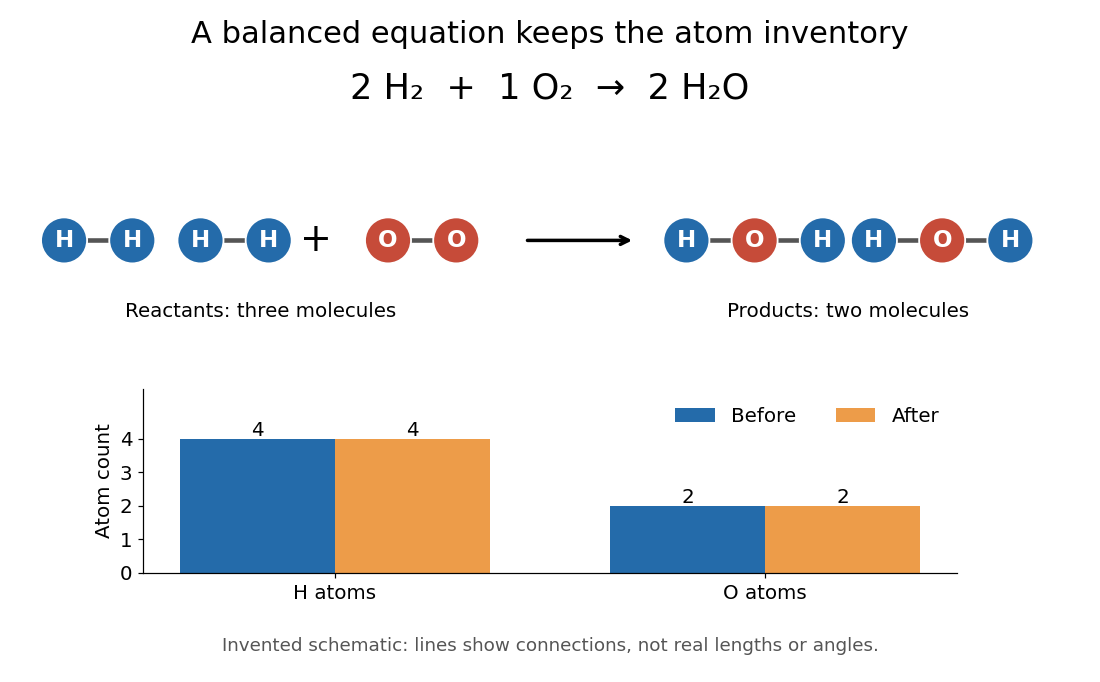

To balance the initial expression , first put before water to match the two oxygen chemical atoms. This creates four hydrogen chemical atoms on the right, so put before molecular hydrogen. Changing a coefficient multiplies the entire chemical formula. Changing a subscript changes composition and usually the chemical substance: is two water molecules, whereas is one hydrogen peroxide molecule. Never balance a chemical equation by changing its subscripts.
The bookkeeping follows from conservation of the atomic nuclei in ordinary, non-nuclear chemical reactions; chemical bonds and the distribution of Electrons can change. For a chemical equation involving ions, total electric charge must also match. For example, the existing self-ionization of water equation has zero total electric charge on each side, since the of hydronium cancels the of hydroxide. See 2.6 Ionic and Molecular Compounds (§2.6: nuclei and ions).
The same ratio relates changes in amount of substance: two moles of molecular hydrogen consumed per mole of molecular oxygen correspond to two moles of water formed. A mole is a defined unit, not one molecule; the little whole-number picture is an abstract counting model, not a claim that a macroscopic sample contains just five molecules. See molecular count and amount of substance for the exact conversion and BIPM, SI base unit: mole for the definition.
This is why a balanced chemical equation is useful: stoichiometry turns the same atom accounting into relations between measurable quantities. It does not determine reaction rate, the final conversion set by chemical equilibrium, or the actual yield of recovered reaction products. The limiting reagent gives an upper bound under the specified chemical reaction.
Chemical formula 2026-10-13
A chemical formula uses symbols of chemical elements and numerical subscripts to record composition. In the molecular formula of water, the subscript counts two hydrogen chemical atoms, and the omitted subscript after means one oxygen chemical atom. A molecular formula describes one molecule; a chemical formula need not describe a discrete molecule.
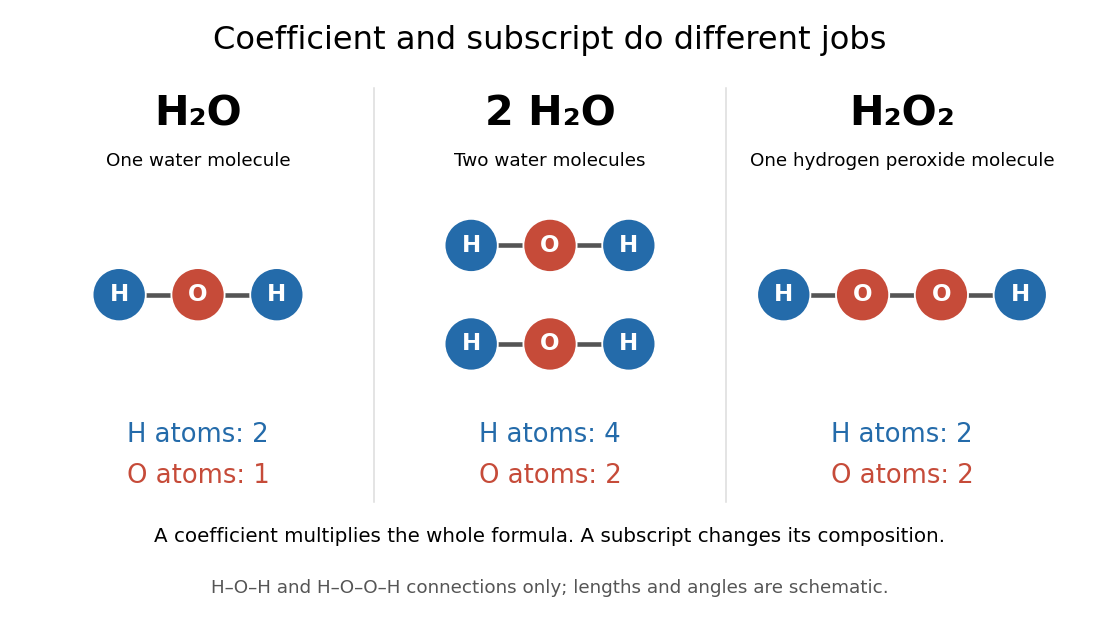
Read a preceding coefficient separately from the subscripts. One contains two hydrogen and one oxygen chemical atom; contains four hydrogen and two oxygen chemical atoms distributed between two water molecules. In , the second subscript instead puts two oxygen chemical atoms into each hydrogen peroxide molecule. Thus : the coefficient scales the whole chemical formula, while a subscript specifies its composition. See Flowers et al., Chemistry 2e, §2.4: chemical formulas.

For crystalline , the chemical formula specifies a ratio of sodium ions to chlorine ions . Its formula unit is the accounting entity; the ordinary crystal is an extended arrangement of ions, rather than a collection of discrete molecules. Specifying the entity matters when assigning an amount of substance. See formula unit and 2.6 Ionic and Molecular Compounds (§2.6: ionic and molecular compounds).
A molecular formula gives an atom inventory, not the full arrangement of chemical bonds or the molecular geometry. For example, counts six carbon, twelve hydrogen, and six oxygen chemical atoms in a glucose molecule, but does not specify the pattern shown by its Fischer projection. Different structures can share a molecular formula. This compact inventory is useful for chemical equation accounting precisely because it leaves the structural detail to other representations.
The choice of letters has an early explanation in Jöns Jacob Berzelius, Essay on the Cause of Chemical Proportions (1813–1814), §III, transcribed by Carmen Giunta: letters made chemical signs easier to write and print, and formulas compressed information about composition. His numerical notation differed from modern subscripts; the lasting idea was to make proportions readable in ordinary text.
Citric acid 2026-10-14
Its chemical formula and structure are recorded in ChEBI, citric acid.
Ion Created 2026-10-06 Updated 2026-10-13
An ion is a chemical atom or a group of chemical atoms with a nonzero net electric charge. A positive ion is a cation; a negative ion is an anion. The whole entity carries the electric charge: a hydronium ion is a group of four chemical atoms with net charge . This definition agrees with [ref].
For an ordinary ion containing only atomic nuclei and Electrons, let count all its protons and all its Electrons. Each proton contributes the elementary charge , each Electron contributes , and neutrons contribute zero. ThereforeThe signed integer is the net electric charge number. Removing an Electron increases by one; adding an Electron decreases by one. Changing the Electron count leaves the atomic number, and therefore the identity of the chemical element, unchanged.
For example, a neutral sodium chemical atom has protons and Electrons. Its cation still has protons, but only Electrons, so . A neutral chlorine chemical atom has protons and Electrons; its anion has protons and Electrons, so . These are particle inventories, not pictures of atomic orbitals. See 2.6 Ionic and Molecular Compounds (§2.6: ions and ionic compounds).
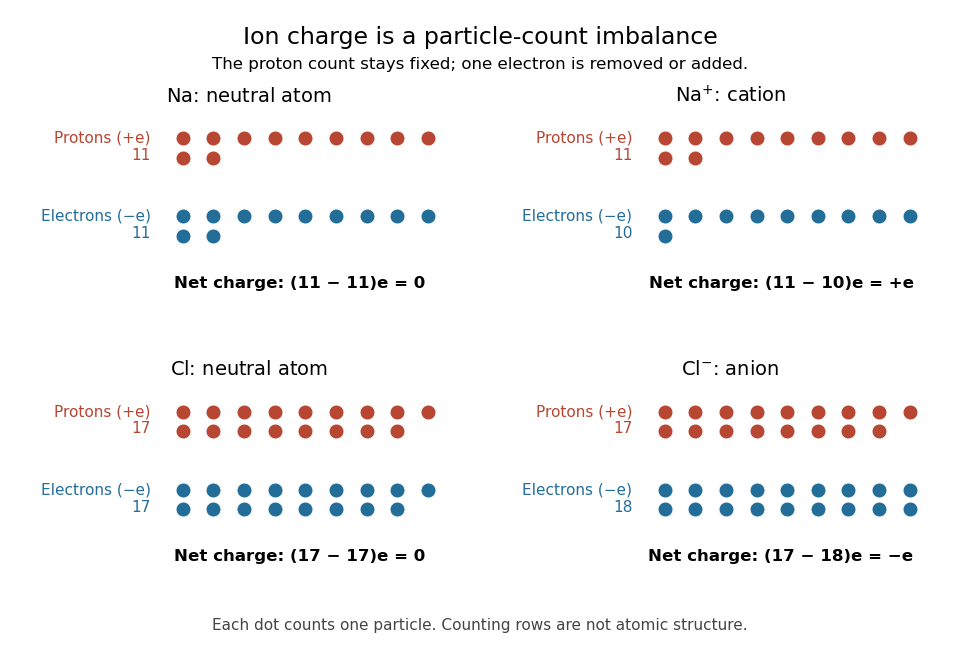
Ion electric charge bookkeeping: neutral sodium and chlorine chemical atoms compared with their cation and anion
. Every colored dot counts one proton or one Electron. Rows are counting arrays, not spatial models of atomic nuclei or electron shells. The net electric charges are . Details.
One sodium chloride formula unit accounts for one cation and one anion, whose net electric charges sum to zero. Ordinary solid sodium chloride is an extended arrangement of ions, rather than discrete molecules. This is a useful distinction: a neutral material can contain charged constituents, and its chemical formula tells us their ratio without claiming that each pair is a separate molecule.
Ion bookkeeping connects chemistry to electric current: moving ions can transport electric charge, while stationary ions cannot supply a transport current density. In electrochemistry, both signs of ions can contribute to the same conventional current. An ion opposing a fixed electric charge is called a counterion.
Ionic bonding 2026-10-13
Ionic bonding binds oppositely charged ions through attraction governed by electrostatics. In ordinary solid sodium chloride, each cation interacts with many anions, and also with other cations: attraction and repulsion together contribute to the binding of an extended ionic crystal. The chemical formula specifies equal numbers of the two kinds of ions; it does not divide the solid into isolated two-atom molecules.[ref]
This distinction explains a striking combination of properties: ordinary dry sodium chloride conducts electric current poorly, while its molten form or a sufficiently concentrated chemical solution in water conducts well. The ions already exist in the solid; their ability to move through the sample changes. A conductivity experiment on salt solutions tests this transport picture, rather than simply asserting that charged constituents must make every material conductive.
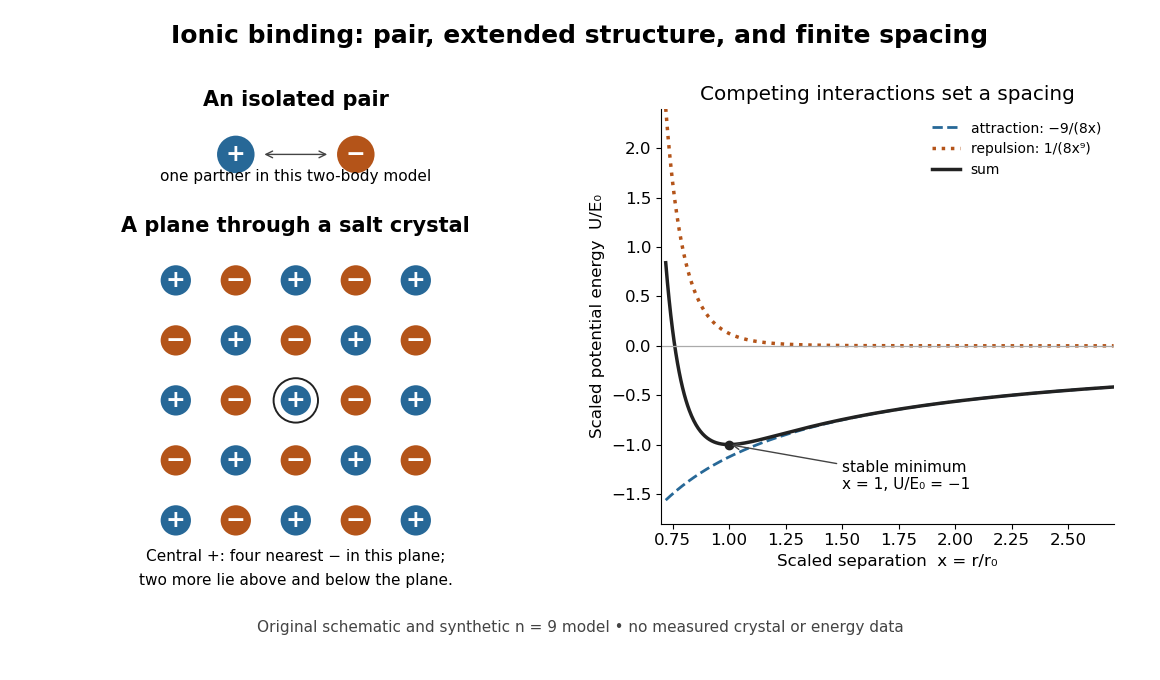
An isolated ion pair, a plane of an extended ionic crystal, and a synthetic potential energy model with a stable spacing
. Original schematic geometry and calculated model curves, not a measured electron density, diffraction pattern, or experimental lattice energy. Four nearest neighbours are visible in the plane of the rock salt structure; two more lie perpendicular to it. Disk sizes are arbitrary. The right-hand curves use the explicitly stipulated dimensionless model below. Details.
Tert-amyl bromide 2026-10-13
The chemical compound used in the conductometric determination of activation energy. Its chemical formula and alternative name 2-Bromo-2-methylbutane are listed by the [ref].