For finite discrete random variables , knowing reduces the information entropy of on average:Equality holds exactly when and are independent random variables. The average over observations is essential: can exceed for a particular . All logarithms here have base two, giving bits, and zero-probability terms contribute zero.[ref]
For Bayesian inference, this compares a prior distribution with the posterior distributions produced by possible observations. An unexpected report can make previously unlikely alternatives plausible, while useful reports reduce uncertainty overall. For lossless source coding, an observation shared by encoder and decoder lets them choose descriptions for the appropriate conditional distribution; sending that observation also has a cost. The example below makes both the saving and that cost explicit.
In A Mathematical Theory of Communication by Claude Shannon (1948), the definition of conditional entropy is already an average over observations, followed by the inequality and its independence condition in section 6, property 6. The phrase “knowledge reduces uncertainty” must be read with that averaging convention.[ref]
A Mathematical Theory of Communication by Claude Shannon. p. 12; title page identifies C. E. Shannon and the 1948 journal publication
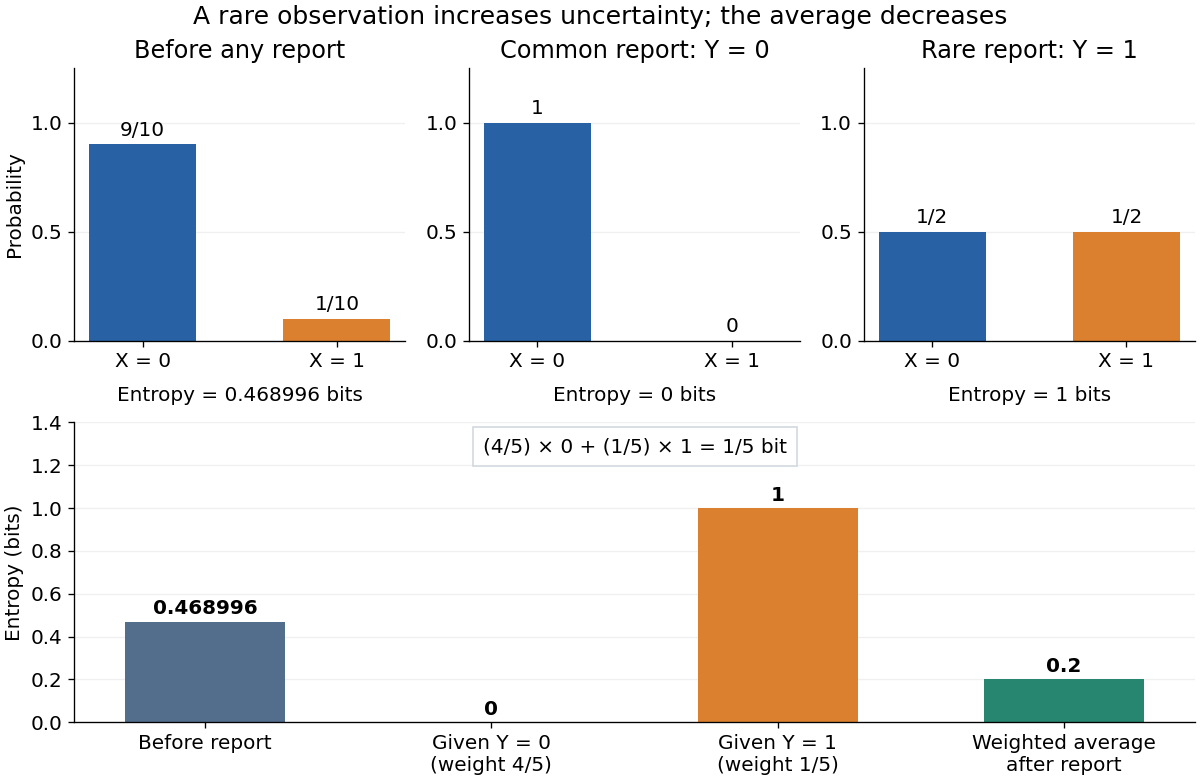
Consider a binary state and a report with the following joint probability mass function:Before the report, is strongly favored: its information entropy is bits, where is binary entropy. A report makes the two states equally likely, so bit, strictly larger than before. This report occurs with probability . The more common report determines , giving . Therefore the averaged conditional entropy isThe resulting mutual information is bits. The rare report increases uncertainty about the state; that increase does not make the report useless. Together the reports remove uncertainty on average. These are stipulated probabilities in an exact model, not measured frequencies.
Let be a Bernoulli random variable with . Independently of , a Bernoulli random variable with decides whether to reveal it:The symbol means “hidden” and is distinct from both binary states. This is a binary erasure channel with erasure probability . The hidden report leaves the posterior distribution equal to the prior distribution, because hiding is independent of the state. Either visible report determines . Weighting these three reports gives the exact conditional entropy and mutual information:For and , bits, while bits. With the report tells us nothing; with it reveals the state completely. If , every positive reveal probability makes the conditioning inequality strict. At or , the state was already known and every value of gives equality.
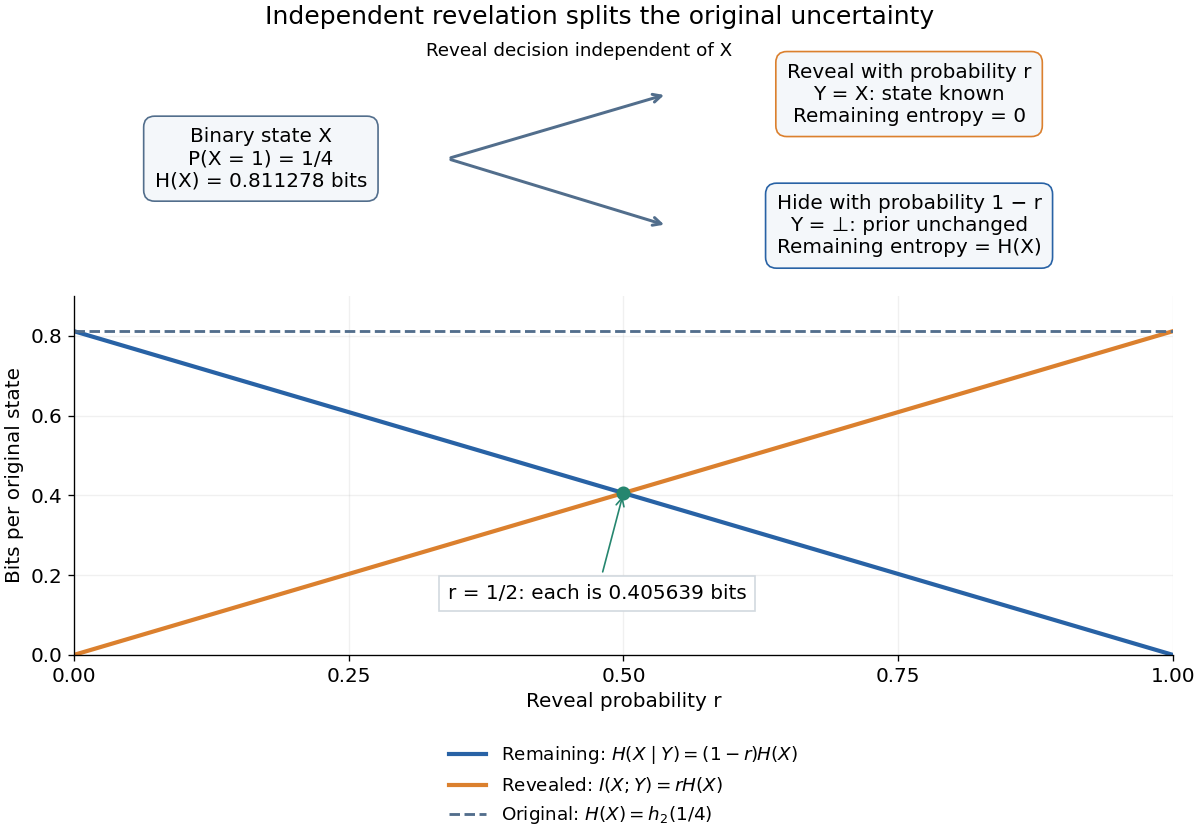


For a Bayesian inference problem, this model distinguishes an uninformative missing report from a decisive observed state. If hiding depended on , even could carry mutual information, and the displayed calculation would change. In lossless source coding, suppose both encoder and decoder already know the reveal pattern for repeated independent and identically distributed pairs. Only the hidden states require descriptions. Applying Shannon's source coding theorem to those states gives an asymptotic average rate bits per original state. A single hidden state need not have a codeword of that fractional length.
The reveal pattern itself has information entropy . If that pattern must also be sent, the chain rule for information entropy gives , since and are independent random variables. Equivalently, and . Thus a saving in the description of given assumes that is already available; it is not a free saving in the description of the whole pair.
For finite discrete random variables , retaining and also observing givesEquality means conditional independence of and given . Both sides average over reports; the additional observation is retained alongside .[ref]
Chapter 2: Information Measures: Mutual Information. Definition 2.4 and Theorem 2.5(1), printed pp. 26–27
A short proof of the original inequality uses Kullback-Leibler divergence:Gibbs inequality makes each term nonnegative, vanishing exactly when : independence for every possible report. Applying this within each and averaging proves the additional-conditioning inequality.[ref]
With appropriate probability density functions and finite differential entropies, , with equality iff independence. Differential entropy does not reverse the inequality; infinite or undefined quantities cannot justify subtraction.[ref]
Chapter 2: Information Measures: Mutual Information. Theorem 2.4(3), printed p. 24: density and finiteness hypotheses for the differential-entropy identity
However, differential entropy can be negative and depends on the choice of coordinates. For with a uniform distribution on an interval of length , ; in particular gives . Rescaling by a constant adds to both and , whenever they are finite, leaving the mutual information unchanged.[ref]
A Mathematical Theory of Communication by Claude Shannon. pp. 37–38: coordinate dependence, negative entropy, and linear rescaling
If a continuously distributed is revealed exactly, its conditional distribution is a Dirac measure with no ordinary probability density function. The discrete identity has no finite differential entropy counterpart. Mutual information, defined through relative entropy, is infinite here.[ref]
Articles by others on the same topic
There are currently no matching articles.