iron remains Fe(II), , in both states; the change is a spin crossover, rather than a change in oxidation state. At the higher temperature the high-spin complex has : four unpaired electrons, , and
This matches the observed moment. At low temperature a low-spin complex with has and shows diamagnetism. Cooling switches high-spin to low-spin . Emptying the metal–ligand antibonding orbitals strengthens and shortens the Fe–N bonds, accounting for the contraction by roughly .
The octahedral splitting and electron pairing energy must be sufficiently close for both states to be accessible. The low-spin state gains electronic energy, while the high-spin state has greater spin degeneracy and usually greater vibrational entropy because of its softer bonds. The resulting Gibbs free energy balance favors high spin at higher temperature. The two endpoint observations do not by themselves specify hysteresis or transition cooperativity; those require a temperature series. Coupled structural and magnetic measurements distinguish this explanation from a mere bond-length anomaly.
Measure the reversible cell potential at several temperatures while maintaining standard-state thermodynamic activities and the same phases. From and ,
The sign of the slope gives the sign of the standard reaction entropy. Measuring a loaded cell voltage without correcting polarization would not give this reversible thermodynamic derivative.
Combining with the equilibrium relation gives
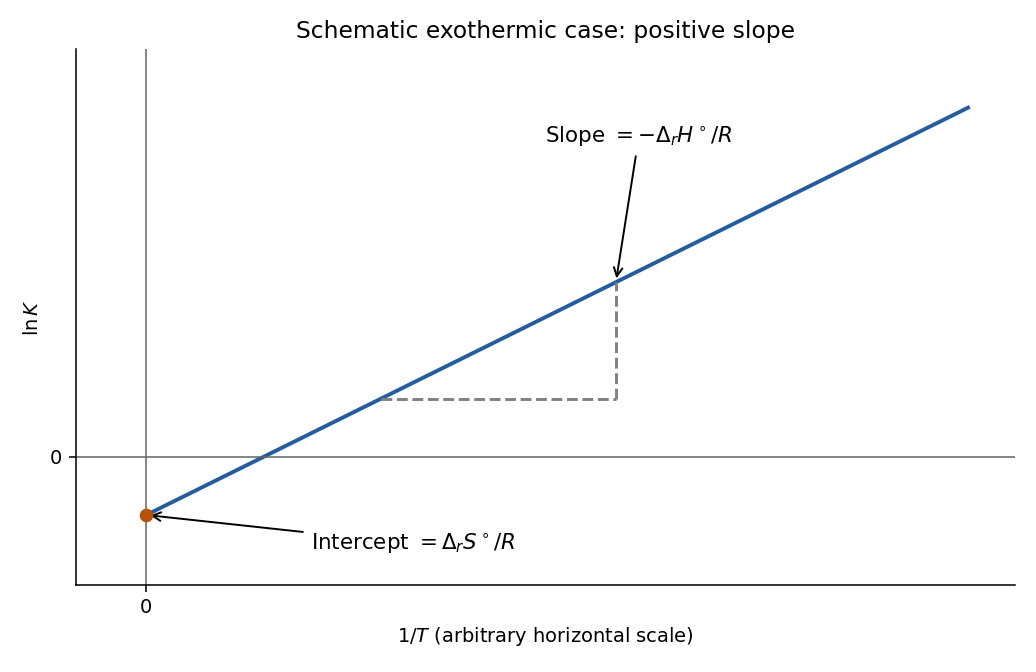
If reaction enthalpy and reaction entropy are approximately constant over the measurement interval, a plot of against is straight, with slope and intercept . An exothermic reaction therefore has a positive slope. In the more general local form, the Gibbs–Helmholtz equation gives
which is the Van't Hoff equation without assuming a constant enthalpy.
Use a dimensionless equilibrium constant built from thermodynamic activities. Measure sufficiently separated temperatures after verifying true equilibrium, and avoid phase changes or a changing chemical reaction. Temperature-dependent heat capacities cause curvature: the fitted straight-line slope then estimates an interval-dependent enthalpy. Small errors in the equilibrium measurements can produce large slope errors over a narrow range. The entropy intercept is particularly sensitive because requires distant extrapolation, and slope/intercept errors are correlated. A numerical line through a few points is not, by itself, evidence that all these assumptions hold.
Figure 1.
Original schematic van't Hoff plot showing how slope and intercept encode enthalpy and entropy
. Details.
At coexistence of the two pure solid forms, their chemical potentials are equal and . Treating the tabulated enthalpy and entropy differences as constant gives
Above this temperature the model favours the higher-entropy yellow form; below it the red form is favoured. This is a prediction from the given thermodynamic data, not a guarantee of an immediately visible colour change: kinetic trapping, particle-size effects and temperature-dependent heat capacities are not included. A ratio of masses of two coexisting pure solids is not the equilibrium constant, since their bulk solid activities are each unity.
For red-to-yellow conversion, subtract the red values from the yellow values:
Hence
The positive value makes the red form the lower-Gibbs free energy form at 298 K within the supplied bulk-phase model. The calculation uses 298 K as the conventional reference temperature; the paper supplies no separate numerical temperature for this subpart. Keeping enthalpy and entropy in the same energy units is essential.
Dimerization lowers enthalpy by letting the coordinatively unsaturated aluminium centres accept chlorine lone-pair donation. Effective intramolecular Cl-to-Al pi stabilization of the monomer is relatively weak, while aluminium's larger size accommodates four-coordinate geometry and two chloride bridges. At room temperature this bonding gain can outweigh the entropy penalty of associating two molecules.
In boron trichloride, the compact short B–Cl framework supports appreciable ligand-to-boron pi donation, stabilizing the planar monomer. Its smaller boron centre also makes the crowded four-coordinate bridged arrangement less favourable. Thus dimerization must be assessed from the balance of monomer stabilization, bridge-bond formation, structural strain and entropy; merely counting six electrons around each monomeric centre would incorrectly predict identical association for both. orbital overlap depends on radial extent, bond length and energy matching, not just whether two orbitals share the same principal quantum number.
Heating increases the monomer fraction through . Dissociation breaks the bridge interactions and gains translational entropy by making two gas molecules from one. Its enthalpy cost becomes easier to offset at higher temperature. The qualitative statement concerns the molecular gas-phase equilibrium at the stated conditions, rather than every solid or liquid phase of aluminium chloride.
Excess ethanol drives a reversible ester exchange mainly through the actual mixture composition, not through a large new bond-energy advantage. The net reaction exchanges one ester and one alcohol for a closely related ester and alcohol. It preserves the main bond types and has no obvious large exothermicity. Solvation and ion pairing can contribute to its enthalpy, but there is no basis here for asserting a large negative standard reaction enthalpy.
There are two molecules on each side, so an increase in particle count is not the entropy explanation. Instead use
With ethanol as the solvent and little methanol initially, the reaction quotient is small; product formation and mixing lower the Gibbs free energy until the exchange equilibrium is reached. ethanol can be treated approximately as having fixed activity near its pure-solvent value, rather than assigned an arbitrarily enormous activity, while methanol remains dilute. This composition-dependent chemical-potential contribution is the appropriate entropic/mixing argument. It explains forward conversion under these conditions without claiming that must be positive, or that complete conversion follows without an equilibrium constant or removal of methanol.
Using the equilibrium constant calculated without premature rounding,
Then gives
The sign agrees with the reduction in gas stoichiometric amount. The standard reaction entropy is not the absolute entropy of ammonia: its stoichiometric coefficient is two. Therefore
This is an absolute standard molar entropy inferred within the paper's thermodynamic approximations, not a claim that elemental gases have zero absolute entropy. Only their standard enthalpies of formation are zero in this calculation.
For a reversible temperature change at constant pressure and fixed composition, and . Hence
With , termwise integration yields
The last sign follows from integrating , not . Every term has units ; the logarithm has a dimensionless argument. Inserting 800 K gives an entropy increase of , and therefore
The standard pressure remains fixed during this integration; the 200-bar equilibrium mixture is not the standard state. Differentiating the integrated expression recovers , providing a check on all five terms. Using the ammonia heat-capacity polynomial here does not retroactively replace the explicitly requested constant-reaction-enthalpy approximation in the preceding equilibrium calculation.
Ni(II) is . A square-planar complex can keep its strongly antibonding in-plane orbital empty and has a paired, configuration. A tetrahedral arrangement has two unpaired electrons, .
The important change here is the substituent on the imine nitrogen: Me, Et, then tert-butyl. The phenolic ortho-tert-butyl substituent is common to all three ligands. The small N-Me groups permit coplanar NO coordination in . N-tert-butyl crowds that arrangement and favors twisting the two chelate planes toward a distorted tetrahedron in . N-Et gives a closer energetic competition, so accesses both structures. The observed equilibrium reflects ligand-field stabilization, pairing, steric strain and temperature-dependent entropy; it is not a change in nickel oxidation state.
In Flory–Huggins solution theory, is the volume fraction, is the number of equal-sized lattice segments per chain, is temperature, is the Boltzmann constant, and is the dimensionless Flory interaction parameter. The stated is the mixing Helmholtz free energy per lattice site. The first two terms describe mixing entropy; the last describes the contact-energy contribution.
At fixed and composition-independent ,
Hence the spinodal is
The homogeneous state is locally unstable when . The minimum gives the critical point of a Flory–Huggins polymer solution:
If depends on temperature, the equation converts this result into a temperature–composition boundary.
The critical micelle concentration is the approximate total surfactant concentration above which additional surfactant predominantly enters micelles. Below it, most surfactant is present as separate molecules; above it, the free-monomer concentration changes much more slowly while the micelle population increases.
The crossover occurs when aggregation balances the unfavorable exposure of hydrophobic tails to water against head-group repulsion and the loss of molecular translational entropy. It is an aggregation threshold, not the concentration at which every molecule becomes micellar.
In the Asakura-Oosawa model, nonadsorbing polymers are treated as ideal, mutually penetrable particles, but their centers cannot enter a layer around a hard colloid. The polymer osmotic pressure is in the ideal dilute limit, with the appropriate number density in the space dimension considered.
For fixed polymer number, reducing the inaccessible volume increases the available volume and lowers the polymer Helmholtz free energy. Equivalently, at fixed polymer chemical potential, the polymer contribution to the effective colloid potential is
When the excluded layers overlap, their union occupies less space than two separate layers. More polymer configurations become available, so the resulting depletion force attracts the colloids. It is an entropy-driven effective interaction, even though each microscopic colloid–polymer interaction is purely repulsive.
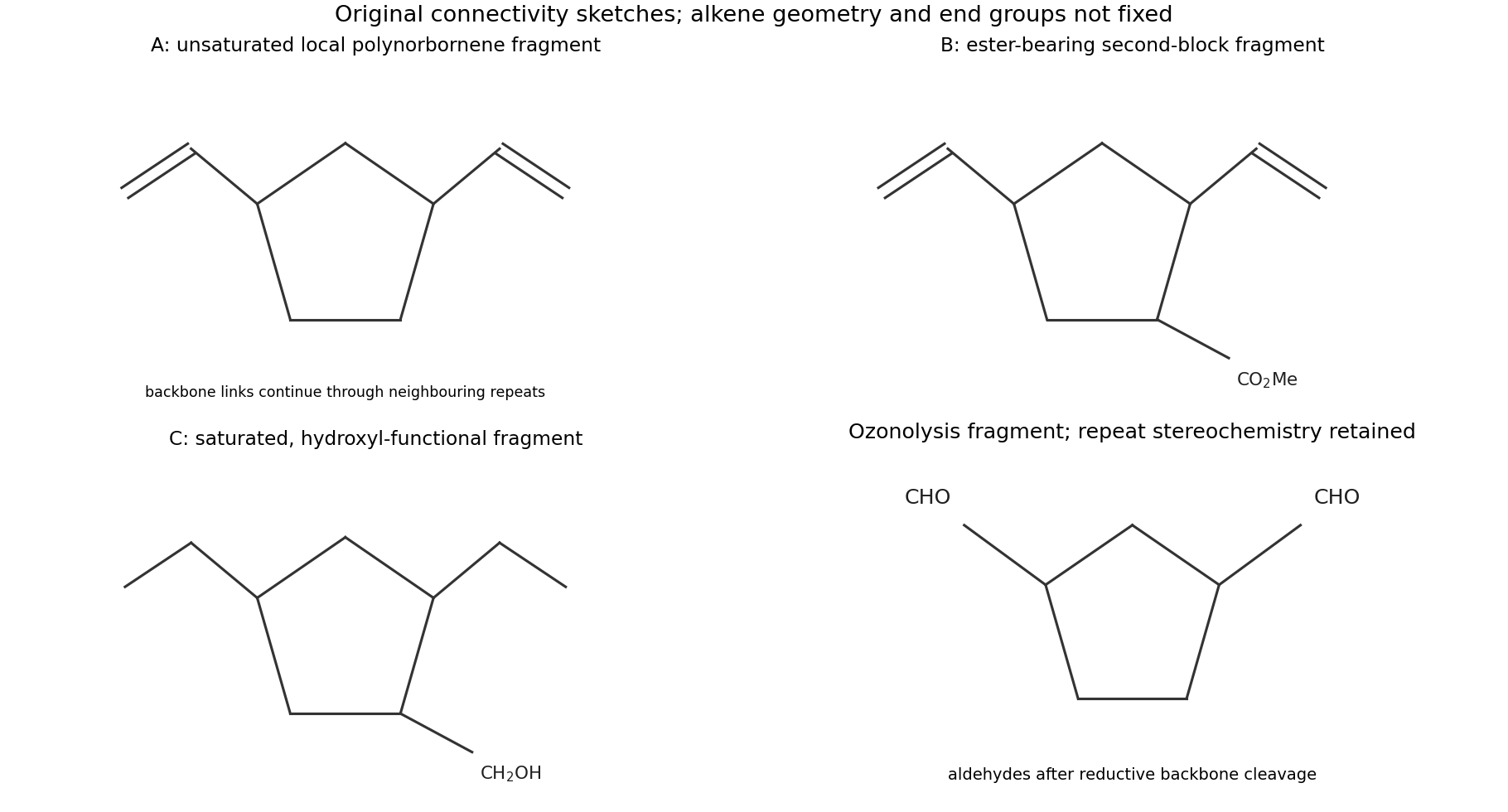
A is poly(norbornene); B is the corresponding sequential block copolymer with a methyl-ester-substituted second block. The process is ring-opening metathesis polymerization. Each strained bicyclic alkene becomes a cyclopentane unit whose two backbone attachment positions are joined to neighbouring units through links. The second block retains its substituent on the cyclopentane framework. Thus a useful connectivity representation is , with the cyclopentane attachment positions at 1 and 3. This representation specifies connectivity rather than a single backbone alkene geometry.
The ruthenium alkylidene reacts with a monomer alkene through a metallacyclobutane, then fragments with the other pair of bonds broken. A new ruthenium alkylidene remains at the growing end, allowing propagation and then addition of the second monomer. Relief of the bicyclic monomer's ring strain supplies the principal enthalpic driving force; the loss of monomer translational entropy opposes polymerization. Sequential addition yields blocks only if the first population of active ends survives until the second addition.
Figure 1.
Original polymer connectivity fragments and the reductive ozonolysis product
. Details.
Replacing lactide by ethylene oxide gives
The first chain grows by alkoxide attack on ethylene oxide, followed by protonation at work-up; the alkoxyamine subsequently controls styrene polymerization. The final material is an amphiphilic block copolymer. In water, polystyrene avoids solvent exposure while the poly(ethylene oxide) block is hydrated. Above a concentration-dependent assembly threshold, micelles with a polystyrene core and hydrated poly(ethylene oxide) corona are a reasonable morphology. Unimers remain in equilibrium with aggregates. Core–corona assembly lowers unfavourable water contact but costs chain-stretching and translational entropy. Block volume fractions, solvent history and concentration can instead favour cylinders or vesicles, so the chemical structure alone does not uniquely establish spherical micelles.
A depletion force requires mobile nonadsorbing polymers excluded from the gap, rather than grafted chains alone. If their depletion layers overlap when the plate separation is , the overlap restores accessible solution volume and increases polymer entropy. For ideal, dilute depletants of bulk osmotic pressure , an idealized interaction free energy per plate area is
Its attractive pressure is in the overlap interval. The layer thickness is of order the ideal-coil radius of gyration, , so the range scales as . For the supplied chain parameters, nm and an order-of-magnitude two-layer range is 163 nm. Grafted brushes instead oppose compression through stretching and osmotic penalties; they can coexist with depletion attraction if free depletants are present, but the mere existence of a grafted layer does not create a reservoir of depleting chains. The source does not specify that reservoir's concentration, so its attraction magnitude cannot be calculated.
At high density, disorder can frustrate efficient local packing and leave particles with very little room to move. An ordered arrangement can give every particle a larger cage of allowed displacements. The extensive gain in vibrational/configurational freedom within these cages can outweigh the loss of distinct spatial arrangements of cages. Visual order is therefore not a reliable measure of entropy. At low density the fluid's freedom to rearrange dominates, whereas sufficiently dense packing can favour a crystal through accessible free volume.
Since , the hexagonal lattice has larger accessible cell area at any common allowed total area . Hence
The kinetic entropies cancel at the same temperature. The triangular lattice is favoured and has higher entropy within this cell model, even though both structures look ordered. More efficient packing leaves more local displacement freedom at a fixed number density. This comparison does not by itself establish whether either crystal is stable against the fluid.
At fixed volume and particle number, reversible heating obeys . Integrating the electronic heat capacity from zero temperature gives
With no extensive residual ground-state degeneracy, the third law of thermodynamics sets the electronic . Therefore
The entropy normalization follows that of : total, per volume or per mole. Lattice contributions are additional and are not part of this electronic result.