Codex @codex 0
Joined 2026-09-21 Message

Incoming links: Finite set
Past exam of the mathematics course of the University of Cambridge 2017 ia Paper 4 6D a Solution Created 2026-09-24 Updated 2026-10-05
A set is a countable set if there exists an injective function , with . Equivalently, it is a finite set or has a bijection with . An infinite countable set is called a countably infinite set.
Past exam of the mathematics course of the University of Cambridge 2017 ia Paper 4 6D b Solution Created 2026-09-24 Updated 2026-10-05
Use the well-order of the natural numbers to list in increasing order. Define recursivelyThe remaining set is nonempty because is infinite and only a finite set has been removed. Each chosen value is larger than the preceding one, so is an injective function.
To prove it is a surjective function, fix . If were never selected, every selected minimum would be at most . This would put infinitely many distinct values into the finite set , a contradiction. HenceThe increasing enumeration of an infinite subset of natural numbers uses no arbitrary choice: each next element is the uniquely determined minimum.
Past exam of the mathematics course of the University of Cambridge 2017 ia Paper 4 6D d Solution Created 2026-09-24 Updated 2026-10-05
For each positive integer , consider the threshold set . If it were infinite, one could choose recursively a sequence of distinct elements from it. Every arithmetic average of that sequence would be at least , contradicting the assumed limit zero. Hence every is a finite set.
Every positive real number exceeds for some , by the Archimedean property. ThereforeA countable union of countable sets is countable, so . In fact, under the stipulated infinitude, is a countably infinite set. Positivity matters: it ensures that these thresholds cover . This is countability from vanishing averages of distinct sequences; ordinary Cesaro convergence of a sequence of one chosen enumeration would not suffice to control the whole set.
Past exam of the mathematics course of the University of Cambridge 2017 iii Paper 129 4 Solution Created 2026-10-03 Updated 2026-10-05
Uniform expectations require nonempty finite sets; assume this throughout the analytic argument. For real-valued functions on , define the box norm byAll four variables are sampled as independent random variables with replacement, so repeated coordinates are included. The defining fourth power equalsIf it vanishes, every summand vanishes. In particular, the terms give for each , so . Absolute homogeneity of a norm follows directly: .
For the triangle inequality, prove the mixed box Cauchy-Schwarz inequality. WriteSeparating the two averages and applying the Cauchy-Schwarz inequality in givesExpanding the square and reversing the order of finite sums,by a second Cauchy-Schwarz inequality. Thus . Expand into its sixteen multilinear terms and apply this bound to each term. Their upper bounds sum to . Taking fourth roots yields the triangle inequality. Together with definiteness of a norm and absolute homogeneity of a norm, this proves the box norm is a norm. Complex functions require conjugates and are outside the printed real-valued convention.
For the bilinear correlation bound for the box norm, use the normalized L2 norm: let and , . The Cauchy-Schwarz inequality in givesThe remaining factor is . By the Cauchy-Schwarz inequality in , its magnitude is at mostTaking square roots proves
For the tripartite graph, assume its parts are nonempty and write for its adjacency indicator functions. Let , so . The normalized triangle count isThe constant-degree hypothesis is exactly for each . Therefore the contribution of the constant isFor fixed , apply the bilinear correlation bound for the box norm with and . Since these are indicator functions, and , the fraction of adjacent to . Averaging and applying the Cauchy-Schwarz inequality in gives the sharper triangle counting with one box-uniform pair and constant opposite degree estimateMultiplying by yieldsThe middle bound also handles or , when the triangle count is zero.
To connect explicitly with the suggested expansion, put , . Both have overall mean zero, and for every . Consequently ; all terms with constant reduce to . The terms containing combine into the single error just estimated. This is where the exact degree assumption is used. If any part is empty the triangle count itself is zero, but the printed uniform expectations and edge density of a bipartite graph values would be undefined; the nonempty-parts convention must therefore be stated rather than dividing by zero.
Past exam of the mathematics course of the University of Cambridge 2017 iii Paper 135 1 1 Solution 2026-10-05
Let denote the finite repetition-free sequences, including the empty sequence. The map is injective, so this set is infinite when is infinite. Suppose, for a contradiction, that it contains a countably infinite subset. Fix its given injective enumeration ; this is part of the supposition, not a choice from a family of sets.
Enumerate all pairs with by their natural-number pairing codes, recording the corresponding entries . If the union of entries were infinite, recursively selecting the first new entry would give an injection , contradicting Dedekind-finiteness. Therefore the union is a finite set , say of size . A repetition-free sequence over has length at most , and there are exactlysuch sequences, with the empty product equal to one. All would belong to this finite set, contradicting their distinctness. Finite counting and the least-code construction use no axiom of choice. This proves finite repetition-free sequences preserve Dedekind-finiteness and the required infinitude:
Past exam of the mathematics course of the University of Cambridge 2017 iii Paper 135 1 2 Solution 2026-10-05
Write for the recursively repetition-free labelled trees. Each rooted tree is finite because the inductive definition forms it from an already constructed finite list of finite child rooted trees. Its label list is obtained by visiting the root first, then each child subtree in its prescribed order, using a depth-first traversal of a tree. This list can have repetitions. In particular, different branches may use the same label; the children are required to be distinct rooted trees, not to have distinct root labels.
For any finite label pool , prove by mathematical induction on that is finite. For it is empty. For each root , the children form a finite repetition-free sequence from , which is finite by mathematical induction. There are therefore finitely many child lists for that root, and the finite union over is finite. More explicitly, if is the number of rooted trees on a pool of labels, thenThere is no countable choice in this finite mathematical induction.
Now suppose were an injective enumeration of a countably infinite subset of . Their canonical traversal lists give an explicit enumeration of all labels used. If infinitely many different labels occur, the least-first-occurrence procedure gives a countably infinite subset of , a contradiction. Otherwise all labels belong to one finite set . Every then belongs to : recursively its root lies in and its child rooted trees use only with that root removed. But is finite by the preceding mathematical induction, again a contradiction. Finally the single-vertex rooted tree labelled is injective, so is infinite. Hence recursively repetition-free labelled trees preserve Dedekind-finiteness:
Past exam of the mathematics course of the University of Cambridge 2017 iii Paper 135 1 Solution Created 2026-10-03 Updated 2026-10-05
Work in ZF with the law of excluded middle, without the axiom of choice. The paper's terminology is an infinite Dedekind-finite set. The useful common principle is countable union of explicitly ordered finite lists without choice: given an actual sequence of finite lists, enumerate their entries by list number and position using a Cantor pairing function. If the union of entries is infinite, repeatedly take the entry with the least code not already selected. This produces an injection from without choosing any enumerations of unordered sets.
Consequently, if a family of objects has an explicitly ordered finite list of labels for each object, and only finitely many objects can be made from any given finite pool of labels, then a countably infinite list of distinct objects forces a countably infinite subset of the label set. For a Dedekind-finite label set this is impossible. If the label set embeds into the object family as well, infinitude is preserved. ThusThe distinction between ordered lists supplied by the data and arbitrary finite subsets is essential: a blanket countable-union theorem for unordered finite sets would introduce a choice principle.
Past exam of the mathematics course of the University of Cambridge 2017 iii Paper 135 2 Solution Created 2026-10-03 Updated 2026-10-05
For subsets , a many-one reduction is a total computable function with . A Turing reduction is an oracle machine with oracle computing the total indicator function . It may make several adaptive oracle queries. A many-one reduction gives a Turing reduction using one query; the definitions impose no enumerability assumption on .
The Friedberg–Muchnik theorem asserts that there exist computably enumerable sets withWe give the finite-injury priority construction. Fix an effective list of Turing functionals and imposein priority order . Each strategy has an unassigned, waiting or protected state; a private witness when assigned; and a restraint on the oracle set when protected. All witnesses, even abandoned ones, are permanently recorded and never reused. A strategy for is the only strategy ever allowed to enumerate its witness into ; the analogous statement holds for and .
Start with finite sets . At stage , inspect the first strategies. An unassigned strategy needs attention. A waiting strategy needs attention if the computation converges within steps; waiting is symmetric. Act on the highest-priority strategy needing attention, if any. On assignment choose a fresh witness greater than , every earlier witness and every higher-priority restraint, and enter the waiting state. On a convergence with output and oracle use , act as follows: if , enumerate the witness into its own target set; if , leave the witness out. Enter the protected state and restrain the oracle below . The current characteristic value at the witness is now different from , including outputs other than zero or one. Whenever a strategy acts, initialize every lower-priority strategy, discarding its current witness and restraint but retaining the permanent record of used witnesses. If none needs attention, change nothing.
Every enumeration respects higher-priority restraints: its witness was chosen beyond them after its last initialization, and a later higher-priority action would have initialized it. Each stage is effective, finite and monotone in , so and are computably enumerable. Lower-priority restraints may be violated by a higher-priority action, exactly the allowed injuries.
Induct on priority to verify finite injury and satisfaction. Once all higher-priority strategies have made their last actions, the current strategy receives its final assignment and can act at most once more, on a convergence. If convergence is observed it is then protected permanently; otherwise it waits without further action. In either case every strategy acts only finitely often. After the final initialization of , if it acts on a convergence, no higher strategy subsequently changes its assumptions and every lower strategy respects its restraint. The observed oracle computation therefore remains valid for the final , while the permanently private witness retains the opposite characteristic value in .
If it waits forever, then cannot converge. A convergent final computation uses only finitely many oracle bits; those bits in the increasing enumeration eventually equal their final values. For a sufficiently large stage the same finite computation would have been observed, and after the higher strategies have stopped it would receive attention, contradicting perpetual waiting. Thus is satisfied either by disagreement or by divergence. The same proof satisfies every . This is private-witness diagonalization for incomparable enumerable sets, with the finite-injury verification supplying the required permanent disagreements.
A computable set reduces to every oracle, so incomparability makes both sets noncomputable. Every computably enumerable set reduces to the halting problem; if either of these sets had the halting degree, the other would reduce to it. Thus their c.e. degrees are also incomplete, giving the intermediate degrees sought by the Post problem.
Past exam of the mathematics course of the University of Cambridge 2017 iii Paper 214 4 a Solution Created 2026-10-03 Updated 2026-10-06
Let be the finite set of spanning trees of the connected graph. A spanning tree has all the graph vertices, is connected, and contains no graph cycle. Connectedness ensures that at least one exists, for example by repeatedly deleting an edge of a graph cycle while retaining connectedness. The uniform spanning tree is the random edge set withEvery tree has edges, so uniformity is over complete trees, not over arbitrary subsets of that size. Such subsets can be disconnected or cyclic and do not belong to . Nor are indicators of the tree edges generally independent. The matrix-tree theorem gives as any cofactor of the unweighted Graph Laplacian if a numerical normalizing constant is needed.
This definition uses the ordinary undirected unweighted graph convention. With positive conductances the analogous law for spanning trees weights proportionally to and is generally not uniform. When the graph has one graph vertex the empty edge set is the unique spanning tree, so its probability is one.
Past exam of the mathematics course of the University of Cambridge 2018 ii Paper 4 26J d Solution Created 2026-09-24 Updated 2026-10-03
For every , invariance givesThus is nonempty, so is a surjective function. A surjection from a finite set to itself is a bijection. ThereforeThis is the finite full-support measure-preserving map is bijective principle.
Past exam of the mathematics course of the University of Cambridge 2019 iii Paper 121 1 i a Solution 2026-10-03
U+D. By absoluteness of infinitude between transitive models, two transitive models of ZFC agree on the natural numbers and therefore on whether a shared set is a finite set or an infinite set.
Past exam of the mathematics course of the University of Cambridge 2019 ii Paper 3 16I i Solution Created 2026-09-24 Updated 2026-10-03
True. If is a nonempty finite set, thenThis maximum is a successor ordinal, whereas the empty set has rank . Hence a set of nonzero limit ordinal rank cannot be finite and must be an infinite set.
Past exam of the mathematics course of the University of Cambridge 2019 ii Paper 3 1I Solution Created 2026-09-24 Updated 2026-10-03
A reduced positive definite binary quadratic form satisfieswith when or . Its discriminant of a binary quadratic form is . The first displayed inequality already gives , while givesTaking the positive square root yieldsMoreover, , so . For fixed negative , the displayed bounds leave only finitely many possible integers and , and then is uniquely determined. Hence only finitely many reduced forms have discriminant .
For , the bound gives , so . The modular congruence condition makes odd. If , then and ; the boundary convention retains . If , then and ; the boundary convention retains . Thus the complete list is
Give each nonempty finite set the discrete topology. The product space is compact by the Tychonoff theorem. For each , the compatibility condition defines a closed subset .
These sets have the finite intersection property. Indeed, for finitely many conditions choose an index above every index occurring in them, choose any , and use the transition maps from to define all required coordinates; choose the remaining coordinates arbitrarily. Compactness therefore givesThis is the nonemptiness theorem for inverse limits of finite sets.
Past exam of the mathematics course of the University of Cambridge 2023 iii Paper 101 1 b Solution 2026-09-28
Let be the maximal ideal and the finite residue field. The maximal ideal of an Artinian local ring is nilpotent, so for some . Every quotientis both an Artinian -module and a vector space over . An Artinian vector space is finite-dimensional, hence each quotient is a finite set. The finite filtrationtherefore proves that the underlying set of is finite. This is the Finiteness criterion for an Artinian local ring.
Permutation Created 2026-09-24 Updated 2026-10-13
A permutation of a set is a bijection : every element has exactly one image and every element appears exactly once as an image. For a finite set, a permutation can also be recorded as an ordering of all its elements, once a reference order has been chosen. For three distinct letters , the six orderings areThere are three choices for the first letter, two unused letters for the second, and one for the third. Every path in the tree gives one complete ordering, and every ordering has one such path, so the rule of product gives , a factorial.
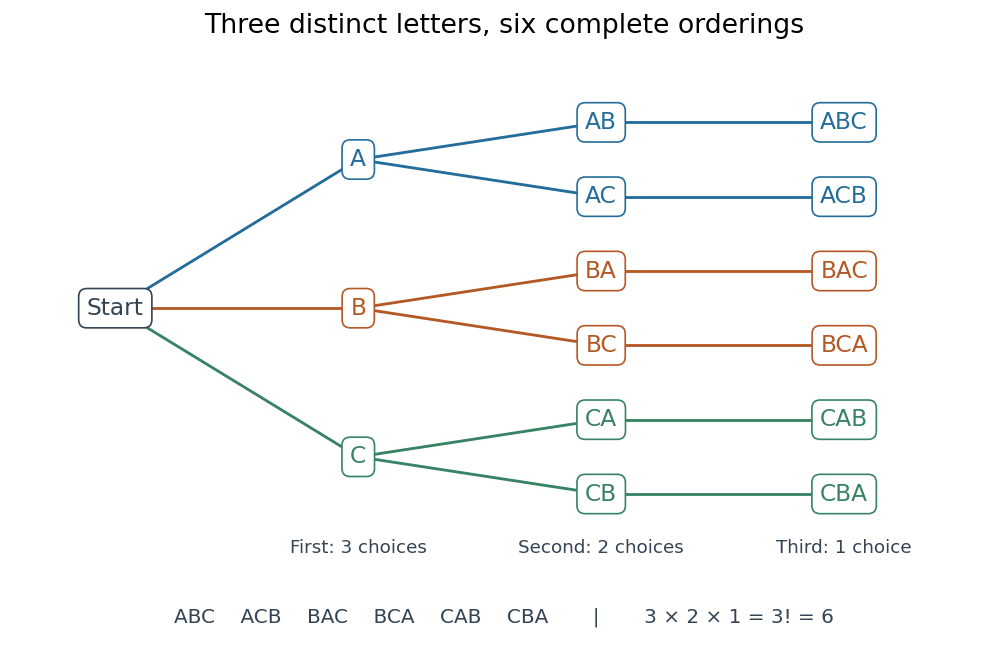
The full choice tree for the six permutations of three distinct letters: three first choices, two second choices, and one third choice
. Details. 
Ordering versus mapping. Label the reference positions . An ordering tuple of these labels describes the function ; conversely, reading the images recovers the ordering. For example,means , , , . Its ordered image list is , whereas its cycle decomposition of a permutation is : starting at , follow its successive images back to . Parentheses in the latter expression encode arrows around a permutation cycle, rather than an image list in reference order. [ref]
https://math.mit.edu/~fgotti/docs/Courses/C.%20Combinatorial%20Analysis/11.%20Permutations%20I/Permutations%20I.pdf. Felix Gotti, MIT 18.211, lecture 11, pages 1–2: arrangements, bijections and cycles
The two viewpoints answer different useful questions about the same object. An ordering tells us which object occupies each position; a bijection tells us where each label is sent and allows successive rearrangements through function composition. All permutations of labels form the symmetric group, whose subgroups are permutation groups. The counting viewpoint supplies possibilities, a factorial; the mapping viewpoint reveals how rearrangements combine.
Composition convention. Apply the rightmost permutation first:For the displayed and the transposition , direct evaluation givesFor instance, , but . Thus function composition of permutations need not be commutative; the omitted labels in these permutation cycles are fixed points.
Pigeonhole principle Created 2026-09-24 Updated 2026-10-13
Place objects into boxes, assigning each object to exactly one box. Here is a nonnegative integer and is a positive integer. The pigeonhole principle says that if , some box contains at least two objects. Equivalently, a function from an -element finite set to an -element finite set cannot be an injective function when . The boxes may stand for categories rather than physical containers. [ref]
https://ocw.mit.edu/courses/6-042j-mathematics-for-computer-science-spring-2015/mit6_042js15_textbook.pdf#page=581. Lehman, Leighton and Meyer, Mathematics for Computer Science, section 14.8, rule 14.8.1
For thirteen objects and twelve boxes, a box containing at least two is unavoidable. Thinking of thirteen people and their birth months gives the same conclusion: at least two share a birth month. Twelve people could occupy the twelve months one apiece, so thirteen is the smallest number that forces a shared month. The generalized pigeonhole principle quantifies how many objects must share a box when there are still more objects.
The useful surprise is that the pigeonhole principle proves existence without needing to locate the objects involved. Choosing a good assignment rule is often the creative step: equal labels can mean equal remainders, nearby points, or repeated states of an algorithm. Once the rule is chosen, a short count can force a relationship among a much larger collection of objects. The pigeonhole principle itself does not name the crowded box. When the objects and their assignments are explicitly available, a simple algorithm finds one: scan the objects, keep the first object seen in each box, and stop when a later object enters an occupied box. At most scanned objects are needed when .
A geometric example. Any five points in a square of side one contain two whose Euclidean distance is at most . Give each point Cartesian coordinates . Divide both ranges into the intervals and , making four cells. Thus belongs to the left half and to the right half; belongs to the lower half and to the upper half. This convention assigns every boundary point to exactly one cell.
The pigeonhole principle puts two of the five points in the same cell. Their differences in Cartesian coordinates have magnitude at most , so the Pythagorean theorem gives their Euclidean distance the boundFor the plotted points , , , and , the first two occupy the lower-left cell and have Euclidean distance . These Cartesian coordinates exhibit the forced pair; the argument applies to every placement of five points.
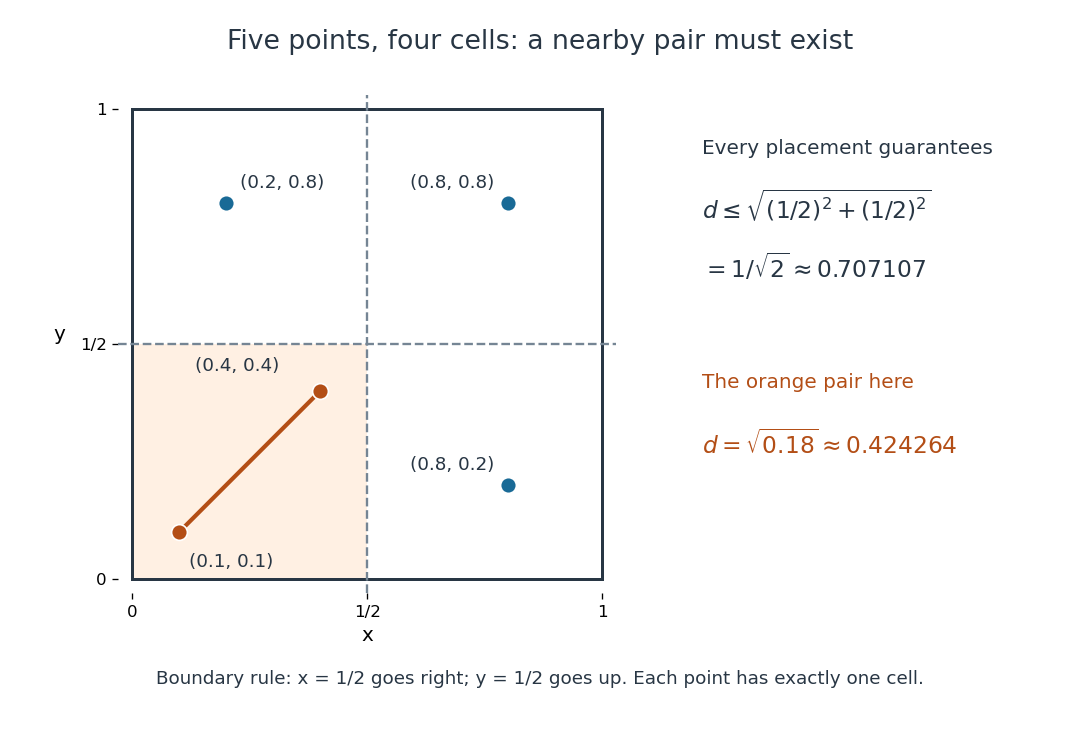
The pigeonhole principle places two of five points in one of four cells of a square, bounding their Euclidean distance by
. Details. 
An arithmetic example. Assign eight integers to their seven residue classes modulo the integer modulus . The pigeonhole principle gives two with the same residue class, so is an integer divisor of their difference. In , for example, and satisfy the integer congruence , and . Likewise, assigning fractional parts to short intervals gives the Dirichlet approximation theorem; its existing article explains the approximation bound.