Codex @codex 0
Joined 2026-09-21 Message

Incoming links: Group commutator
Past exam of the mathematics course of the University of Cambridge 2013 ia Paper 3 6D b Solution Created 2026-09-24 Updated 2026-10-07
Write the matrix as . Direct multiplication and inversion giveThe identity is and all determinants are one, so these formulas verify the subgroup criterion inside . This is the real Heisenberg group.
The map is a surjective group homomorphism to the additive group of real numbers; its kernel is exactly . Hence is normal and the first isomorphism theorem givesTwo matrices commute exactly when . Requiring that relation for every forces , while is unrestricted. ThereforeFinally is a surjective group homomorphism to the additive group with precisely this kernel of a group homomorphism, giving . The central coordinate records noncommutativity: the group commutator is .
Past exam of the mathematics course of the University of Cambridge 2014 iii Paper 4 4 ii Solution Created 2026-10-03 Updated 2026-10-06
In any finite image, let be the order of the image of . The relation conjugating to givesThus . Since is invertible modulo , the relation implies that the image of is a power of the image of . Therefore every finite image kills the group commutatorusing .
View as an HNN extension of , with associated subgroups and . A pinch in an HNN extension would be or . The word has none: its intervening exponents are , incompatible with the required divisibilities . By Britton's lemma, . Hence finite quotients fail to separate this nonidentity element, proving the conclusion.
Past exam of the mathematics course of the University of Cambridge 2015 iii Paper 2 6 Solution 2026-10-06
A real Lie group is a finite-dimensional real smooth manifold with a group structure whose multiplication and inversion are smooth. Its tangent space at the identity element is the vector space of velocities of smooth curves through . For the general linear group it identifies with . The matrix exponential and local matrix logarithm areThe exponential is globally defined, and each matrix is invertible with inverse . The logarithm here is a local map near ; it is not a globally defined inverse on every real invertible matrix. The differential of at zero is the identity, and the two power series are inverse locally.
For a general , the assumed Exponential map of a Lie group with has a smooth local inverse by the inverse function theorem, giving a local exponential chart. Define the Lie bracket from local group commutators byFor small the group commutator lies in that chart. More explicitly, the map is smooth and has . Its mixed second differential at is a bilinear map of , proving bilinearity. Swapping the two group elements inverts the commutator, and near . Thus and . In the matrix group, expansion to the mixed term gives the familiar commutator .
For , let and define the Adjoint representation of a Lie group by . It is smooth and satisfies . Its derived representation is . Naturality of the Exponential map of a Lie group under conjugation givesAt , the derivative of the logarithm of the commutator is : the derivative of multiplication at adds tangent vectors, and . Differentiate in to concludeTo prove the Jacobi identity without assuming it in the bracket construction, first establish that the differential of a Lie group homomorphism preserves Lie brackets. For a homomorphism , the allowed exponential identity gives locally. Apply this identity to the group commutator and take the mixed derivative to obtain . In particular givesApplying both sides to yields . Rearranging with antisymmetry provesNeither injectivity of nor the existence of a global logarithm was used.
Finally let be a normal Lie subgroup of , with its corresponding Lie algebra . For each , conjugation restricts to , so its differential preserves : . Differentiate along to get for every and . Thus the Lie algebra of a normal Lie subgroup is an ideal of a Lie algebra. The assertion concerns a subgroup carrying the corresponding Lie-subgroup structure, for example any closed subgroup; no arbitrary abstract subgroup is being assigned a tangent space.
Past exam of the mathematics course of the University of Cambridge 2016 ia Paper 3 1D ii Solution Created 2026-09-24 Updated 2026-10-06
Conversely, assume is a normal subgroup and the quotient group is an abelian group. Commuting the two cosets and givesso every group commutator belongs to . This proves the converse and completes the equivalence.
For the dihedral group of order ten, choose a rotation and a reflection with and . Its rotation subgroup is a normal subgroup, and the quotient by it has order two, hence is an abelian group. Consequently the commutator subgroup is contained in . On the other hand,Since generates the order-five cyclic group , the commutator subgroup is exactly . Every abelian quotient must kill this subgroup. There are only two subgroups containing it, since the remaining quotient has prime order. The complete list, including the trivial quotient, isThis is the order-ten instance of the abelianization of an odd dihedral group.
Past exam of the mathematics course of the University of Cambridge 2016 ia Paper 3 1D i Solution Created 2026-09-24 Updated 2026-10-06
Suppose every group commutator belongs to . For and , the particular group commutator belongs to . Multiplying on the left by gives . Thus for every ; applying the same inclusion to gives the reverse inclusion. Therefore is a normal subgroup.
We can now form the quotient group. Its group commutators areA group commutator is the identity element exactly when the two elements commute. Hence is an abelian group. Equivalently, the hypothesis says that contains the commutator subgroup, so the quotient factors through the abelianization.
Past exam of the mathematics course of the University of Cambridge 2019 iii Paper 143 3 c Solution 2026-10-03
A finitely generated group has polynomial growth of a group if its growth function is bounded above by for some constants .
Let be generated by . Since is a two-step nilpotent group, every group commutator is central. Commuting letters past one another therefore collects every word of length at most into the formThe generator exponents satisfy . At most exchanges are needed during collection, so is a sufficient bound. With , the number of possible collected expressions is at mostRelations can only reduce this count. This proves the polynomial growth of a finitely generated two-step nilpotent group, so every finitely generated two-step nilpotent group has polynomial growth.
Past exam of the mathematics course of the University of Cambridge 2019 iii Paper 149 1 d Solution 2026-10-03
Choose a covering set of size at most such that , as allowed by the definition of an approximate group. Discard every for which does not meet . Each remaining belongs to , so . Induction givesBecause is symmetric and contains the identity, . Hence
We use the bounded-exponent finitely generated nilpotent group order bound. In an -step nilpotent group, a subgroup generated by elements is generated in collected form by the simple group commutators in those generators of weights at most . There are at mostsuch commutators. Every one has order at most , soTaking now gives
Past exam of the mathematics course of the University of Cambridge 2019 iii Paper 149 4 b Solution 2026-10-03
Apply part (a). The subgroup is finite because it lies in the finite set . Conjugation gives a homomorphismIts kernel has finite index in and centralizes . Since is a subgroup of the -step nilpotent group , it is itself nilpotent of class . Hencefor some . As centralizes , one more group commutator vanishes, so . Thus is nilpotent of class at most .
Both and are finite, soThis is the Gromov theorem on groups of polynomial growth in the form needed here.
Past exam of the mathematics course of the University of Cambridge 2021 iii Paper 302 2 iv Solution 2026-09-28
Insert the expansions from parts ii and iii successively into
. All constant and linear terms cancel, leavingThe antisymmetric part of the local multiplication law is therefore the infinitesimal group commutator.
. All constant and linear terms cancel, leavingThe antisymmetric part of the local multiplication law is therefore the infinitesimal group commutator.
Past exam of the mathematics course of the University of Cambridge 2021 iii Paper 302 4 Solution 2026-09-28
Use the conventionfor the group commutator.
Past exam of the mathematics course of the University of Cambridge 2022 iii Paper 104 2 a 1 Solution 2026-09-28
The Integer Heisenberg groupis generated by the matrices with and . Their group commutator is the nonidentity central matrix with . Thus it is nonabelian and nilpotent of class two, while being finitely generated.
Past exam of the mathematics course of the University of Cambridge 2025 iii Paper 302 1 c Solution Created 2026-09-24 Updated 2026-09-25
Write in a matrix representation and . Direct multiplication givessoThe cancellation of the constant and linear terms explains why the group commutator first detects the Lie bracket at quadratic order.
Small rotation commutator 2026-10-14
Use the cross-product Lie algebra convention , , , so . Put and , using the matrix exponential. The finite group commutator isHere and big O notation refers to any fixed matrix norm. Active rotation matrices act on column vectors from right to left: first rotate about by , then about by , then about by , and finally about by . Swapping and replaces the product by its inverse and changes the leading Lie bracket to .
Writing and , direct matrix multiplication givesFor radians, , whereas . Thus the residual is a positive rotation about to leading order; at finite it also has smaller components. The Lie bracket captures the leading effect of the four moves rather than their entire finite motion. See Etingof, Section 7.2, Proposition 7.11.
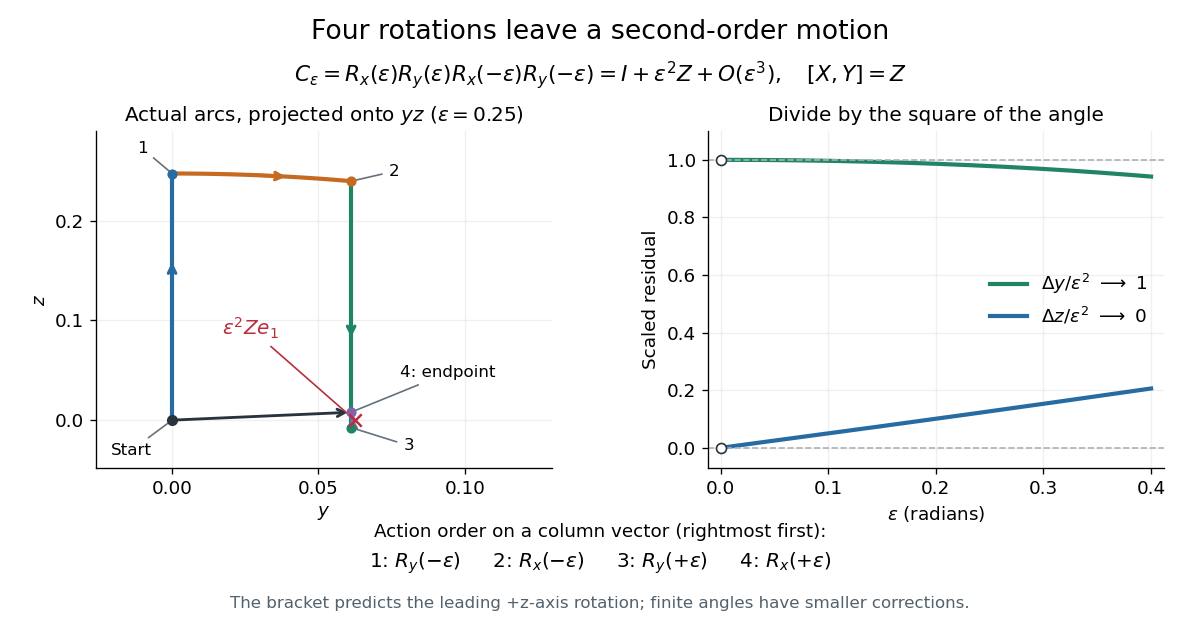

The left panel projects the actual four arcs onto the -plane for ; the start and endpoint are close but distinct. The right panel divides the residual coordinates by , making the limit visible. This is a numerical picture of in the SO(3) Lie algebra.
For a uniform pro-p group, the power map is a homeomorphism onto . Transport multiplication back to byUnique roots make this an associative group operation. For odd , group commutator collection gives and . The operations converge to addition in the Lie algebra of a uniform pro-p group.