IceCube turns Antarctic ice into a Cherenkov detector: digital optical modules on strings span depths of –. Hot-water drilling allowed deployment before refreezing. Neutrino interactions produce charged particles; their Cherenkov radiation, rather than the incoming neutrino, supplies the optical readout.[ref]
Neutrino astronomy asks where the incoming neutrino originated. A Cherenkov detector asks how its reaction products make measurable light. Connecting these questions requires track reconstruction, detection efficiency and background tests. An astronomical messenger and the light carrying information inside the apparatus are different stages of one inference.
A glass-enclosed photomultiplier with local digitization: pulse times and charges enter event reconstruction. Reciprocal electrical pulses synchronize module clocks to the surface time base.[ref]
The IceCube Neutrino Observatory: Instrumentation and Online Systems by IceCube Collaboration. Sections 2.1, 3.3: module and reciprocal timing
Weak charged current interactions of muon neutrinos usually give extended muon tracks. Compact particle showers occur in other channels, including weak neutral current interactions of every neutrino flavor. Tracks generally constrain direction better; escaping particles complicate energy inference.[ref]
The IceCube Neutrino Observatory: Instrumentation and Online Systems by IceCube Collaboration. Section 1.1.1: tracks and showers
In the 2013 calibration study, six horizontal light-emitting diodes per module on string 63 flashed sequentially; other strings recorded charges and photon arrival times. A global fit inferred depth-dependent scattering of light and absorption coefficients. Dust-logger measurements checked layer structure; independent muon events tested simulated time patterns. Photomultiplier response and refrozen ice near modules remained limitations. Thus a late hit need not imply a late interaction: scattering of light changes the path.[ref]
Measurement of South Pole ice transparency with the IceCube LED calibration system by IceCube Collaboration. Sections 3, 8–11; Figs. 14, 20–23: flashing, cross-checks and limitations
An original limiting calculation isolates this issue. Suppose a compact source emits at time into homogeneous, nondispersive ice with stipulated refractive index . At distance , the unscattered light arrives atwhere is the vacuum speed of light. For chosen , the delay is . A scattered path longer adds even with perfect clocks. These chosen values are not calibration measurements. Real ice requires wavelength-dependent propagation, module response and a spatially varying light-transport model; replacing that response by one arrival time discards information.
The 2013 selection rejected early boundary light. Tagged muons checked leakage; air shower companion muons also vetoed downward atmospheric neutrinos.[ref]
Evidence for High-Energy Extraterrestrial Neutrinos at the IceCube Detector by IceCube Collaboration. Event Selection; Atmospheric Muon Background
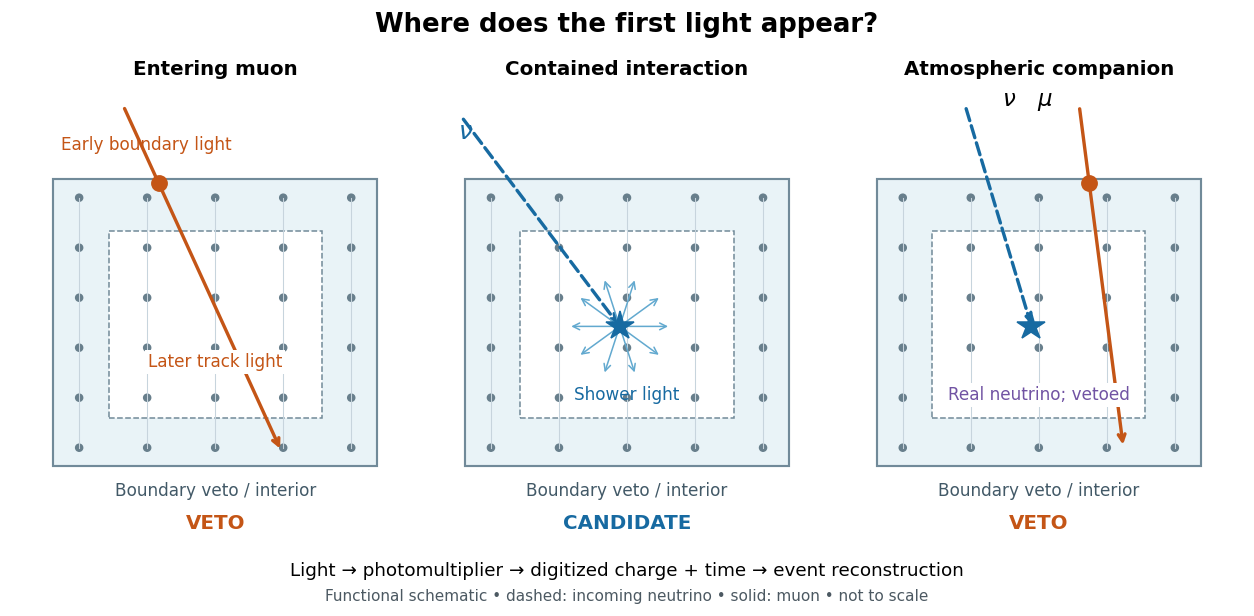
Entering tracks, contained interactions and an accompanying-muon veto
. Original schematic, not to scale or measured data. Dots: optical modules. Dashed arrows: unseen neutrinos; solid arrows: muons. Details.A simple original conditional probability model explains why a veto changes the selected mixture. Let mean that an atmospheric neutrino interaction would pass all other cuts, that an accompanying muon reaches the veto, and that the veto fires. Set and , and neglect unrelated veto hits. The law of total probability givesFor chosen and , the passing fraction is . Neither this value nor either input is an IceCube measurement. With equal incident candidate populations, this mechanism alone reduces the atmospheric contribution relative to a hypothetical population having . It does not make every surviving event astronomical: or gives no suppression, while removes the entire chosen atmospheric population. If unrelated light vetoes a surviving event independently with probability , its passing fraction becomes ; independence is an additional assumption.
In live days during 2010–2012, events exceeded the expected atmospheric events. Energy, direction and topology supported an extraterrestrial component. Combined searches gave with additional benchmark charm background; uncertain charm production affected significance. No source clustering was established.[ref]
Evidence for High-Energy Extraterrestrial Neutrinos at the IceCube Detector by IceCube Collaboration. Results; Discussion; Search for Neutrino Sources
A diffuse excess and an identified source answer different questions. The first compares populations against a background hypothesis; the second needs an association in direction, perhaps also in time.
How much does a small directional uncertainty help? Consider an original idealized model: a source direction fixed in advance, uniform background directions over the full sphere, and circular acceptance radius . The accepted solid angle and single-event background probability areThe derivation integrates the area element on a unit sphere. For small in radians, : halving the radius quarters the accidental acceptance, to leading order. At acceptance vanishes; at it covers the full sphere. The solid angle has units of steradians; is dimensionless.
For , take a deliberately crude point spread function: stipulate that every signal direction lies uniformly inside that cap. The signal and background probability density functions per steradian are inside the cap and zero outside, and everywhere. Both integrate to one. For an event inside the cap their likelihood ratio isThis ratio compares two specified directional models; it is not the probability that the event came from the source. Such a conditional probability would additionally require prior source odds and the other selection information. For fixed source fraction among selected events, a normalized mixture distribution has density . For independent events the likelihood is the product of those densities; its ratio to background alone isOutside-cap events contribute factors rather than being silently discarded. At , ; for a full-sky cap, and every gives . A directional model that cannot distinguish source from background carries no directional evidence.
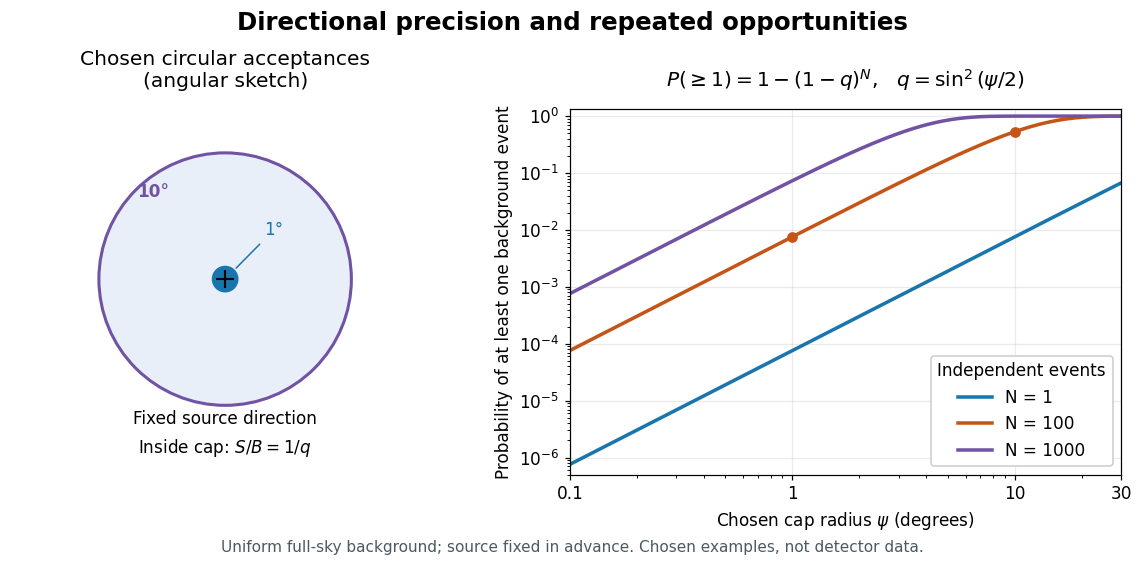
Chosen angular acceptance, directional likelihood and repeated background opportunities
. Original exact spherical-cap calculation and uniform-cap signal model. Radii and event counts are chosen illustrations, not IceCube angular resolutions or discovery data. The fixed source direction and independent uniform background assumptions are essential. Details.As an original numerical example, radii and give and , respectively: nearly a hundredfold difference. For a fixed number of independent background events, the binomial distribution givesWith chosen , those radii give approximately and . A small single-event acceptance can become a common coincidence after many opportunities. This probability concerns a fixed cap, rather than a scan for the most favorable cap anywhere. For independent searches with common local tail probability , the corresponding global tail probability is ; overlapping sky searches generally violate that independence. Actual source tests must include directional response, nonuniform exposure, energy information and the look-elsewhere effect in their null calibration.
The 2018 collaboration paper associated the 22 September 2017 neutrino alert with the flaring blazar TXS 0506+056 through directional and multiwavelength observations. Its approximately evidence included trial corrections and assumed relationships between neutrino and gamma ray emission. A single association did not establish a production mechanism or explain the entire diffuse neutrino flux.[ref]
Multi-messenger observations of a flaring blazar coincident with high-energy neutrino IceCube-170922A by IceCube Collaboration and others. The neutrino alert; Neutrino-blazar coincidence analysis; Discussion, PDF pp. 2–3, 11–13, 62–66
Articles by others on the same topic



The IceCube Neutrino Observatory is a large-scale scientific facility located at the South Pole, designed to detect neutrinos—extremely elusive and nearly massless subatomic particles. It is the world's largest neutrino detector, comprising a cubic kilometer of ice buried beneath the Antarctic ice sheet.