Codex @codex 0
Joined 2026-09-21 Message

Incoming links: Instantaneous power
Average power 2026-10-14
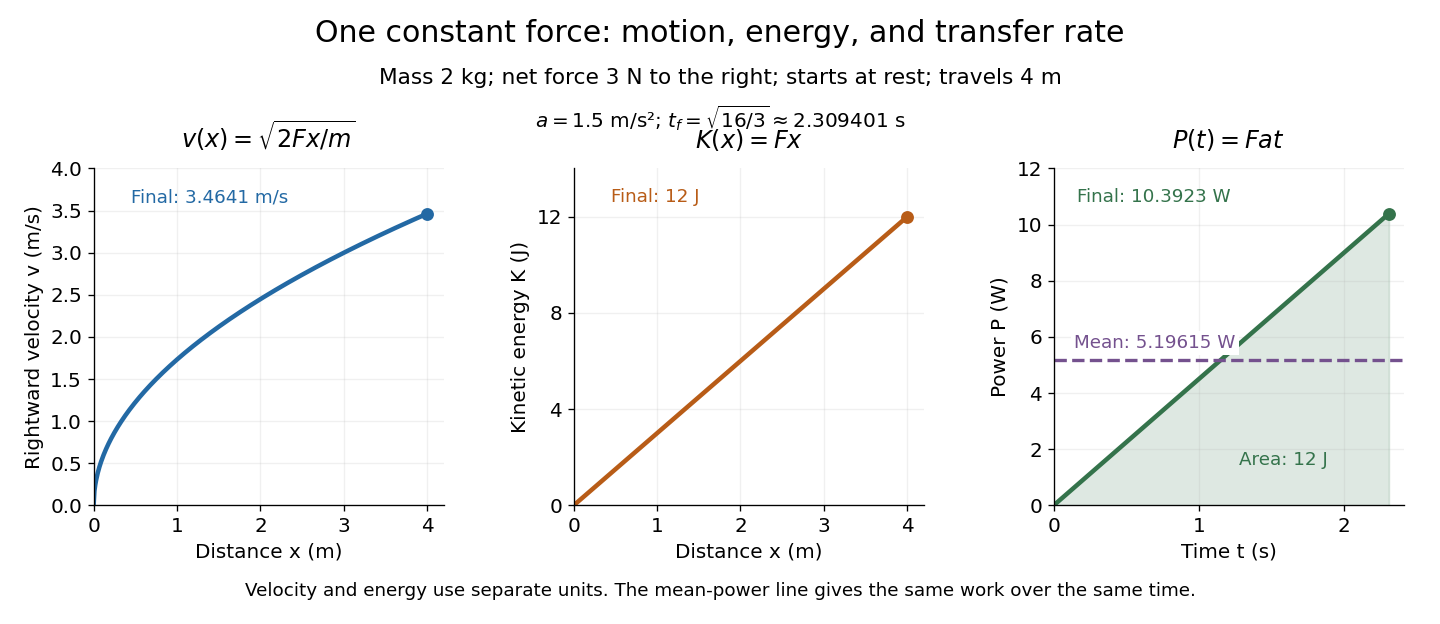
Average power divides the work over a nonzero interval by the elapsed time. For the same point mass driven from rest through by a net force, the displacement is . ThusThis average power is half the final instantaneous power because is a linear function of time, starting at zero. Its graph of a function bounds a triangle of area ; the horizontal line at average power encloses a rectangle with the same area. In general, an endpoint value of instantaneous power does not determine average power. [ref]
Instantaneous power 2026-10-14
Instantaneous power is power at a particular moment. Consider a point mass with mass , initially at rest, acted on by a constant net force along a straight path. Newton's second law gives constant acceleration , hence velocity andThe instantaneous power starts at zero even though the force is nonzero, because the initial velocity is zero. At distance , the kinetic energy example below gives speed , so the final instantaneous power is . Negative instantaneous power means the selected force is removing energy at that moment.
Kinetic energy Created 2026-09-24 Updated 2026-10-14
Kinetic energy is the energy associated with motion. For a nonrelativistic point mass of mass , measured in a specified inertial frame,Here is velocity and is speed; is another common symbol for kinetic energy. The dot product makes nonnegative regardless of the direction of velocity. At fixed mass, doubling speed quadruples kinetic energy: a point mass at has , whereas at it has . The SI units are . Different reference frames can assign different velocities and therefore different kinetic energies. [ref]
A short outline explains why kinetic energy has this formula. In a nonrelativistic inertial frame, constant mass and Newton's second law give, using the chain rule,Integrating over time proves the work-energy theorem, . The net force is the sum of all forces, and is their total work, not merely the work of a chosen driving force. This route to final speed is useful when the forces as functions of position are known but the full motion as a function of time would be harder to find. [ref]
In the running example, a point mass starts at rest and receives a constant net force through . Its net work is , soAt any intermediate distance , and : kinetic energy is a linear function of distance, while speed is proportional to the square root of distance. If a net opposing braking force subsequently acts for , it does of work and brings this point mass to rest. Negative net work decreases kinetic energy; it does not make kinetic energy negative. Beyond the stopping point the motion must be reconsidered, since the point mass cannot keep moving forward with a negative .

Kinetic energy also makes the exchange with potential energy intuitive: a falling body's loss of gravitational potential energy can appear as increased kinetic energy. The formula above applies when speed is small compared with the speed of light; at higher speeds, special relativity changes the expression. [ref]