The one-sample Kolmogorov-Smirnov test checks goodness of fit by comparing an empirical distribution function with a specified cumulative distribution function . Its Kolmogorov-Smirnov statistic is the largest vertical gap anywhere between the two curves. Every threshold asks the same concrete question: what proportion of the observations are at or below it, and what probability does the proposed probability distribution assign there? A large discrepancy supplies evidence against the null hypothesis.
For example, four stipulated observations compared with the uniform distribution on give . Just before , only two observations have been counted, so the empirical distribution function approaches , while approaches . The Kolmogorov-Smirnov statistic section calculates every jump-side gap. These are exact illustrative numbers, not experimental measurements or a claim of statistical significance.
The ordinary one-sample calibration assumes independent and identically distributed real observations and a simple hypothesis , with a continuous function fixed before inspecting these observations. All statistical parameters of must be specified.[ref] Under that null hypothesis, the probability integral transform gives with the uniform distribution on , retaining independence. Consequently the sampling distribution of depends on the sample size , but not on the particular continuous . This is the useful sense in which the calibration is distribution-free.
For the exponential distribution of rate one, for . Take for the four stipulated above. The probability integral transform changes the horizontal coordinates but preserves both the order statistics and their cumulative heights, so the same Kolmogorov-Smirnov statistic appears on both scales. More generally, for continuous , the jump-side formulas depend only on . Strict increase everywhere is unnecessary: intervals on which is constant have probability zero under the null hypothesis. This explains the invariance without assuming a strictly positive probability density function.
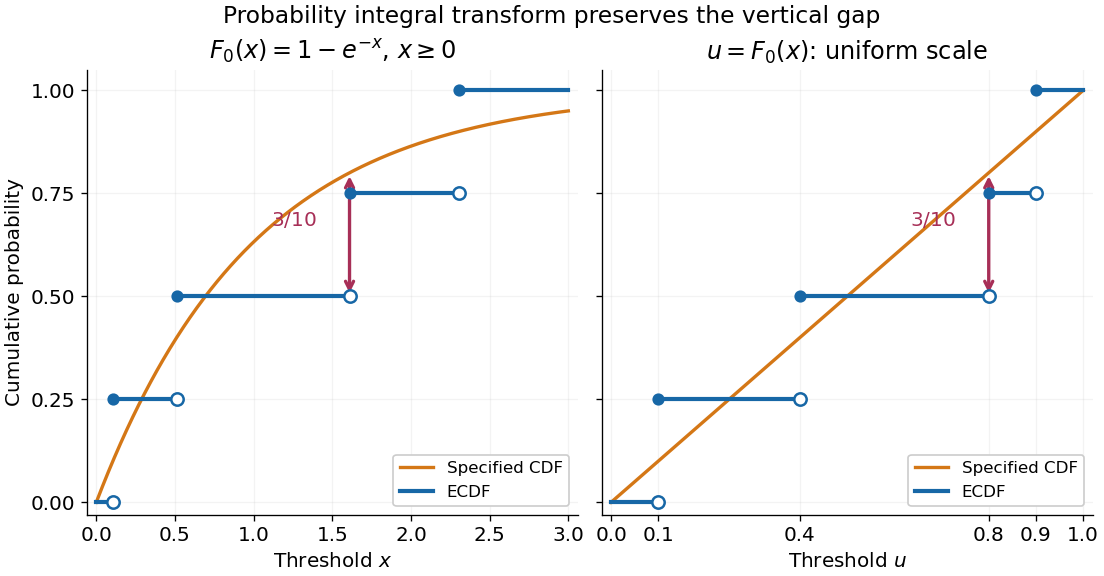
The probability integral transform preserves the Kolmogorov-Smirnov gap on exponential and uniform scales
. The same four stipulated points are shown as on the left and on the right. Open circles indicate left limits of the empirical distribution function, filled circles its values. The gap is approached from below the third observation on both scales. Details.
The observed Kolmogorov-Smirnov statistic is a discrepancy, whereas its p-value is a tail probability under the null hypothesis:Here is computed from a fresh sample of the same sample size. Choose a significance level before the test and reject when the calibrated p-value is at most . The value alone supplies neither a p-value nor a rejection decision. Failure to reject does not establish that the null hypothesis is true. A finite-sample calibration and the asymptotic Kolmogorov-Smirnov theorem are distinct; a cutoff for must be rescaled before use with .[ref]
Fitting statistical parameters on the tested observations replaces by the random . The resulting transformed observations need not be independent and identically distributed uniforms, so the ordinary reference law fails. The Lilliefors test addresses a particular fitted normal distribution. More general parametric bootstrap calibration must simulate from the fitted statistical model and repeat the fitting in every replicate; holding the fitted statistical parameters fixed during those comparisons calibrates a different procedure. Such a parametric bootstrap requires its own validity justification rather than inheriting exactness from the simple-null test.
For a discrete probability distribution, is generally not uniform. Equal observations also arise from rounding, so tied data require a calibration that accounts for the discrete probability distribution or the rounding rule. The discrepancy remains meaningful, but continuous-null p-values are not automatically valid. Statistical dependence likewise changes the reference law. The two-sample Kolmogorov-Smirnov test compares two empirical distribution functions and has a different calibration.[ref]
Articles by others on the same topic
There are currently no matching articles.