The log-likelihood is the natural logarithm of the likelihood function:For positive finite likelihood, the natural logarithm is a strictly increasing function, so the maximizing parameter values are unchanged. Set ℓ=−∞ where L=0; the same ordering then includes zero-likelihood boundaries whenever a positive finite maximum exists. For independent and identically distributed random variables, a product becomes a sum,This makes derivatives simpler and avoids forming products of tiny numbers in floating-point arithmetic. These equal-maximizer and additive formulas underlie the worked calculations in MIT 18.05, Reading 10b, section 3.1.
ℓ(θ;x)=logL(θ;x).
L(θ;x)=∏i=1nfθ(xi),ℓ(θ;x)=∑i=1nlogfθ(xi).
For the ordered sample of eight successes and two failures in likelihood function, on 0<p<1,The score equation ℓ′(p)=0 gives 8(1−p)=2p, hence p=8/10=0.8. The negative second derivative proves strict concavity, so this is the unique interior maximum. Both counts are positive, so L(0)=L(1)=0, while L(p)>0 inside: the same point is the unique global maximum on [0,1]. Counting only successes adds log45 to the log-likelihood, leaving both derivatives and the MLE unchanged. For all-success or all-failure samples, the boundary analysis in maximum-likelihood estimator applies instead of an interior score equation.
ℓ(p)=8logp+2log(1−p),ℓ′(p)=p8−1−p2,ℓ′′(p)=−p28−(1−p)22<0.
The two panels below compare k=2,5,8 successes out of ten Bernoulli trials. Their peaks are at p=k/10. The left panel uses relative height; the right panel uses the log-likelihood difference from each peak. These are the same comparison on two scales:A difference of −2 means relative height e−2, and a difference of −10 means e−10; the log-likelihood scale makes small relative heights easier to see. Neither vertical axis is a parameter probability density function. The zero likelihood endpoints have log-likelihood −∞ and are outside the finite vertical range in the right panel.
ℓ(p)−ℓ(p)=logL(p)L(p),L(p)L(p)=exp(ℓ(p)−ℓ(p)).
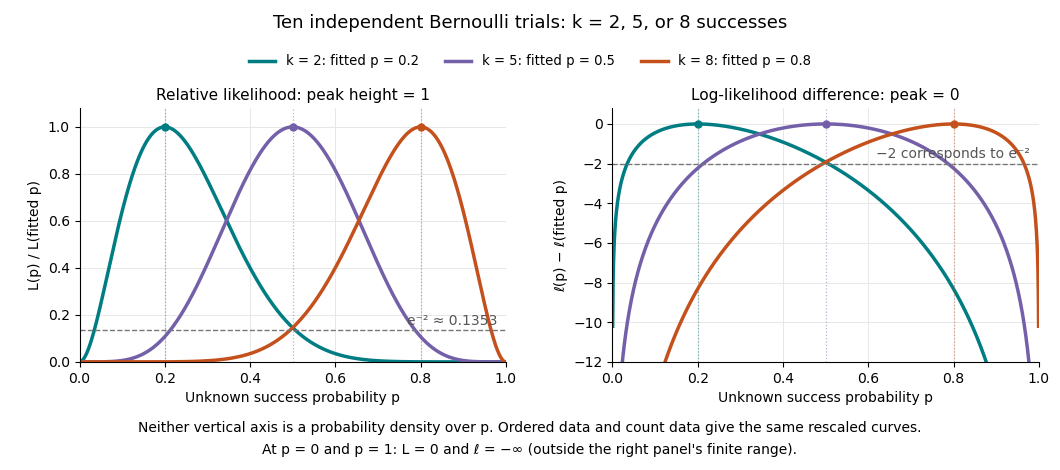
Ten Bernoulli trials: relative likelihood heights and log-likelihood differences share the same peaks
. Details. 
Multiplying a likelihood function by a positive parameter-independent constant adds a constant to its log-likelihood. Subtracting its peak removes that constant. This is why the ordered-data and count-data curves coincide in this figure after rescaling. When differentiable, the gradient of the log-likelihood is the score function; the negative Hessian matrix is the observed information. A solution of a score equation still needs checking against other stationary points and boundaries: maximizing the log-likelihood does not automatically make it concave.
Ancestors (9)
- Likelihood function
- Maximum-likelihood estimator
- Maximum likelihood estimation
- Statistical modelling
- Statistical model
- Probability and statistics
- Area of mathematics
- Mathematics
- Home
Incoming links (250)
- Bayesian deviance
- Bernoulli saturated log-likelihood
- Binomial likelihood-power annealing
- Bradley-Terry likelihood Hessian
- Bradley-Terry maximum-likelihood estimate on a comparison tree
- Bradley-Terry score equation
- Concavity of the Poisson regression likelihood
- Conditional cure-weight equations for paired Poisson counts
- Conditional multinomial sufficient statistics
- Constrained Kaplan–Meier estimator
- Cox–Snell likelihood pseudo-R-squared
- Edge log-ratios in a Bradley-Terry comparison tree
- EM algorithm for zero-inflated Poisson regression
- EM expectation step
- EM for a missing observation in a Gaussian AR1 process
- EM for merged multinomial cells
- EM for zero-inflated negative binomial regression
- EM likelihood monotonicity
- EM maximization step
- Expectation-maximization algorithm
- Exponential rate with a small known additive hazard
- Identical-mean EM trap
- Known-variance Gaussian mixture EM example
- Likelihood-power annealing
- Likelihood-ratio confidence interval
- Likelihood support reduction under censoring
- Log-likelihood
- Maximum likelihood estimation
- Maximum-likelihood estimator
- Monotonicity bound for a mixed-censoring likelihood
- Normal mean and variance maximum-likelihood estimators
- Observed Fisher information
- Ordered-rate exponential M-step
- Past exam of the chemistry course of the year 4 of the natural sciences course of the University of Cambridge / 2022 / Paper 1 / 15 / c / Solution
- Past exam of the mathematical and Computational Biology course of the University of Cambridge / 2024 / Paper 1 / A1 / c / Solution
- Past exam of the mathematical and Computational Biology course of the University of Cambridge / 2024 / Paper 1 / A1 / d / Solution
- Past exam of the mathematical and Computational Biology course of the University of Cambridge / 2024 / Paper 1 / A1 / h / Solution
- Past exam of the mathematical and Computational Biology course of the University of Cambridge / 2024 / Paper 2 / B4 / a / Solution
- Past exam of the mathematical and Computational Biology course of the University of Cambridge / 2025 / Paper 1 / 2 / b / Solution
- Past exam of the mathematical and Computational Biology course of the University of Cambridge / 2025 / Paper 1 / 2 / c / Solution
- Past exam of the mathematical and Computational Biology course of the University of Cambridge / 2025 / Paper 2 / 4 / b / Solution
- Past exam of the mathematics course of the University of Cambridge / 2001 / ib / Paper 1 / 3D / Solution
- Past exam of the mathematics course of the University of Cambridge / 2001 / ib / Paper 4 / 12D / Solution
- Past exam of the mathematics course of the University of Cambridge / 2001 / iii / Paper 28 / 5 / ii / Solution
- Past exam of the mathematics course of the University of Cambridge / 2001 / iii / Paper 29 / 6 / v / Solution
- Past exam of the mathematics course of the University of Cambridge / 2001 / iii / Paper 30 / 1 / i / Solution
- Past exam of the mathematics course of the University of Cambridge / 2001 / iii / Paper 32 / 6 / iii / Solution
- Past exam of the mathematics course of the University of Cambridge / 2001 / iii / Paper 32 / 6 / ii / Solution
- Past exam of the mathematics course of the University of Cambridge / 2002 / iii / Paper 36 / 2 / ii / Solution
- Past exam of the mathematics course of the University of Cambridge / 2002 / iii / Paper 36 / 2 / i / Solution
- Past exam of the mathematics course of the University of Cambridge / 2002 / iii / Paper 36 / 3 / i / Solution
- Past exam of the mathematics course of the University of Cambridge / 2002 / iii / Paper 36 / 5 / ii / Solution
- Past exam of the mathematics course of the University of Cambridge / 2002 / iii / Paper 36 / 5 / i / Solution
- Past exam of the mathematics course of the University of Cambridge / 2002 / iii / Paper 38 / 1 / Solution
- Past exam of the mathematics course of the University of Cambridge / 2002 / iii / Paper 38 / 2 / Solution
- Past exam of the mathematics course of the University of Cambridge / 2002 / iii / Paper 39 / 1 / i / Solution
- Past exam of the mathematics course of the University of Cambridge / 2002 / iii / Paper 40 / 4 / a / i / Solution
- Past exam of the mathematics course of the University of Cambridge / 2002 / iii / Paper 40 / 4 / b / iii / Solution
- Past exam of the mathematics course of the University of Cambridge / 2002 / iii / Paper 40 / 4 / b / i / Solution
- Past exam of the mathematics course of the University of Cambridge / 2003 / iii / Paper 38 / 3 / a / Solution
- Past exam of the mathematics course of the University of Cambridge / 2003 / iii / Paper 38 / 3 / b / Solution
- Past exam of the mathematics course of the University of Cambridge / 2003 / iii / Paper 38 / 4 / ii / Solution
- Past exam of the mathematics course of the University of Cambridge / 2003 / iii / Paper 38 / 4 / Solution
- Past exam of the mathematics course of the University of Cambridge / 2003 / iii / Paper 40 / 1 / b / iv / Solution
- Past exam of the mathematics course of the University of Cambridge / 2003 / iii / Paper 40 / 1 / b / v / Solution
- Past exam of the mathematics course of the University of Cambridge / 2003 / iii / Paper 41 / 1 / i / Solution
- Past exam of the mathematics course of the University of Cambridge / 2003 / iii / Paper 41 / 2 / Solution
- Past exam of the mathematics course of the University of Cambridge / 2003 / iii / Paper 41 / 3 / Solution
- Past exam of the mathematics course of the University of Cambridge / 2003 / iii / Paper 43 / 3 / c / Solution
- Past exam of the mathematics course of the University of Cambridge / 2003 / iii / Paper 43 / 4 / Solution
- Past exam of the mathematics course of the University of Cambridge / 2004 / iii / Paper 37 / 1 / i / Solution
- Past exam of the mathematics course of the University of Cambridge / 2004 / iii / Paper 37 / 2 / ii / Solution
- Past exam of the mathematics course of the University of Cambridge / 2004 / iii / Paper 40 / 6 / iii / Solution
- Past exam of the mathematics course of the University of Cambridge / 2004 / iii / Paper 40 / 6 / ii / Solution
- Past exam of the mathematics course of the University of Cambridge / 2004 / iii / Paper 40 / 6 / iv / Solution
- Past exam of the mathematics course of the University of Cambridge / 2004 / iii / Paper 42 / 5 / Solution
- Past exam of the mathematics course of the University of Cambridge / 2004 / iii / Paper 42 / 6 / Solution
- Past exam of the mathematics course of the University of Cambridge / 2004 / iii / Paper 43 / 2 / ii / Solution
- Past exam of the mathematics course of the University of Cambridge / 2004 / iii / Paper 43 / 2 / i / Solution
- Past exam of the mathematics course of the University of Cambridge / 2005 / iii / Paper 41 / 2 / Solution
- Past exam of the mathematics course of the University of Cambridge / 2005 / iii / Paper 41 / 4 / Solution
- Past exam of the mathematics course of the University of Cambridge / 2005 / iii / Paper 42 / 1 / Solution
- Past exam of the mathematics course of the University of Cambridge / 2005 / iii / Paper 42 / 3 / Solution
- Past exam of the mathematics course of the University of Cambridge / 2005 / iii / Paper 42 / 6 / iv / Solution
- Past exam of the mathematics course of the University of Cambridge / 2005 / iii / Paper 44 / 1 / c / Solution
- Past exam of the mathematics course of the University of Cambridge / 2005 / iii / Paper 44 / 1 / d / Solution
- Past exam of the mathematics course of the University of Cambridge / 2005 / iii / Paper 44 / 3 / Solution
- Past exam of the mathematics course of the University of Cambridge / 2005 / iii / Paper 44 / 5 / b / Solution
- Past exam of the mathematics course of the University of Cambridge / 2005 / iii / Paper 47 / 6 / Solution
- Past exam of the mathematics course of the University of Cambridge / 2005 / iii / Paper 48 / 5 / c / Solution
- Past exam of the mathematics course of the University of Cambridge / 2005 / ii / Paper 1 / 5I / Solution
- Past exam of the mathematics course of the University of Cambridge / 2005 / ii / Paper 4 / 13I / ii / Solution
- Past exam of the mathematics course of the University of Cambridge / 2006 / iii / Paper 41 / 3 / Solution
- Past exam of the mathematics course of the University of Cambridge / 2006 / iii / Paper 41 / 4 / Solution
- Past exam of the mathematics course of the University of Cambridge / 2006 / iii / Paper 41 / 5 / b / Solution
- Past exam of the mathematics course of the University of Cambridge / 2006 / iii / Paper 41 / 5 / c / Solution
- Past exam of the mathematics course of the University of Cambridge / 2006 / iii / Paper 41 / 5 / Solution
- Past exam of the mathematics course of the University of Cambridge / 2006 / iii / Paper 44 / 2 / a / Solution
- Past exam of the mathematics course of the University of Cambridge / 2007 / ib / Paper 4 / 19C / ii / Solution
- Past exam of the mathematics course of the University of Cambridge / 2007 / ib / Paper 4 / 19C / i / Solution
- Past exam of the mathematics course of the University of Cambridge / 2007 / iii / Paper 43 / 2 / Solution
- Past exam of the mathematics course of the University of Cambridge / 2007 / iii / Paper 44 / 3 / Solution
- Past exam of the mathematics course of the University of Cambridge / 2007 / iii / Paper 44 / 4 / Solution
- Past exam of the mathematics course of the University of Cambridge / 2007 / iii / Paper 46 / 4 / Solution
- Past exam of the mathematics course of the University of Cambridge / 2007 / iii / Paper 73 / 1 / c / Solution
- Past exam of the mathematics course of the University of Cambridge / 2007 / ii / Paper 1 / 27I / Solution
- Past exam of the mathematics course of the University of Cambridge / 2007 / ii / Paper 3 / 5I / Solution
- Past exam of the mathematics course of the University of Cambridge / 2007 / ii / Paper 4 / 5I / Solution
- Past exam of the mathematics course of the University of Cambridge / 2008 / ib / Paper 4 / 19H / i / Solution
- Past exam of the mathematics course of the University of Cambridge / 2008 / iii / Paper 41 / 3 / Solution
- Past exam of the mathematics course of the University of Cambridge / 2008 / iii / Paper 46 / 3 / b / i / Solution
- Past exam of the mathematics course of the University of Cambridge / 2008 / iii / Paper 46 / 3 / b / Solution
- Past exam of the mathematics course of the University of Cambridge / 2008 / iii / Paper 47 / 5 / a / ii / Solution
- Past exam of the mathematics course of the University of Cambridge / 2008 / iii / Paper 47 / 6 / a / Solution
- Past exam of the mathematics course of the University of Cambridge / 2008 / iii / Paper 47 / 6 / b / iii / Solution
- Past exam of the mathematics course of the University of Cambridge / 2008 / iii / Paper 47 / 6 / b / ii / Solution
- Past exam of the mathematics course of the University of Cambridge / 2008 / iii / Paper 47 / 6 / b / i / Solution
- Past exam of the mathematics course of the University of Cambridge / 2008 / ii / Paper 1 / 5J / Solution
- Past exam of the mathematics course of the University of Cambridge / 2009 / ib / Paper 1 / 7H / Solution
- Past exam of the mathematics course of the University of Cambridge / 2009 / iii / Paper 34 / 1 / b / Solution
- Past exam of the mathematics course of the University of Cambridge / 2009 / iii / Paper 40 / 6 / a / Solution
- Past exam of the mathematics course of the University of Cambridge / 2009 / iii / Paper 40 / 6 / c / Solution
- Past exam of the mathematics course of the University of Cambridge / 2009 / iii / Paper 40 / 6 / d / Solution
- Past exam of the mathematics course of the University of Cambridge / 2009 / ii / Paper 1 / 13I / Solution
- Past exam of the mathematics course of the University of Cambridge / 2009 / ii / Paper 1 / 5I / Solution
- Past exam of the mathematics course of the University of Cambridge / 2010 / iii / Paper 32 / 1 / Solution
- Past exam of the mathematics course of the University of Cambridge / 2010 / iii / Paper 32 / 2 / 2 / Solution
- Past exam of the mathematics course of the University of Cambridge / 2010 / iii / Paper 32 / 2 / Solution
- Past exam of the mathematics course of the University of Cambridge / 2010 / iii / Paper 33 / 2 / Solution
- Past exam of the mathematics course of the University of Cambridge / 2010 / iii / Paper 34 / 3 / b / Solution
- Past exam of the mathematics course of the University of Cambridge / 2010 / iii / Paper 34 / 5 / Solution
- Past exam of the mathematics course of the University of Cambridge / 2010 / iii / Paper 36 / 2 / a / Solution
- Past exam of the mathematics course of the University of Cambridge / 2010 / iii / Paper 36 / 3 / b / Solution
- Past exam of the mathematics course of the University of Cambridge / 2010 / iii / Paper 37 / 1 / Solution
- Past exam of the mathematics course of the University of Cambridge / 2010 / iii / Paper 37 / 3 / b / Solution
- Past exam of the mathematics course of the University of Cambridge / 2010 / iii / Paper 37 / 5 / c / Solution
- Past exam of the mathematics course of the University of Cambridge / 2010 / ii / Paper 1 / 13J / Solution
- Past exam of the mathematics course of the University of Cambridge / 2010 / ii / Paper 1 / 5J / Solution
- Past exam of the mathematics course of the University of Cambridge / 2010 / ii / Paper 2 / 5J / Solution
- Past exam of the mathematics course of the University of Cambridge / 2012 / iii / Paper 36 / 4 / a / Solution
- Past exam of the mathematics course of the University of Cambridge / 2012 / iii / Paper 36 / 4 / c / Solution
- Past exam of the mathematics course of the University of Cambridge / 2012 / iii / Paper 37 / 1 / a / Solution
- Past exam of the mathematics course of the University of Cambridge / 2012 / iii / Paper 37 / 4 / a / Solution
- Past exam of the mathematics course of the University of Cambridge / 2012 / iii / Paper 37 / 4 / b / Solution
- Past exam of the mathematics course of the University of Cambridge / 2012 / iii / Paper 37 / 6 / e / Solution
- Past exam of the mathematics course of the University of Cambridge / 2013 / iii / Paper 30 / 2 / a / Solution
- Past exam of the mathematics course of the University of Cambridge / 2013 / iii / Paper 30 / 4 / c / Solution
- Past exam of the mathematics course of the University of Cambridge / 2013 / iii / Paper 32 / 1 / b / Solution
- Past exam of the mathematics course of the University of Cambridge / 2013 / iii / Paper 32 / 7 / i / Solution
- Past exam of the mathematics course of the University of Cambridge / 2013 / iii / Paper 34 / 1 / f / Solution
- Past exam of the mathematics course of the University of Cambridge / 2013 / iii / Paper 64 / 2 / Solution
- Past exam of the mathematics course of the University of Cambridge / 2014 / iii / Paper 30 / 1 / Solution
- Past exam of the mathematics course of the University of Cambridge / 2014 / iii / Paper 33 / 1 / Solution
- Past exam of the mathematics course of the University of Cambridge / 2014 / iii / Paper 33 / 6 / a / Solution
- Past exam of the mathematics course of the University of Cambridge / 2014 / iii / Paper 39 / 5 / Solution
- Past exam of the mathematics course of the University of Cambridge / 2015 / iii / Paper 33 / 6 / a / Solution
- Past exam of the mathematics course of the University of Cambridge / 2015 / iii / Paper 33 / 6 / b / Solution
- Past exam of the mathematics course of the University of Cambridge / 2015 / iii / Paper 33 / 6 / c / Solution
- Past exam of the mathematics course of the University of Cambridge / 2015 / iii / Paper 35 / 3 / e / Solution
- Past exam of the mathematics course of the University of Cambridge / 2015 / ii / Paper 2 / 25J / Solution
- Past exam of the mathematics course of the University of Cambridge / 2015 / ii / Paper 2 / 4J / Solution
- Past exam of the mathematics course of the University of Cambridge / 2015 / ii / Paper 3 / 24J / Solution
- Past exam of the mathematics course of the University of Cambridge / 2016 / ib / Paper 3 / 20H / a / Solution
- Past exam of the mathematics course of the University of Cambridge / 2016 / iii / Paper 205 / 4 / Solution
- Past exam of the mathematics course of the University of Cambridge / 2016 / iii / Paper 206 / 2 / a / Solution
- Past exam of the mathematics course of the University of Cambridge / 2016 / iii / Paper 206 / 4 / b / Solution
- Past exam of the mathematics course of the University of Cambridge / 2017 / iii / Paper 206 / 1 / b / Solution
- Past exam of the mathematics course of the University of Cambridge / 2017 / iii / Paper 206 / 1 / e / Solution
- Past exam of the mathematics course of the University of Cambridge / 2017 / iii / Paper 206 / 1 / f / Solution
- Past exam of the mathematics course of the University of Cambridge / 2017 / iii / Paper 206 / 2 / a / Solution
- Past exam of the mathematics course of the University of Cambridge / 2017 / iii / Paper 206 / 4 / b / Solution
- Past exam of the mathematics course of the University of Cambridge / 2017 / iii / Paper 206 / 4 / c / Solution
- Past exam of the mathematics course of the University of Cambridge / 2017 / iii / Paper 206 / 6 / e / Solution
- Past exam of the mathematics course of the University of Cambridge / 2017 / iii / Paper 207 / 3 / b / ii / Solution
- Past exam of the mathematics course of the University of Cambridge / 2017 / iii / Paper 207 / 3 / b / i / Solution
- Past exam of the mathematics course of the University of Cambridge / 2017 / ii / Paper 3 / 5J / Solution
- Past exam of the mathematics course of the University of Cambridge / 2017 / ii / Paper 4 / 27K / a / Solution
- Past exam of the mathematics course of the University of Cambridge / 2018 / iii / Paper 216 / 4 / b / Solution
- Past exam of the mathematics course of the University of Cambridge / 2018 / iii / Paper 218 / 1 / d / Solution
- Past exam of the mathematics course of the University of Cambridge / 2018 / iii / Paper 218 / 3 / d / Solution
- Past exam of the mathematics course of the University of Cambridge / 2018 / iii / Paper 218 / 4 / a / Solution
- Past exam of the mathematics course of the University of Cambridge / 2018 / iii / Paper 218 / 4 / b / Solution
- Past exam of the mathematics course of the University of Cambridge / 2018 / iii / Paper 218 / 5 / d / Solution
- Past exam of the mathematics course of the University of Cambridge / 2018 / iii / Paper 219 / 1 / v / Solution
- Past exam of the mathematics course of the University of Cambridge / 2019 / ib / Paper 1 / 7H / a / Solution
- Past exam of the mathematics course of the University of Cambridge / 2019 / ib / Paper 4 / 19H / a / Solution
- Past exam of the mathematics course of the University of Cambridge / 2019 / ii / Paper 2 / 28J / a / Solution
- Past exam of the mathematics course of the University of Cambridge / 2019 / ii / Paper 3 / 28J / a / Solution
- Past exam of the mathematics course of the University of Cambridge / 2019 / ii / Paper 3 / 5J / a / Solution
- Past exam of the mathematics course of the University of Cambridge / 2020 / ii / Paper 2 / 28J / Solution
- Past exam of the mathematics course of the University of Cambridge / 2020 / ii / Paper 3 / 5J / a / Solution
- Past exam of the mathematics course of the University of Cambridge / 2021 / ib / Paper 4 / 17H / a / Solution
- Past exam of the mathematics course of the University of Cambridge / 2021 / ii / Paper 1 / 29J / a / Solution
- Past exam of the mathematics course of the University of Cambridge / 2021 / ii / Paper 3 / 28J / a / Solution
- Past exam of the mathematics course of the University of Cambridge / 2022 / iii / Paper 218 / 1 / b / Solution
- Past exam of the mathematics course of the University of Cambridge / 2022 / iii / Paper 218 / 3 / c / Solution
- Past exam of the mathematics course of the University of Cambridge / 2022 / iii / Paper 219 / 1 / c / Solution
- Past exam of the mathematics course of the University of Cambridge / 2022 / ii / Paper 1 / 29K / b / Solution
- Past exam of the mathematics course of the University of Cambridge / 2022 / ii / Paper 2 / 5J / c / Solution
- Past exam of the mathematics course of the University of Cambridge / 2022 / ii / Paper 3 / 5J / Solution
- Past exam of the mathematics course of the University of Cambridge / 2023 / ib / Paper 4 / 17H / b / Solution
- Past exam of the mathematics course of the University of Cambridge / 2023 / iii / Paper 216 / 1 / b / Solution
- Past exam of the mathematics course of the University of Cambridge / 2023 / iii / Paper 218 / 1 / a / Solution
- Past exam of the mathematics course of the University of Cambridge / 2024 / iii / Paper 218 / 1 / a / Solution
- Past exam of the mathematics course of the University of Cambridge / 2025 / iii / Paper 207 / 5 / a / Solution
- Past exam of the mathematics course of the University of Cambridge / 2026 / iii / Paper 207 / 6 / a / Solution
- Past exam of the mathematics course of the University of Cambridge / 2026 / iii / Paper 219 / 1 / b / Solution
- Past exam of the mathematics course of the University of Oxford / 2015 / Prelims / Mathematics III / 7 / b / i / Solution
- Past exam of the mathematics course of the University of Oxford / 2023 / Prelims / Mathematics III / 7 / a / iii / Solution
- Past exam of the mathematics course of the University of Oxford / 2023 / Prelims / Mathematics III / 8 / a / i / Solution
- Past exam of the multisensory perception: attention, integration, and development course of the University of Oxford / 2022 / 6 / Solution
- Past exam of the options I course of the University of Oxford / 2006 / O / O1 / i / Solution
- Past exam of the options I course of the University of Oxford / 2009 / O / O2 / i / Solution
- Past exam of the options I course of the University of Oxford / 2011 / O / 1 / b / Solution
- Past exam of the options I course of the University of Oxford / 2012 / O / O1 / a / Solution
- Past exam of the options I course of the University of Oxford / 2013 / O / 1 / a / Solution
- Past exam of the options II course of the University of Oxford / 2009 / O / O5 / Solution
- Past exam of the options II course of the University of Oxford / 2010 / O / O4 / b / i / Solution
- Past exam of the perception course of the year 2 of the psychology (experimental) course of the University of Oxford / 2022 / 2 / Solution
- Past exam of the probability, statistics and options I course of the University of Oxford / 2011 / O / 1 / b / Solution
- Past exam of the Probability, statistics and options II course of the University of Oxford / 2011 / O / O4 / a / Solution
- Past exam of the Probability, statistics and options II course of the University of Oxford / 2011 / O / O4 / b / Solution
- Past exam of the Probability, statistics and options II course of the University of Oxford / 2011 / O / O5 / a / Solution
- Past exam of the simulation and statistical programming course of the University of Oxford / 2021 / 3 / c / ii / Solution
- Past exam of the simulation and statistical programming course of the University of Oxford / 2021 / 3 / c / i / Solution
- Past exam of the statistics course of the University of Oxford / 2014 / 1 / a / iii / Solution
- Past exam of the statistics course of the University of Oxford / 2015 / 2 / a / Solution
- Past exam of the statistics course of the University of Oxford / 2015 / 2 / b / i / Solution
- Past exam of the statistics course of the University of Oxford / 2015 / 2 / c / Solution
- Past exam of the systems biology course of the University of Cambridge / 2024 / Paper 3 / 2 / b / ii / Solution
- Perplexity
- Poisson observation
- Poisson regression margin-matching score equations
- Poisson surrogate for a conditional multinomial model
- Positive and negative phases of Boltzmann learning
- Profile log-likelihood
- P-star density for two exponential rates
- Quasi-complete separation
- Residual deviance
- Saturated statistical model
- Score equation
- Score factorization implies parameter orthogonality
- Separation in logistic regression
- Shifted Poisson data fidelity
- Sigmoid-softmax network gradients
- Simulated annealing
- Temperature scaling
- Two-spin Boltzmann learning
- Uniform-alternative binomial Bayes factor
- Wilks theorem
Synonyms (1)
Discussion (0) New discussion
There are no discussions about this article yet.
Articles by others on the same topic (0)
There are currently no matching articles.