A nuclear pore complex is an assembly of proteins spanning the nuclear envelope and regulating passage between the cell nucleus and cytosol. It is a selective gateway, not simply an unregulated hole: messenger RNA export and import of nuclear proteins require appropriate transport machinery. See Alberts et al.: nuclear pore complexes.
The nuclear pore complex occupies a junction of both nuclear envelope membranes. Its protein scaffold surrounds an aqueous passage connecting cytosol to the cell nucleus, rather than the intermembrane space. Diffusion permits small soluble cargo to pass; selective receptors transport other cargo. Molecular mass alone is not a universal cutoff.[ref]
Molecular Biology of the Cell, 4th edition by Bruce Alberts and others. Nuclear Pore Complexes Perforate the Nuclear Envelope, Figures 12-10–12-11; Nuclear Localization Signals Direct Nuclear Proteins to the Nucleus
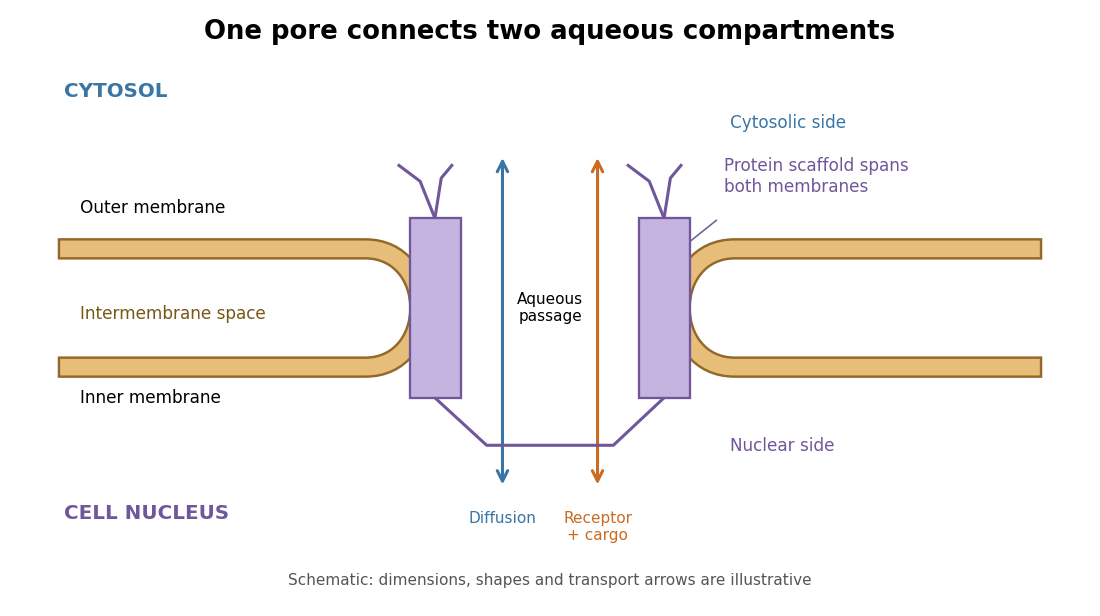
The nuclear pore complex bridges both membranes of the nuclear envelope
. Original topology schematic, not a measured structure. The central passage connects cytosol and cell nucleus; cargo does not enter the intermembrane space. Shapes, distances and arrows are illustrative. Details.
A nuclear localization sequence is an ordered stretch of amino acid residues that can direct protein import into a cell nucleus. In the classical pathway, importin α recognizes the nuclear localization sequence, and importin β mediates passage through the nuclear pore complex. Other recognition pathways exist. An exposed nuclear localization sequence is a targeting feature, not a guarantee of import under every condition.[ref]
RNA export is a different cargo pathway: RNA travels associated with proteins, as a ribonucleoprotein, rather than being imported by its own nuclear localization sequence. Export of messenger RNA connects nuclear transcription to cytoplasmic biological translation.[ref]
The Cell: A Molecular Approach, 2nd edition by Geoffrey M. Cooper. Transport of RNAs, opening paragraphs
In a 1982 experiment, purified nucleoplasmin was labeled with radioactive iodine and cleaved by proteolysis. Microinjection delivered cargo into Xenopus laevis oocyte cytoplasm. Manually separated cell nuclei and cytoplasm were compared by gel electrophoresis and autoradiography; section autoradiography checked internal localization. Tail-bearing cargo entered the cell nucleus; tailless cores did not. Direct nuclear microinjection retained the cores: the tails mattered for entry, but the assay did not identify a receptor.[ref]
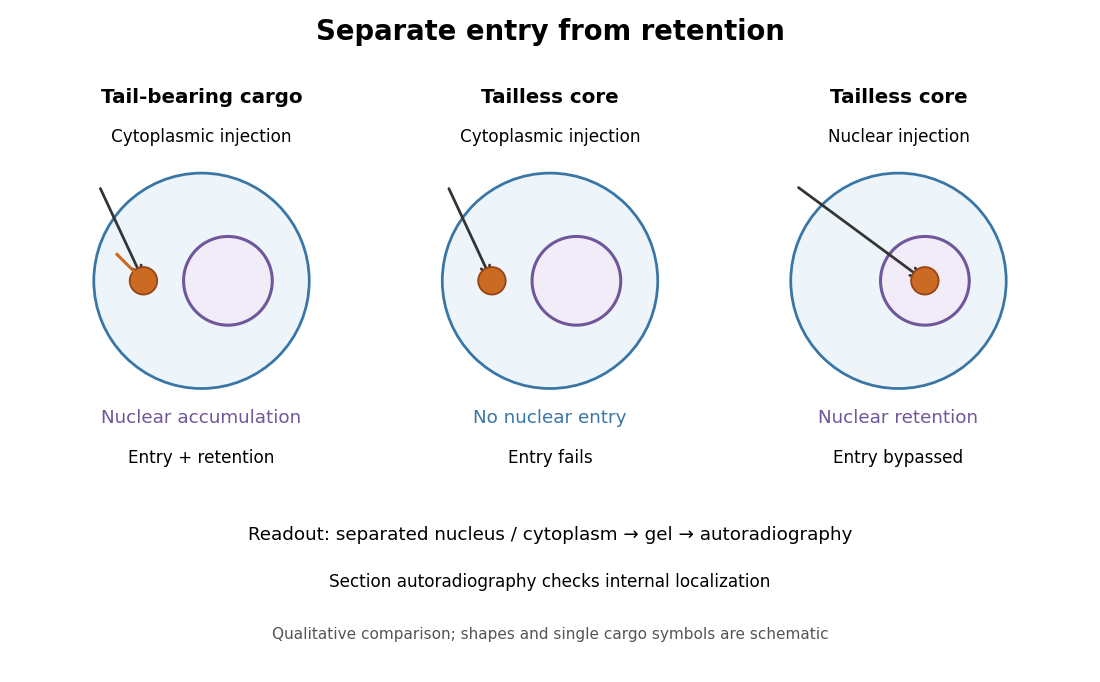
Changing cargo and injection site separates nuclear entry from retention
. Original qualitative summary of the nucleoplasmin comparisons above. Symbols represent localization, not measured counts or copied source images. Details.
Direct nuclear microinjection bypassed entry, distinguishing failure to enter from failure to remain inside a cell nucleus.
Nuclear accumulation should compare concentrations, not just total cargo. In an original constructed example, a cell nucleus occupies one volume unit and the accessible cytosol occupies nine. Of tracer units, are nuclear and are cytosolic. With the amounts and the accessible volume, the concentration ratio isOnly of the cargo is nuclear, yet nuclear concentration is four times cytosolic concentration. A majority outside the cell nucleus does not rule out nuclear enrichment.
For comparison, freely exchanging nonbinding cargo at equal concentrations would have : the nuclear fraction would equal the nuclear fraction of accessible volume, . These are constructed amounts, not measurements from the nuclear pore localization experiment. Binding, unequal recovery or cargo degradation would require additional accounting before interpreting an assay.
A minimal two-compartment ordinary differential equation makes the distinction precise. Assume fixed accessible volume, no synthesis or degradation, and effective first-order exchange rates :Total cargo is conserved. Setting the derivative to zero givesFor symmetric passive exchange with conductance , and , so the concentration ratio is one even when the amounts differ. Choosing instead and in reciprocal model-time units gives for . The exact ordinary differential equation solution isSubstitution verifies the solution, and makes departures decay. This effective model can describe an asymmetric exchange balance, but does not by itself identify a nuclear localization sequence, transport receptor or source of energy.
The usefulness of the nuclear pore complex is precisely this combination of separation and exchange: a cell nucleus can maintain a distinctive protein population while receiving new cargo and exporting RNA. The nuclear pore localization experiment asks what feature controls entry; the nuclear pore transport balance asks what an accumulation readout actually means.
Articles by others on the same topic
There are currently no matching articles.