
Adam Riess Created 2026-10-18 Updated 2026-11-05
Adam Riess led the 1998 analysis of Type Ia supernovae that provided evidence for accelerating cosmic expansion. His team compared distant and nearby supernovae, using their light curves to estimate distances and their cosmological redshifts to test the expansion history.
The distant events were farther away than expected in the cited low-mass density model without a cosmological constant. Different fitting methods and sample selections favored a positive cosmological constant and present acceleration. The evidence came from a distance–redshift relation interpreted within cosmological models.[ref]
Observational Evidence from Supernovae for an Accelerating Universe and a Cosmological Constant by Adam Riess and others. Abstract: nearby and high-redshift samples, distance excess and agreement of independent fits

Portrait of Adam Riess
. Original photographer not named; Commons crop/rights release credited to Falcorian (assumed by File metadata). Public-domain dedication by copyright holder (PD-self), with fallback unrestricted permission where dedication is not legally possible, via Wikimedia Commons. Source. Alex Filippenko Created 2026-10-24 Updated 2026-11-05
Alex Filippenko studies exploding stars and the use of supernovae as cosmological probes. He coauthored both major late-1990s analyses that compared distant Type Ia supernovae with nearby reference samples.
The technique connects a standardized supernova luminosity to its measured brightness, then compares the inferred luminosity distance with cosmological redshift. The distant events favored models with an accelerating cosmic expansion. Their interpretation required checking extinction and other systematic changes that could also make distant sources appear faint.[ref]
Observational Evidence from Supernovae for an Accelerating Universe and a Cosmological Constant by Adam Riess and others. Author list and abstract: supernova distances, cosmological fits and systematic tests
[ref]Measurements of Omega and Lambda from 42 High-Redshift Supernovae by Saul Perlmutter and others. Author list and abstract: independent standardized supernova sample

Portrait of Alex Filippenko
. Jeffrey Silverman. CC BY-SA 3.0, via Wikimedia Commons. Source. Brian Schmidt Created 2026-10-18 Updated 2026-11-05
Brian Schmidt coauthored the High-Z Supernova Search Team's 1998 evidence for accelerating cosmic expansion. The analysis joined nearby Type Ia supernovae to a more distant sample to test the relation between luminosity distance and cosmological redshift.
Comparing multiple light curve fitting procedures helped test whether the inferred faintness depended on one calibration method. The combined observations favored an accelerating cosmological model with a positive cosmological constant.[ref]
Observational Evidence from Supernovae for an Accelerating Universe and a Cosmological Constant by Adam Riess and others. Author list and abstract: combined samples, alternative light-curve fits and cosmological constraints

Portrait of Brian Schmidt
. Tim Wetherell. CC BY-SA 3.0, via Wikimedia Commons. Source. High-Z Supernova Search Team Created 2026-10-18 Updated 2026-11-05
The High-Z Supernova Search Team used distant Type Ia supernovae to compare the observed relation between luminosity distance and redshift with models of cosmic expansion. Its analysis combined distant events with nearby calibrators and tested how light-curve fitting and sample choices affected the inferred acceleration.[ref]
Observational Evidence from Supernovae for an Accelerating Universe and a Cosmological Constant by Adam Riess and others. Abstract: nearby/high-redshift samples, fitting methods and systematic tests
The physical inference is that sources at a specified redshift were farther away than predicted by relevant nonaccelerating comparison models. Calibration, extinction and population evolution are therefore central to interpreting the brightness difference, rather than secondary corrections to an otherwise direct acceleration measurement.
Type Ia supernovae are standardizable candles. Multi-epoch photometry measures peak brightness, light-curve shape and color; spectroscopy identifies the supernova type and supplies a redshift, preferably also using the host. Correcting the empirical width–luminosity relation and attenuation reduces the spread of absolute magnitudes. A nearby sample fixes a distance-ladder intercept, while distant events test the shape of the Hubble diagram. The observable relation isAn unknown common remains degenerate with the Hubble-constant intercept unless externally calibrated; relative distance-versus-redshift shape can still constrain acceleration.
For a cosmological spacetime described by an FLRW metric, the deceleration parameter is , and the low-redshift luminosity-distance expansion isA range of redshifts therefore tests the expansion history beyond the leading linear Hubble law. Within conventional matter-plus-cosmological-constant models, standardized distant supernovae fainter than a specified decelerating prediction imply larger luminosity distances and can favor . For late-time matter and a cosmological constant, . A flat example has . One brightness residual alone does not establish acceleration across arbitrary expansion histories or arbitrary attenuation models.
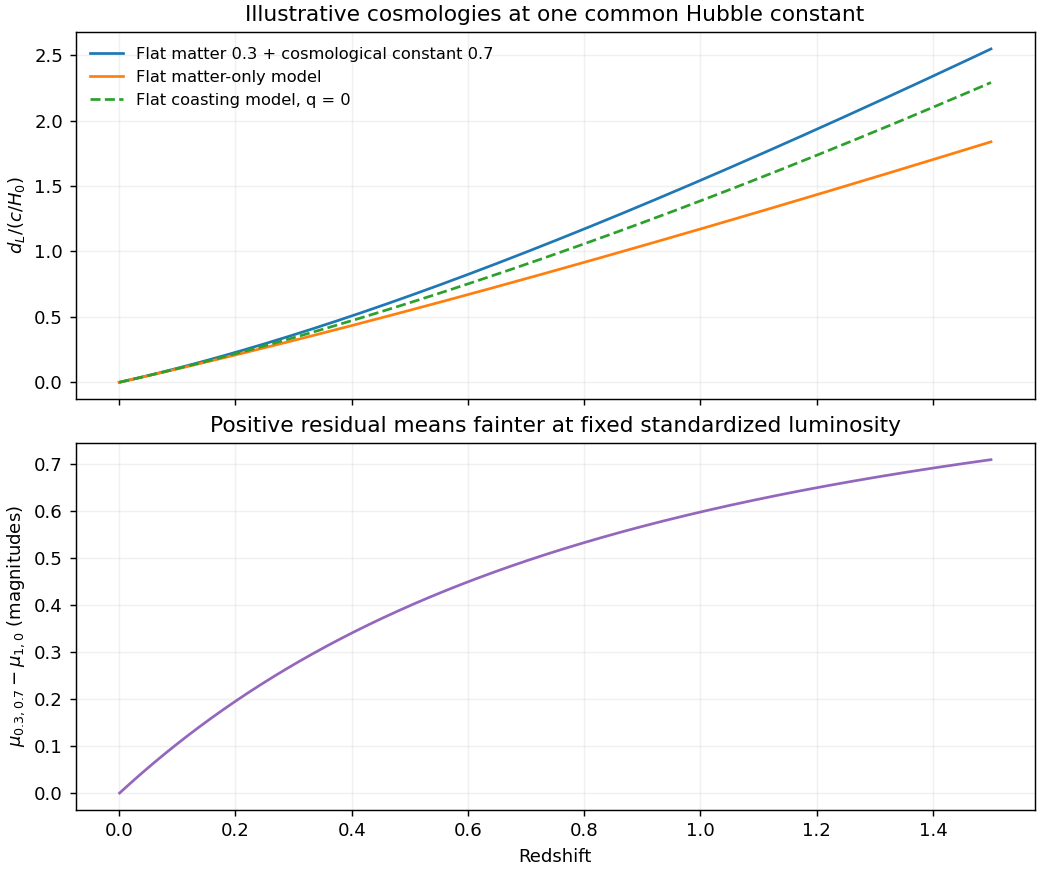
Illustrative luminosity-distance curves: expansion histories change standardized supernova magnitudes
. Details. The supernova discovery of accelerating expansion combined repeated imaging, difference-image candidate searches, spectroscopic classification and calibrated light curves. In the High-Z survey, CCD discovery images and later host images separated transient light from its host; point-spread-function fitting and artificial-star recovery tests checked the photometry. The measurements require K corrections between received and emitted passbands and account for the observed stretching of light-curve times.[ref]
Observational Evidence from Supernovae for an Accelerating Universe and a Cosmological Constant by Adam Riess and others. Sections 2.1–2.2, discovery imaging, spectroscopy and photometric controls
Relevant systematic tests include dust and color laws, possible population evolution, flux-limited selection, calibration across filters and telescopes, gravitational lensing and host contamination. An accelerating interpretation is assessed by fitting a specified cosmological family and its nuisance parameters, checking those effects and comparing independent observations. The two principal discovery teams provided independent distant-supernova analyses, including the 42-event Supernova Cosmology Project result.[ref]
Type Ia supernovae are standardizable candles. Repeated multiband photometry measures peak apparent magnitude, light-curve width and colour; spectra identify the supernova class and determine redshift, often from the host galaxy. Nearby objects calibrate the relation between light-curve shape, colour and absolute luminosity. Applying those relations produces a corrected apparent magnitude , not an assumption that every event has identical luminosity. The distance modulus then givesA common uncertainty in is degenerate with the absolute distance scale, but does not erase the redshift-dependent shape of the Hubble diagram.
luminosity distance probes the expansion history. In a spatially flat model,For fixed low-redshift calibration, a negative increases the second-order distance relative to a decelerating model. Objects at a given redshift are therefore fainter. A Hubble diagram spanning enough redshift can distinguish this curvature from the common magnitude intercept. In matter-plus-cosmological-constant models, ; fitting the distances can test whether . The two original supernova teams found distances supporting an accelerating expansion in that framework.[ref]
Observational Evidence from Supernovae for an Accelerating Universe and a Cosmological Constant by Adam Riess and others. abstract and cosmological interpretation of standardized supernova luminosity distances
[ref]Measurements of Omega and Lambda from 42 High-Redshift Supernovae by Saul Perlmutter and others. abstract; cosmological likelihood constraints and tests of systematic uncertainty
The comparison requires matched rest-frame passbands and K corrections, correction for redshift time dilation in the light curves, a common photometric calibration, and explicit uncertainty propagation. Dust extinction can imitate dimming; multicolour and infrared observations test reddening and the adopted extinction law. Evolution in the progenitor population or host-galaxy dependence can alter standardization, so one compares matched populations and fits host-dependent terms where warranted. Flux-limited discovery introduces Malmquist bias and other selection effects, which must be modelled through the survey detection efficiency. peculiar velocities matter at low redshift, while gravitational lensing and intrinsic scatter broaden the distant sample. Classification and outlier tests reduce contamination by other transient types.
Independent data reductions, nearby anchors, spectroscopic checks and a fit over the full redshift range distinguish an expansion-history signal from one instrumental offset. Complementary cosmological observations help separate matter density, curvature and dark-energy parameters. The acceleration inference comes from the relative distance-redshift relation, conditional on standardization and an expansion model. Distant supernovae integrate the past expansion history; they do not directly measure the instantaneous second time derivative of today's scale factor without such modelling.
At maximum expansion, . With , the present Friedmann equation gives , so positive curvature requires . Taking for the presently expanding branch givesThe lifetime of a closed dust universe follows by setting . The deceleration parameter follows from the Friedmann acceleration equation, . Thus this model always decelerates while expanding. Its total lifetime includes the elapsed age; it is not the remaining lifetime.
The supernova discovery of accelerating expansion does not support this dust-only recollapse model as a description of the observed expansion history. Already the 1998 and 1999 Type Ia supernova analyses favoured accelerating expansion, requiring ingredients beyond this zero-cosmological constant, positive-curvature dust model within the usual FLRW metric interpretation.[ref]
Observational Evidence from Supernovae for an Accelerating Universe and a Cosmological Constant by Adam Riess and others. Abstract: evidence for present acceleration
[ref] Past exam of the particle Astrophysics course of the University of Cambridge 2014 Paper 1 2 Solution 2026-10-20
For successive radial null rays from a comoving source, equals the same spatial integral. Subtracting two nearby wavecrests gives , hence the cosmological redshiftFor transparent propagation, photon energies are reduced by and arrival intervals increased by . The observer-area sphere is , so the observed bolometric flux isThus the requested uses , the present transverse proper/area distance. In a curved metric this is not the radial proper distance ; the two coincide for . The source's unqualified “proper distance” needs this distinction.
Type Ia supernovae are standardizable candles: light-curve shape and colour calibrate their luminosity. Distant events are fainter, hence have larger inferred luminosity distances, than appropriate matter-only decelerating models predict. Their redshift–distance relation favours recent accelerated expansion. In general relativity, sufficiently negative pressure, , drives acceleration. Dust, evolution, calibration and selection are checked as possible systematics; a single faint supernova is not the argument.[ref]
An independent complementary test combines the cosmic microwave background acoustic distance/near-flat geometry with matter-density and baryon acoustic oscillation constraints. Matter alone does not supply the required late-time expansion history; a dark-energy component fits the joint data. CMB geometry alone has curvature/expansion degeneracies and is not an assumption-free detection of a cosmological constant.[ref]
Planck 2013 results. XVI. Cosmological parameters by Planck Collaboration. CMB,BAO and expansion-model constraints
In natural units , a regulated zero-point energy estimate isThe integral is ultraviolet divergent and requires renormalization; it is not a finite prediction from counting “virtual pairs.” An electroweak scale estimate gives , or somewhat smaller with loop factors. Compared with this is roughly too large.
The source's units are inconsistent: is a vacuum energy density, whereas has units . The comparison above consistently uses densities. Bare and quantum contributions must cancel to extraordinary accuracy if this naive scale estimate is representative: the cosmological constant problem. Its severity is not a measured value of an individual cutoff integral.
A positive cosmological constant contributes a constant vacuum energy density and negative pressure. In the time-unit convention of Question 2,It therefore causes accelerating expansion once its negative-pressure effect outweighs the decelerating components. Its density stays constant while matter dilutes, so a small early contribution can dominate late. For an isolated positive-vacuum component the scale factor grows exponentially. The cosmological constant problem is the mismatch between the small inferred vacuum density and generic quantum-field vacuum-energy expectations, rather than a failure of the background solution itself.
The key direct expansion evidence came from Type Ia supernova distance-redshift measurements. After light-curve and colour standardization, distant events were fainter than expected in simple decelerating matter-only models, indicating larger luminosity distances. Riess and collaborators' 1998 analysis and Perlmutter and collaborators' independent 42-supernova study favoured an accelerating low-matter-density cosmology with a positive vacuum contribution. Dust, source evolution, selection effects, photometric calibration and peculiar velocities must be controlled: faintness alone is not a model-independent measurement of .[ref]
Observational Evidence from Supernovae for an Accelerating Universe and a Cosmological Constant by Adam Riess and others. abstract; distance fitting and systematic-error discussion
[ref]Measurements of Omega and Lambda from 42 High-Redshift Supernovae by Saul Perlmutter and others. abstract; cosmological likelihoods and systematic checks
cosmic microwave background acoustic geometry and independent matter-density constraints help break the supernova parameter degeneracy: nearly flat geometry with substantially less than critical matter requires another component within the FLRW model. large-scale structure of the universe and distance measurements provide further consistency tests. The combined evidence supports a dark-energy contribution compatible with a constant; accelerating expansion by itself does not prove exactly constant vacuum energy or rule out every alternative gravity model.
The Friedmann-Lemaître-Robertson-Walker metric describes homogeneous, isotropic spatial slices. Here is cosmic time, equal to the proper time of a comoving observer; is the length-valued scale factor; and are dimensionless comoving radial, polar and azimuthal coordinates. The speed of light is , andfor positive, zero and negative cosmological spatial curvature. The convention used makes a squared time interval, with signature ; multiplying the metric by gives the more usual squared-length convention. At fixed , radial proper length is , while a sphere has area .
luminosity distance is defined by for bolometric radiative flux and intrinsic luminosity . Radial null propagation gives . Applying the same path integral to two successive wave crests gives , hence . Each photon loses an energy factor , and their arrival rate loses another. For transparent propagation and isotropic emission,The two redshift factors have distinct physical origins; geometrical dilution alone is insufficient.
With , differentiating yields . Therefore the radial comoving coordinate isThis is independent of any particular matter model; the transverse comoving distance is , which equals only for flat space.
For pressureless matter, the continuity equation integrates to . The cosmological constant is kept separately from this matter density. In the flat Friedmann equation, defineThe flat dust-vacuum Hubble parameter is thereforeIn the equation's convention is mass-equivalent energy density and has units ; the geometrical cosmological constant convention instead writes . The model contains dust and vacuum energy with negligible radiation over the relevant late epochs: “matter-dominated” here does not require matter to exceed vacuum energy today.
The cosmic microwave background supplies a standard ruler through its acoustic scale: the angular positions of the Cosmic microwave background acoustic peaks constrain cosmological spatial curvature, while their relative heights constrain matter and baryon densities. Together with independent distance information, these favour a nearly flat Lambda-CDM model containing substantial cold dark matter and vacuum energy. The cosmic microwave background alone has a geometrical degeneracy between parameters affecting distance to last scattering; its analysis also includes early radiation, which the late-time formula above omits. The nine-year WMAP results were already available as a December 2012 preprint.[ref]
Nine-Year Wilkinson Microwave Anisotropy Probe (WMAP) Observations: Final Maps and Results by C. L. Bennett and others. Version 1 abstract: combined-data curvature constraint and consistency with the six-parameter Lambda-CDM model
A standardized Type Ia supernova at appreciable redshift is fainter, hence farther in luminosity distance, than in a matter-only Einstein-de Sitter universe with the same local expansion scale. Fitting the supernova Hubble diagram supports late acceleration; in flat dust plus vacuum, is negative for . Light-curve and colour corrections, extinction, calibration, selection bias and possible population evolution must be controlled. The supernova evidence and cosmic microwave background constraints are complementary; together they favour this model without proving that every alternative dark-energy model is impossible.[ref]
Observational Evidence from Supernovae for an Accelerating Universe and a Cosmological Constant by Adam Riess and others. Abstract and cosmological fits of the supernova distance-redshift relation
[ref]For the final comparison, assume , a common and in model (a). ThenThus and the integrands obey . Because all three models are flat, compare the normalization-independent distance , rather than separately normalized coordinates. The luminosity-distance ordering of flat dust-vacuum universes is , henceModel (b) gives the largest received flux, model (c) the smallest. Equalities replace the strict ordering at the endpoint values of the vacuum fraction; all have the same leading local Hubble law as .
Definitions and pressure convention. is the scale factor, cosmic time and dots time derivatives. is the gravitational constant, the speed of light, the mass-equivalent density of the material fluid and the spatial-curvature sign in this normalization. here has units of inverse time squared, rather than inverse length squared. Comparison of the acceleration equation with fixesThis is a pressure parameter, unrelated to Question 1's radiative efficiency. pressureless matter has and . When solving the generalized model below, is assumed constant.
Evidence for a positive vacuum component. Standardized Type Ia supernovae measure the luminosity-distance–redshift relation. Their corrected apparent magnitudes at cosmological distances imply greater distances than a decelerating matter-dominated model of comparable parameters, favoring late accelerated expansion. Light-curve standardization, interstellar extinction, selection bias and possible population evolution must be controlled rather than treating every supernova as an identical candle.[ref]
Observational Evidence from Supernovae for an Accelerating Universe and a Cosmological Constant by Adam Riess and others. Abstract and distance–redshift analysis
[ref]Measurements of Omega and Lambda from 42 High-Redshift Supernovae by Saul Perlmutter and others. Abstract and cosmological likelihood analysis
The cosmic microwave background and baryon acoustic oscillation measurements constrain geometry and matter density in combination. Near spatial flatness together with a subcritical matter density leaves room for an additional smooth component; cosmic ages and structure growth supply consistency tests. A positive cosmological constant fits these observations within the standard framework. They do not establish that every allowed dark-energy theory must be a strictly constant vacuum energy; the inference depends on the cosmological and gravitational model.
pressureless matter evolution. Set and . Since , eliminating givesFor , and . ThereforeOn the expanding Big-Bang branch with positive , chooseThe origin is the Big Bang; an arbitrary time translation would shift this origin. Integrating gives . At early times , while at late times .
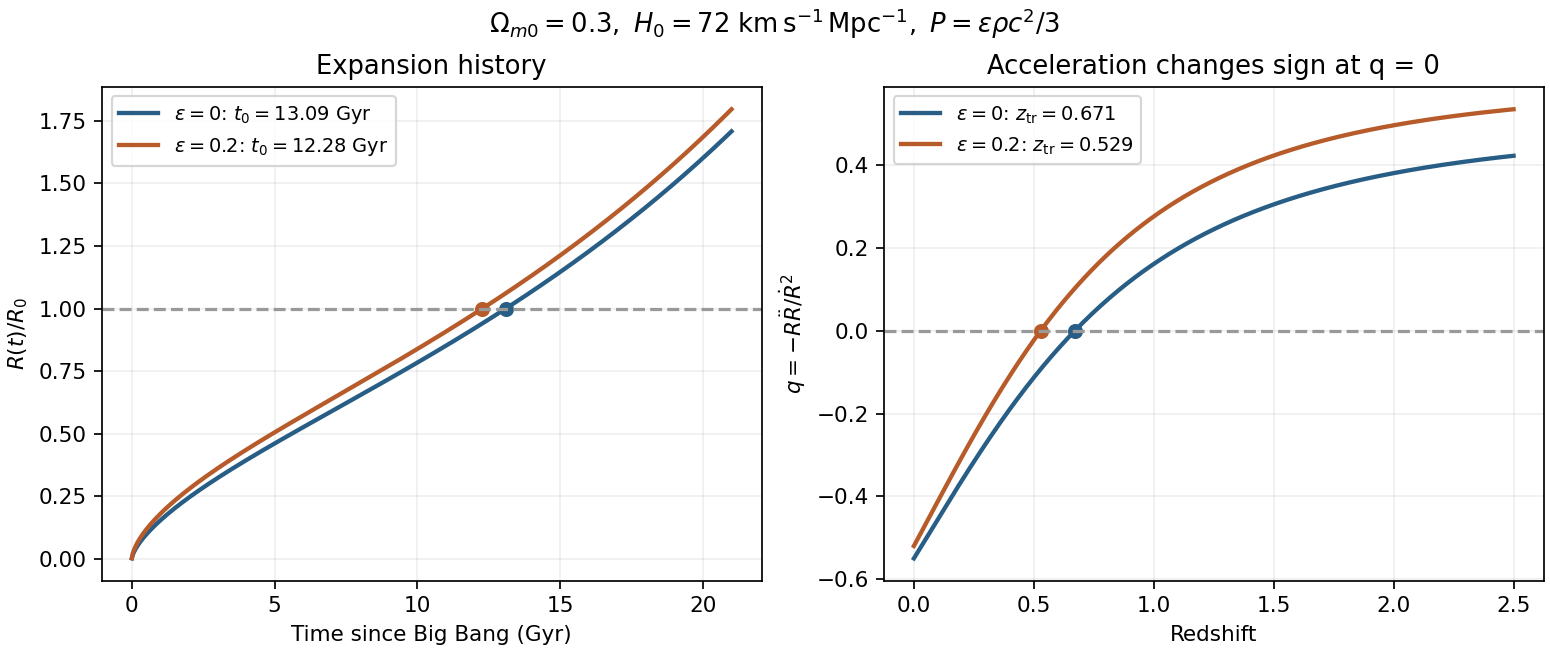
Age and the density fractions. Dividing the flat constraint by , with , givesThe solution implies , soHere , using the printed megaparsec conversion. Taking one year as days givesFor the same , an Einstein-de Sitter universe hasA cosmic model must be older than its oldest objects, with additional time allowed for their formation. Old stellar populations are dated through stellar-evolution fitting, particularly the globular cluster main-sequence turnoff, with uncertainties from distances, composition and input stellar physics. A pre-examination globular-cluster age constraint on cosmology obtained a lower cosmic-age limit of after allowing for formation time. This conflicts with the model but is compatible with the calculation.[ref]
New Globular Cluster Age Estimates and Constraints on the Cosmic Equation of State and The Matter Density of the Universe by Lawrence M. Krauss and Brian Chaboyer. Abstract and stellar-age/formation-time analysis
Individual stellar age estimates are not exact clocks, and the numerical is the result for the specified and matter fraction, not a claim to be a contemporary best-fit age.Constant nonzero pressure parameter. Eliminating before setting the pressure to zero instead givesHenceFor constant , the positive-density expanding Big-Bang branch isEquivalently use in the pressureless matter solution. The scale factor obeys , and the early limit is . The age of a flat barotropic matter-vacuum universe with the same present density fractions and isThusThe small positive pressure makes the early universe expand with a smaller age at the same late expansion parameters.
The acceleration transition. Normalize the present scale factor to one. Constant and the continuity equation give . Dividing the acceleration equation by givesAt the barotropic matter-vacuum acceleration transition its right-hand side vanishes. For the parameters here, , so the past transition isAt greater redshift the material term dominates and expansion decelerates; at smaller redshift vacuum energy dominates and expansion accelerates. The pressure factor belongs in the numerator of the gravitating material term; omitting it would confuse this model with pressureless matter.


Supernova calibration and population tests 2026-10-18
The High-Z Supernova Search Team analysis fitted multicolour light curves and interstellar extinction, and compared a second decline-rate method. Similar local and distant spectroscopy supported, but did not establish, population stability. Nearly colourless attenuation remained a qualified alternative.[ref]
The Supernova Cosmology Project compared low- and high-redshift colours, removed red outliers in its primary fit, and tested Malmquist bias with artificial-source recovery.[ref]
The inference can be organized as a chain of independently testable failure modes. A magnitude zero point offset between nearby and distant observations imitates a distance modulus offset; a common offset instead changes the intercept. An erroneous photometric passband response changes a K correction in a redshift-dependent way because different emitted wavelengths cross the detector band. Residual host-galaxy light changes the recovered radiative flux. Color excess constrains wavelength-dependent interstellar extinction only after intrinsic colour is modeled; grey attenuation is not bounded by colour alone. Changes in stellar population or metallicity could shift standardized absolute magnitude without large changes in the chosen shape parameter. These are logical degeneracies, so increasing the sample size alone cannot remove them.
A useful control strategy therefore compares subsets with different host environments, fits consistent rest-frame photometric passbands, and checks artificial-source recovery through the same image processing and selection. A Malmquist bias tends to select brighter detectable sources, but the relative bias between the nearby and distant samples is what matters. Peculiar velocity mainly perturbs the nearby redshift anchor; weak gravitational lensing changes individual brightnesses and the selection distribution. Neither can be replaced by an arbitrary extra scatter term when its mean or selection dependence is uncertain.
The 1998 High-Z Supernova Search Team paper by Adam Riess, Brian Schmidt and collaborators presented supernova evidence for acceleration.[ref]
The 1999 Supernova Cosmology Project paper by Saul Perlmutter and collaborators independently analysed 42 distant events. Alexei V. Filippenko coauthored both papers.[ref]
The High-Z Supernova Search Team search used the CTIO Blanco 4-m telescope and a charge-coupled device, comparing fields across dark runs. Difference images located rising candidates; Keck, MMT and ESO spectroscopy classified them and measured host redshifts. Follow-up photometry used filters approximating emitted B and V bands. Calibrated field stars transferred the magnitude zero point; late host images removed galaxy light, point spread function fits measured brightness, and inserted artificial stars tested recovery.[ref]
The Supernova Cosmology Project likewise discovered rising events with CTIO 4-m charge-coupled device imaging, then followed their light curves with several telescopes. Keck LRIS and ESO spectroscopy supplied classification and redshift, preferably from narrow host lines. Cross-filter K corrections connected received R/I observations to emitted B/V light.[ref]
Measurements of Omega and Lambda from 42 High-Redshift Supernovae by Saul Perlmutter and others. Section 2, PDF pp.2–3: apparatus and corrections
Why does fainter mean accelerating? First it means a larger inferred luminosity distance only at fixed standardized luminosity and corrected attenuation. Next it favours acceleration only after a comparison family is specified: an FLRW metric, representative propagation of light, common nearby and distant standardization, and controlled measurement calibration and selection. For the usual general relativity models containing nonnegative pressureless matter, spatial curvature of an FLRW universe and a cosmological constant, the shape of the Hubble diagram constrains and thus . A positive residual relative to one decelerating model rejects that prediction; it does not alone prove across arbitrary expansion histories or arbitrary opacity laws.
The essential advance is that a nearby sample fixes an intercept while a range of distant redshifts measures the shape. The two teams supplied independent observations and analysis, although common nearby calibrators and Type Ia supernova physics can produce shared uncertainties. The dark-energy acceleration criterion explains the interpretation within general relativity; the worked supernova distance comparison shows the size and sign of the effect without fitting any survey data.