A one-parameter subgroup of a Lie group is a smooth group homomorphism : it satisfies , with and . Every such map has the form for a unique in the Lie algebra of . Thus its initial tangent vector determines the whole motion, for all real times. The map need not be injective; the word subgroup describes its image. See MIT 18.745, Lecture 7, Proposition 7.1.
Differentiate the planar rotation matrix at angle zero:The even and odd powers in the matrix exponential therefore giveThis exact formula gives the whole one-parameter subgroup. Taking means unit angular velocity: at , sends to , a counterclockwise quarter-turn. At , it equals ; at , it returns to . Choosing reaches the quarter-turn at . Changing the generator changes the speed, while preserving the circular path.
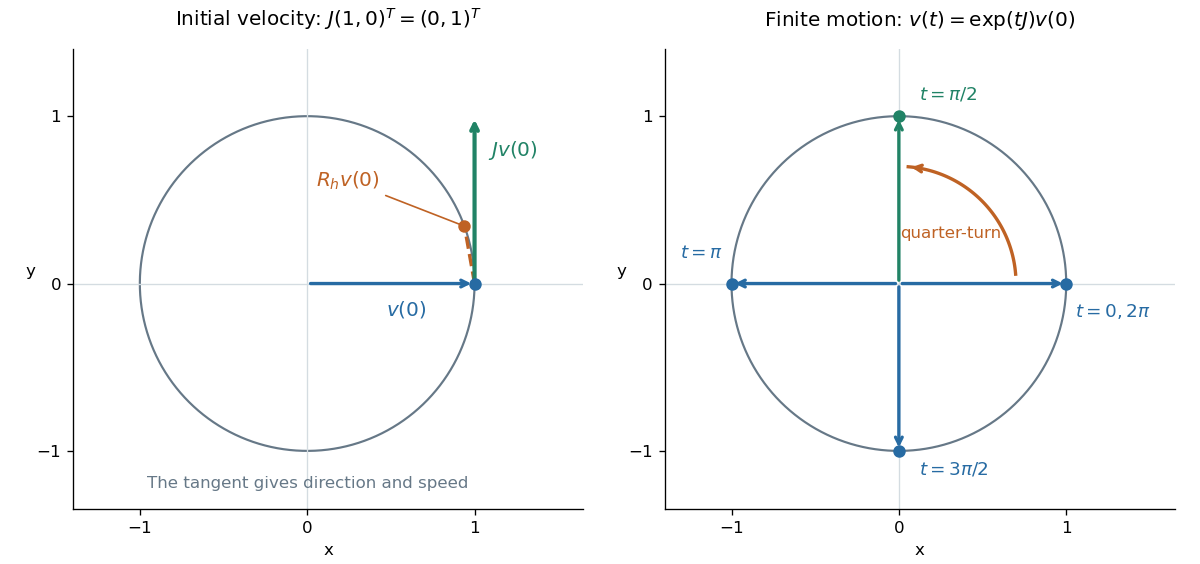
For a moving vector , the ordinary differential equation says its velocity is perpendicular to its position. The beautiful compression is that one constant matrix specifies every angle of this endless family of rotations.
For , the image of , with its intrinsic immersed Lie subgroup topology, is isomorphic to or the circle group. The kernel is respectively zero or for a least positive period . The case is the trivial group. An irrational winding in a two-dimensional torus need not be an embedded or closed subgroup, so its intrinsic topology must be distinguished from the subspace topology.
For , the image of its matrix exponential is compact precisely when or . If , then and its image is conjugate to the circle group. A nonzero nilpotent generator or a generator with real nonzero eigenvalues produces an unbounded image.
Articles by others on the same topic


The one parameter subgroup of a Lie group for a given element of its Lie algebra is a subgroup of given by:
Intuitively, is a direction, and is how far we move along a given direction. This intuition is especially vivid in for example in the case of the Lie algebra of , the rotation group.
One parameter subgroups can be seen as the continuous analogue to the cycle of an element of a group.