A spherical tensor operator of rank transforms under rotation like an angular momentum . The Wigner-Eckart theorem writes its matrix elements asThe reduced matrix element contains the radial and other dynamical information; the Clebsch-Gordan coefficients determine the dependence on the projections. Ratios within a fixed pair of multiplets therefore follow without a radial integral. The angular selection rules include and .
For the position vector, choose the rank-one componentsLet . The stretched Clebsch-Gordan coefficients and one lowering step giveFor example, apply the total angular momentum ladder operator to the stretched state. The result has components with coefficients and , corresponding to lowering the initial angular momentum and the vector component, respectively.
Only the component of contributes to . The operator cannot connect the projections in , so that matrix element vanishes. With the convention above,Thus the requested relative magnitudes and their squared values areThese ratios presume a common nonzero reduced matrix element. The position operator has odd parity, so an electric dipole transition requires opposite-parity multiplets; for one Electron the electric-dipole selection rule also gives . The displayed labels alone do not establish that condition. If the common reduced matrix element vanishes, all three matrix elements vanish and no nonzero ratio can be inferred.
A uniform magnetic field quantizes the transverse cyclotron motion of an Electron. With Electron charge and the Landau gauge for a uniform magnetic field , minimal coupling givesFor an eigenstate of with eigenvalue , this is a quantum harmonic oscillator centered at , with cyclotron frequency . Its Landau levels areThe oscillator width is set by the magnetic length . In three dimensions, the free motion parallel to the magnetic field adds . The Electron spin adds a Zeeman splitting . In a crystal the appropriate band effective mass and effective spin factor replace the free-electron values.
Changing moves the orbit center without changing the energy. In a rectangle , adjacent allowed centers differ by . Requiring the center to lie in the sample gives the degeneracy of a Landau level, per spin,This large state degeneracy, together with the increasing level spacing, rearranges the occupied states as the magnetic field changes. To resolve the Landau levels, thermal broadening and disorder broadening should both be small compared with .
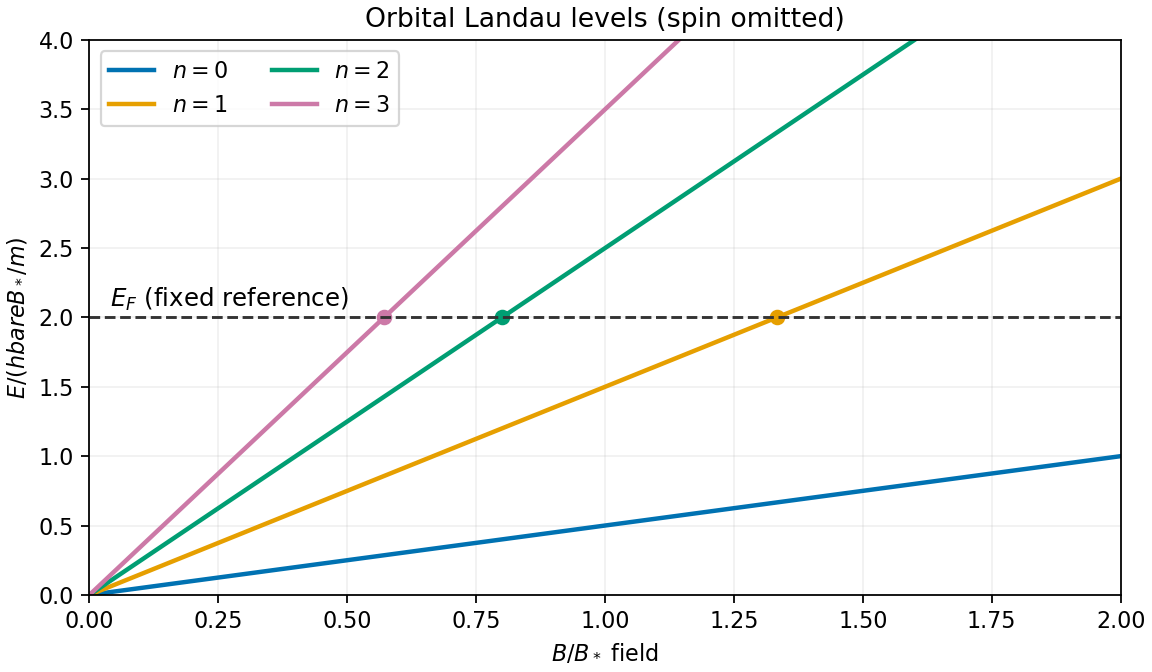

The de Haas-van Alphen effect is an oscillation of magnetization as successive Landau levels pass the Fermi energy. The Shubnikov-de Haas effect is the corresponding oscillation in longitudinal magnetoresistance. For a simple orbit, successive crossings occur periodically in ; the general relation to the extremal orbit area is Onsager quantization. These measurements reveal the geometry and effective masses of a Fermi surface.
In a two-dimensional Electron system, filling an integer number of resolved levels leads to the integer quantum Hall effect, withand very small longitudinal resistivity on a plateau. Disorder localization helps produce finite plateau widths. Cyclotron resonance provides another direct signature: radiation is absorbed at the adjacent-level spacing .
A coherent state is a normalized eigenstate of the annihilation operator, . Expanding in the Fock state eigenbasis gives a recurrence , and wavefunction normalization fixesThe displacement operator therefore shifts the oscillator ground state in phase space. Distinct coherent states are not orthogonal:
The occupation probabilities form a Poisson distribution,For the quantum harmonic oscillator, the expectation values of position and momentum areThe fluctuations equal those of the ground state,Thus the position wavefunction is a displaced Gaussian wave packet that saturates the Heisenberg uncertainty principle.
Time evolution under preserves this form:The center follows the classical oscillator trajectory while the packet width stays constant. Its mean energy is ; it is generally a superposition of energy eigenstates, rather than a state of definite energy. For , the relative occupation fluctuation is , explaining the classical appearance of a highly excited coherent state.
Articles by others on the same topic
There are currently no matching articles.