The AFM pulls a tethered molecule through its cantilever. Deflection, multiplied by a calibrated cantilever spring constant, measures force; support motion must be corrected for that deflection and any linker compliance to obtain molecular extension. Initially folded structure can resist extension, then contacts break and more polypeptide polymer contour length becomes available. The readable trace rises with increasing extension, with fluctuations and a strongly rising large-extension part. It should not be interpreted as a direct image of individual amino acids or as establishing a unique microscopic unfolding pathway.
An ideal inextensible freely jointed chain with the stated segment count and length hasIts mean extension is strictly below at every finite force. Thus the quoted maximum does not establish ideal FJC behaviour: if both numbers are taken literally, it exceeds the model's polymer contour length by about . Finite segment stretch, inaccurate effective segment parameters, additional linkers or an extension-zero/calibration error can account for such a difference. If the numerical descriptions are approximate, the discrepancy may be within their uncertainty; even exact agreement with a polymer contour length would not prove freely jointed statistics. Low-force fluctuations and the full force–extension relation are separate tests.
Let a segment of fixed length make angle with an applied force . Its energy contribution is . Independent freely jointed orientations give the single-segment partition function and chain partition functionThe mean end-to-end projection is the force derivative of :For , the Langevin function is . Isotropy therefore gives the vector responseThe covariance at zero force provides an independent route: , and the Boltzmann weight's first-order term yields . This is a relation for the mean vector or its projection. The zero-force mean vector vanishes even though the chain has finite root mean square size .
The controlled weak-force condition is , not merely that a short part of a measured curve looks straight. With the supplied , at . A raw force near , as in the figure's labelled low-extension portion, would give and is not asymptotically weak for those literal segment parameters. A force offset or different effective model might change that interpretation, but no such correction should be invented from the plot.
The coefficient in the linear force law isStretching suppresses the many disordered orientations available to the chain. The Gaussian chain free energy cost has gradient equal to this restoring force. This is entropic elasticity; individual covalent bonds need not stretch to produce the weak-force spring.
At moderate force, even an ideal FJC becomes nonlinear as its orientations align, so failure of a linear fit alone need not imply nonideal chemistry. But failure of the full FJC curve can reflect backbone spring constant and correlated segment angles, nonuniform effective links, remaining folded contacts, force-induced conformational changes, energetic bond compliance, or tether/calibration effects. An extensible FJC or an appropriate semiflexible model includes some of these effects; their parameters require independent justification. The stated inextensible polymer contour length already excludes a literal extension.
The first panel of the original model figure below shows the full orientational response and weak-force tangents without tracing the experimental data.
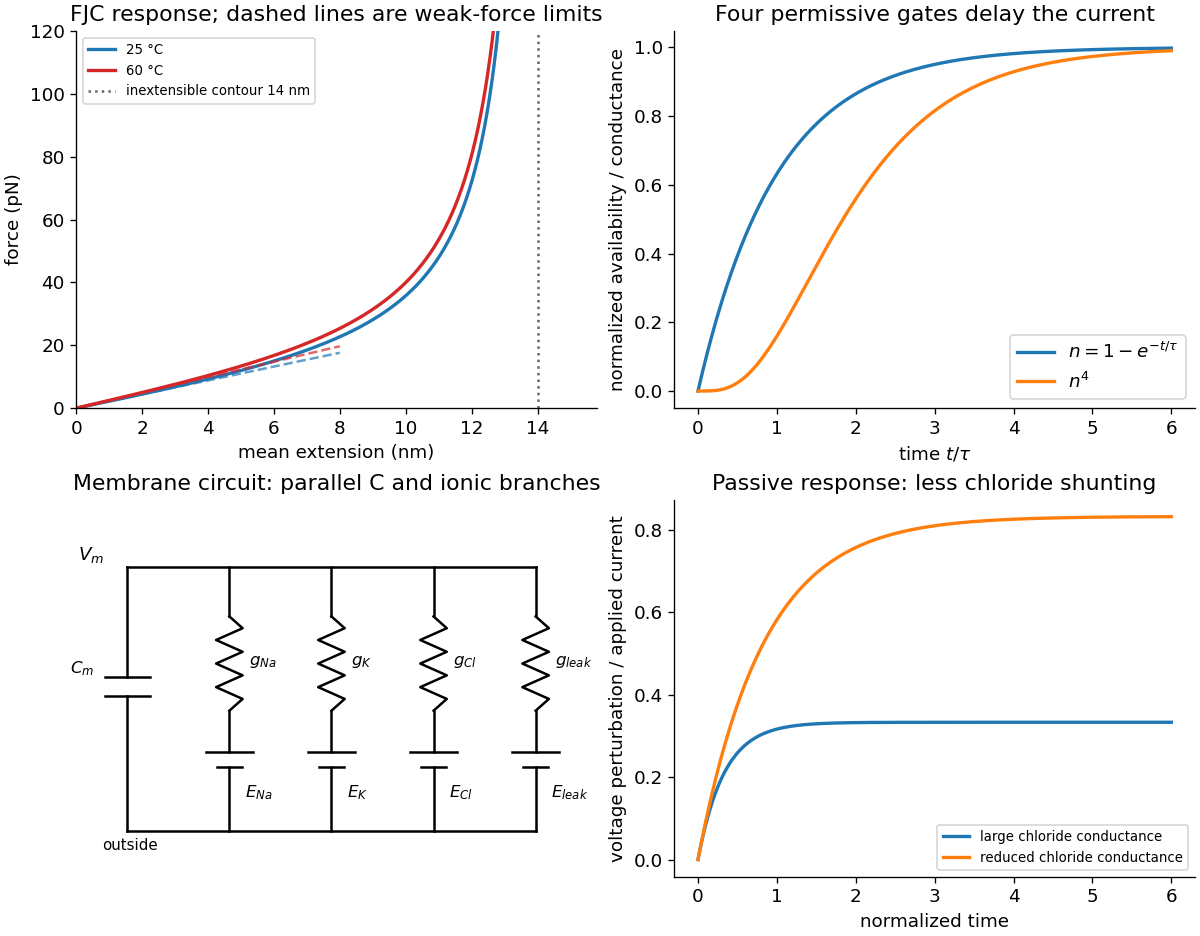

If the ideal-chain segment count and segment length remain fixed, the entropic spring constant is proportional to absolute temperature. ThereforeThis is an increase by about . The factor multiplies the free energy penalty for the loss of chain configurations; a larger force is required to impose the same normalized weak extension at higher temperature.
Not degrading does not guarantee that a real protein's folded state, effective spring constant or solvent interactions remain unchanged. Thermal unfolding and changes in persistence length can occur without covalent degradation. Those changes modify the experimental curve and may invalidate a fixed- comparison. The boxed value is the explicit ideal-FJC prediction under fixed segment geometry, not an unconditional thermal-stability prediction for the protein.
On releasing the tensile load, the extended chain first retracts towards less aligned conformations because they have much greater configurational multiplicity. Viscous friction and internal relaxation determine the time course; stored free energy is dissipated as heat. An unconstrained ideal chain does not shrink to a point: its mean vector is zero but its root mean square end-to-end length is for the supplied ideal-chain parameters.
A real polypeptide also has sequence-dependent interactions. If the original native structure is the stable state in the prevailing solvent and the molecule remains intact and capable of folding, it can subsequently refold, gaining favourable intramolecular and solvent free energy. The folded state is not selected by chain entropy alone, and formation of native contacts need not be instantaneous. Kinetic traps, proline isomerization, protein aggregation, misfolding, surface attachments or chemical damage may prevent complete recovery or produce hysteresis. Thus reversible refolding is a physically motivated possibility, not guaranteed simply by removal of force. This distinction connects the recoil of a stretched polymer to the thermodynamics discussed in Question 6(c).
Articles by others on the same topic
There are currently no matching articles.