For each bond minimizes its energy when its two Ising spins are opposite, giving bond energy . An even ring allows every bond to do this simultaneously, including the closing bond required by the periodic boundary conditions. Its two ground states areThe two configurations are related by spin inversion symmetry. There is no geometrical frustration.
Let count parallel bonds. Then bonds are antiparallel and the energy isThe periodic boundary conditions imposeHence must be even. For odd , is odd, so its minimum is one: one bond must be parallel. All other bonds alternate. Choosing that bond in ways and then choosing either value of determines every Ising spin, givingThis is an odd antiferromagnetic Ising ring: geometrical frustration forces one defect, whose location is unrestricted. The ground-state degeneracy includes both its possible locations and global spin inversion symmetry. The formula also includes the self-bond case under the stated Hamiltonian convention.
Set . The transfer matrix for the one-dimensional Ising model assigns a Boltzmann factor to each bond. In the Ising spin order , it isMultiplying these bond factors and summing every Ising spin implements the canonical ensemble. The periodic boundary conditions close the product into a trace:The eigenvectors and form an orthonormal basis, with eigenvaluesThe negative second eigenvalue encodes alternating correlations. Defining , the exact partition function and total Helmholtz free energy areThe parity-dependent term must be retained for finite ; in particular it nearly cancels the leading term of at low temperature when is odd.
Represent insertion of one Ising spin by . In the eigenbasis of , this matrix swaps and . Its diagonal entries in that eigenbasis vanish, giving the exact one-point correlation functionEquivalently, configurations pair with their opposites under spin inversion symmetry, with the same Boltzmann factor and opposite .
Two insertions separated by bonds give the two-point correlation functionThus the exact finite antiferromagnetic Ising-ring correlation isThe two numerator terms represent the two arcs between the sites. The formula has and , as required by the periodic boundary conditions. Since the one-point correlation function is zero, this is also the connected correlation function. At , every Ising spin is independent, so for distinct sites and ; powers with exponent zero are understood as one.
For , . Taking the thermodynamic limit at fixed separation removes and from the finite antiferromagnetic Ising-ring correlation. ThereforeThe correlation length is measured in lattice spacings. If the lattice spacing is , its physical value is . The factor expresses antiferromagnetism, while measures the decay of the staggered two-point correlation function.
At every positive temperature, is finite. At low temperature, , giving . At infinite temperature, , distinct Ising spins are uncorrelated; the limiting correlation length is zero.
Put , so as the temperature tends to zero. For even , the finite antiferromagnetic Ising-ring correlation becomesThe two perfectly alternating ground states give exactly the same product ; averaging them preserves its magnitude even though the one-point correlation function remains zero.
For odd the signs instead giveBoth numerator and denominator vanish. Set and expand at fixed :HenceThere is a direct ground state interpretation. The mandatory parallel bond of an odd antiferromagnetic Ising ring is uniformly distributed among its bonds in the limiting canonical ensemble. Along the directed -bond arc from site 1 to site , the product is if the defect lies outside that arc, and if it lies inside. The respective probabilities are and , giving the displayed two-point correlation function. Global spin inversion symmetry doubles the number of ground states but leaves each product unchanged.
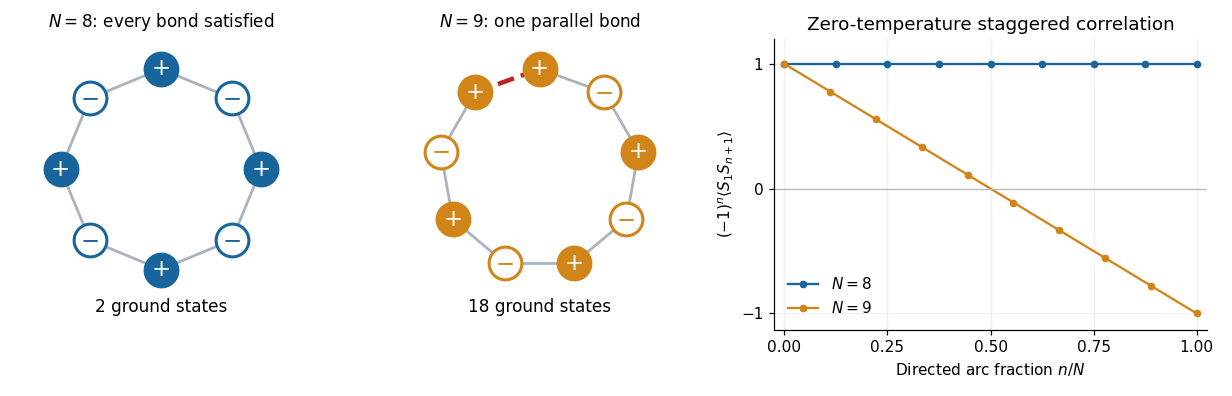
One unavoidable parallel bond changes the zero-temperature correlations of an odd antiferromagnetic ring
. Details. 
The reduction on an odd ring survives at separations comparable with , despite the vanishing defect density . For fixed , however, taking after the zero-temperature limit recovers for either parity, consistently with the diverging correlation length. The linear envelope at finite odd comes from one freely located frustration defect; it is distinct from the exponential decay caused by thermal defects in the thermodynamic limit.
Articles by others on the same topic
There are currently no matching articles.