Original public paper: FOI release, physical pages 667–668; questions on page 668.
The detector is intended for arcsecond-scale astronomical seeing, rather than the telescope's diffraction limit. A circular aperture of this area has diameter , giving a Rayleigh criterion angle about arcsec at the observing wavelength. One-arcsecond pixels conventionally sample an astronomical seeing profile of roughly two arcseconds across with two samples; a one-arcsecond profile would be undersampled. The pixel scale alone does not determine an exact astronomical seeing width.
Use the supplied surface brightness as radiative flux integrated over the photometric passband: its units contain no inverse hertz. Treat as the representative photon energy, and assume unit throughput and quantum efficiency. A genuinely frequency-specific brightness would require a bandwidth. With angles measured consistently in arcseconds, an annulus has area square arcseconds, soThis is flux per collecting area; collected energy is . There is no extra conversion to steradians when both brightness and angular area use square arcseconds.
For Poisson photon counting, a pixel with expected count has energy and standard deviation . Thus the local four-sigma rule gives , or 16 photons at the boundary. With pixel area ,Consequently arcsec andIntegrating to the model's outer radius arcsec instead givesThe pixel cut retains 51.6% of this total. It is an imposed isophotal photometry rule, not a fundamental limit: averaging annuli or fitting a justified profile can recover signal below the per-pixel cut.
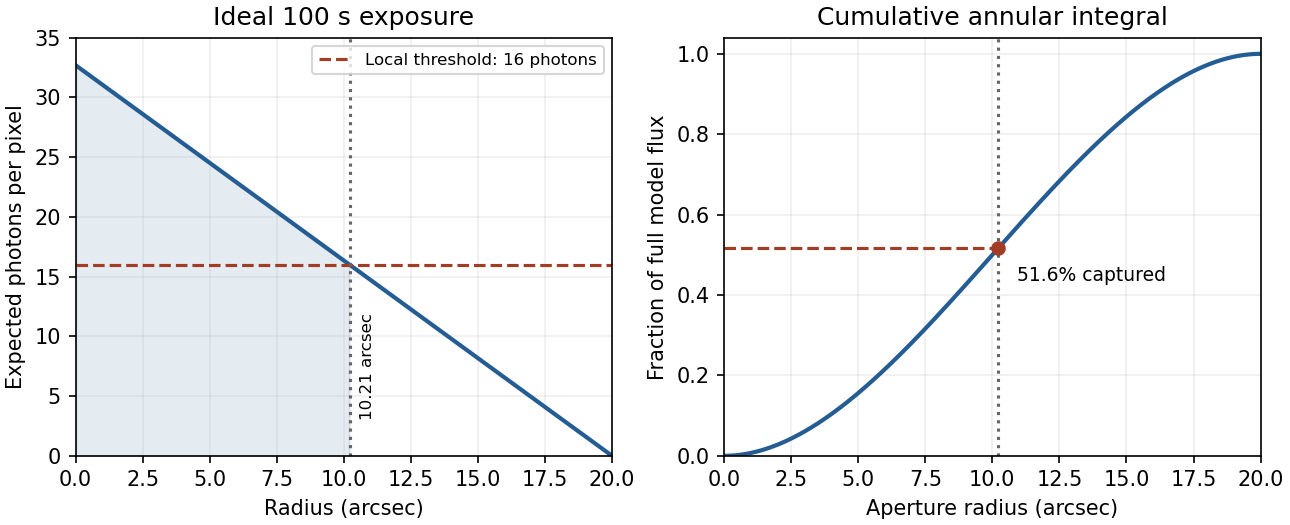

In practice, sky background photons add shot noise even after subtraction of the mean sky. read noise, dark current, imperfect flat-field correction, throughput calibration and atmospheric extinction also matter. At large radius the dominant uncertainty can be a tiny error in the sky level, scattered light or the wings of the point spread function, rather than source photon statistics. Mask foreground stars and background objects, compare blank-sky regions and dithered exposures, and check profile recovery by inserting artificial extended sources. astronomical seeing and finite pixels convolve the intrinsic profile; model that response when extrapolating the total.
The luminosity convergence of an outer surface-brightness profile follows directly: contributes , hence at large radius for . For either shallow index considered, ever larger annuli dominate: extending the law to infinity gives an unphysical divergent luminosity. Such a law must eventually steepen or truncate. Over a finite range, however, substantial light can lie below a surface-brightness selection threshold and be mistaken for sky. This biases galaxy luminosities, the luminosity function and the inferred diffuse light budget; distant diffuse galaxies become especially incomplete because bolometric cosmological surface-brightness dimming scales as . An assumed finite-aperture total is therefore a model-dependent quantity.
The observed population is the parent population filtered by an astronomical selection function and measurement errors. Malmquist bias arises because a flux-limited galaxy selection admits luminous objects from larger volumes: in Euclidean space and . Thus observed luminosity counts are weighted by . Even a nominal standard candle with intrinsic scatter is preferentially observed on its bright side near the limit; ignoring this can underestimate distances. A volume-limited sample or a justified weighting helps, subject to completeness, geometry and evolution assumptions. Separately, Eddington bias occurs when noise scatters a steeply rising population across a detection threshold: more faint objects enter than bright objects leave.
Lutz-Kelker bias concerns noisy stellar parallaxes and population/selection weighting. Locally uniform spatial density gives and, by changing variables, over the model's valid finite range. More distant stars are available to scatter into a parallax-limited sample than nearby stars to scatter out. Inverting an uncertain parallax also introduces a distinct nonlinear-estimation problem. There is no universal magnitude correction for every star: spatial density, luminosity, extinction and how the sample was selected all matter. The classical treatment motivates this issue; it should not replace an explicit generative model.[ref]
On the Use of Trigonometric Parallaxes for the Calibration of Luminosity Systems: Theory by T. E. Lutz and D. H. Kelker. PASP 85, 573–578; classical uniform-density calibration model
Bayes' theorem combines the measurement likelihood function with a justified prior distribution. For example, with a Gaussian parallax error and consistent distance/parallax units,A proper distance prior for parallax inference might have with a justified scale ; extending to infinity gives an improper posterior here. Negative measured parallaxes remain valid noisy data. For selection conditioning in Bayesian inference, distinguish individual inference from population inference: if selection is determined entirely by the exact data already conditioned on, it adds no further information about that individual's parameters. For population parameters , the selected-data likelihood must instead include the detection normalization . Applying a cut twice is also an error.
Selection can depend on surface brightness, angular resolution, dust, sky coverage, colour and observing cadence as well as total flux. Crowding and unresolved binaries bias distance calibrators. Transit surveys favour large planets and short periods, with an additional geometric transit probability approximately for small planets on circular orbits; injection/recovery tests quantify the remaining transit survey completeness. Cluster catalogues select noisy mass proxies from a steep abundance distribution. Planck's 2013 SZ catalogue explicitly characterized detection completeness and reliability rather than identifying every detection with an unbiased mass census.[ref]
Planck 2013 results. XXIX. Planck catalogue of Sunyaev-Zeldovich sources by Planck Collaboration. abstract and selection-function/completeness analysis, 2013 preprint
Calibrators, artificial-source tests and a forward model of detection, measurement and follow-up are the practical checks on any correction.The thermal Sunyaev-Zeldovich effect is inverse Compton scattering of cosmic microwave background photons by hot cluster electrons. For an optically thin, nonrelativistic thermal plasma,The Compton y parameter measures the electron pressure column. The distortion is a decrement below roughly 217 GHz, an increment above it, and has in the Rayleigh-Jeans law limit. Relativistic electron corrections modify the spectrum and null.[ref]
Multifrequency maps separate this spectrum from primary Cosmic microwave background anisotropy, radio sources and dust; atmospheric subtraction, beams and calibration require control. The kinetic Sunyaev-Zeldovich effect has and a CMB-temperature-like spectrum, so it is both a contaminant and a peculiar-velocity probe. Planck demonstrated blind multifrequency cluster detection with external confirmation and a measured selection function.[ref]
Planck 2013 results. XXIX. Planck catalogue of Sunyaev-Zeldovich sources by Planck Collaboration. abstract; multifrequency detection and catalogue validation
For a fixed physical pressure column, has no ordinary cosmological surface-brightness dimming: the distorted spectrum and CMB redshift together. The integrated Compton parameter still scales as for fixed integrated physical pressure. SZ observations therefore find distant clusters and measure thermal pressure; integrated is a useful mass proxy, requiring calibration and a selection model for cosmological counts. X-ray emission scales approximately as , while SZ scales as . Combining them and a measured temperature constrains density, depth and, with angular geometry, distance. gas clumping factor, asphericity, temperature structure and nonthermal support limit that inference.
An astronomical interferometer combines light from collectors separated by projected interferometric baseline . For a distant, narrowband, spatially incoherent source, the Van Cittert-Zernike theorem gives normalized complex visibilityThe resolving scale is , while the individual collector and beam combiner restrict the field of view. Delay lines compensate geometric path differences. To see broadband fringes, residual optical path length mismatch must lie within the coherence length of order ; fringe tracking follows rapidly changing atmospheric piston in interferometry. Baseline changes and Earth-rotation aperture synthesis sample additional spatial frequencies.
For an ideal uniform circular star of full angular diameter ,Real limb darkening changes the conversion. Several baselines constrain binaries, stellar radii and circumstellar structure; orbital angular separations combined with radial velocities can give physical orbital scales. calibration stars test contrast losses, alongside wavelength, photometric imbalance, polarization and bandwidth controls. For three collectors the closure phase cancels telescope-based phase errors: retains source asymmetry information. Sparse baseline coverage still leaves image/model ambiguities.
In stellar intensity interferometry, thermal-light correlations instead give for an ideal single-polarization resolved temporal mode. The Sirius experiment correlated separate detector outputs rather than optically combining the beams.[ref]
A Test of a New Type of Stellar Interferometer on Sirius by Robert Hanbury Brown and Richard Quentin Twiss. Nature 178, 1046–1048 (1956)
Pure atmospheric phase shifts do not alter local intensities, but finite detector bandwidth dilutes the correlation and photon statistics limit sensitivity; the two-detector observable also loses the complex phase.annual stellar parallax uses the known Earth-orbit baseline, with . Repeated positions separate parallax from proper motion; calibration offsets, binarity and noisy-parallax selection require checks. Nearby stars calibrate absolute luminosities. Extinction-corrected distance modulus then givesmain-sequence fitting compares a cluster sequence with nearby calibrated stars; age, metallicity, reddening and unresolved binaries limit the match. Cepheid variables extend the range to nearby galaxies: measure periods and mean multiband magnitudes, calibrate the Cepheid period-luminosity relation, and correct for extinction, metallicity, crowding and pulsation mode. RR Lyrae stars and the tip of the red giant branch provide complementary population-II routes with their own composition and calibration dependence.
Some anchors bypass intermediate rungs. An eclipsing-binary distance starts from a double-lined eclipsing binary: velocities give ; eclipses give inclination and relative radii , hence physical radii. An independently calibrated surface-brightness/colour relation gives angular radii and distance; alternatively corrected bolometric flux satisfies for a component. temperature, extinction, third light and surface-brightness calibration remain systematic errors. Eight late-type binaries gave a 2.2%-accuracy LMC anchor in 2013.[ref]
An eclipsing-binary distance to the Large Magellanic Cloud accurate to two per cent by G. Pietrzyński and others. abstract, Nature 495, 76–79; photometric and orbital information
A maser-disk geometric distance uses water masers orbiting in the nearly edge-on nuclear disk of NGC 4258. very-long-baseline interferometry, Doppler velocities, proper motions and accelerations constrain its orbit scale and distance. In an ideal circular, matched-radius example and ; real fits account for disk warp and different maser locations. This geometric method calibrated an extragalactic distance independently of stellar luminosities.[ref]
A 4% Geometric Distance to the Galaxy NGC4258 from Orbital Motions in a Nuclear Gas Disk by J. R. Herrnstein and others. abstract; orbital proper motions and accelerations, 1999
These overlapping anchors cross-check the nearby-galaxy ladder; no Hubble-flow fit is needed here.thermal bremsstrahlung is continuum radiation from electrons accelerated in ion electric fields. For Maxwellian electrons,At high frequency the exponential cutoff constrains ; X-ray fitting must also model foreground absorption, line emission, detector response and possible multitemperature or nonthermal components. At radio frequencies, , an optically thin free-free spectrum is almost flat, with the weak frequency dependence set mainly by the Gaunt factor.
For pure ionized hydrogen, radio free-free opacity givesThe turnover constrains emission measure; a resolved, optically thick source has brightness temperature approaching . An unresolved source has an unknown beam filling factor, so its observed brightness need not equal its electron temperature. Angular size and an independent distance give a geometric depth ; a uniform model then yields . Clumping instead measures a density-squared average, not the mean density.[ref]
Essential Radio Astronomy by James J. Condon and Scott M. Ransom. chapter 4, equations (4.57)–(4.60); emission measure and thick/thin spectra
A free-free spectrum alone does not uniquely determine density and size. The density-depth degeneracy of free-free radiation is explicit: for a resolved uniform column, , leaves both emissivity-integrated brightness and optical depth unchanged at fixed temperature. With independent SZ information and known , the electron column is ; thenThese equalities require consistent composition and geometry, and uniform density and temperature. Relating to angular extent can give distance; asphericity and the gas clumping factor are important limitations of this combined cluster method.
Articles by others on the same topic
There are currently no matching articles.