Consider a string element of equilibrium length . Its mass is , where is mass per unit length. Under the small-slope approximation, the tension is approximately uniform and its transverse component at an endpoint is . The two endpoint forces have net transverse componentNewton's second law gives . Cancelling the element length yieldsThis is the one-dimensional wave equation for transverse displacement. Its derivation neglects gravity, bending stiffness and nonlinear changes in tension and segment length; the given small slope makes those omissions consistent to first order in the displacement.
Seek a separated normal mode . Substitution in the wave equation gives . For an oscillatory mode choose the separation constant :The fixed endpoints impose . In , the first condition gives , and the second requires . Nonzero displacement therefore requiresEach spatial shape has fixed nodes and an oscillating overall amplitude: a standing wave. A general lossless motion is a superposition of these standing normal modes, not necessarily one single-frequency standing wave. The solution is trivial under both fixed-end conditions and does not supply an additional vibrational mode.
Use with . The initial shape becomesThe sine functions are orthogonal on , so this decomposition directly identifies the two nonzero spatial normal mode coefficients. Since the string is released from rest, every time-dependent sine coefficient vanishes and the subsequent motion isThus the signed mode amplitudes are , and for ; their magnitude amplitudes are and . The factor of two in the second angular frequency is fixed by the same boundary conditions as its spatial wavelength.
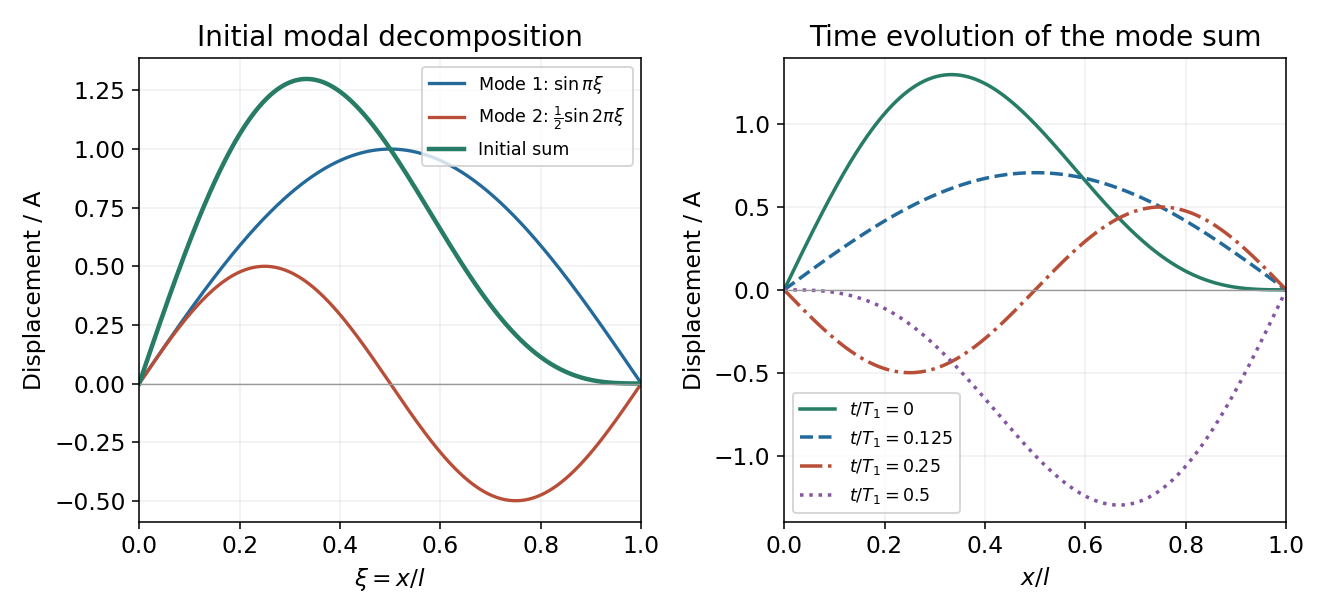

For a single normal mode , the kinetic energy is the integral of . Using givesThe extra string length is . Multiplying by tension gives the quadratic potential energy, so impliesSince , the sum is time independent:For the released shape, and , soThe second mode's smaller displacement is offset by its doubled spatial wavenumber and angular frequency. orthogonality of distinct sine and cosine spatial modes eliminates cross terms in the integrated energies, so the total is their sum. Initially the kinetic energy is zero and all the energy is stored in the string's deformation; during the motion the total remains constant.
Articles by others on the same topic
There are currently no matching articles.